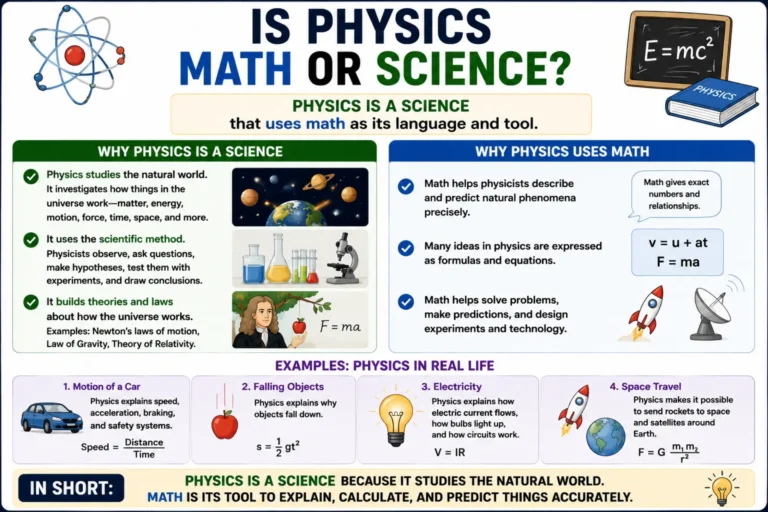
Is physics math or science? This is a common question among students. The short answer is that physics is a science. However, physics also uses math as an important tool. Science helps us understand how the natural world works. Math helps us measure, calculate, and explain scientific ideas. Together, they make physics one of the most interesting subjects to study.
Physics explains motion, energy, forces, light, electricity, and much more. It uses experiments to test ideas and mathematics to describe results. In this guide, you will learn why physics is considered a science, how math supports it, and how both subjects work together. The explanations use simple language and real-life examples to make learning easy.
Quick Summary
Is Physics Math or Science?
- Physics is a branch of science.
- It studies matter, energy, force, and motion.
- Physics uses math to solve problems.
- Math is a tool, not the subject itself.
- Experiments and observations make physics a science.
- Physics and math work together closely.
What Is Physics?
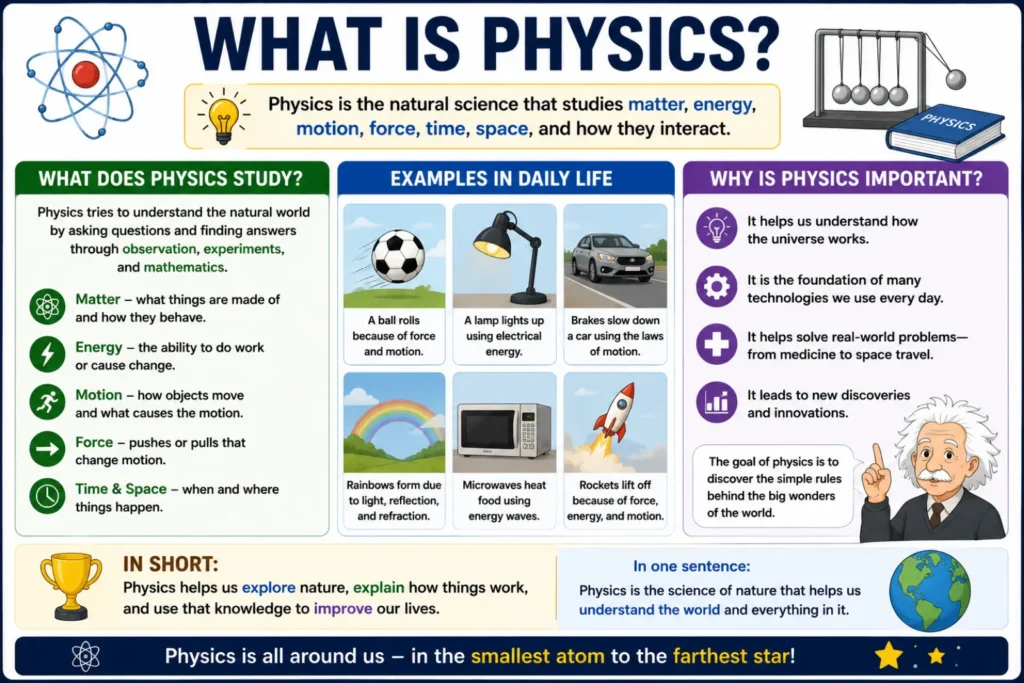
Physics is the study of how the universe works.
It explains how objects move, how energy changes, and how forces act on matter.
Physicists ask questions such as:
- Why do objects fall?
- How does light travel?
- What causes electricity?
- Why do planets orbit the Sun?
Physics helps answer these questions through careful observation and experiments.
Key Facts
| Property | Description |
|---|---|
| Subject | Natural Science |
| Main Focus | Matter, energy, force, and motion |
| Uses Math | Yes |
| Requires Experiments | Yes |
| Goal | Explain natural phenomena |
Why Is Physics a Science?
Physics belongs to science because it follows the scientific method.
Scientists observe nature.
They ask questions.
They create hypotheses.
Next, they perform experiments.
Finally, they analyze results and draw conclusions.
Physics relies on evidence instead of guesses.
Every scientific idea must match observations.
If new evidence appears, scientists improve their theories.
This process makes physics a true science.
Why Does Physics Use Math?
Math helps physicists describe nature accurately.
Numbers make scientific ideas clear.
For example, a scientist can measure:
- Speed
- Distance
- Time
- Temperature
- Energy
- Force
Instead of saying a car moves fast, physics calculates its exact speed.
Math allows scientists to predict future events.
Without mathematics, physics would lose much of its accuracy.
How Physics and Math Work Together
Physics and mathematics support each other.
Physics asks questions about nature.
Math provides the language to answer those questions.
For example:
- Physics explains gravity.
- Math calculates how fast an object falls.
Physics explains electricity.
Math predicts how electrical circuits behave.
Together, they solve real-world problems.
Neither subject replaces the other.
Instead, they work as a team.
What Makes Physics Different from Mathematics?
Although they are closely connected, physics and mathematics have different goals.
Mathematics studies numbers, patterns, and logical relationships.
Physics studies the real world.
Mathematicians prove formulas using logic.
Physicists test ideas using experiments.
A mathematical equation may exist without any physical object.
Physics always connects ideas to nature.
That is why physics remains a science instead of a branch of mathematics.
Examples of Physics in Everyday Life
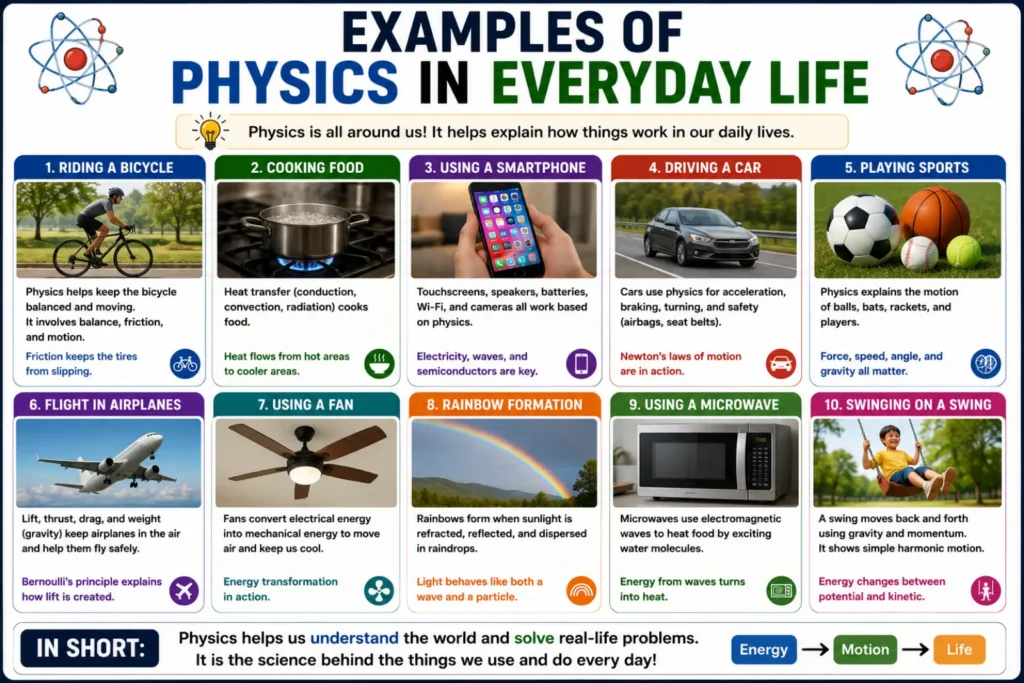
Physics is everywhere around us.
You use it every day without noticing.
Here are a few examples.
Riding a Bicycle
Balance, motion, and friction help you ride safely.
Playing Football
Force and momentum affect every kick.
Cooking Food
Heat transfers from the stove to the pan.
Using a Smartphone
Electricity, sound waves, and light make the device work.
Driving a Car
Speed, acceleration, and braking all follow the laws of physics.
These examples show why physics is important in everyday life.
Branches of Physics
Physics includes many exciting fields.
Each branch studies a different part of nature.
Some major branches include:
- Mechanics
- Thermodynamics
- Electromagnetism
- Optics
- Quantum Physics
- Nuclear Physics
- Astrophysics
Although each branch focuses on different topics, they all rely on scientific observation and mathematical calcula
Physics vs Math vs Science: Comparison Table
Many students think physics and math are the same subject. They are closely related, but they are not identical.
| Feature | Physics | Mathematics | Science |
|---|---|---|---|
| Main Purpose | Explain the natural world | Study numbers, patterns, and logic | Understand the natural and physical world |
| Based on Experiments | Yes | No | Yes |
| Uses Calculations | Yes | Yes | Sometimes |
| Uses Observation | Yes | No | Yes |
| Focus | Matter, energy, force, and motion | Numbers, equations, and proofs | Living and non-living things |
| Subject Type | Natural Science | Formal Science | Broad Field of Study |
Simple Explanation
- Physics explains how nature works.
- Math provides formulas and calculations.
- Science includes physics, chemistry, biology, and Earth science.
Real-Life Examples of Physics and Math Working Together
Physics and math appear in many everyday activities.
Building Bridges
Engineers use physics to understand forces.
They use math to calculate the bridge’s strength.
Space Exploration
Scientists use physics to study gravity.
Math helps calculate spacecraft paths.
Sports
Physics explains motion and energy.
Math measures speed, distance, and angles.
Weather Forecasting
Physics explains air movement and temperature.
Math helps create accurate weather models.
Medical Technology
MRI machines, X-rays, and ultrasound rely on physics.
Math processes the data into clear images.
These examples show that physics and math work together in many careers.
Common Mistakes Students Make
Many learners misunderstand the relationship between physics and math.
Here are some common mistakes.
Mistake 1: Thinking Physics Is Just Math
Physics uses math, but it also includes experiments, observations, and scientific reasoning.
Mistake 2: Believing Physics Has No Experiments
Experiments are a key part of physics.
Scientists test every major theory with evidence.
Mistake 3: Assuming Science and Physics Mean the Same Thing
Science is a broad field.
Physics is one branch of science.
Mistake 4: Ignoring Concepts
Some students memorize formulas without understanding the ideas behind them.
Learning the concepts first makes solving problems much easier.
Tips for Learning Physics More Easily
Physics becomes easier with the right approach.
Try these simple tips.
- Learn the basic concepts before memorizing formulas.
- Practice solving problems every day.
- Draw diagrams to understand motion and forces.
- Connect lessons to real-life situations.
- Review important formulas regularly.
- Ask questions whenever you feel confused.
Small daily practice builds confidence over time.
Why Physics Matters in Daily Life
Physics affects almost everything around us.
It helps us understand how the world works.
You experience physics when you:
- Turn on a light.
- Ride a bicycle.
- Throw a ball.
- Fly on an airplane.
- Charge your phone.
- Listen to music.
- Cook food.
Understanding physics also helps people design safer buildings, faster computers, cleaner energy systems, and better medical equipment.
Synonyms and Related Keywords
Using related terms improves topical relevance and helps search engines understand your content.
Some useful keywords include:
- physics science
- is physics a science
- physics vs mathematics
- science vs math
- physics and mathematics
- natural science
- applied mathematics
- scientific method
- laws of physics
- importance of physics
- branches of science
- mathematics in physics
- physics for beginners
- role of math in physics
Include these naturally throughout your content instead of repeating the same keyword.
Expert Insight
Physics is often called the foundation of modern science.
It explains the basic laws that govern the universe.
Mathematics gives physicists a precise way to describe these laws.
However, physics remains a science because every theory must match real-world observations and experimental evidence.
Students who understand this difference find it easier to learn advanced topics such as engineering, astronomy, chemistry, and computer science.
Building strong skills in both physics and mathematics opens many academic and career opportunities.
Frequently Asked Questions
Is physics considered math or science?
Physics is considered a natural science. It uses mathematics as a tool.
Why does physics use so much math?
Math helps physicists measure, calculate, and predict natural events accurately.
Can you study physics without math?
Basic physics requires simple math. Advanced physics depends on algebra, calculus, and other mathematical methods.
Which came first, physics or math?
Both developed over thousands of years. Mathematics evolved alongside early scientific observations.
Is physics harder than math?
Difficulty depends on the learner. Physics combines scientific concepts with mathematical problem-solving.
Why is mathematics important in physics?
Mathematics allows scientists to describe physical laws with precision.
Is engineering more physics or math?
Engineering uses both. Physics explains how systems work, while math helps engineers design and calculate solutions.
What careers use physics and math together?
Many careers combine both subjects, including engineering, astronomy, data science, architecture, robotics, and aerospace.
Conclusion
The answer to “is physics math or science” is clear. Physics is a branch of natural science that studies matter, energy, force, and motion through observation and experimentation. Mathematics is not the same as physics, but it plays a vital role in explaining and predicting physical phenomena. Together, physics and math help scientists understand the universe with accuracy and confidence.
If you remember one key idea, let it be this: physics is the science, and math is the language it uses. Learning both subjects together builds stronger problem-solving skills and prepares you for many careers in science, technology, engineering, and mathematics.