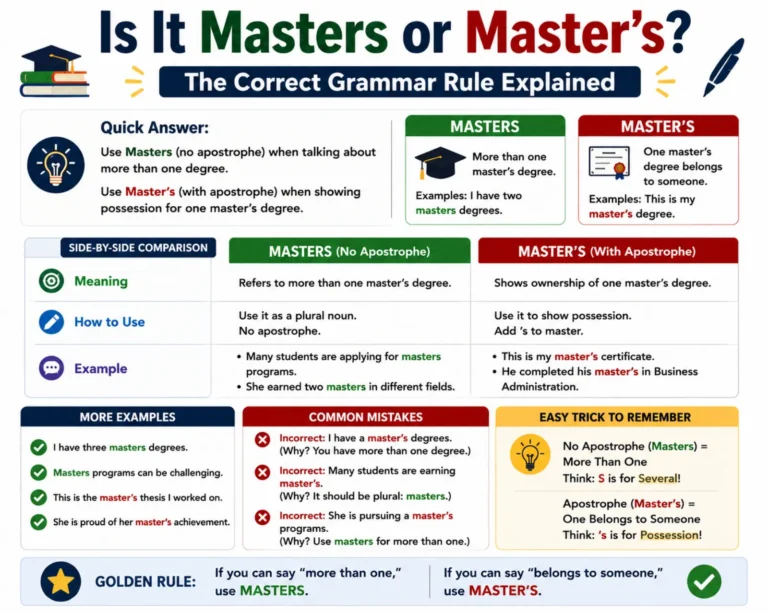
If you have ever wondered is it masters or master’s, you are not alone. Many students, professionals, and writers make this mistake.
The confusion comes from the apostrophe. Some people write “master’s degree,” while others write “masters degree.” Both look similar, but only one is usually correct.
Understanding the difference helps you write clearly and professionally. It also prevents grammar mistakes in applications, resumes, academic papers, and business communication.
In this guide, you will learn the correct form, why it matters, and when to use each version. You will also see real-life examples, common mistakes, and expert tips.
By the end, you will know exactly whether to write masters or master’s in any situation.
Quick Summary Box
- The correct term is usually master’s degree.
- The apostrophe shows possession.
- “Master’s” means a degree belonging to a master.
- “Masters degree” is generally incorrect.
- Use master’s degree in academic and professional writing.
- Some institutions may use unique style guides.
- Always check official university terminology.
What Does “Master’s Degree” Mean?
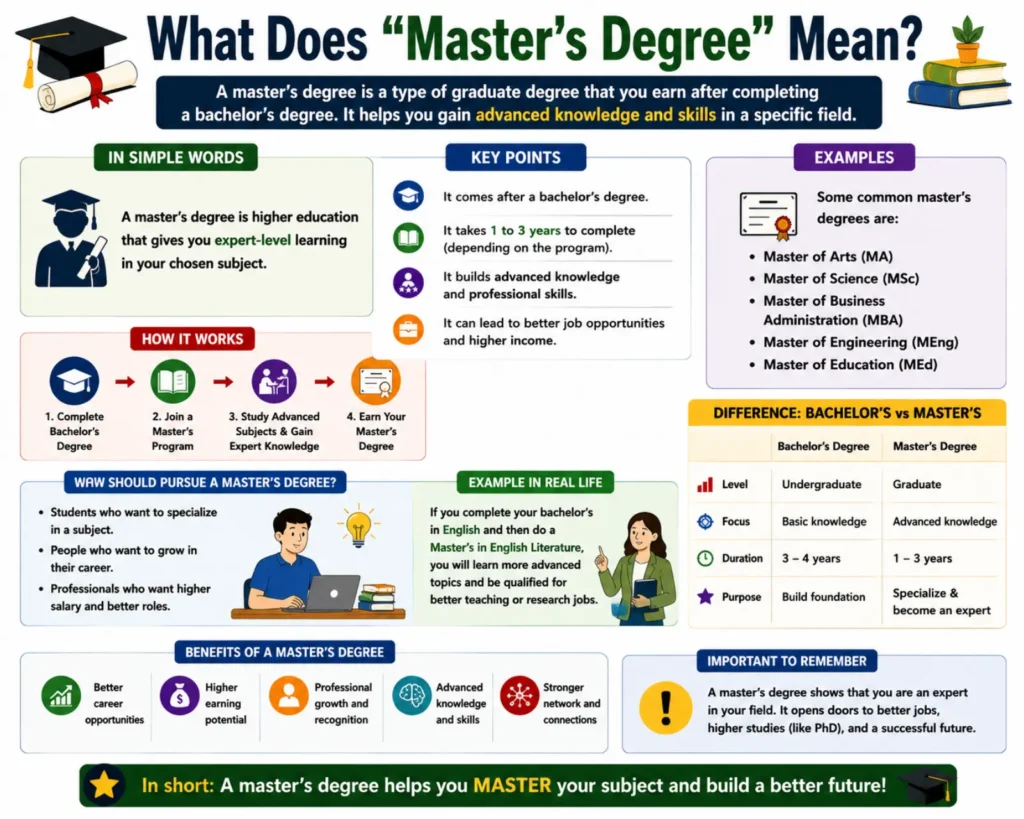
A master’s degree is a graduate-level academic qualification.
Students earn it after completing a bachelor’s degree. It usually requires one to three years of additional study.
Examples include:
- Master’s in Business Administration (MBA)
- Master’s in Education
- Master’s in Computer Science
- Master’s in Psychology
The apostrophe in “master’s” is part of the standard term.
Is It Masters or Master’s?
The correct phrase is usually master’s degree.
Correct:
- I earned a master’s degree in engineering.
- She is studying for her master’s degree.
Incorrect:
- I earned a masters degree in engineering.
- She completed her masters degree last year.
The apostrophe is important because it follows traditional English grammar rules.
Why Does “Master’s” Have an Apostrophe?
The apostrophe shows possession.
Historically, a master’s degree meant a degree awarded to someone who achieved the rank of master.
Think of it this way:
- Bachelor’s degree = degree of a bachelor
- Master’s degree = degree of a master
The possessive form became the accepted standard in English.
Masters vs Master’s: Comparison Table
| Feature | Master’s | Masters |
|---|---|---|
| Standard academic term | Yes | No |
| Contains apostrophe | Yes | No |
| Correct in “master’s degree” | Yes | No |
| Used by universities | Yes | Mostly no |
| Accepted in formal writing | Yes | Usually no |
| Grammar accuracy | Correct | Usually incorrect |
Quick Answer
When referring to the degree, use master’s degree.
c
Here are examples you may see every day.
Resume
Correct:
- Master’s Degree in Marketing
Incorrect:
- Masters Degree in Marketing
University Application
Correct:
- I am applying for a master’s program.
Incorrect:
- I am applying for a masters program.
LinkedIn Profile
Correct:
- Master’s in Data Science
Incorrect:
- Masters in Data Science
Using the correct version makes your writing look more professional.
When Can “Masters” Be Correct?
The word masters can be correct in other situations.
It is the plural form of “master.”
Examples:
- The chess masters competed in the tournament.
- Several masters taught the workshop.
- The old masters created famous paintings.
In these cases, “masters” does not refer to an academic degree.
Common Mistakes People Make
Many writers make the same errors.
Mistake 1: Removing the Apostrophe
Incorrect:
- Masters degree
Correct:
- Master’s degree
Mistake 2: Using an Apostrophe in the Wrong Place
Incorrect:
- Masters’ degree
Correct:
- Master’s degree
Mistake 3: Mixing Styles
Incorrect:
- I completed my masters’ program.
Correct:
- I completed my master’s program.
Consistency matters in formal writing.
Why This Grammar Rule Matters
Small grammar mistakes can affect credibility.
Employers notice resume errors.
Admissions officers review application essays carefully.
Professional writing creates a stronger first impression.
Using “master’s degree” correctly shows attention to detail.
How Universities Usually Write It
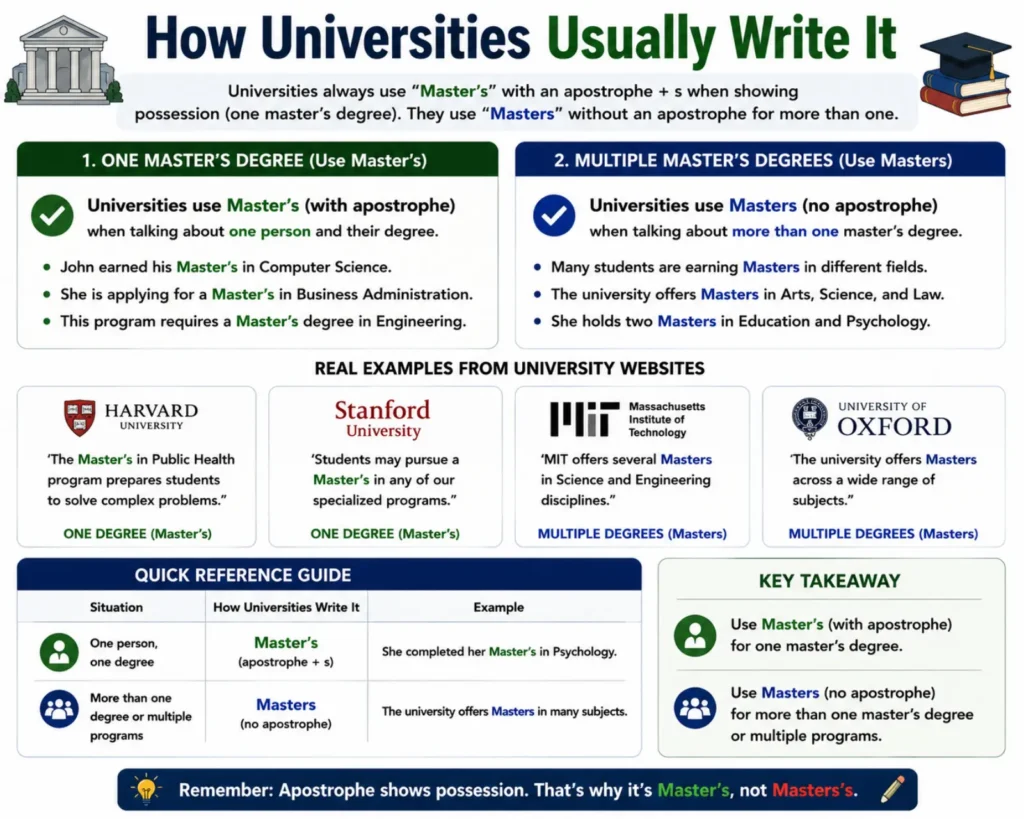
Most universities use master’s degree in official materials.
Examples include:
- Master’s Degree Programs
- Master’s Admissions
- Master’s Scholarships
- Master’s Thesis Requirements
However, some institutions may use different branding styles. Always follow the official wording if you are referencing a specific university program.
Easy Trick to Remember the Difference
Use this simple memory trick:
Ask yourself:
“Am I talking about the degree?”
If yes, write:
master’s degree
If no, and you mean multiple experts or teachers, write:
masters
Example
Degree:
- She earned her master’s degree.
Multiple experts:
- The masters shared their knowledge.
This quick test prevents mistakes.
Related Terms and Synonyms
These related terms help expand your understanding.
Synonyms and Related Keywords
- Graduate degree
- Postgraduate degree
- Advanced degree
- Master’s program
- Graduate education
- Academic qualification
- Higher education degree
- Master’s certification
- Graduate studies
- Postgraduate studies
LSI Keywords
- master’s degree grammar
- masters vs master’s
- how to write master’s degree
- apostrophe in master’s degree
- correct spelling of master’s degree
- master’s program meaning
- graduate degree terminology
- academic writing rules
Usage in Daily Life
You may use this phrase in many situations.
Education
- I completed my master’s degree.
Job Applications
- A master’s degree is required.
Professional Networking
- She holds a master’s in finance.
Academic Writing
- Students pursuing a master’s degree often conduct research.
Using the correct form improves clarity everywhere.
Expert Insight: Why Correct Usage Builds Credibility
Grammar affects perception.
Readers often judge professionalism based on writing quality.
A small error like “masters degree” may seem minor. However, it can create a negative impression in academic or professional settings.
Experts recommend following standard grammar conventions whenever possible.
Benefits include:
- Better credibility
- Stronger academic writing
- More professional resumes
- Improved communication
- Greater attention to detail
These advantages matter in competitive environments.
Frequently Asked Questions
Is it master’s degree or masters degree?
The correct form is master’s degree.
Why is there an apostrophe in master’s degree?
The apostrophe reflects the possessive grammatical form used in standard English.
Can I write masters degree on my resume?
It is better to write master’s degree because it follows accepted grammar rules.
Is masters ever correct?
Yes. “Masters” is correct as the plural form of “master.”
Do universities use master’s or masters?
Most universities use master’s degree in official documents.
Is master’s capitalized?
Only when it is part of an official title or heading.
What is the difference between master’s and masters?
“Master’s” refers to the academic degree. “Masters” usually refers to multiple masters.
Is Master’s Degree capitalized?
Generally, no. Capitalize it only in official program names or titles.
Internal Linking Suggestions
Consider linking this article to:
- Bachelor’s Degree vs Master’s Degree
- Common Grammar Mistakes in Academic Writing
- Resume Writing Tips for Graduates
- How to List Education on a Resume
- Graduate School Application Guide
These related topics can improve user engagement and SEO performance.
Conclusion
If you are asking is it masters or master’s, the answer is simple. In most academic and professional situations, the correct form is master’s degree. The apostrophe is important because it follows established English grammar rules.
While “masters” can be correct when referring to multiple masters, it is generally not the right choice when describing an academic qualification. Using the correct form helps your writing appear polished, professional, and trustworthy.
Whenever you mention a graduate degree, remember this simple rule: write master’s degree with an apostrophe. This small detail can make a big difference in resumes, applications, academic papers, and everyday communication.