Further or farther can confuse many English learners and native speakers alike. Both words talk about distance. However, they do not always mean the same thing.
Knowing the difference helps you write and speak more clearly. It also makes your English sound more natural.
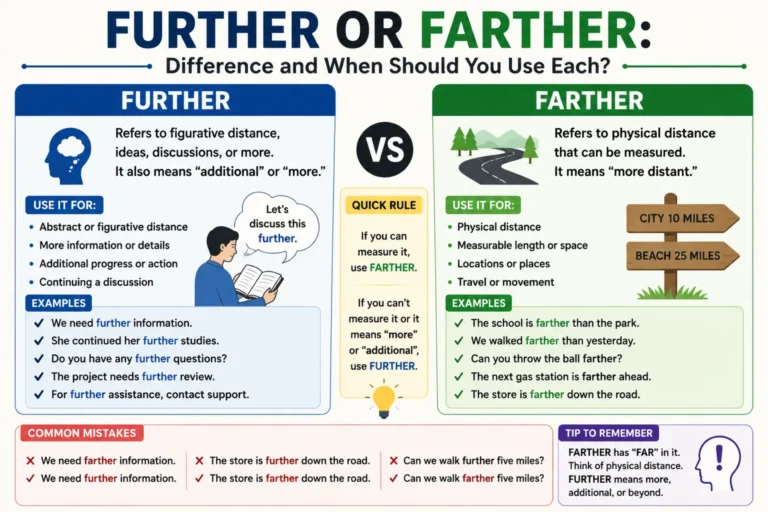
In simple terms, farther usually refers to physical distance. Further often refers to figurative distance, extra information, or additional progress. Still, many people use them interchangeably in everyday conversation.
This guide explains the meaning of each word. You will also learn simple rules, real-life examples, common mistakes, and expert tips. By the end, you will know exactly when to use further and farther with confidence.
Quick Summary
- Farther refers to physical distance.
- Further refers to figurative or abstract distance.
- Further also means “additional” or “more.”
- Both words sometimes overlap in modern English.
- When talking about miles or feet, choose farther.
- When talking about ideas, discussions, education, or progress, choose further.
What Does “Farther” Mean?
Farther means a greater physical distance.
Use it when you can measure the distance.
Examples
- The school is farther than the park.
- We walked farther than yesterday.
- Can you throw the ball farther?
Think of farther as something you can measure on a map.
What Does “Further” Mean?
Further means more, additional, or beyond.
It usually describes ideas, actions, discussions, knowledge, or progress.
Examples
- We need further information.
- She continued her further studies.
- Do you have any further questions?
- The project needs further review.
You cannot measure these with a ruler.
Further or Farther: What’s the Difference?
Although both words relate to distance, their usage differs.
| Feature | Further | Farther |
|---|---|---|
| Physical distance | Sometimes | Yes |
| Figurative distance | Yes | No |
| Means “additional” | Yes | No |
| Formal writing | Preferred for abstract ideas | Preferred for measurable distance |
| Everyday speech | Common | Common |
Easy Rule
- Physical distance → Farther
- Ideas or additional information → Further
Simple Trick to Remember
A simple memory trick makes the difference easy.
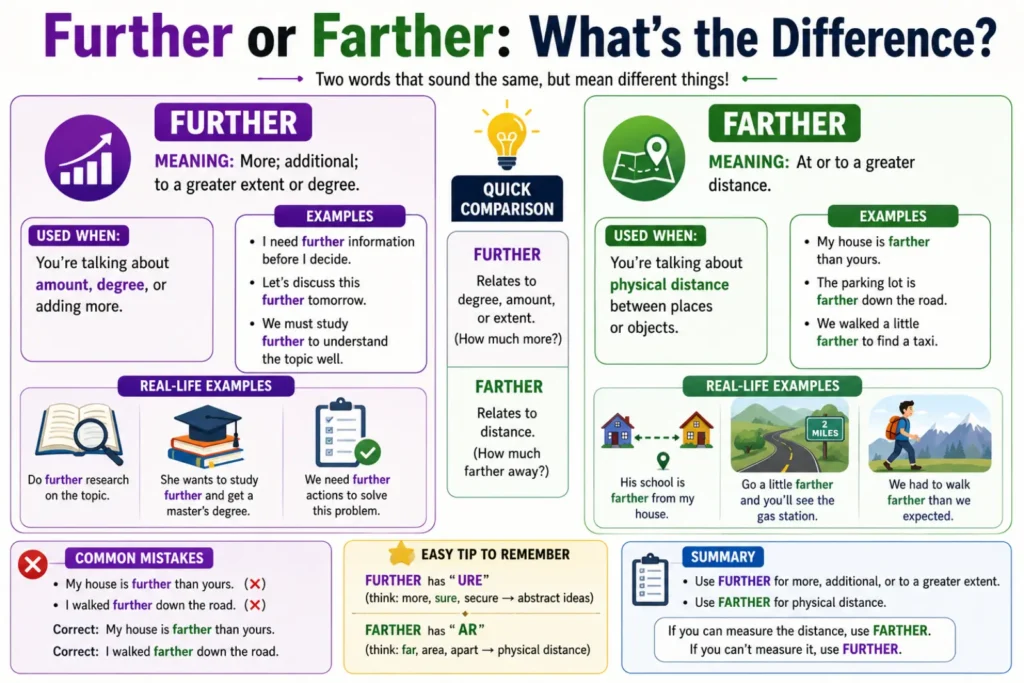
- Farther contains far.
- Think about places that are physically far away.
Further means further discussion, further research, or further details.
If you cannot measure it, use further.
Real-Life Examples
Physical Distance
✅ The supermarket is farther from my house.
✅ We drove farther than planned.
✅ She ran farther than anyone else.
Abstract Distance
✅ Let’s discuss this further.
✅ Further improvements are needed.
✅ We need further evidence.
Additional Meaning
✅ For further assistance, contact support.
✅ Further updates will come tomorrow.
When Can They Be Used Interchangeably?
Modern dictionaries accept further for physical distance in many situations.
For example:
- We walked further.
- We walked farther.
Both sentences sound natural.
However, formal writing often prefers farther for measurable distance.
Using the traditional rule makes your writing clearer.
Common Mistakes People Make
Many writers mix these words.
Mistake 1
❌ We need farther information.
✅ We need further information.
Mistake 2
❌ The store is further down the road.
✅ The store is farther down the road.
Although “further” is accepted by many style guides, “farther” is more precise.
Mistake 3
❌ Can we walk further five miles?
✅ Can we walk farther five miles?
Five miles is measurable.
Tips to Remember the Difference
These simple tips help you choose the correct word.
- Use farther for miles, feet, roads, or locations.
- Use further for ideas and discussions.
- Use further when you mean “additional.”
- Remember that measurable distance uses farther.
- If unsure, think about whether you can measure the distance.
How We Use Further and Farther in Daily Life
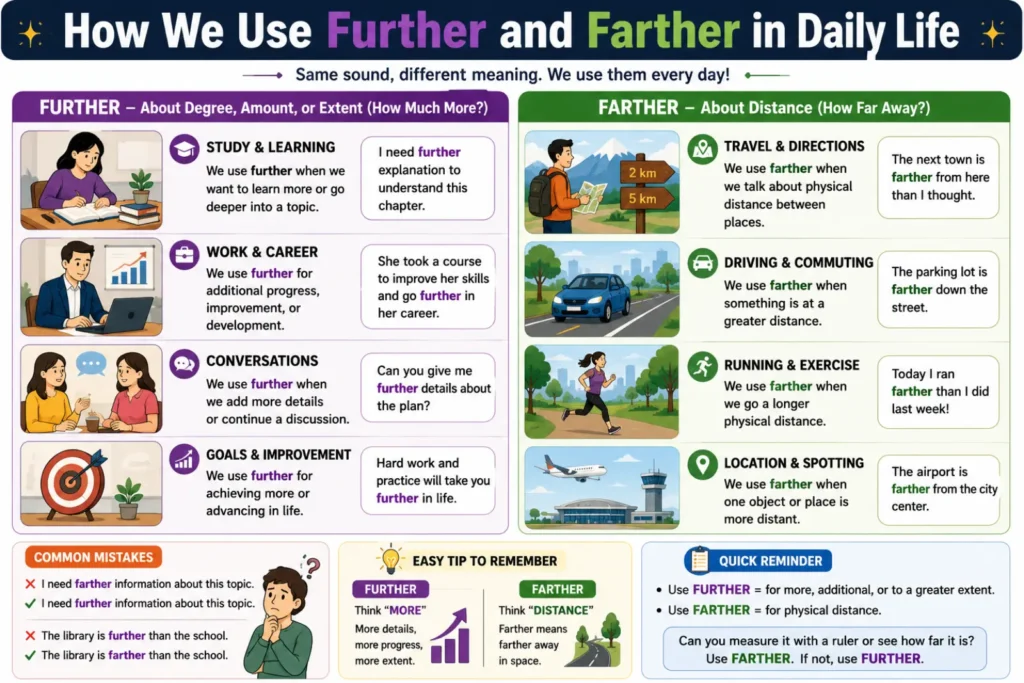
These words appear in everyday conversations.
At School
- Further reading is available online.
- The library is farther than the cafeteria.
At Work
- We need further approval.
- The new office is farther from downtown.
While Traveling
- The next gas station is farther ahead.
- Further travel updates will follow.
In Conversations
- Can you explain further?
- Let’s walk farther tomorrow.
Synonyms and Related Keywords
Synonyms for Further
- Additional
- More
- Extra
- Beyond
- Extended
- Continued
Synonyms for Farther
- More distant
- More remote
- Beyond
- Further away
- At a greater distance
Related (LSI) Keywords
- further meaning
- farther meaning
- further vs farther
- difference between further and farther
- farther definition
- further definition
- grammar rules
- English grammar
- word usage
- common grammar mistakes
- when to use further
- when to use farther
- farther examples
- further examples
Why Do People Confuse Further and Farther?
The confusion has historical roots.
Long ago, people often used both words for physical distance.
Over time, grammar experts encouraged separate meanings.
Today:
- Farther mainly refers to measurable distance.
- Further mainly refers to abstract distance or additional information.
Even so, many modern dictionaries still accept both for physical distance.
Expert Insight
Grammar experts recommend using the traditional distinction.
Doing so improves clarity and professionalism.
Professional writers often choose farther for measurable distance and further for abstract ideas.
This simple habit reduces confusion.
Clear writing builds trust with readers.
It also improves readability and creates a better user experience.
(FAQs)
Is farther only for physical distance?
Yes. Traditionally, farther describes measurable physical distance.
Can further describe physical distance?
Yes. Modern English allows it. However, farther is usually more precise.
Which is more common in everyday English?
Further appears more often because it has more meanings.
Is it “further information” or “farther information”?
Use further information.
Which word should students use?
Follow the simple rule.
Use farther for physical distance.
Use further for ideas and additional information.
Are further and farther interchangeable?
Sometimes.
Many dictionaries allow further for physical distance.
However, farther remains the preferred choice for measurable distances.
Why does grammar matter?
Correct grammar improves communication.
It also makes writing more professional and easier to understand.
Final Comparison
| Situation | Correct Word |
|---|---|
| Walking another mile | Farther |
| Need more details | Further |
| Additional research | Further |
| Drive another 10 miles | Farther |
| Continue a discussion | Further |
| Extra support | Further |
| Greater physical distance | Farther |
| More progress | Further |
Conclusion
Understanding further or farther becomes simple once you know the basic rule. Use farther when talking about measurable physical distance. Use further for abstract ideas, additional information, or continued progress. Although modern English sometimes accepts further for physical distance, following the traditional distinction makes your writing clearer and more professional. Whether you are writing an email, school assignment, blog post, or business document, choosing the correct word improves readability and builds confidence. Keep this simple rule in mind, practice with real-life examples, and soon using further and farther correctly will become second nature.