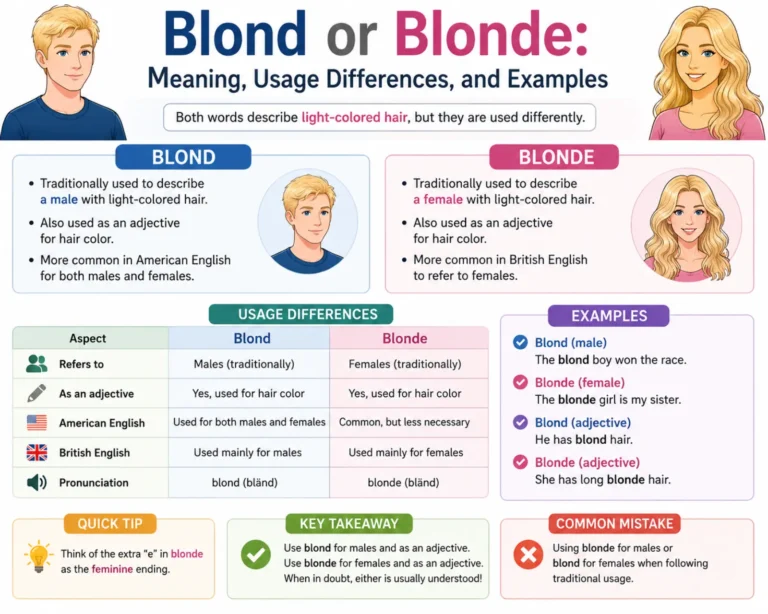
Blond or Blonde is a common grammar question. Many people wonder which spelling is correct. The simple answer is that both words are correct, but they have different uses. Knowing when to use each one helps you write clearly and correctly.
In English, these two spellings often describe light-colored hair. However, the choice depends on the person’s gender and the style of English you use. Some writers always use blond, while others follow the traditional rule and use blonde for women.
This guide explains everything in simple words. You will learn the meanings, differences, examples, common mistakes, and expert tips. By the end, you will know exactly when to use blond or blonde with confidence.
Quick Summary
- Blond and blonde both describe light-colored hair.
- Blond traditionally refers to a man or acts as an adjective.
- Blonde traditionally refers to a woman.
- American English often uses blond for everyone.
- British English usually keeps the traditional difference.
- Both spellings are widely accepted today.
- Choose one style and stay consistent.
What Does Blond or Blonde Mean?
Blond and blonde describe hair that ranges from pale yellow to golden or light brown.
The words can also describe people with this hair color.
Simple Definition
- Blond: A person with light-colored hair or an adjective describing light hair.
- Blonde: Traditionally a woman or girl with light-colored hair.
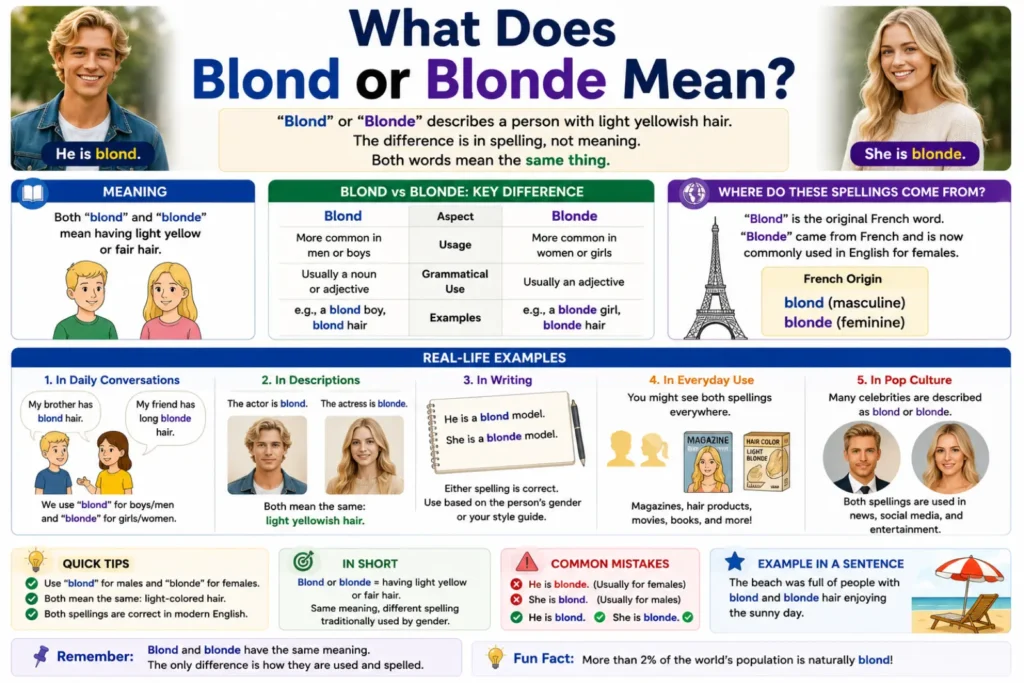
Why Are There Two Spellings?
The words come from the French language.
French nouns have masculine and feminine forms.
- Blond = Masculine
- Blonde = Feminine
English borrowed both spellings. Over time, different English-speaking countries developed different preferences.
Blond vs Blonde: What’s the Difference?
The main difference is gender and writing style.
| Feature | Blond | Blonde |
|---|---|---|
| Traditional use | Male | Female |
| As an adjective | Often used | Sometimes used |
| American English | Often used for everyone | Mainly for women |
| British English | Less common as a universal spelling | Traditional female spelling |
| Meaning | Light-colored hair | Light-colored hair |
Quick Rule
- Use blond for men.
- Use blonde for women.
- If you write for an American audience, blond often works for both.
How to Use Blond in a Sentence
Use blond when talking about a man or describing light-colored hair.
Examples
- He has blond hair.
- The blond boy smiled at everyone.
- My brother has naturally blond hair.
- A blond child played in the park.
- His blond beard turned darker with age.
How to Use Blonde in a Sentence
Use blonde when referring to a woman or girl.
Examples
- She is a blonde with bright blue eyes.
- The blonde woman won the race.
- My sister has long blonde hair.
- A smiling blonde greeted the guests.
- The actress became famous for her blonde curls.
Real-Life Examples of Blond and Blonde
Here are simple situations where each word fits naturally.
At School
“My blond friend plays football.”
“My blonde friend loves painting.”
At Work
“The blonde manager welcomed the new team.”
“Our blond designer created the logo.”
In Daily Conversation
“My cousin has blond hair.”
“My aunt is naturally blonde.”
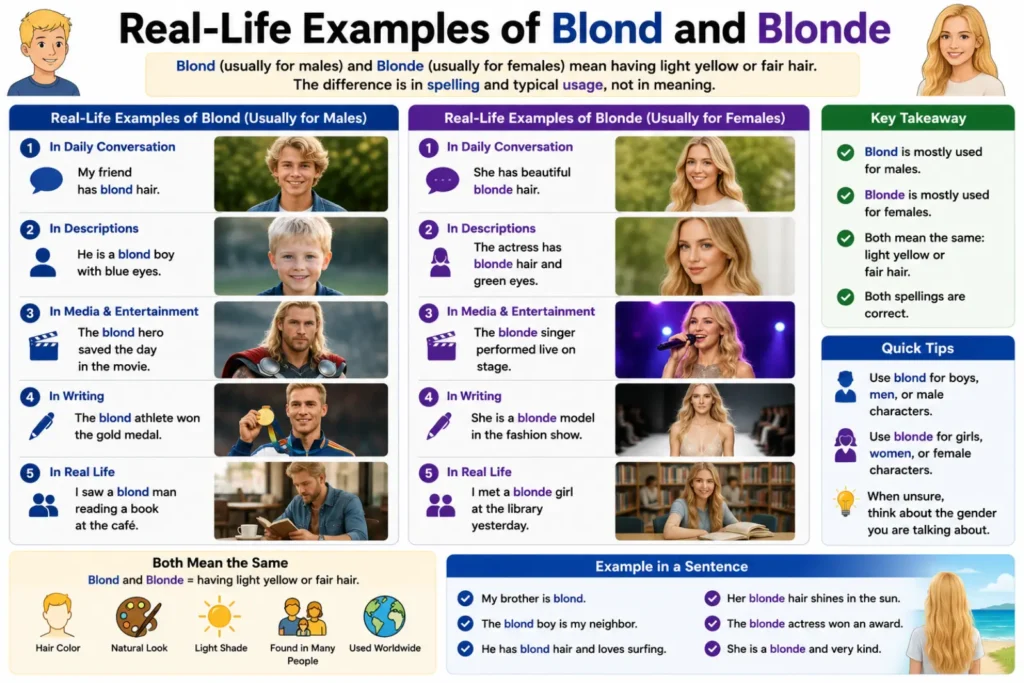
American English vs British English
The spelling depends on where you write.
American English
Many style guides accept blond for everyone.
Examples:
- Blond hair
- Blond child
- Blond actress
British English
British English usually keeps the traditional difference.
Examples:
- Blond man
- Blonde woman
If you write for an international audience, consistency matters more than the exact choice.
Common Mistakes People Make
Many writers confuse these spellings.
Mistake 1
Using blonde for every person.
Correct: Use blond for men if following the traditional rule.
Mistake 2
Switching spellings in the same article.
Stay consistent throughout your writing.
Mistake 3
Thinking one spelling is wrong.
Both are correct.
Mistake 4
Ignoring your audience.
American readers often expect different spelling than British readers.
Tips to Remember the Difference
Learning the difference is easy with these tricks.
- Blond = Boy
- Blonde = Girl
- Think of the extra “e” as representing the traditional feminine form.
- Follow one style guide.
- Stay consistent in every article.
Blond or Blonde in Daily Life
You will see these words in many places.
Examples include:
- Hair salons
- Fashion magazines
- Beauty blogs
- Books
- Newspapers
- Movie reviews
- Social media posts
Most people understand both spellings without confusion.
Synonyms and Related Words
Using related words improves your vocabulary and supports SEO.
Synonyms
- Fair-haired
- Golden-haired
- Light-haired
- Pale-haired
- Honey-haired
- Ash-blond
- Golden blond
Related Terms
- Hair color
- Natural blond hair
- Dyed blonde hair
- Platinum blonde
- Dirty blond
- Golden blonde
- Hair shades
- Hair dye
- Light hair color
Expert Insights
Language changes over time.
Modern style guides accept both spellings in many situations. However, professional writing benefits from consistency.
If you write for American readers, using blond more broadly is common.
If your audience is British or international, following the traditional distinction may feel more natural.
Always consider your readers before choosing a spelling.
Consistency improves readability and builds trust.
Featured Snippet: Blond vs Blonde
Blond and blonde both describe people with light-colored hair. Traditionally, blond refers to males, while blonde refers to females. American English often uses blond for everyone, while British English usually keeps the traditional distinction. Both spellings are correct when used consistently.
Frequently Asked Questions
Is blond or blonde correct?
Both are correct. Their use depends on gender, writing style, and regional English.
Should I use blond for men?
Traditionally, yes.
Should I use blonde for women?
Traditionally, yes.
Which spelling is more common in American English?
American English often uses blond for both men and women.
Which spelling does British English prefer?
British English usually keeps blond for men and blonde for women.
Is blond an adjective?
Yes. It commonly describes light-colored hair.
Example: She has blond hair.
Is blonde a noun?
Yes. It often refers to a woman with light-colored hair.
Example: She is a blonde.
Can I use either spelling?
Yes. Many modern publications accept either spelling if you remain consistent.
Conclusion
The choice between blond or blonde is simpler than it first appears. Both spellings describe light-colored hair, but tradition gives blond to males and blonde to females. American English often uses blond more broadly, while British English usually keeps the traditional difference. The most important rule is consistency. Choose the spelling that fits your audience and stick with it throughout your writing. Doing so makes your content look professional and easier to read. Whether you write for school, work, or your blog, understanding blond or blonde will help you communicate clearly and confidently.