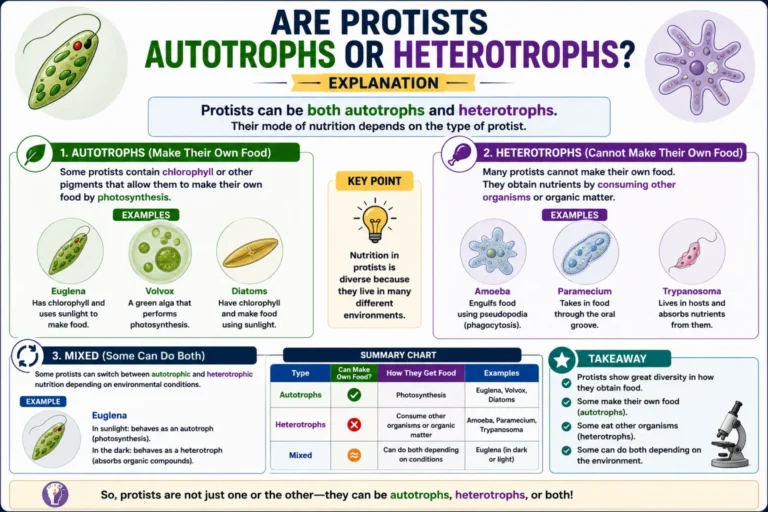
Are protists autotrophs or heterotrophs? This is a common biology question. The answer is not always simple because protists include many different organisms. Some protists make their own food through photosynthesis. Others eat plants, animals, or tiny organisms to get energy. A few can even do both, depending on their environment.
Understanding how protists obtain food helps you learn about ecosystems, food chains, and cell biology. It also makes it easier to classify living organisms. In this guide, you will discover the different types of protists, how they get nutrition, and why some are autotrophs while others are heterotrophs. The explanations use simple language and real-life examples to make learning easy.
Quick Summary
Are Protists Autotrophs or Heterotrophs?
- Protists can be autotrophs, heterotrophs, or both.
- Autotrophic protists make their own food using sunlight.
- Heterotrophic protists eat other organisms.
- Some protists are mixotrophs and switch between both methods.
- Protists live in freshwater, oceans, and moist environments.
- Nutrition depends on the type of protist.
What Are Protists?
Protists are simple organisms with cells that contain a nucleus.
Most protists have only one cell, but some have many cells.
Scientists place them in the kingdom Protista because they do not fit into the plant, animal, or fungus kingdoms.
Protists live in many places, including:
- Ponds
- Lakes
- Oceans
- Wet soil
- Damp forests
Some protists help the environment, while others cause diseases.
Key Facts About Protists
| Property | Description |
|---|---|
| Kingdom | Protista |
| Cell Type | Eukaryotic |
| Number of Cells | Mostly single-celled |
| Habitat | Water and moist places |
| Nutrition | Autotrophic, heterotrophic, or mixotrophic |
What Are Autotrophs?
Autotrophs are organisms that make their own food.
Most autotrophs use sunlight, water, and carbon dioxide to produce glucose.
This process is called photosynthesis.
Autotrophic protists contain chloroplasts with chlorophyll.
These structures capture sunlight and convert it into chemical energy.
Examples of Autotrophic Protists
- Green algae
- Diatoms
- Dinoflagellates (many species)
- Some Euglena species
These organisms act like plants because they produce their own food.
What Are Heterotrophs?
Heterotrophs cannot make their own food.
Instead, they obtain nutrients by eating other living organisms or organic matter.
Some hunt bacteria.
Others feed on algae or dead material.
Many heterotrophic protists move to find food.
Examples of Heterotrophic Protists
- Amoeba
- Paramecium
- Trypanosoma
- Plasmodium
These organisms depend on external food sources to survive.
Are Protists Autotrophs or Heterotrophs?
The answer is both.
Protists are one of the most diverse groups of living organisms.
Different species obtain food in different ways.
Some use sunlight to make food.
Others capture and digest tiny organisms.
A few can switch between these methods.
Because of this diversity, scientists cannot classify all protists as only autotrophs or only heterotrophs.
Simple Rule
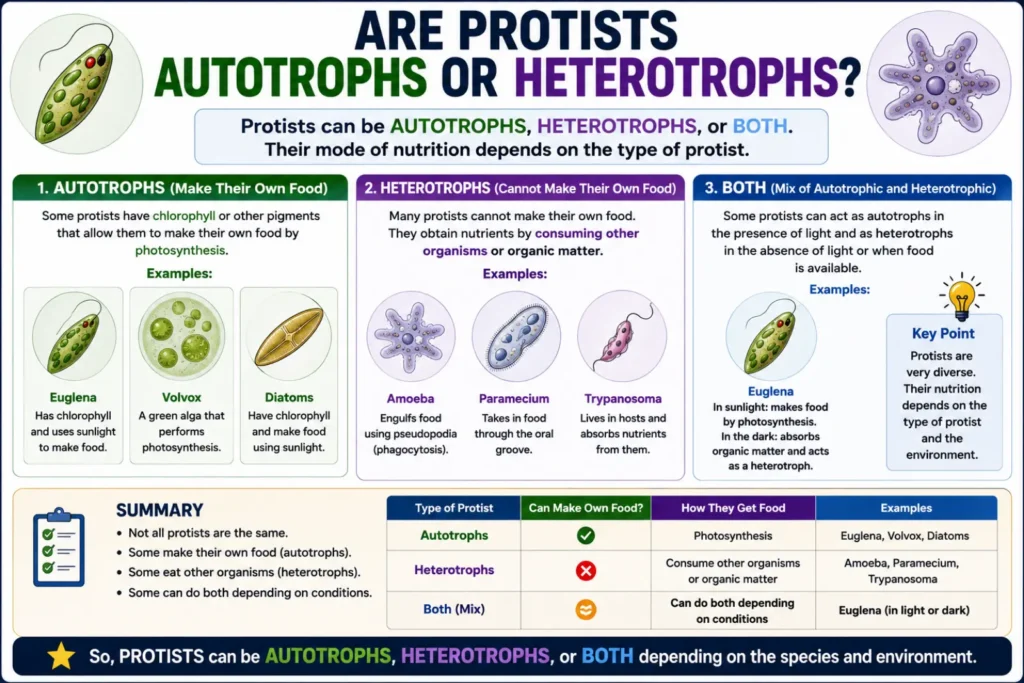
- Photosynthesis = Autotroph
- Eats other organisms = Heterotroph
- Can do both = Mixotroph
This simple rule helps identify the nutritional mode of most protists.
Types of Protists Based on Nutrition
Scientists often group protists according to how they obtain food.
Autotrophic Protists
These protists produce food through photosynthesis.
They play an important role in aquatic ecosystems by producing oxygen.
Heterotrophic Protists
These protists consume bacteria, algae, or other organisms.
Many act as predators in microscopic food chains.
Mixotrophic Protists
These protists combine both methods.
They make food when sunlight is available.
They feed on other organisms when light is limited.
This flexibility helps them survive changing environments.
Real-Life Examples of Protist Nutrition
Different protists use different feeding methods.
Here are some common examples.
| Protist | Type of Nutrition | Example |
| Green algae | Autotroph | Makes food through photosynthesis |
| Amoeba | Heterotroph | Engulfs bacteria and tiny organisms |
| Paramecium | Heterotroph | Uses cilia to sweep food into its mouth opening |
| Euglena | Mixotroph | Photosynthesizes in light and feeds in darkness |
| Diatoms | Autotroph | Produce food and oxygen in oceans |
These examples show why protists are considered one of the most diverse groups of organisms on Earth.
Why Do Some Protists Use Different Feeding Methods?
Protists live in many different environments.
Food and sunlight are not always available.
Some protists adapt by changing how they obtain energy.
For example, Euglena uses chloroplasts to make food when sunlight is present.
When light disappears, it absorbs or consumes organic nutrients from its surroundings.
This ability improves survival in changing conditions and makes some protists highly adaptable.
Autotrophs vs Heterotrophs vs Mixotrophs: Comparison Table
Understanding the differences between these nutritional modes makes protist classification much easier.
| Feature | Autotrophs | Heterotrophs | Mixotrophs |
|---|---|---|---|
| Food Source | Make their own food | Eat other organisms | Use both methods |
| Energy Source | Sunlight | Organic matter | Sunlight and organic matter |
| Photosynthesis | Yes | No | Yes, when light is available |
| Chloroplasts | Present | Absent | Present in many species |
| Examples | Green algae, Diatoms | Amoeba, Paramecium | Euglena |
| Main Role | Producers | Consumers | Producer and consumer |
Which Type Is Most Common?
Many protists are heterotrophs, while many algae are autotrophs. Mixotrophs are less common but play an important role in changing environments.
Why Is Protist Nutrition Important?
Protists help keep ecosystems healthy.
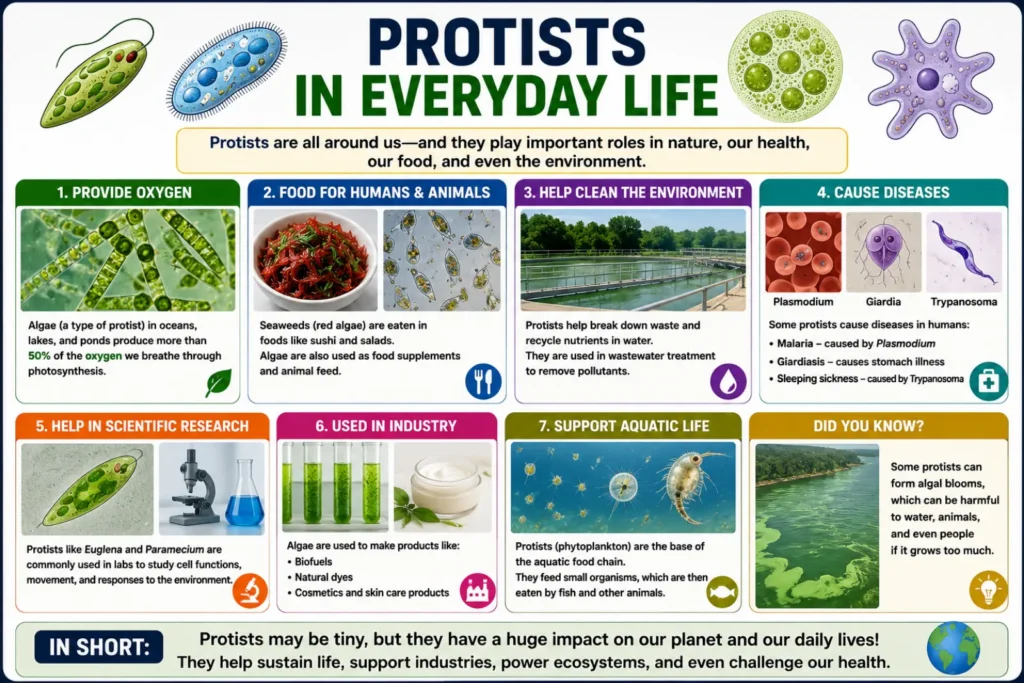
Autotrophic protists produce oxygen through photosynthesis. They also form the base of many aquatic food chains.
Heterotrophic protists control populations of bacteria and other microorganisms.
Mixotrophic protists adapt to changing conditions. This helps them survive when food or sunlight becomes limited.
Without protists, many aquatic ecosystems would not function properly.
Protists in Everyday Life
You may not see protists every day, but they affect your life in many ways.
Oxygen Production
Many algae release oxygen into the atmosphere.
Food Chains
Tiny fish and other aquatic animals feed on autotrophic protists.
Medicine
Some protists cause diseases. Scientists study them to develop medicines and vaccines.
Environmental Health
Protists help recycle nutrients in lakes, rivers, and oceans.
Scientific Research
Researchers use protists to study cells, genetics, and evolution.
Common Mistakes Students Make
Many students misunderstand how protists obtain food.
Avoid these common mistakes.
Mistake 1: Thinking All Protists Are Plants
Protists are not plants.
Some behave like plants, but many do not.
Mistake 2: Believing Every Protist Uses Photosynthesis
Only autotrophic and some mixotrophic protists perform photosynthesis.
Mistake 3: Forgetting About Mixotrophs
Some protists can both make and consume food.
Euglena is the best-known example.
Mistake 4: Assuming One Rule Fits Every Protist
Protists are extremely diverse.
Their nutrition depends on the species and environment.
Tips to Remember Protist Nutrition
These simple tricks make the topic easier.
- Green algae = Autotroph
- Amoeba = Heterotroph
- Euglena = Both (Mixotroph)
Another easy rule is:
- Makes food = Autotroph
- Eats food = Heterotroph
- Does both = Mixotroph
This shortcut works for most classroom questions.
Synonyms and Related Keywords
Using related terms helps improve understanding and supports SEO.
Common related keywords include:
- protist nutrition
- autotrophic protists
- heterotrophic protists
- mixotrophic protists
- kingdom Protista
- photosynthetic protists
- eukaryotic microorganisms
- protist examples
- protist classification
- photosynthesis in protists
- protist food source
- algae nutrition
- microscopic organisms
- aquatic microorganisms
- protist biology
These terms naturally relate to the main keyword and improve topical relevance.
Expert Insight
Protists are one of the most diverse groups of organisms on Earth.
Scientists classify their nutrition based on how each species obtains energy rather than placing all protists into one category.
Learning the nutritional strategies of protists also helps students understand ecosystems, evolution, and biodiversity.
Instead of memorizing examples, focus on the basic rule: identify whether the organism makes its own food, consumes other organisms, or does both.
This approach makes biology easier and improves long-term understanding.
Frequently Asked Questions
Are all protists autotrophs?
No. Some protists are autotrophs, while others are heterotrophs or mixotrophs.
Are all protists heterotrophs?
No. Many protists make their own food through photosynthesis.
What is a mixotrophic protist?
A mixotrophic protist can make food through photosynthesis and consume other organisms when needed.
Is Euglena an autotroph or a heterotroph?
Euglena is a mixotroph. It uses photosynthesis in sunlight and feeds on organic matter in darkness.
Why are protists important?
Protists produce oxygen, recycle nutrients, support food chains, and contribute to scientific research.
Do protists perform photosynthesis?
Many protists do, especially algae and other autotrophic species.
Where do protists live?
Most protists live in freshwater, oceans, moist soil, and other damp environments.
Why do scientists classify protists differently?
Protists vary greatly in structure, behavior, and nutrition, making them one of the most diverse groups of eukaryotic organisms.
Conclusion
The answer to “are protists autotrophs or heterotrophs” is that protists can be autotrophs, heterotrophs, or mixotrophs. Their method of obtaining food depends on the species and its environment. Autotrophic protists use photosynthesis to produce food. Heterotrophic protists consume other organisms for energy. Mixotrophic protists combine both strategies, allowing them to adapt to changing conditions.
Understanding these nutritional methods helps explain the important role protists play in ecosystems. They produce oxygen, support aquatic food chains, recycle nutrients, and contribute to biodiversity. Remember this simple rule: if a protist makes its own food, it is an autotroph; if it eats other organisms, it is a heterotroph; if it does both, it is a mixotroph.