Is exocytosis active or passive? Exocytosis is an active transport process used by cells. It requires energy from the cell to move materials outside. The cell packages substances inside small sacs called vesicles. These vesicles then move toward the cell membrane. Next, the vesicle joins with the membrane and releases its contents outside. This process helps cells remove waste and release useful substances. For example, nerve cells use exocytosis to release neurotransmitters. Other cells use it to release hormones and digestive enzymes. Exocytosis plays a key role in keeping cells healthy. It also helps cells communicate with nearby cells. Understanding this process makes cell transport much easier. In this guide, you will learn how exocytosis works and why it needs energy.
Quick Summary
- Exocytosis is an active transport process.
- It requires energy from the cell.
- The cell uses vesicles to carry materials outside.
- Vesicles fuse with the cell membrane.
- The vesicle releases its contents outside the cell.
- Cells use exocytosis to release hormones, enzymes, and neurotransmitters.
- Exocytosis differs from passive transport because passive transport does not require cellular energy.
What Is Exocytosis?
Exocytosis is a process that moves substances out of a cell.
The word comes from two parts. “Exo” means outside, while “cytosis” relates to cells.
During exocytosis, a vesicle carries material toward the cell membrane. The vesicle then joins with the membrane.
After fusion, the vesicle releases its contents outside the cell.
The cell can then use the same membrane to support other functions.
Exocytosis belongs to a group of processes called bulk transport. These processes move large materials across cell membranes.

Is Exocytosis Active or Passive?
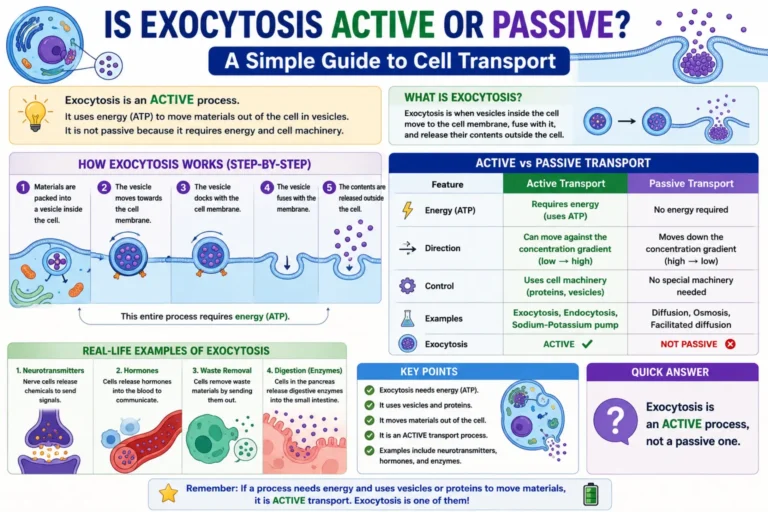
Exocytosis is active transport.
The process needs energy from the cell. This energy usually comes from ATP, the cell’s main energy source.
The cell spends energy to prepare, move, and fuse vesicles with the membrane.
Therefore, exocytosis does not happen through simple diffusion.
This point is important for biology tests. If a question asks whether exocytosis is active or passive, the answer is active.
Featured Snippet Answer
Exocytosis is active transport because it requires cellular energy, usually from ATP. It moves substances out of cells through vesicles that fuse with the cell membrane.
How Does Exocytosis Work?
Exocytosis follows several basic steps.
1. The Cell Packages Materials
The cell places materials inside a vesicle.
These materials can include proteins, hormones, enzymes, or waste products.
2. The Vesicle Moves Toward the Membrane
The vesicle travels through the cell toward the plasma membrane.
Cell structures help guide this movement.
3. The Vesicle Reaches the Membrane
The vesicle comes close to the cell membrane.
Special proteins help the vesicle connect with the membrane.
4. The Membranes Fuse
The vesicle membrane joins with the plasma membrane.
This creates an opening between the vesicle and the outside of the cell.
5. The Contents Leave the Cell
The vesicle releases its contents outside the cell.
The vesicle membrane becomes part of the cell membrane.
This completes the exocytosis process.
Why Does Exocytosis Need Energy?
Exocytosis requires energy because the cell must actively control several steps.
The cell must prepare the vesicle and move it toward the membrane.
It must also control vesicle docking and membrane fusion.
These activities depend on cellular machinery.
ATP provides energy for many cellular activities. Therefore, exocytosis is classified as active transport.
This differs from passive transport. Passive processes do not require the cell to spend ATP for movement.
Exocytosis vs. Endocytosis
Exocytosis and endocytosis are closely related processes.
However, they move materials in opposite directions.
| Feature | Exocytosis | Endocytosis |
|---|---|---|
| Direction | Out of the cell | Into the cell |
| Transport type | Active | Active |
| Uses vesicles | Yes | Yes |
| Requires cellular energy | Yes | Yes |
| Main purpose | Releases materials | Takes materials inside |
| Example | Hormone release | Nutrient uptake |
A simple way to remember them is this:
Exocytosis = exit.
Endocytosis = enter.
Both processes help cells move large materials that cannot easily cross the membrane.
Exocytosis vs. Passive Transport
Exocytosis differs greatly from passive transport.
| Feature | Exocytosis | Passive Transport |
| Energy required | Yes | No cellular energy required |
| Main direction | Out of the cell | Along a concentration gradient |
| Vesicles | Used | Usually not used |
| Examples | Neurotransmitter release | Diffusion and osmosis |
| Transport type | Active | Passive |
Passive transport includes processes such as diffusion, osmosis, and facilitated diffusion.
These processes move substances without the cell directly using ATP for transport.
Exocytosis instead uses vesicles and cellular energy.
Real-Life Examples of Exocytosis
Exocytosis happens constantly inside living organisms.
Nerve Cells
Nerve cells use exocytosis to release neurotransmitters.
These chemical messengers help nerve cells communicate.
The neurotransmitters leave small vesicles near the cell membrane.
Hormone Release
Some cells release hormones through exocytosis.
For example, endocrine cells can package hormones inside vesicles.
The vesicles then release those hormones outside the cell.
Digestive Enzymes
Certain cells release digestive enzymes using exocytosis.
These enzymes help break down food.
The enzymes must leave the cell before they can perform their functions.
Waste Removal
Cells can also use exocytosis to remove certain unwanted materials.
This helps maintain a stable internal environment.
Where Does Exocytosis Happen in the Body?
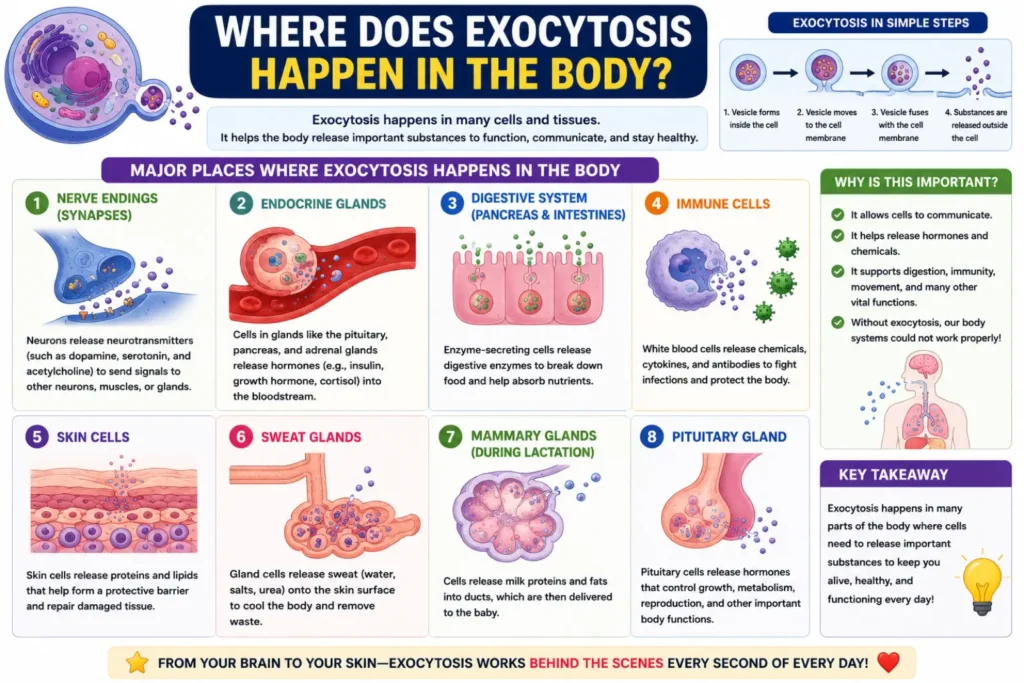
Exocytosis occurs in many types of cells.
It happens in nerve cells, gland cells, and other secretory cells.
For example, nerve cells use it during communication.
Gland cells use it when releasing substances such as hormones or enzymes.
Cells throughout the body depend on controlled transport systems.
Therefore, exocytosis supports many normal body functions.
Common Mistakes About Exocytosis
Students often confuse exocytosis with other transport processes.
Here are some common mistakes.
Mistake 1: Calling Exocytosis Passive
This is incorrect.
Exocytosis requires cellular energy, so it is active transport.
Mistake 2: Confusing Exocytosis With Endocytosis
Remember the direction.
Exocytosis moves materials out.
Endocytosis moves materials in.
Mistake 3: Saying Diffusion Uses Vesicles
Simple diffusion does not use vesicles.
It moves small molecules across a membrane based on concentration differences.
Mistake 4: Forgetting ATP
Exocytosis requires energy.
ATP supports the cellular processes involved in vesicle transport and fusion.
Mistake 5: Thinking Exocytosis Only Removes Waste
Cells also use exocytosis to release useful substances.
These include hormones, neurotransmitters, and enzymes.
Tips to Remember Exocytosis
Use these simple memory tricks.
Remember “EX”
The word exocytosis starts with “ex.”
Think of “exit.”
Exocytosis moves materials out.
Remember “ENDO” for Enter
Endocytosis brings materials into the cell.
This gives you an easy pair:
EXO = exit
ENDO = enter
Remember ATP
If your biology question asks about energy use, exocytosis is active.
Think:
Exocytosis → vesicles → ATP → active transport.
Exocytosis in Daily Life
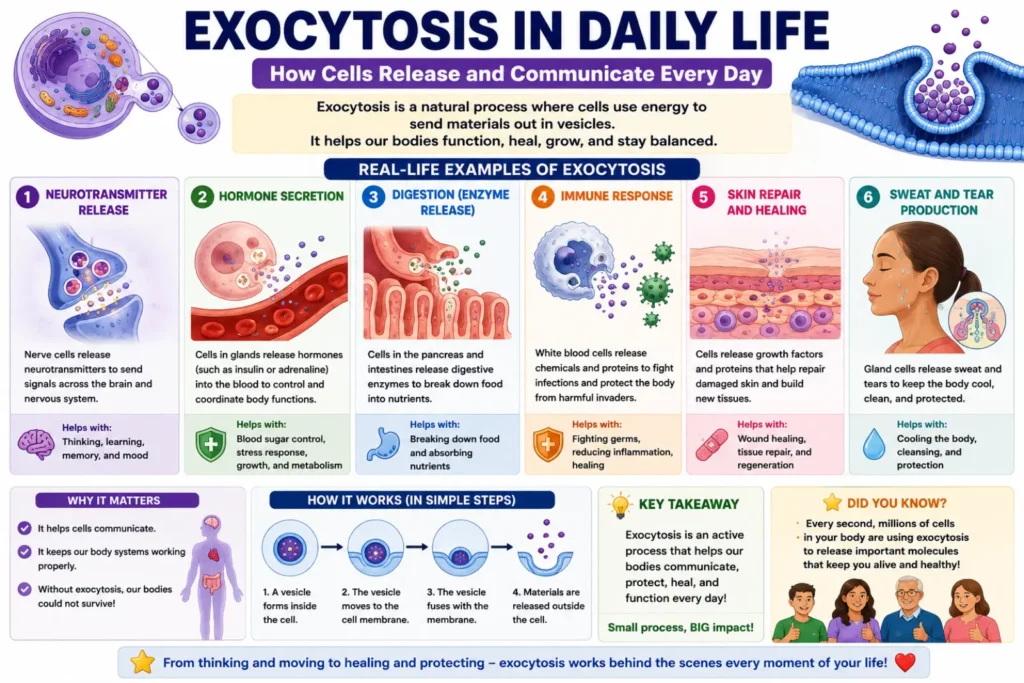
You cannot usually see exocytosis happening directly.
However, your cells perform it every day.
nervous system depends on exocytosis for cell communication.
Your endocrine system uses it to release certain hormones.
Your digestive system also depends on cells that release digestive substances.
Therefore, exocytosis supports important body functions.
It helps cells communicate, release substances, and maintain proper internal conditions.
Synonyms and Related Terms
Exocytosis has several related search terms.
These terms can help you understand the topic from different angles:
- Active transport
- Vesicular transport
- Bulk transport
- Vesicle fusion
- Plasma membrane
- Cell membrane transport
- Vesicle-mediated transport
- Cellular secretion
- Secretion from cells
- ATP-dependent transport
- Exocytotic pathway
These terms do not always mean exactly the same thing.
However, they often appear when scientists discuss exocytosis.
Expert Insights: Why Exocytosis Matters
Exocytosis shows how cells control their environment.
Cells cannot simply release every substance whenever they want.
They need controlled systems for secretion.
Vesicles provide one way to organize and transport materials.
Energy-dependent control also allows cells to release substances at the right time.
This matters especially in nerve cells.
A nerve cell must release chemical signals in a carefully controlled way.
Exocytosis makes this communication possible.
From an expert biology perspective, the key idea is simple:
Exocytosis is active because the cell uses energy to move vesicle contents outside the cell.
Frequently Asked Questions
Is exocytosis active or passive?
Exocytosis is active transport. It requires cellular energy and uses vesicles to move materials outside the cell.
Does exocytosis require ATP?
Yes. Exocytosis requires cellular energy. ATP supports the processes involved in vesicle movement and fusion.
Does exocytosis move substances into or out of the cell?
Exocytosis moves substances out of the cell.
Is exocytosis a type of bulk transport?
Yes. Exocytosis is a form of bulk or vesicular transport.
What is an example of exocytosis?
A common example involves nerve cells releasing neurotransmitters.
What is the opposite of exocytosis?
Endocytosis is the opposite process. It brings materials into the cell.
Does exocytosis use vesicles?
Yes. Vesicles carry materials toward the cell membrane before releasing them outside.
Why is exocytosis important?
Exocytosis helps cells release hormones, neurotransmitters, enzymes, and other substances.
Conclusion
So, is exocytosis active or passive? Exocytosis is active transport.
It requires cellular energy and uses vesicles to move substances outside the cell.
The vesicle carries materials toward the plasma membrane. Then, it fuses with the membrane and releases its contents.
Cells use this process for many important tasks.
These tasks include releasing neurotransmitters, hormones, enzymes, and some waste materials.
The easiest way to remember the process is “EXO means exit.”
Also remember that exocytosis and endocytosis work in opposite directions.
Exocytosis moves materials out, while endocytosis moves materials in.