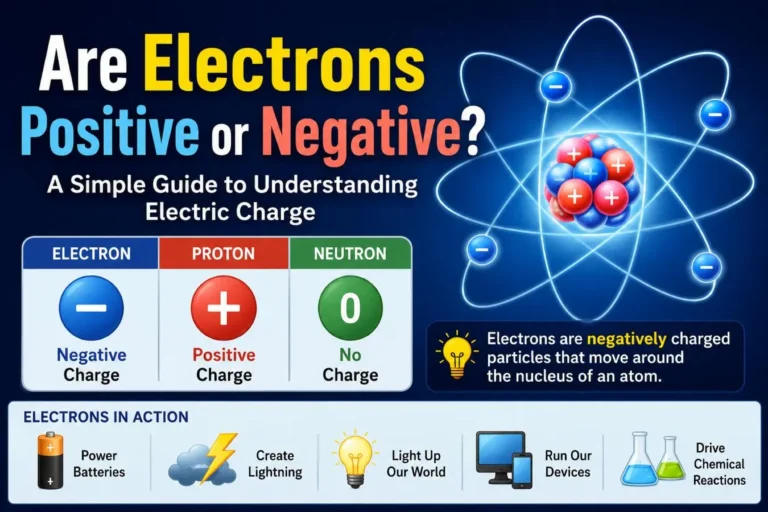
Electrons are negatively charged particles. An electron has a negative electric charge, commonly written as −1e or approximately −1.602 × 10⁻¹⁹ coulombs.
Electrons are one of the three main subatomic particles found in atoms. Unlike protons, which have a positive charge, electrons have a negative charge, while neutrons have no net electric charge.
Understanding the charge of an electron is essential for learning about atoms, electricity, electric fields, ions, and chemical reactions.
Quick Answer: Are Electrons Positive or Negative?
Electrons are negative. Every electron carries one unit of negative elementary charge. In an electrically neutral atom, the number of electrons equals the number of protons, so their opposite charges balance each other.
What Is an Electron?
An electron is a subatomic particle with a negative electric charge.
Electrons are much smaller in mass than protons and neutrons and are associated with the region surrounding an atom’s nucleus.
An atom contains three familiar types of particles:
- Electrons — negative
- Protons — positive
- Neutrons — neutral
The nucleus contains protons and neutrons. Electrons occupy atomic orbitals around the nucleus.
A simple picture of an atom is therefore:
Nucleus → protons + neutrons
Outside the nucleus → electrons
Modern atomic physics describes electrons using quantum mechanics rather than simple planetary-style orbits.
What Charge Does an Electron Have?
An electron carries a negative elementary charge.
Its charge is approximately:
−1.602 × 10⁻¹⁹ coulombs
The negative sign tells us the direction of the electron’s electric charge relative to the positive charge of a proton.
The magnitude of an electron’s charge is equal to the magnitude of a proton’s charge, but the signs are opposite.
| Particle | Charge | Relative Charge |
|---|---|---|
| Electron | Negative | −1 |
| Proton | Positive | +1 |
| Neutron | None | 0 |
This is one of the most important facts to remember about atomic structure.
Why Are Electrons Negative?
The electron’s negative charge is a fundamental property of the particle.
In basic science, we do not explain the negative charge as something caused by another smaller component inside the electron. As far as current established physics describes it, the electron is an elementary particle with an intrinsic electric charge.
The terms positive and negative are conventions used to distinguish the two types of electric charge.
The names themselves do not mean that an electron is “bad” or that a proton is “good.” They simply describe opposite types of electric charge.
Are Electrons Negative in an Atom?
Yes.
Electrons remain negatively charged whether they are associated with an atom, involved in a chemical bond, moving through a conductor, or participating in another physical process.
For example, a neutral hydrogen atom contains:
- 1 proton
- 1 electron
- 0 neutrons in its most common isotope
The proton contributes a positive charge, while the electron contributes an equal-magnitude negative charge.
The overall atom is electrically neutral because the charges cancel.
Why Is a Neutral Atom Not Negative?
This is a common source of confusion.
A neutral atom can contain negatively charged electrons without having an overall negative charge.
That’s because it also contains positively charged protons.
For a neutral atom:
Number of protons = Number of electrons
Their charges balance.
For example, an atom with 6 protons and 6 electrons has:
- Positive charge from 6 protons
- Negative charge from 6 electrons
- Overall charge = 0
Here, Np represents the number of protons, Ne represents the number of electrons, and e represents the elementary charge magnitude.
Are Protons Positive or Negative?
Protons are positively charged.
This makes protons the opposite of electrons in terms of electric charge.
| Particle | Electric Charge |
|---|---|
| Electron | Negative |
| Proton | Positive |
| Neutron | Neutral |
Electrons and protons attract each other because opposite electric charges attract.
However, two electrons repel each other because they have the same negative charge.
Likewise, two protons repel each other because both are positively charged.
Are Neutrons Positive or Negative?
Neutrons have no net electric charge.
A neutron is electrically neutral.
This gives us the basic three-particle comparison:
Electron = negative
Proton = positive
Neutron = neutral
This simple relationship is fundamental to understanding atoms.
Do Electrons Attract or Repel?
Electrons repel one another because they have the same negative electric charge.
The basic rule is:
- Opposite charges attract.
- Like charges repel.
Therefore:
Electron + electron → repel
Electron + proton → attract
Proton + proton → repel
These electric interactions are described by electromagnetic physics.
Why Don’t Electrons Fall Into the Nucleus?
At a basic level, it may seem strange that negatively charged electrons do not simply fall into the positively charged nucleus.
The answer comes from quantum mechanics.
Electrons in atoms are not simply tiny balls traveling around the nucleus along fixed classical paths. They occupy quantum states described by wavefunctions.
Only certain energy states are allowed.
The stable structure of atoms results from quantum mechanics and electromagnetic interactions.
So the simple statement “opposite charges attract” is true, but it does not by itself explain the full structure of an atom.
Do Electrons Have Mass?
Yes.
Electrons have mass, although their mass is extremely small compared with that of protons and neutrons.
The electron’s mass is approximately:
9.11 × 10⁻³¹ kilograms
For comparison, a proton has roughly 1,836 times the mass of an electron.
This difference helps explain why electrons are often treated differently from the much heavier particles in the nucleus.
Do Electrons Have Energy?
Yes.
Electrons can have different amounts of energy depending on their quantum state and physical environment.
In an atom, electrons can occupy different energy levels or states.
If an electron absorbs the right amount of energy, it can move to a higher-energy state.
When it moves to a lower-energy state, energy can be released, often as electromagnetic radiation such as a photon.
This behavior is important in:
- Light emission
- Lasers
- Spectroscopy
- Chemistry
- Electronics
- Solar cells
What Happens When an Atom Gains Electrons?
When an atom gains one or more electrons, it becomes negatively charged.
The resulting charged atom is called an anion.
For example, a neutral chlorine atom has 17 protons and 17 electrons.
If it gains one electron, it has:
- 17 protons
- 18 electrons
There is now one more negative charge than positive charge.
The ion therefore has a −1 charge.
What Happens When an Atom Loses Electrons?
When an atom loses one or more electrons, it becomes positively charged.
The resulting ion is called a cation.
For example, a neutral sodium atom has 11 protons and 11 electrons.
If it loses one electron, it has:
- 11 protons
- 10 electrons
There is now one more positive charge than negative charge.
The sodium ion therefore has a +1 charge.
Electrons and Ions
Ions form when atoms or molecules gain or lose electrons.
Anion
Gains electrons → becomes negative
Cation
Loses electrons → becomes positive
| Change | Result |
|---|---|
| Gains electrons | Negative ion |
| Loses electrons | Positive ion |
| Gains and loses equal amounts | Can become neutral |
A useful memory trick is:
Anion = adds electrons
Cation = cuts away electrons
Are Electrons Responsible for Electricity?
Electrons play a major role in many forms of electricity.
In ordinary metal wires, electrical current is associated with the movement of electrons through the material.
When a voltage is applied across a conductor, electrons respond to the electric field and acquire a small average drift velocity.
It is important, however, to distinguish electron movement from conventional current direction.
Do Electrons Move From Negative to Positive?
In a typical metal circuit, electrons drift from the negative side toward the positive side when driven by an electric field.
However, conventional current is defined in the opposite direction.
Electron flow
Negative → Positive
Conventional current
Positive → Negative
This can be confusing because the conventional current direction was established before the electron’s negative charge was understood.
Electron Charge vs. Conventional Current
The difference can be summarized like this:
| Concept | Direction in a typical metal circuit |
|---|---|
| Electron drift | Negative → Positive |
| Conventional current | Positive → Negative |
Both descriptions can be used correctly as long as the distinction is understood.
Are Electrons Always Moving?
Electrons in atoms do not behave like tiny planets following simple circular paths.
Quantum mechanics describes their states in terms of probability distributions.
In a conductor, electrons can also participate in collective behavior and respond to electric fields.
So the simple statement “electrons orbit the nucleus” is useful as an introductory picture but is not an accurate modern description of atomic electron behavior.
Are Electrons Matter?
Yes.
Electrons are matter in the sense that they are particles with mass and are part of the physical universe.
They are classified as leptons, a family of elementary particles.
Unlike protons and neutrons, electrons are not currently understood to be made of smaller constituent particles.
Are Electrons Fundamental Particles?
Yes.
According to the Standard Model of particle physics, the electron is an elementary particle.
It belongs to the lepton family.
Other members of the lepton family include:
- Muon
- Tau
- Electron neutrino
- Muon neutrino
- Tau neutrino
The electron is therefore not considered to be made from quarks.
Who Discovered the Electron?
The electron is historically associated with J. J. Thomson, who provided strong experimental evidence for electrons in the late 19th century through studies of cathode rays.
In 1897, Thomson demonstrated that cathode rays consisted of particles much smaller than atoms and that these particles carried negative charge.
This work was a major step toward the modern understanding of atomic structure.
It is important to note that scientists had been studying electrical phenomena before Thomson, but his experiments provided crucial evidence for the existence of the electron as a universal subatomic particle.
How Small Is an Electron?
An electron has an extremely small mass.
Its mass is approximately:
9.109 × 10⁻³¹ kg
Its electric charge is approximately:
−1.602 × 10⁻¹⁹ C
Because the electron is treated as an elementary particle in the Standard Model, it does not have a known internal structure or ordinary measurable radius in the way a larger composite object does.
Electron vs. Proton
The electron and proton have equal-magnitude but opposite electric charges.
| Property | Electron | Proton |
|---|---|---|
| Charge | Negative | Positive |
| Relative charge | −1 | +1 |
| Mass | Much smaller | Much larger |
| Location in atom | Associated with orbitals around nucleus | In nucleus |
| Particle type | Lepton | Baryon |
| Elementary? | Yes | No; made of quarks |
Their opposite charges are central to the structure of ordinary matter.
Electron vs. Neutron
| Property | Electron | Neutron |
|---|---|---|
| Charge | Negative | Neutral |
| Relative charge | −1 | 0 |
| Mass | Very small | Much larger |
| Location | Outside nucleus in atomic states | Nucleus |
| Particle type | Lepton | Baryon |
The neutron does not have a net electric charge.
Why Are Electrons Important?
Electrons are involved in many fundamental processes.
They are important for:
- Atomic structure
- Chemical bonding
- Electricity
- Electronics
- Chemical reactions
- Electric currents
- Light emission
- Semiconductors
- Solar cells
- Biological chemistry
Without electrons, the chemistry of ordinary matter would be completely different.
Electrons in Chemical Bonds
Electrons are central to chemical bonding.
Atoms can share electrons in covalent bonds or transfer electrons in processes that produce ions and ionic bonds.
For example, sodium can transfer an electron to chlorine.
This produces:
- Na⁺
- Cl⁻
The opposite charges then contribute to the ionic attraction in sodium chloride.
Electrons also participate in metallic bonding and other forms of chemical interaction.
Common Misconceptions About Electrons
“Electrons are positive.”
False. Electrons have negative electric charge.
“Protons and electrons have the same charge.”
They have the same magnitude of charge but opposite signs.
“A neutral atom has no electrons.”
False. A neutral atom normally has equal numbers of protons and electrons.
“An atom becomes negative when it loses electrons.”
False. Losing negative electrons makes an atom more positive.
“An atom becomes positive when it gains electrons.”
False. Gaining negative electrons makes it more negative.
“Electrons are inside the nucleus.”
Normally, electrons are associated with quantum states around the nucleus, while protons and neutrons make up the nucleus.
Easy Way to Remember Electron Charge
Use this simple rule:
Electron = Negative
Then remember:
Proton = Positive
Neutron = Neutral
You can also remember the first letters:
E = Electron = −
P = Proton = +
N = Neutron = Neutral
Frequently Asked Questions
Are electrons positive or negative?
Electrons are negative. Each electron has one unit of negative elementary charge.
What is the charge of an electron?
An electron has a charge of approximately −1.602 × 10⁻¹⁹ coulombs.
Are electrons negatively charged?
Yes. Negative electric charge is one of the electron’s fundamental properties.
Are protons positive?
Yes. Protons have positive electric charge.
Are neutrons negative?
No. Neutrons have no net electric charge.
Why is an atom neutral if electrons are negative?
A neutral atom contains equal numbers of negatively charged electrons and positively charged protons. Their charges cancel overall.
What happens if an atom gains an electron?
It becomes more negative and can form a negatively charged ion called an anion.
What happens if an atom loses an electron?
It becomes more positive and can form a positively charged ion called a cation.
Do electrons attract protons?
Yes. Opposite electric charges attract.
Do electrons repel each other?
Yes. Electrons have the same negative charge, so they repel each other electromagnetically.
Do electrons have mass?
Yes. An electron has a very small mass of approximately 9.11 × 10⁻³¹ kg.
Are electrons smaller than protons?
An electron has vastly less mass than a proton. In the Standard Model, electrons are elementary particles, whereas protons are composite particles made of quarks.
Do electrons orbit the nucleus?
The traditional orbit picture is an oversimplification. Modern quantum mechanics describes electrons in atoms using quantum states and orbitals rather than simple fixed paths.
Are electrons matter?
Electrons are physical elementary particles with mass, charge, and quantum properties.
Are electrons made of quarks?
No. Electrons are leptons and are not known to be made of quarks.
Who discovered the electron?
J. J. Thomson provided important experimental evidence for the electron in 1897 through his work on cathode rays.
Do electrons cause electricity?
The movement and behavior of electrons are responsible for electric current in many conductors, particularly metals.
Do electrons move from negative to positive?
In a typical metal circuit, electrons drift from the negative side toward the positive side. Conventional current is defined in the opposite direction.
What is an anion?
An anion is a negatively charged ion, usually formed when an atom or molecule gains electrons.
What is a cation?
A cation is a positively charged ion, usually formed when an atom or molecule loses electrons.
Final Verdict: Are Electrons Positive or Negative?
Electrons are negatively charged. This is one of the most basic and important facts in atomic science.
Remember the three main particles:
Electron → Negative (−)
Proton → Positive (+)
Neutron → Neutral (0)
An atom can be electrically neutral when it has equal numbers of protons and electrons. If it gains electrons, it becomes negatively charged. If it loses electrons, it becomes positively charged.
Understanding electron charge provides the foundation for learning about electricity, ions, chemical bonding, circuits, atomic structure, and many other areas of science.