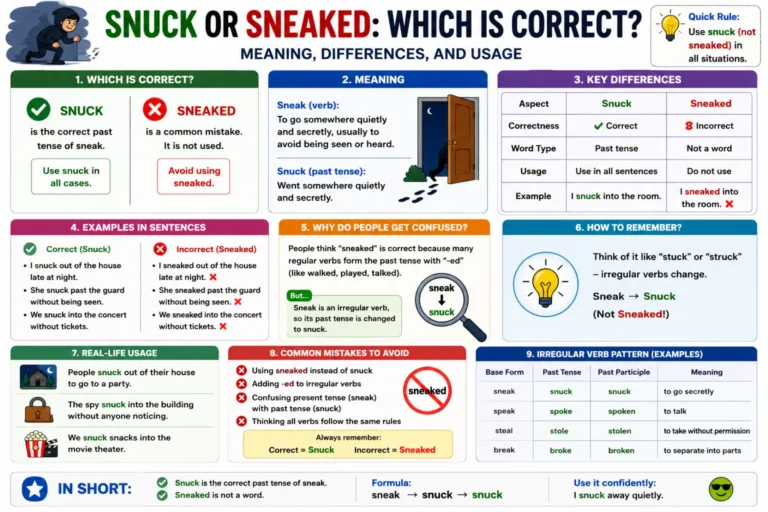
Snuck or sneaked is a common grammar question. Many English learners and native speakers ask which word is correct. The good news is simple. Both words are correct. However, people use them in different places and situations.
The verb sneak means to move quietly without being noticed. Its past tense can be snuck or sneaked. Both forms appear in dictionaries and modern English. Still, some teachers, editors, and style guides prefer one over the other.
This guide explains the difference in easy English. You will learn when to use each word. You will also see real-life examples, common mistakes, and expert writing tips. By the end, you will feel confident using the correct form in any situation.
Quick Summary Box
- Both “snuck” and “sneaked” are correct.
- Sneaked is the traditional past tense of sneak.
- Snuck became popular in American English.
- Sneaked is more common in formal writing.
- Snuck sounds more natural in casual conversations.
- Choose the form that matches your audience and writing style.
What Does “Snuck or Sneaked” Mean?
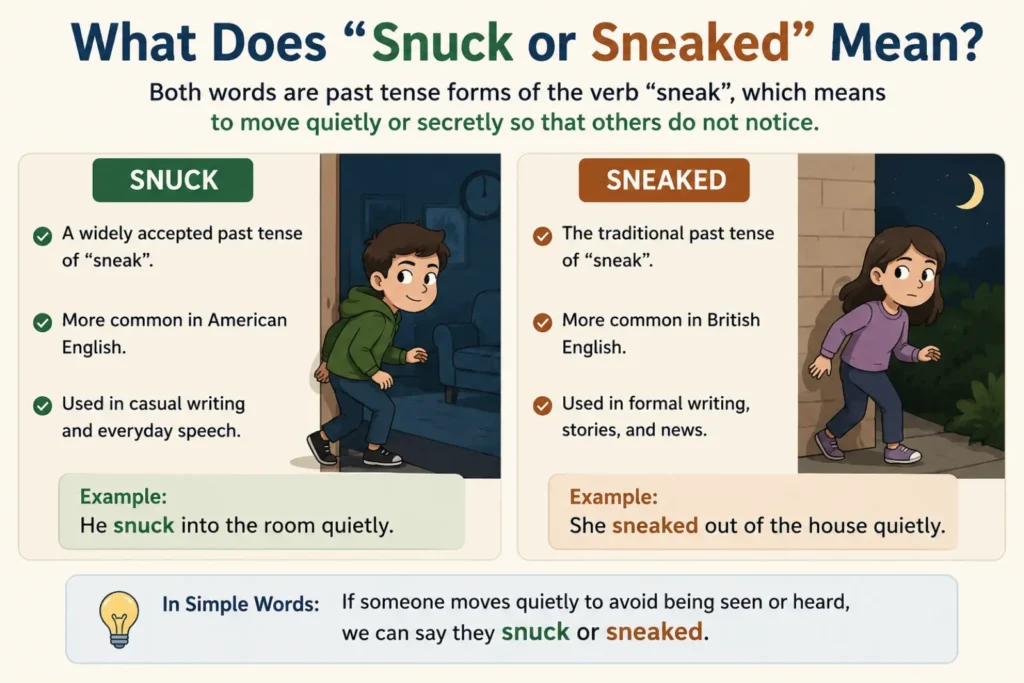
The words snuck and sneaked are both past tense forms of the verb sneak.
Sneak means:
- Move quietly
- Avoid being noticed
- Enter or leave secretly
- Do something without permission
Examples
- She snuck into the room.
- She sneaked into the room.
Both sentences are correct.
Is “Snuck” or “Sneaked” Correct?
Yes. Both are correct.
The difference comes from language history and style.
- Sneaked is the original past tense.
- Snuck appeared later and became widely accepted.
Today, major dictionaries accept both forms.
If you write for school, business, or formal documents, sneaked is often the safer choice.
If you write blogs, stories, or everyday content, snuck sounds natural in American English.
Snuck vs Sneaked: Key Differences
| Feature | Snuck | Sneaked |
|---|---|---|
| Grammar | Correct | Correct |
| Traditional form | No | Yes |
| American English | Very common | Common |
| British English | Less common | More common |
| Formal writing | Less preferred | Preferred |
| Casual speech | Very common | Common |
| Modern usage | Popular | Standard |
Quick Tip
Use sneaked when you want a formal tone.
Use snuck when writing naturally for American readers.
Why Are There Two Past Tense Forms?
English changes over time.
Many verbs develop new forms because people use them often.
For example:
- Dive → Dove / Dived
- Dream → Dreamed / Dreamt
- Learn → Learned / Learnt
- Sneak → Sneaked / Snuck
People used snuck so often that dictionaries accepted it.
Language grows through everyday use.
Real-Life Examples of Snuck and Sneaked
Casual Conversation
“I snuck out after dinner.”
School Essay
“The student sneaked into the library quietly.”
News Article
“The suspect sneaked into the building.”
Storytelling
“The cat snuck behind the couch.”
Workplace
“He sneaked into the meeting without anyone noticing.”
When Should You Use “Snuck”?
Use snuck when writing:
- Blog posts
- Fiction
- Personal stories
- Conversations
- Social media
- American audiences
Examples
- My dog snuck onto the bed.
- We snuck into the theater.
- They snuck away before sunrise.
- He snuck a cookie before dinner.
These examples sound natural in everyday American English.
When Should You Use “Sneaked”?
Use sneaked when writing:
- Academic papers
- Business emails
- News reports
- Professional documents
- Formal articles
Examples
- The employee sneaked into the office.
- She sneaked a quick look.
- The child sneaked downstairs quietly.
- They sneaked past security.
Formal readers often expect this version.
Common Mistakes People Make
Many learners confuse these forms.
Here are the most common mistakes.
Mistake 1
❌ She sneak into the room yesterday.
✅ She snuck into the room yesterday.
✅ She sneaked into the room yesterday.
Mistake 2
❌ He has sneakeded away.
✅ He has snuck away.
✅ He has sneaked away.
Mistake 3
Mixing styles in one article.
Choose one version and stay consistent.
Mistake 4
Thinking one word is wrong.
Both are correct.
Easy Trick to Remember
Remember this simple rule.
Formal = Sneaked
Casual = Snuck
If you are unsure, choose sneaked.
If your audience is American and casual, snuck works well.
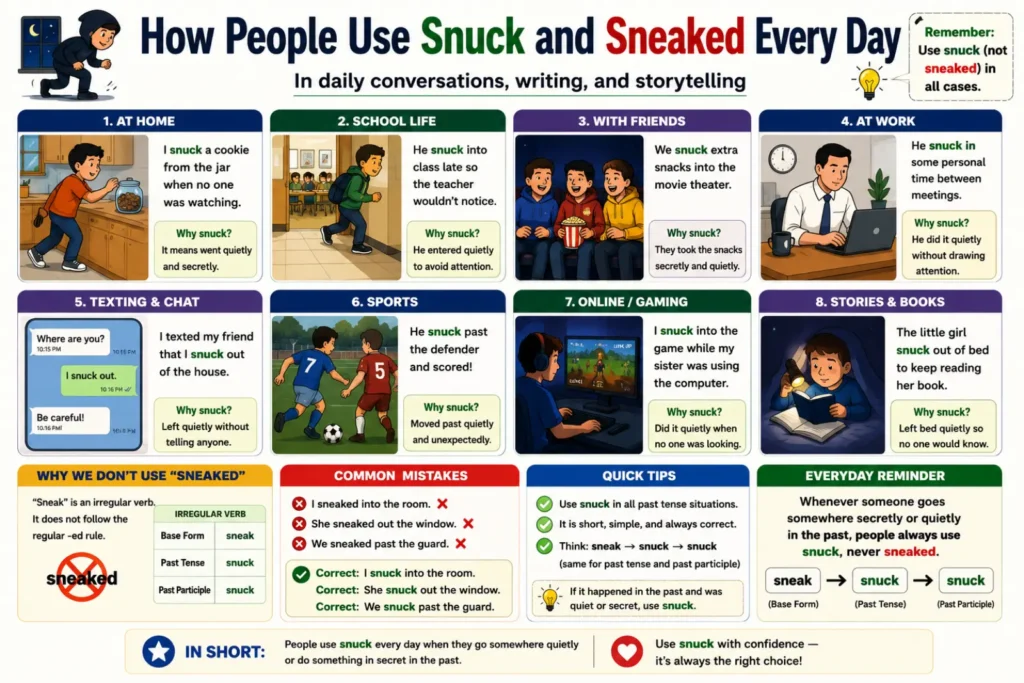
How People Use Snuck and Sneaked Every Day
You hear these words often.
At Home
“The kids snuck outside.”
At School
“The student sneaked into class.”
At Work
“He sneaked a quick break.”
While Traveling
“We snuck onto the empty beach.”
In Sports
“The player snuck past the defense.”
Synonyms and Related Words
Using related words makes your writing richer.
Synonyms
- Crept
- Slipped
- Tiptoed
- Stole
- Moved quietly
- Crept away
- Glided
- Inched
- Quietly entered
- Secretly moved
Related (LSI) Keywords
- sneak past tense
- snuck meaning
- sneaked meaning
- is snuck correct
- snuck vs sneaked
- grammar difference
- English grammar
- past tense of sneak
- American English grammar
- British English grammar
Expert Insights
Professional writers focus on clarity before preference.
Modern dictionaries accept both snuck and sneaked. However, audience matters. American readers often expect snuck in casual content. Academic and professional readers usually prefer sneaked.
Consistency also improves readability. Pick one form and use it throughout your article unless you compare both words.
For SEO content, answer the user’s question quickly. Then support it with examples, comparisons, and practical advice. This approach builds trust and keeps readers engaged.
Featured Snippet Answer
Is it “snuck” or “sneaked”?
Both snuck and sneaked are correct past tense forms of sneak. Sneaked is the traditional and more formal form. Snuck is widely accepted and very common in American English, especially in casual speech and writing.
Frequently Asked Questions
Is “snuck” a real word?
Yes. Major dictionaries recognize snuck as a correct past tense of sneak.
Is “sneaked” more correct than “snuck”?
No. Both are correct. However, sneaked is more traditional and formal.
Which form is more common in America?
Snuck is very common in everyday American English.
Which word should students use?
Students should use sneaked unless their teacher accepts both forms.
Is “snuck” informal?
Yes. It is more common in casual speaking and writing.
Do British speakers use “snuck”?
Some do. However, sneaked remains more common in British English.
Can I use “snuck” in a blog post?
Yes. It sounds natural for many online readers, especially in American English.
Are both words accepted by dictionaries?
Yes. Modern dictionaries include both snuck and sneaked.
Best Practices for Writers
Follow these tips for clear writing.
- Know your audience.
- Stay consistent throughout your content.
- Use sneaked in formal writing.
- Use snuck in conversational writing.
- Check your style guide before publishing.
- Add examples to improve understanding.
- Keep your sentences simple and direct.
Conclusion
The answer to snuck or sneaked is simple. Both words are correct, and both serve as the past tense of sneak. The best choice depends on your audience and writing style. Sneaked remains the traditional option and fits formal writing well. Snuck is widely accepted and feels natural in everyday American English.
The most important rule is consistency. Pick one form and use it throughout your writing. Doing this creates a smoother reading experience and helps your content look more professional. Whether you choose snuck or sneaked, your readers will understand your meaning when you use the word correctly. Keep practicing with real examples, and choosing the right form will soon become second nature.