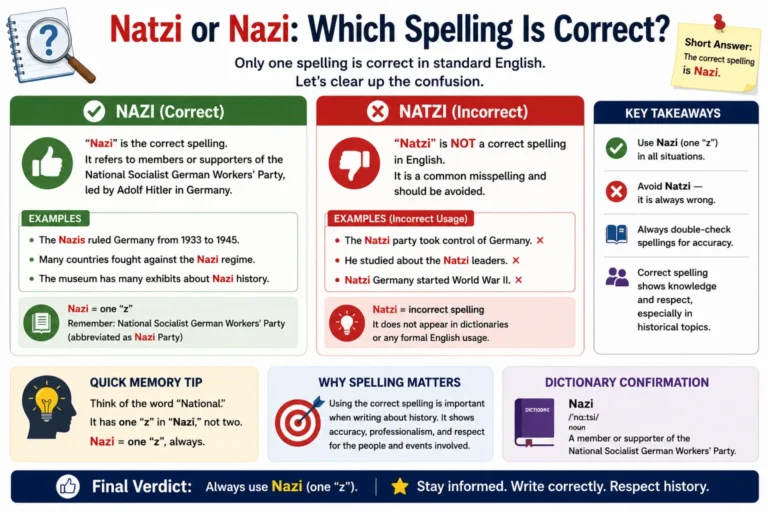
“Natzi or Nazi” is a common spelling question for people writing about history. The correct English spelling is Nazi. “Natzi” is a common misspelling of the word. The term “Nazi” refers to a member or supporter of the National Socialist German Workers’ Party. This political party ruled Germany under Adolf Hitler from 1933 to 1945. Today, the word mainly appears in history, education, and discussions about extremism. It can also appear as an adjective when describing Nazi Germany or Nazi policies. Knowing the correct spelling helps writers avoid errors. It also makes historical research easier. In this guide, you will learn the difference between “Natzi” and “Nazi.” You will also see examples, common mistakes, related terms, and simple usage tips.
Quick Summary
- Nazi is the correct English spelling.
- Natzi is usually a misspelling.
- Nazi comes from the German name of the National Socialist movement.
- The term is strongly linked to Adolf Hitler and Nazi Germany.
- Use Nazi when writing about the historical movement.
- Do not use “Natzi” in formal writing unless discussing the spelling error itself.
- The plural form is usually Nazis.
- The adjective is also Nazi, as in “Nazi Germany.”
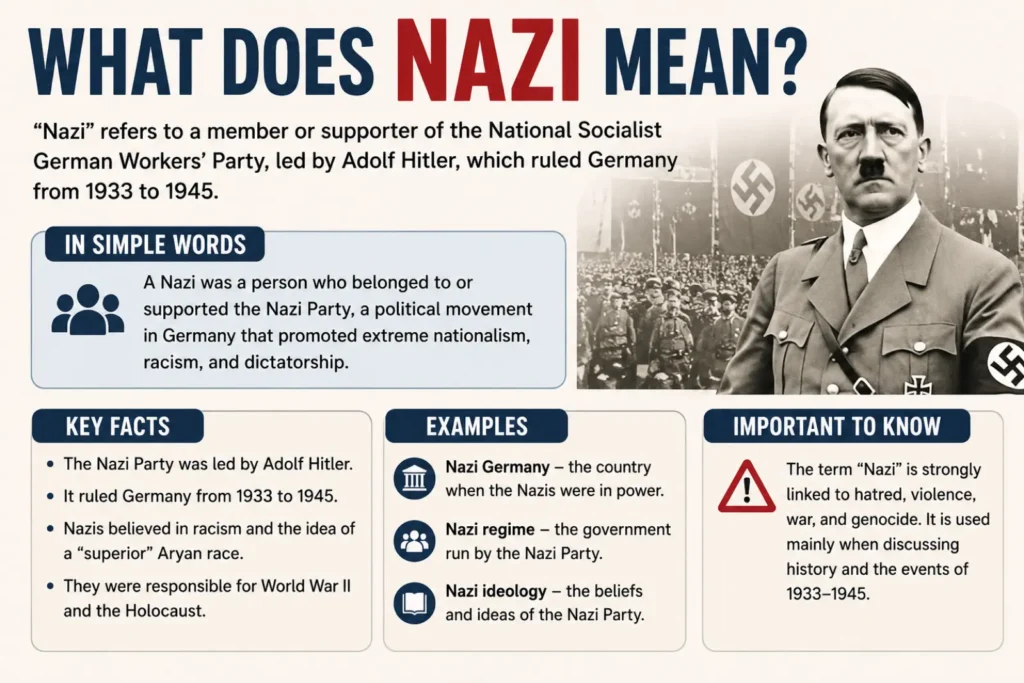
What Does Nazi Mean?
Nazi is a shortened form of the German political name Nationalsozialist.
The term became associated with the National Socialist German Workers’ Party. The party was known as the NSDAP in German.
The Nazi Party controlled Germany under Adolf Hitler from 1933 to 1945.
The word can describe a person who belonged to or supported that movement.
It can also describe things linked to the Nazi regime.
For example:
- Nazi Germany
- Nazi Party
- Nazi government
- Nazi propaganda
- Nazi ideology
- Nazi persecution
The word has a specific historical meaning. Writers should use it carefully and accurately.
Natzi or Nazi: Which One Is Correct?
The correct spelling is Nazi.
The spelling Natzi is generally incorrect in English.
| Spelling | Correct? | Meaning |
|---|---|---|
| Nazi | Yes | Historical term for the Nazi movement or its members |
| Natzi | No | Common misspelling of Nazi |
| Nazis | Yes | Plural form of Nazi |
| Nazi Party | Yes | Common name for the historical political party |
| Nazi Germany | Yes | Germany under Nazi rule |
If you are writing an essay, article, report, or school assignment, use Nazi.
Why Do People Spell It “Natzi”?
Several factors can cause the mistake.
One reason is pronunciation.
Some speakers may hear a stronger “t” sound when saying “Nazi.” This can make “Natzi” seem natural when writing the word.
Another reason comes from English spelling patterns.
English contains many words with combinations such as “ts” or “tz.” People may therefore add a “t” without checking the standard spelling.
Search engines also show many spelling mistakes. Seeing an incorrect spelling repeatedly can make it look correct.
However, repetition does not make “Natzi” the standard spelling.
For formal English, Nazi is the correct choice.
Nazi Definition in Simple English
In simple terms, a Nazi was a person connected with the Nazi political movement in Germany.
The movement promoted an extreme form of nationalism and racist ideology.
The Nazi regime also carried out persecution and mass murder.
Millions of people suffered under Nazi rule.
This included Jewish people and many other targeted groups.
The Holocaust refers to the systematic persecution and murder of approximately six million European Jews by Nazi Germany and its collaborators.
The term “Nazi” therefore has an important historical meaning.
What Was the Nazi Party?
The Nazi Party was a German political organization.
Its full German name was Nationalsozialistische Deutsche Arbeiterpartei.
The party used nationalism, racism, antisemitism, and dictatorship as major parts of its ideology.
Adolf Hitler became its most important leader.
In 1933, Hitler became Germany’s chancellor.
The Nazi regime then removed democratic freedoms and created a dictatorship.
It also began widespread persecution of people it considered political or racial enemies.
The regime eventually led Germany into World War II in Europe.
Germany was defeated in 1945.
The Nazi Party was then banned.
Real-Life Examples of “Nazi”
The word appears often in historical writing.
Here are simple examples:
1:
“Students studied Nazi Germany in their history class.”
2:
“The museum displays documents from the Nazi era.”
3:
“Books about World War II often discuss Nazi policies.”
4:
“Historians study Nazi propaganda to understand the period.”
These examples use Nazi correctly.
Using “Natzi” in these sentences would create a spelling error.
Nazi vs Natzi: Key Differences
The main difference is spelling.
Nazi is the accepted English form.
Natzi is normally an incorrect spelling.
There is no standard historical movement called the “Natzi Party.”
There is also no separate ideology called “Natzism.”
When discussing the historical German movement, use terms such as:
- Nazi
- Nazis
- Nazi Party
- Nazi Germany
- Nazi regime
- Nazi ideology
- National Socialism
Accuracy matters because historical terms carry specific meanings.
Common Mistakes When Using Nazi
Writers often make several mistakes with this term.
1. Writing “Natzi”
This is the most common spelling mistake.
Use Nazi instead.
2. Writing “Nazi” as a general insult
The word has a specific historical meaning.
Using it for anyone you dislike can weaken its meaning.
It can also make serious writing less precise.
3. Confusing Nazi and German
Not every German person was a Nazi.
“Nazi” refers to a specific political movement and its supporters.
“German” describes nationality or connection to Germany.
These words do not mean the same thing.
4. Confusing Nazis with the Holocaust
The Holocaust was a specific historical genocide.
The Nazi regime played a central role in it.
However, Nazi history also includes many other events and policies.
5. Using incorrect historical claims
Historical topics need careful research.
Avoid presenting uncertain claims as facts.
Use reliable history sources when writing academic content.
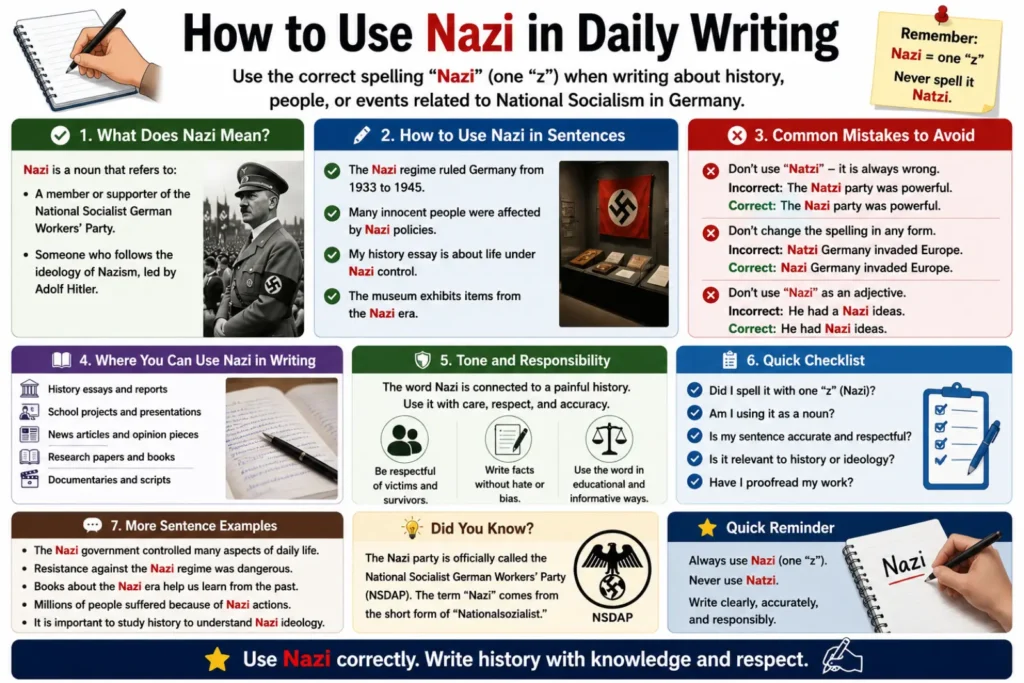
How to Use Nazi in Daily Writing
You may see “Nazi” in several types of writing.
History Articles
“Nazi Germany” is a common historical phrase.
School Assignments
Students may write about Nazi Germany, World War II, or the Holocaust.
Museums
Museum descriptions may use the term when explaining historical artifacts.
News and Research
Journalists and historians may discuss Nazi-era events.
Books and Documentaries
Historical works often use “Nazi” when discussing the period from the 1920s to 1945.
In all these cases, correct spelling improves clarity.
Nazi Synonyms and Related Terms
“Nazi” does not have a perfect synonym.
The word identifies a specific historical movement.
However, several related terms can help explain the topic.
Related Terms
- National Socialism
- Nazi Party
- NSDAP
- Nazi Germany
- Nazi regime
- Nazi era
- Nazi ideology
- Adolf Hitler
- World War II
- Holocaust
- German dictatorship
- fascism
Be careful with the word fascist.
It is a broader political term.
It does not mean exactly the same thing as Nazi.
Nazi and Fascist: Are They the Same?
Nazi and fascist are related terms, but they are not identical.
Fascism describes a broader family of authoritarian political movements.
The Nazi movement had fascist characteristics.
However, Nazi ideology also placed strong emphasis on racial hierarchy and antisemitism.
Therefore, calling every fascist movement “Nazi” can create historical confusion.
The best word depends on the specific movement being discussed.
For historical writing, precise terms are usually better.
Expert Insight
Correct spelling improves both trust and search visibility.
A reader may quickly notice a repeated spelling error.
That can reduce confidence in the rest of an article.
The correct spelling also matches standard historical sources.
For SEO, do not repeat “Natzi” unnaturally.
Instead, explain the spelling question once.
Then use Nazi naturally throughout the article.
You can target related searches with useful phrases.
Examples include:
- natzi or nazi spelling
- is natzi correct
- is Nazi the correct spelling
- Nazi meaning
- Nazi definition
- what does Nazi mean
- Nazi vs Natzi
- correct spelling of Nazi
- Nazi Party meaning
- Nazi Germany meaning
This approach supports search intent without keyword stuffing.
Frequently Asked Questions
Is “Natzi” or “Nazi” correct?
Nazi is correct. “Natzi” is normally a misspelling.
What does Nazi mean?
Nazi refers to a member or supporter of the National Socialist movement in Germany.
Is Nazi a German word?
The English word comes from German usage and became a common short form for National Socialist.
What is the plural of Nazi?
The standard plural form is Nazis.
What is Nazi Germany?
“Nazi Germany” refers to Germany under Nazi rule, especially from 1933 to 1945.
Is “Natzi” a different political group?
No. In most English contexts, “Natzi” is simply a misspelling of “Nazi.”
Should I write Nazi with a capital letter?
Yes. Nazi is normally capitalized because it comes from the name of a specific political movement.
Is Nazi the same as fascist?
Not exactly. Nazi refers to a specific German movement. Fascism is a broader political term.
conclusion
The answer to “natzi or nazi” is simple: Nazi is the correct spelling.
“Natzi” is generally a spelling mistake.
The term “Nazi” refers to the National Socialist movement in Germany. It is strongly connected with Adolf Hitler, Nazi Germany, World War II, and the Holocaust. The word has a specific historical meaning. Therefore, writers should use it accurately and avoid using it as a casual insult. Correct spelling also makes historical articles, schoolwork, and online content more credible. If you are unsure, remember the simple rule: write Nazi, not Natzi. When discussing this subject, focus on accurate history and clear language. That approach helps readers understand both the word and the events behind it.