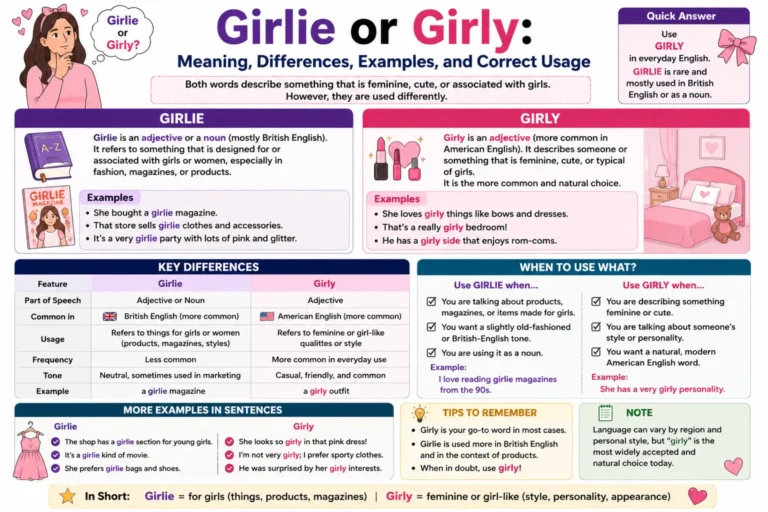
Girlie or girly can look like the same word, but they often have different uses. Both words relate to things linked with girls or traditionally feminine styles. However, their tone and meaning can change with context. Girly usually describes something feminine, cute, or associated with girls. Girlie can mean the same thing, but it often sounds more casual, playful, or friendly. You may see both words in fashion, beauty, social media, lifestyle, and everyday conversations. This guide explains the difference between girlie and girly in simple English. You will learn their meanings, examples, common mistakes, synonyms, and correct usage. By the end, you will know which word fits your sentence best.
Quick Summary
- Girly means feminine, cute, or traditionally associated with girls.
- Girlie often has a more casual, playful, or friendly tone.
- Both words can describe clothes, colors, styles, hobbies, or behavior.
- Girly is usually more common in standard English.
- Girlie often appears in informal speech, social media, and modern slang.
- The correct choice depends on the sentence and intended tone.
What Does “Girly” Mean?
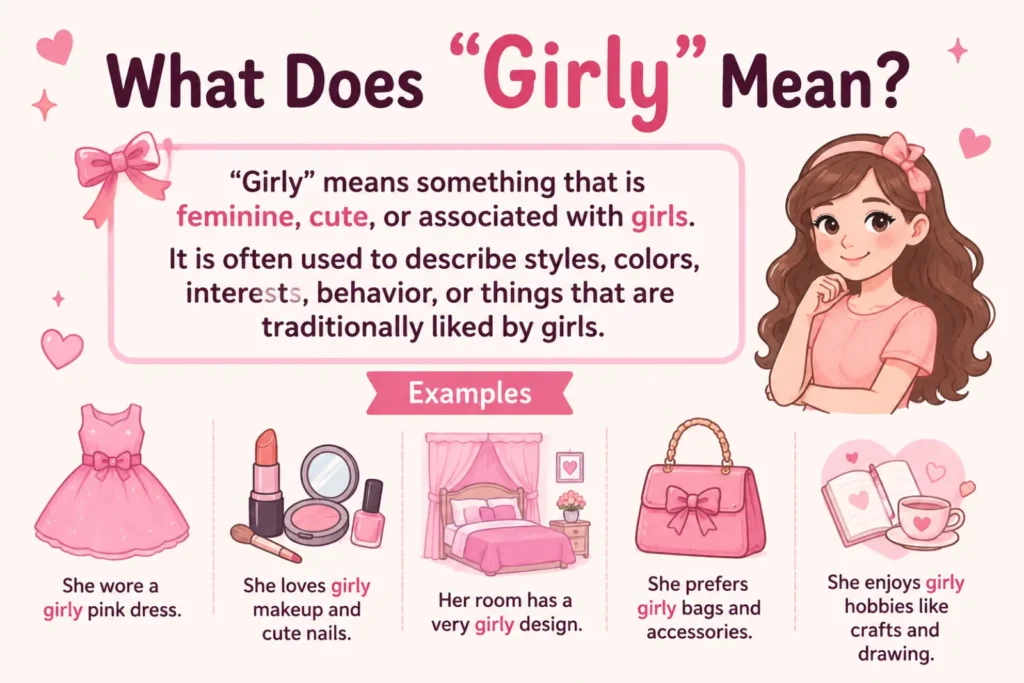
Girly means having qualities that people traditionally connect with girls or femininity.
For example, someone may call a pink dress “girly.” They may also describe bows, flowers, glitter, or soft colors as girly.
The word can describe:
- Clothing
- Colors
- Hairstyles
- Hobbies
- Personality
- Decorations
- Beauty styles
- Social behavior
Examples of “Girly”
- She wore a girly pink dress.
- The room has a very girly design.
- She enjoys girly hobbies like fashion and makeup.
However, “girly” does not always describe a person positively. Its meaning depends on the speaker and context.
What Does “Girlie” Mean?
Girlie can also mean feminine or associated with girls.
However, it often sounds more informal. Many people use it in friendly conversations, online posts, and social media captions.
For example:
- “This outfit is so girlie!”
- “We had a fun girlie day.”
- “I love our girlie friendship.”
In modern online language, girlie can also sound playful or affectionate.
People may use it to create a friendly tone. The word often appears in phrases like “girlies,” “girlie pop,” or “girlie things.”
Girlie or Girly: What Is the Difference?
The main difference involves tone and usage.
Girly is the more common standard adjective. It usually describes something feminine or associated with girls.
Girlie can have a similar meaning. However, it often sounds more casual, playful, or conversational.
Simple Difference
| Word | Main Meaning | Common Tone | Example |
|---|---|---|---|
| Girly | Feminine or associated with girls | Standard and descriptive | She likes girly clothes. |
| Girlie | Feminine, playful, or associated with girls | Casual and friendly | We had a girlie shopping day. |
The two words can overlap. Still, they do not always sound equally natural in every sentence.
Girly vs Girlie: Which Word Is Correct?
Both girly and girlie can be correct.
The best choice depends on your sentence.
Use girly when you want a simple descriptive adjective.
Example:
She has a girly style.
Use girlie when you want a more casual or playful feeling.
Example:
We planned a fun girlie weekend.
In formal writing, girly may sound more natural. In casual writing, girlie can feel warmer and more modern.
Real-Life Examples of “Girly”
Here are common examples from daily life.
Fashion
- She prefers a girly fashion style.
- The dress has a cute, girly design.
- Her outfit looks colorful and girly.
Beauty
- She chose a girly pink nail design.
- The makeup style looks soft and girly.
Home Decor
- The bedroom has a girly theme.
- She decorated the room with flowers and pastel colors.
Hobbies
- Some people enjoy traditionally girly hobbies.
- She loves fashion and other girly interests.
The word does not create a fixed rule. People can enjoy any style or hobby they like.
Real-Life Examples of “Girlie”
The word girlie often appears in relaxed conversations.
Friendly Conversations
- “Come on, girlie, let’s go shopping.”
- “Hey girlie, how are you?”
Social Media
- “A perfect girlie day.”
- “Just doing girlie things.”
- “My girlies make everything better.”
Group Activities
- We planned a girlie night.
- The friends enjoyed a girlie weekend together.
In these examples, girlie creates a friendly and informal tone.
Is “Girly” a Positive or Negative Word?
The word girly can be positive, neutral, or negative.
Context matters most.
Someone may say:
“That dress is so girly!”
They may mean the dress looks cute and feminine.
Another person may use the word to criticize something as childish or overly feminine.
Therefore, the word itself does not always have one fixed feeling.
The speaker’s tone and the situation help explain the meaning.
Is “Girlie” More Informal Than “Girly”?
Yes, girlie usually sounds more informal.
People often use it in:
- Text messages
- Social media captions
- Friendly conversations
- Lifestyle content
- Fashion posts
- Online communities
Girly usually works better as a general adjective.
For example:
- She likes girly clothes.
- The room has a girly style.
Girlie often sounds more personal or playful.
For example:
- Hey girlie!
- We had a girlie day.
Common Mistakes When Using Girlie or Girly
Many people confuse these words. Here are common mistakes to avoid.
Mistake 1: Treating Both Words as Exactly the Same
The meanings overlap, but the tone can differ.
Girly often sounds descriptive.
Girlie often sounds casual or playful.
Mistake 2: Using “Girlie” in Formal Writing
“Girlie” may sound too informal for some professional writing.
Instead, consider words like:
- Feminine
- Traditional
- Elegant
- Youthful
- Delicate
Mistake 3: Assuming “Girly” Describes Every Girl
Not every girl likes traditionally feminine styles.
The word describes a style or quality. It does not define every person.
Mistake 4: Using “Girly” as an Insult
Some people may find the word dismissive.
Always consider the context and the person’s preferences.
Mistake 5: Ignoring Modern Slang
Online language changes quickly.
“Girlie” may appear as a friendly term. Its meaning can differ from traditional dictionary usage.
How to Choose Between Girlie and Girly
Use this simple rule:
Choose “Girly” When:
- You describe a feminine style.
- You discuss colors or clothing.
- You write general content.
- You want a common adjective.
Example:
She likes a girly fashion style.
Choose “Girlie” When:
- You speak casually.
- You address a female friend.
- You write a playful social media caption.
- You want a warm, friendly tone.
Example:
Hey girlie, how have you been?
This simple rule works in most everyday situations.
Synonyms and Related Words
Several words can replace girly or girlie.
Common Synonyms
- Feminine
- Cute
- Playful
- Youthful
- Pretty
- Delicate
- Sweet
- Stylish
- Elegant
- Womanly
However, these words do not always mean exactly the same thing.
For example, feminine sounds more formal. Cute focuses more on appearance or charm. Playful focuses on personality or style.
Choose the synonym that matches your intended meaning.
LSI Keywords and Related Search Terms
People searching for girlie or girly may also use related terms.
These include:
- girlie meaning
- girly meaning
- girlie vs girly
- difference between girlie and girly
- is girlie a word
- is girly a word
- what does girlie mean
- what does girly mean
- girlie slang meaning
- girly style meaning
- girlie meaning in text
- girly meaning in fashion
- feminine meaning
- casual slang words for girls
These semantic keywords help search engines understand the topic.
Girly or Girlie in Daily Life
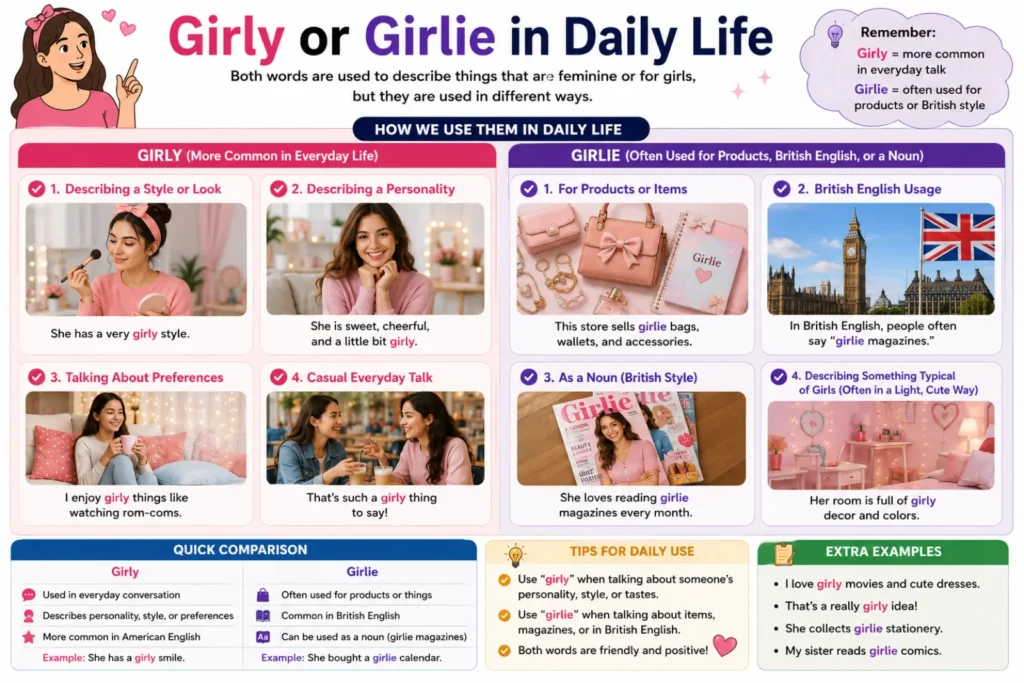
You can see both words in many everyday situations.
Fashion
People may describe dresses, skirts, colors, and accessories as girly.
Social Media
Users often write “girlie” in captions and comments.
Friendship
Friends may call each other “girlie” in a warm, casual way.
Beauty
Makeup, nails, hairstyles, and skincare may have a girly style.
Lifestyle
People may use both words when discussing hobbies, shopping, or personal style.
Remember, these terms describe styles and language. They do not create rules about what people should enjoy.
Expert Insight
Language experts often focus on context when explaining similar words.
The word girly usually works as a descriptive adjective. It describes a style, object, or quality.
The word girlie often adds a casual or playful feeling. Modern online communication has expanded its use.
This difference matters for SEO writers, social media creators, and English learners.
A word can have a basic dictionary meaning. Its tone can still change in real conversations.
Therefore, always consider:
- The audience
- The platform
- The sentence
- The level of formality
- The speaker’s intention
Good word choice improves clarity and avoids confusion.
Tip: How to Use “Girlie or Girly” Naturally
Content creators should avoid repeating the keyword too often.
Instead, use natural variations such as:
- girly meaning
- girlie meaning
- feminine style
- casual expression
- playful language
- girlie slang
- everyday usage
Google understands related words and topic context.
Strong content answers the reader’s question clearly. It does not simply repeat one keyword.
Frequently Asked Questions
Is “girlie” a real word?
Yes. “Girlie” is an English word. It can describe something feminine or act as a casual term for a female friend.
Is “girly” a real word?
Yes. “Girly” commonly describes something associated with girls or traditional femininity.
What is the difference between girlie and girly?
“Girly” usually sounds more standard and descriptive. “Girlie” often sounds more casual, playful, or friendly.
Is “girlie” slang?
It can be. Modern speakers often use “girlie” casually in conversations, texts, and social media.
Can I use “girly” for a person?
Yes, but context matters. Some people may enjoy the description, while others may not identify with it.
Which word is better for formal writing?
“Girly” may sound more natural than “girlie.” However, “feminine” may work better in formal writing.
What does “hey girlie” mean?
“Hey girlie” usually works as a friendly and casual greeting.
Are girlie and girly synonyms?
They can have similar meanings. However, their tone and common usage can differ.
Conclusion
Girlie or girly can both describe feminine styles, qualities, or interests. However, their tone often differs. Girly usually sounds more standard and descriptive. Girlie often feels more casual, playful, and friendly. You can use both words in everyday English. The best choice depends on your sentence, audience, and purpose. Use girly when describing a style or quality. Use girlie when you want a relaxed or personal tone. Context remains the most important factor. Once you understand this small difference, choosing between girlie and girly becomes easy. The simple takeaway is this: girly is usually descriptive, while girlie often sounds more casual and playful.