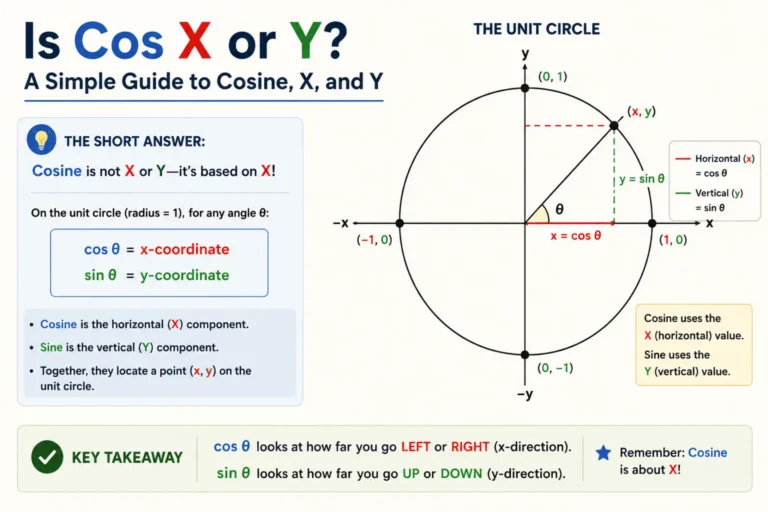
Is cos x or y? The answer depends on the angle you use. In trigonometry, cosine is a function, not a fixed variable. You can write cos x or cos y. Both forms can be correct. The key difference comes from the angle or variable in the problem. Many students ask this question when they see cos x, cos y, or cos θ. This guide explains the idea in simple English. You will learn what cosine means, when to use x or y, and how to avoid common mistakes. We will also cover graphs, triangles, equations, and real-life uses. By the end, you will know exactly when to write cos x and when to write cos y.
Quick Summary
- Cos means cosine, a trigonometric function.
- You can write cos x or cos y.
- The letter shows the angle or input.
- cos x means the cosine of angle x.
- cos y means the cosine of angle y.
- In a right triangle, cosine equals adjacent ÷ hypotenuse.
- Always use the variable given in the question.
- The angle can also use symbols like θ or α.
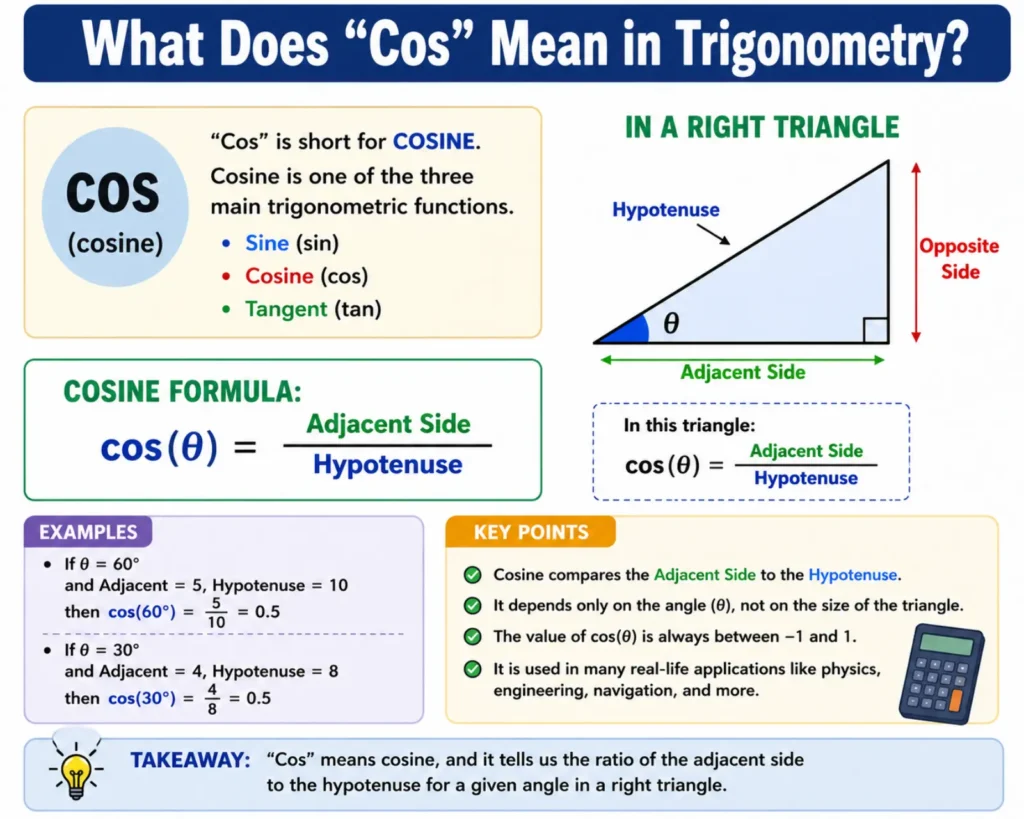
What Does “Cos” Mean in Trigonometry?
Cos is short for cosine.
Cosine is one of the three main trigonometric functions:
- Sine, written as sin
- Cosine, written as cos
- Tangent, written as tan
In a right triangle:
cos(angle) = adjacent side ÷ hypotenuse
For example:
cos θ = adjacent ÷ hypotenuse
Here, θ represents the angle.
The letter after cos does not change the function. It only identifies the input angle.
So, these are all valid:
- cos x
- cos y
- cos θ
- cos 30°
The function stays the same. Only the input changes.
Is Cos X or Y?
The short answer is:
Cos can be either x or y. It depends on the problem.
If the angle is called x, use:
cos x
If the angle is called y, use:
cos y
For example:
Find cos x.
You should calculate the cosine of angle x.
Likewise:
Find cos y.
You should calculate the cosine of angle y.
The letters x and y have no special power in cosine. They simply name values or angles.
What Is the Difference Between Cos X and Cos Y?
The difference depends on the values of x and y.
Suppose:
x = 60°
Then:
cos x = cos 60° = 0.5
Now suppose:
y = 30°
Then:
cos y = cos 30° ≈ 0.866
The function stays the same.
However, the results differ because the angles differ.
Simple comparison
| Expression | Meaning |
|---|---|
| cos x | Cosine of x |
| cos y | Cosine of y |
| cos θ | Cosine of theta |
| cos 45° | Cosine of 45 degrees |
Therefore, cos x and cos y are not automatically equal.
They become equal only in certain situations.
Is Cos X the Same as Cos Y?
Not always.
If x = y, then:
cos x = cos y
For example:
x = 60° and y = 60°
Therefore:
cos x = cos y = 0.5
However, different angles can sometimes have the same cosine value.
For example:
cos 60° = cos 300° = 0.5
This happens because cosine repeats around the unit circle.
So, you should not assume:
cos x = cos y
unless the problem gives enough information.
Cos X or Y in a Right Triangle
In a right triangle, cosine uses a specific angle.
The formula is:
cos θ = adjacent side ÷ hypotenuse
The chosen angle matters.
Imagine a triangle with two acute angles, x and y.
The sides next to each angle differ.
Therefore:
cos x may not equal cos y.
For example:
- cos x = side next to x ÷ hypotenuse
- cos y = side next to y ÷ hypotenuse
The hypotenuse stays the same.
The adjacent side changes.
Important tip
Always identify the angle first.
Then find the side next to that angle.
This prevents many cosine errors.
Why Do Math Problems Use X, Y, and Theta?
Mathematicians use letters to represent unknown values.
Common choices include:
- x
- y
- θ
- α
- β
The letter depends on the problem.
For example:
cos x = 0.5
Here, x is the unknown angle.
Another problem may say:
cos θ = 0.5
Here, θ is the unknown angle.
The method remains the same.
The variable name does not change the cosine rule.
How to Calculate Cos X
To calculate cos x, follow these steps.
Step 1: Identify the angle
Find the value of x.
For example:
x = 60°
Step 2: Use the cosine function
Write:
cos x = cos 60°
Step 3: Calculate the value
Using a calculator:
cos 60° = 0.5
Therefore:
cos x = 0.5
Calculator tip
Check your calculator mode.
Use degree mode for angles written with degrees.
Use radian mode for angles written in radians.
This simple check prevents wrong answers.
How to Calculate Cos Y
The process works the same way.
Suppose:
y = 45°
Then:
cos y = cos 45°
The answer is approximately:
0.707
Therefore:
cos y ≈ 0.707
The variable changes from x to y.
The cosine process does not change.
Is Cos X or Y on a Graph?
In coordinate geometry, x and y often represent coordinates.
However, cosine can use either variable.
For example:
y = cos x
This means the output is y.
The input angle is x.
Here:
- x is the input.
- cos x is the function value.
- y is the output.
You can also write:
x = cos y
This reverses the roles.
However, these equations describe different relationships.
Common graph form
The standard cosine graph is:
y = cos x
This graph repeats in a smooth wave.
It has:
- Maximum value of 1
- Minimum value of −1
- Period of 2π radians
- Period of 360°
So, in y = cos x, cosine uses x as the input.
Cos X vs. Cos Y: Comparison Table
| Feature | cos x | cos y |
|---|---|---|
| Function | Cosine | Cosine |
| Input | x | y |
| Meaning | Cosine of x | Cosine of y |
| Common use | y = cos x | x = cos y |
| Result | Depends on x | Depends on y |
| Always equal? | No | No |
The main difference is the input variable.
The cosine function itself stays unchanged.
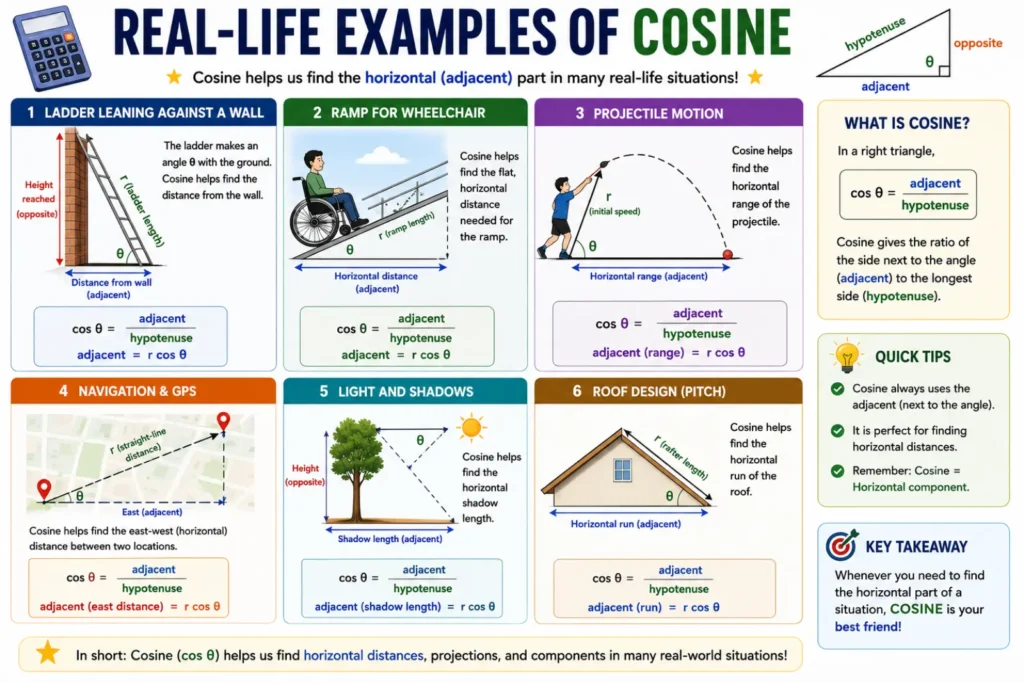
Real-Life Examples of Cosine
Cosine appears in many real-world fields.
1. Measuring distances
Surveyors use trigonometry to measure distances.
They can calculate unknown lengths using angles.
2. Engineering
Engineers use cosine to study forces.
A force can split into horizontal and vertical parts.
3. Physics
Cosine helps describe waves and motion.
Sound and light can follow wave patterns.
4. Computer graphics
Cosine helps create smooth movement.
It also supports 3D lighting and rotation.
5. Navigation
Cosine helps calculate distances between locations.
It can also support direction calculations.
So, cosine is more than a classroom formula.
It helps solve practical problems.
Common Mistakes When Using Cos X or Y
Many students make simple mistakes.
Here are the most common ones.
Mistake 1: Assuming x always means cosine
The letter x does not automatically belong with cosine.
Use the variable given in the question.
Mistake 2: Assuming cos x equals cos y
This is not always true.
Different inputs can produce different results.
Mistake 3: Choosing the wrong triangle side
Cosine uses:
Adjacent ÷ hypotenuse
Do not use the opposite side.
Mistake 4: Using the wrong calculator mode
Degrees and radians produce different results.
Check the mode before calculating.
Mistake 5: Confusing cos⁻¹ with 1 ÷ cos
These expressions have different meanings.
- cos⁻¹ x usually means inverse cosine.
- 1 ÷ cos x means the reciprocal of cosine.
The reciprocal is called secant.
Tips and Tricks for Remembering Cosine
A popular memory trick is:
CAH
This means:
- C = Cosine
- A = Adjacent
- H = Hypotenuse
So:
Cosine = Adjacent ÷ Hypotenuse
You can also remember:
SOH CAH TOA
This gives all three basic triangle rules:
- SOH: Sine = Opposite ÷ Hypotenuse
- CAH: Cosine = Adjacent ÷ Hypotenuse
- TOA: Tangent = Opposite ÷ Adjacent
These memory tools help beginners solve triangle problems faster.
Cosine Synonyms and Related Search Terms
People may search for the same idea in different ways.
Common related terms include:
- Is cos x or y?
- What does cos x mean?
- What is cosine of x?
- What is cos y?
- Cosine formula
- Cosine rule
- Cosine in a right triangle
- cos x function
- y = cos x graph
- cosine of an angle
- adjacent over hypotenuse
- trigonometric functions
- sine cosine tangent
- inverse cosine
- cosine equation
These terms connect to the same topic.
However, each term can have a slightly different meaning.
Expert Insight
A useful expert rule is simple:
Focus on the input, not the letter.
The expression cos x means the cosine function receives x.
The expression cos y means the cosine function receives y.
This idea appears throughout mathematics.
Functions often use letters as inputs.
For example:
- f(x) means function f receives x.
- sin x means sine receives x.
- cos x means cosine receives x.
Therefore, the letter does not define the function.
The function defines the operation.
This concept helps students understand algebra, calculus, and trigonometry.
Frequently Asked Questions
Is cos always related to x?
No. Cosine can use any variable or angle.
You can write cos x, cos y, or cos θ.
Is cos x equal to cos y?
Not always.
They are equal only when their cosine values match.
What does cos x mean?
It means the cosine of the value or angle x.
What is the formula for cosine?
In a right triangle:
cos θ = adjacent ÷ hypotenuse
Is y = cos x a cosine function?
Yes.
In y = cos x, the input is x.
The output is y.
Can x be the output of cosine?
Yes.
For example:
x = cos y
Here, y is the input.
The value of cosine becomes x.
What is the difference between cos x and cos⁻¹ x?
cos x finds the cosine of x.
cos⁻¹ x usually finds the angle with cosine x.
They perform different operations.
Should my calculator use degrees or radians?
the mode that matches the problem.
degrees for 30°.
Use radians for values such as π/3
Conclusion
So, is cos x or y? The answer is that cosine can use either variable. The letter simply represents the input. Cos x means the cosine of x. Cos y means the cosine of y. Neither form is automatically correct in every problem. Always follow the variable or angle given. In a right triangle, remember the key rule: cosine equals adjacent divided by hypotenuse. Also, check your calculator mode before solving. The main takeaway is simple: cos is the function, while x or y is the input. Once you understand this idea, cosine expressions become much easier to read and solve.