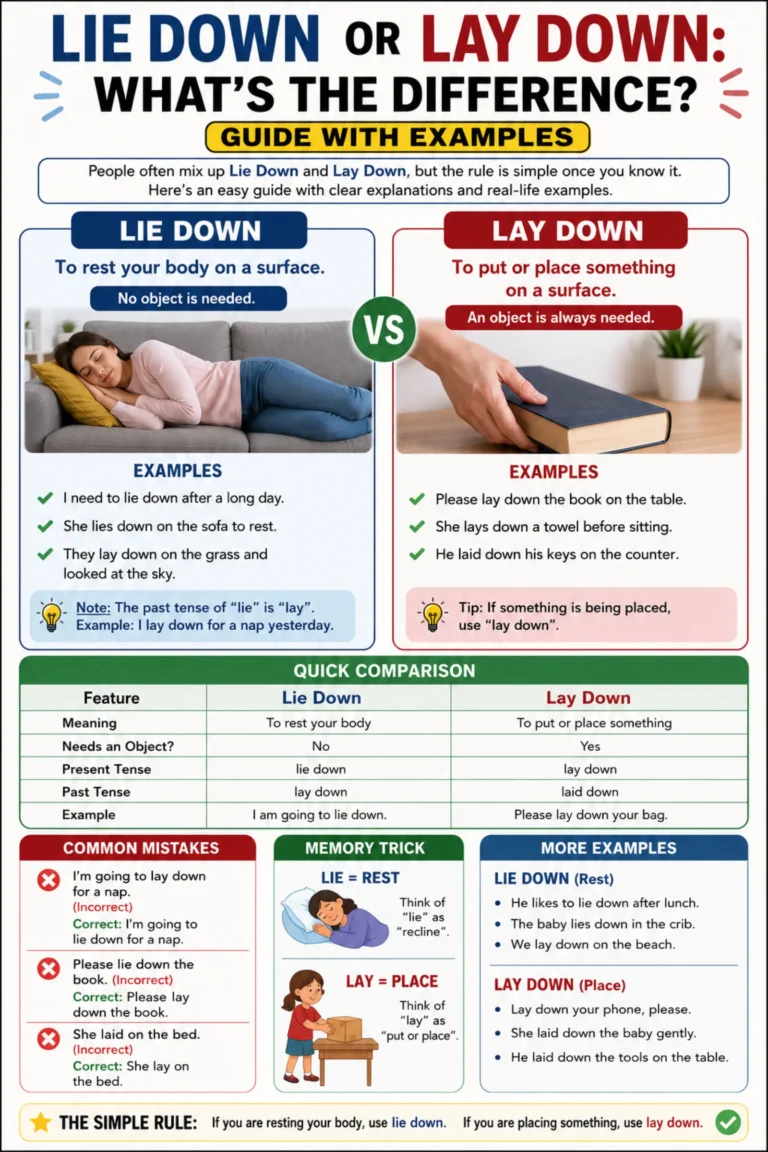
Lie down or lay down is one of the most common grammar questions in English. Many people use these phrases the wrong way every day. The confusion happens because both words look and sound similar.
The good news is that the rule is easy once you understand it. Lie means to rest or recline. Lay means to put or place something somewhere.
In this guide, you will learn the difference in simple words. You will also see easy examples, common mistakes, comparison tables, memory tricks, and daily-life situations. By the end, you will know exactly when to say lie down and when to say lay down.
Quick Summary Box
- Lie down = Rest your body on a bed, sofa, or floor.
- Lay down = Put an object onto a surface.
- Lie does not need an object.
- Lay always needs an object.
- Correct: I need to lie down.
- Correct: Please lay down the book.
- Incorrect: I’m going to lay down for a nap. (Standard English)
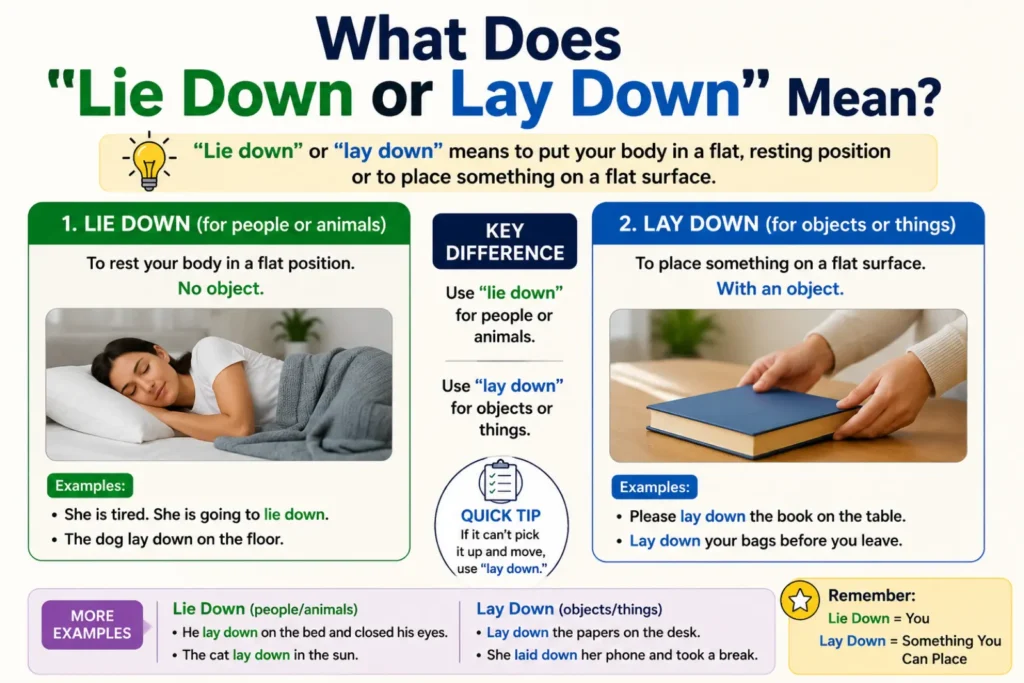
What Does “Lie Down or Lay Down” Mean?
Both phrases involve something going downward, but they have different meanings.
- Lie down means to move your own body into a resting position.
- Lay down means to place another person or thing onto a surface.
Examples
Lie down:
- I need to lie down after work.
- The dog likes to lie down near the door.
Lay down:
- Please lay down your phone.
- She laid down the blanket.
The biggest difference is simple:
- Lie = Rest
- Lay = Place
Lie Down Explained in Simple Words
Use lie down when someone rests.
Nobody receives the action. The subject performs it.
Examples
- I want to lie down.
- Please lie down for the exam.
- Babies usually lie down after feeding.
- We lay on the beach yesterday. (Past tense of lie is lay.)
Remember:
Present:
- lie
Past:
- lay
Past participle:
- lain
Lay Down Explained in Simple Words
Use lay down when placing something somewhere.
The action affects an object.
Examples
- Lay down your keys.
- She lays down fresh towels.
- He laid down his backpack.
- Please lay down the cards.
The object may be:
- a book
- a phone
- clothes
- tools
- a baby
- a weapon
Lie Down vs Lay Down: Key Differences
| Feature | Lie Down | Lay Down |
|---|---|---|
| Meaning | Rest yourself | Place something |
| Needs an object | No | Yes |
| Action | Person rests | Person places something |
| Present tense | Lie | Lay |
| Past tense | Lay | Laid |
| Example | Lie down on the couch. | Lay down the blanket. |
Why Do People Confuse Lie and Lay?
There are several reasons.
1. The past tense of “lie” is “lay.”
Example:
Today:
- I lie down.
Yesterday:
- I lay down.
2. They sound alike.
Both words begin with “L” and have similar pronunciation.
3. Casual speech
Many native speakers casually say:
I’m going to lay down.
Although common in conversation, formal grammar prefers:
I’m going to lie down.
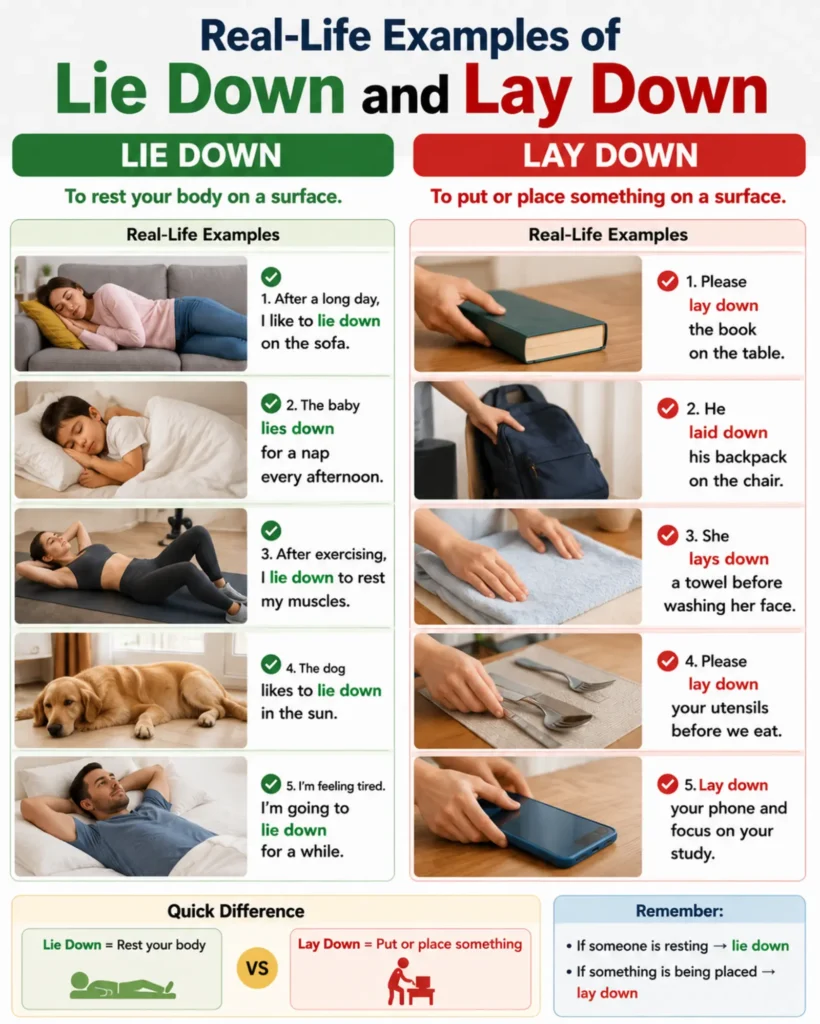
Real-Life Examples of Lie Down and Lay Down
Here are everyday situations.
At Home
✅ I need to lie down after dinner.
✅ Please lay down the tablecloth.
At the Doctor
✅ Lie down on the examination table.
At School
✅ Lay down your pencils before leaving.
At the Beach
✅ We like to lie down in the sunz
During Yoga
✅ Everyone should lie down and relax.
With a Baby
✅ Lay down the baby carefully.
At Work
✅ Lay down the documents on my desk.
After Exercise
✅ I usually lie down for ten minutes.
Common Mistakes
Many learners make these mistakes.
Incorrect
❌ I’m going to lay down for a nap.
Correct
✅ I’m going to lie down for a nap.
Incorrect
❌ Please lie down the book.
Correct
✅ Please lay down the book.
Incorrect
❌ She laid on the couch all afternoon.
Correct
✅ She lay on the couch all afternoon.
Easy Memory Trick
This trick helps most learners.
Lie = Recline
Both describe resting.
Think:
Lie = Lounge
Lay = Place
Both involve putting something somewhere.
Think:
Lay = Place
If you can ask:
“What are you laying?”
Then lay is probably correct.
If there is no object,
use lie.
Using Lie Down and Lay Down in Daily Life
These phrases appear everywhere.
Home
- Lie down for a nap.
- Lay down the groceries.
School
- Lay down your notebook.
- Don’t lie down during class.
Work
- Lay down the files.
- Lie down if you feel sick.
the Gym
- Lie down on the bench.
- Lay down your towel.
At the Hospital
- Please lie down.
- Lay down your belongings.
Synonyms and Related Words
for Lie Down
- recline
- rest
- stretch out
- relax
- lounge
- nap
Synonyms for Lay Down
Related Keywords (LSI)
- lie vs lay
- lie down meaning
- lay down meaning
- lie or lay grammar
- grammar rules
- English verbs
- common grammar mistakes
- lay vs lie examples
- when to use lie
- when to use lay
Expert Insights
Grammar experts teach one simple rule.
Always look for an object.
If the sentence includes something being placed, use lay.
If someone simply rests, use lie.
Learning this rule improves:
- writing
- speaking
- school assignments
- business emails
- professional communication
Small grammar improvements make your English sound more natural.
Frequently Asked Questions
Is it “lie down” or “lay down for a nap”?
Use lie down.
Example:
“I need to lie down.”
Why is the past tense of lie “lay”?
English has irregular verbs.
Present:
- lie
Past:
- lay
Past participle:
- lain
Does lay always need an object?
Yes.
Example:
Lay down the book.
Can I say “I’m going to lay down”?
Many people say it in casual speech.
Formal English prefers:
“I’m going to lie down.”
Is “lay down the law” correct?
Yes.
It is an idiom meaning to establish strict rules.
How do I remember the difference?
Remember:
- Lie = Rest
- Lay = Place
Which phrase appears more often in conversation?
Both appear often.
However:
- Lie down usually refers to resting.
- Lay down usually refers to placing objects.
Common Expressions
These phrases use the verbs correctly.
Lie Down
- lie down and relax
- lie down for a nap
- lie down on the couch
- lie down in bed
- lie down after work
Lay Down
- lay down the rules
- lay down the law
- lay down your phone
- lay down your cards
- lay down the blanket
Featured Snippet: Lie Down vs Lay Down
| Phrase | Meaning | Example |
|---|---|---|
| Lie down | Rest yourself | I need to lie down. |
| Lay down | Put something somewhere | Please lay down the |
Conclusion
Understanding lie down or lay down becomes much easier when you remember one simple rule. Lie down means to rest your body, while lay down means to place something on a surface. The biggest source of confusion is that the past tense of lie is lay, but once you know that, the difference becomes clear.
Whenever you’re unsure, ask yourself a simple question: Is there an object being placed? If yes, use lay. If someone is simply resting, use lie. Practicing these phrases in everyday conversations will help you build confidence and improve your grammar naturally. With this simple rule, you’ll use lie down and lay down correctly every time.