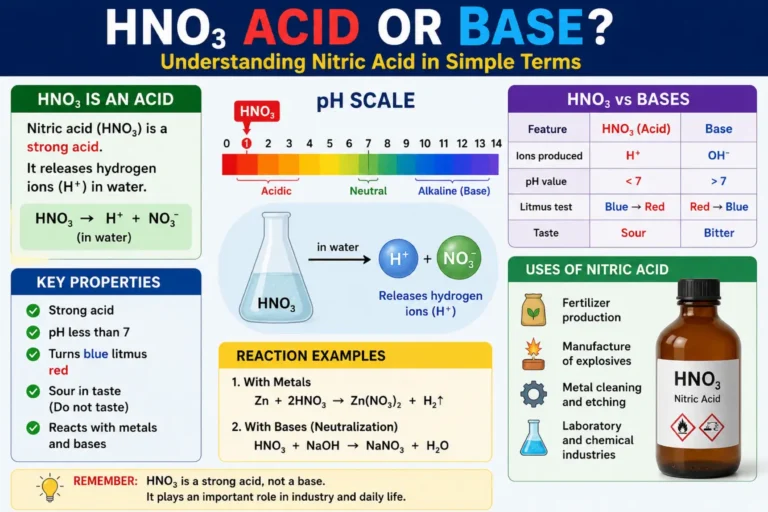
HNO3 acid or base is a common question in chemistry. HNO3 is known as nitric acid. It is a strong acid that releases hydrogen ions in water.
Many students confuse acids and bases. However, nitric acid is easy to understand once you know how it behaves.
HNO3 plays an important role in science and industry. People use it to make fertilizers, explosives, and laboratory chemicals.
In this guide, you will learn what HNO3 is, why it is an acid, and how it compares with bases. The explanations use simple language for easy learning.
Quick Summary Box
- HNO3 is nitric acid.
- HNO3 is a strong acid.
- It releases hydrogen ions (H⁺) in water.
- Its pH is below 7.
- HNO3 is not a base.
- It reacts with metals and bases.
- Nitric acid has many industrial uses.
What Is HNO3?
HNO3 is the chemical formula for nitric acid.
It contains:
- One hydrogen atom (H)
- One nitrogen atom (N)
- Three oxygen atoms (O)
Nitric acid is a colorless liquid. It becomes yellow when exposed to light over time.
Is HNO3 an Acid or a Base?
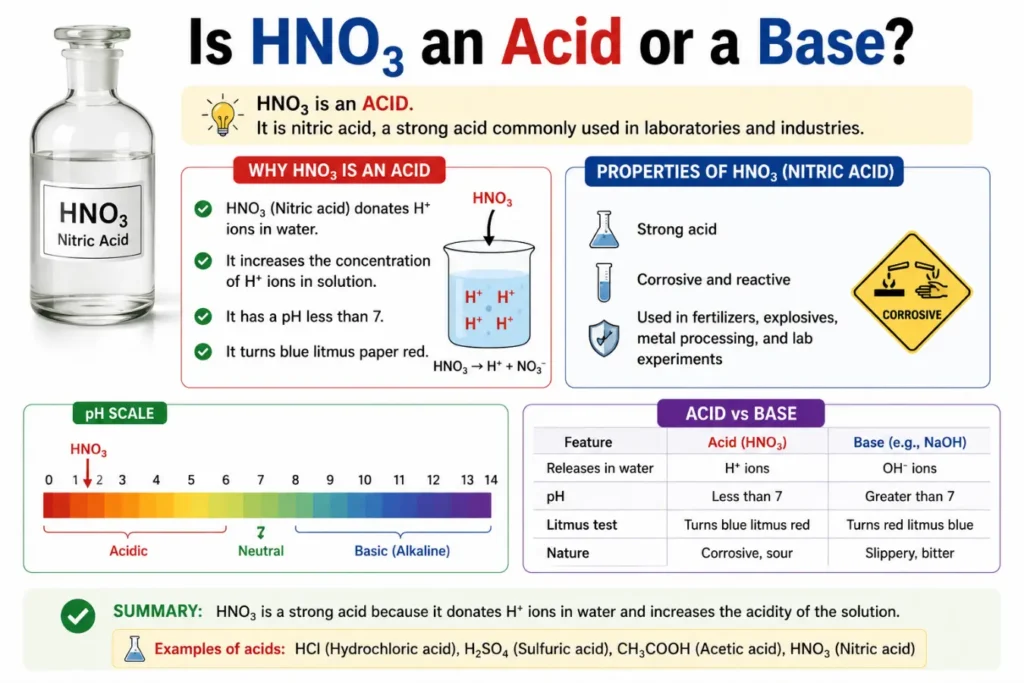
HNO3 is an acid.
When dissolved in water, it produces hydrogen ions:
HNO3 → H⁺ + NO3⁻
The release of hydrogen ions makes it acidic.
Therefore, the answer to “HNO3 acid or base?” is:
HNO3 is a strong acid
Why Is HNO3 Considered a Strong Acid?
Strong acids separate completely in water.
Nitric acid breaks apart almost 100%.
Because of this:
- It has a very low pH.
- It reacts quickly with other substances.
- It conducts electricity in solution.
Examples of strong acids include:
- Hydrochloric acid (HCl)
- Sulfuric acid (H₂SO₄)
- Nitric acid (HNO3)
How Does HNO3 Behave in Water?
When nitric acid enters water, it ionizes completely.
Chemical Equation
HNO3 + H2O → H3O⁺ + NO3⁻
The hydronium ion (H3O⁺) causes acidic properties.
As a result, nitric acid:
- Tastes sour (never taste chemicals in real life)
- Turns blue litmus paper red
- Reacts with metals
- Neutralizes bases
What Is the pH of HNO3?
Nitric acid has a pH below 7.
Concentrated nitric acid can have a pH close to 1.
The lower the pH, the stronger the acid.
pH Scale
| Substance | pH Range | Type |
|---|---|---|
| Battery acid | 0-1 | Strong acid |
| HNO3 | 1-2 | Strong acid |
| Pure water | 7 | Neutral |
| Soap solution | 9-10 | Base |
HNO3 vs Bases
Bases release hydroxide ions (OH⁻), while acids release hydrogen ions (H⁺).
Comparison Table
| Feature | HNO3 (Nitric Acid) | Base |
| Type | Acid | Base |
| Ions Produced | H⁺ ions | OH⁻ ions |
| pH Value | Less than 7 | Greater than 7 |
| Litmus Test | Turns blue red | Turns red blue |
| Taste | Sour | Bitter |
| Example | HNO3 | NaOH |
Is HNO3 a Lewis Acid?
Yes.
According to Lewis theory, acids accept electron pairs.
Nitric acid can act as a Lewis acid in certain reactions.
Therefore, HNO3 fits both:
- Arrhenius acid
- Brønsted-Lowry acid
- Lewis acid
Real-Life Uses of Nitric Acid
Nitric acid has many practical applications.
Fertilizer Production
Manufacturers use nitric acid to make ammonium nitrate fertilizers.
Explosives
It helps produce TNT and other explosives.
Metal Cleaning
Industries use it to clean metals before manufacturing.
Laboratory Work
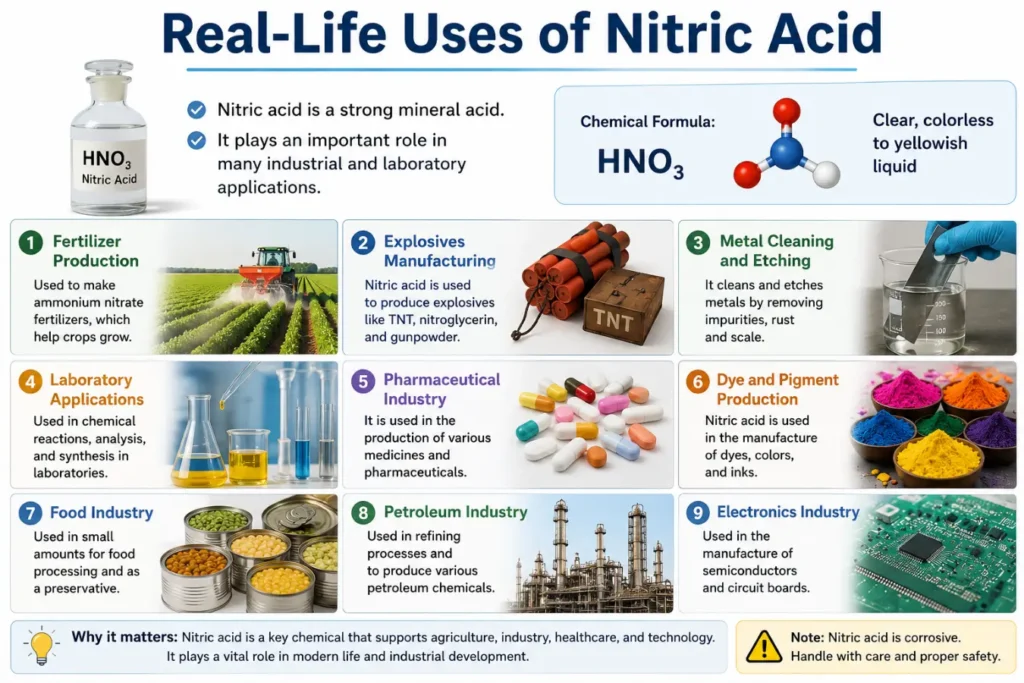
Scientists use nitric acid in chemical experiments.
Pharmaceutical Industry
Some medicines require nitric acid during production.
Examples of HNO3 Reactions
Reaction with Metals
Zn + 2HNO3 → Zn(NO3)2 + H2
Neutralization Reaction
HNO3 + NaOH → NaNO3 + H2O
This reaction forms salt and water.
Common Mistakes Students Make
Mistake 1: Thinking HNO3 Is a Base
HNO3 releases hydrogen ions, so it is an acid.
Mistake 2: Confusing Strong Acid with Concentrated Acid
Strong refers to ionization. Concentrated refers to amount.
Mistake 3: Forgetting the pH Rule
Acids have pH values below 7.
Mistake 4: Ignoring Chemical Equations
Equations help identify acids and bases quickly.
Tips to Identify Acids Easily
Follow these tricks:
- Compounds starting with H are often acids.
- Acids produce H⁺ ions.
- Acids have pH values below 7.
- Acids turn blue litmus paper red.
- Strong acids ionize completely.
These tips make chemistry easier.
HNO3 in Daily Life
Most people do not use pure nitric acid at home.
However, products made with nitric acid affect everyday life.
Examples include:
- Crop fertilizers
- Medicines
- Industrial products
- Dyes and plastics
So, nitric acid indirectly supports modern life.
Related Terms and LSI Keywords
People also search for:
- Nitric acid formula
- Is HNO3 a strong acid
- HNO3 pH value
- Nitric acid properties
- Acid versus base
- Strong acids list
- Nitric acid uses
- HNO3 chemical name
- Arrhenius acid definition
- Brønsted-Lowry acid examples
Expert Insight
Chemistry experts classify HNO3 as one of the most important strong acids.
Understanding nitric acid helps students learn:
- pH concepts
- Chemical reactions
- Acid-base theory
- Industrial chemistry
Knowing whether HNO3 is an acid or base creates a strong foundation for future chemistry topics.
Frequently Asked Questions
Is HNO3 an acid or a base?
HNO3 is a strong acid.
What is the chemical name of HNO3?
Its chemical name is nitric acid.
Why is HNO3 called a strong acid?
Because it ionizes completely in water.
What ions does HNO3 produce?
It produces hydrogen ions (H⁺) and nitrate ions (NO3⁻).
What is the pH of nitric acid?
Its pH is below 7 and may be close to 1.
Is HNO3 a Lewis acid?
Yes. It can accept electron pairs in some reactions.
Does HNO3 react with bases?
Yes. It neutralizes bases to form salt and water.
What are the uses of nitric acid?
It is used in fertilizers, explosives, laboratories, and manufacturing.
Internal Linking Suggestions
Link this article to:
- Strong Acids and Weak Acids Explained
- What Is pH in Chemistry?
- Arrhenius Acid Definition
- Lewis Acid vs Lewis Base
- Acid and Base Examples for Students
Conclusion
The answer to HNO3 acid or base is simple. HNO3 is nitric acid, and it is a strong acid. It releases hydrogen ions when mixed with water and has a pH below 7.
Nitric acid plays a major role in chemistry and industry. It helps produce fertilizers, medicines, and many everyday products.
Understanding HNO3 makes acid-base concepts easier. Once you know how hydrogen ions work, identifying acids becomes much simpler.
If you remember one thing, remember this:
HNO3 is a strong acid, not a base.