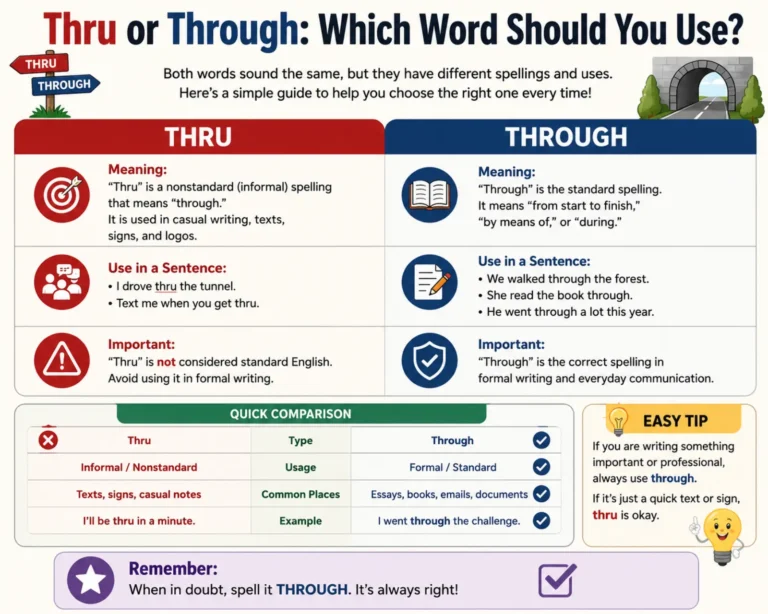
Thru or through can confuse even strong English writers. Both words relate to movement, time, or completion. However, they do not fit every situation. Through is the standard spelling used in formal and academic English. Thru is a shorter, informal form used in some signs, names, and casual writing. For example, you may see “drive-thru” at a restaurant. You may also see “through” in a school essay or business email. Understanding the difference helps you choose the right word quickly. This guide explains thru vs through in simple English. You will learn their meanings, correct usage, common mistakes, examples, and easy memory tips. By the end, you will know exactly when to use thru and when to use through.
Quick Summary
- Through is the standard spelling in formal English.
- Thru is a shorter, informal spelling.
- Use through in essays, emails, reports, and professional writing.
- Use thru mainly in signs, labels, names, and casual contexts.
- “We walked through the park” is correct standard English.
- “Drive-thru” is a common fixed expression.
- When unsure, choose through.
What Does “Through” Mean?
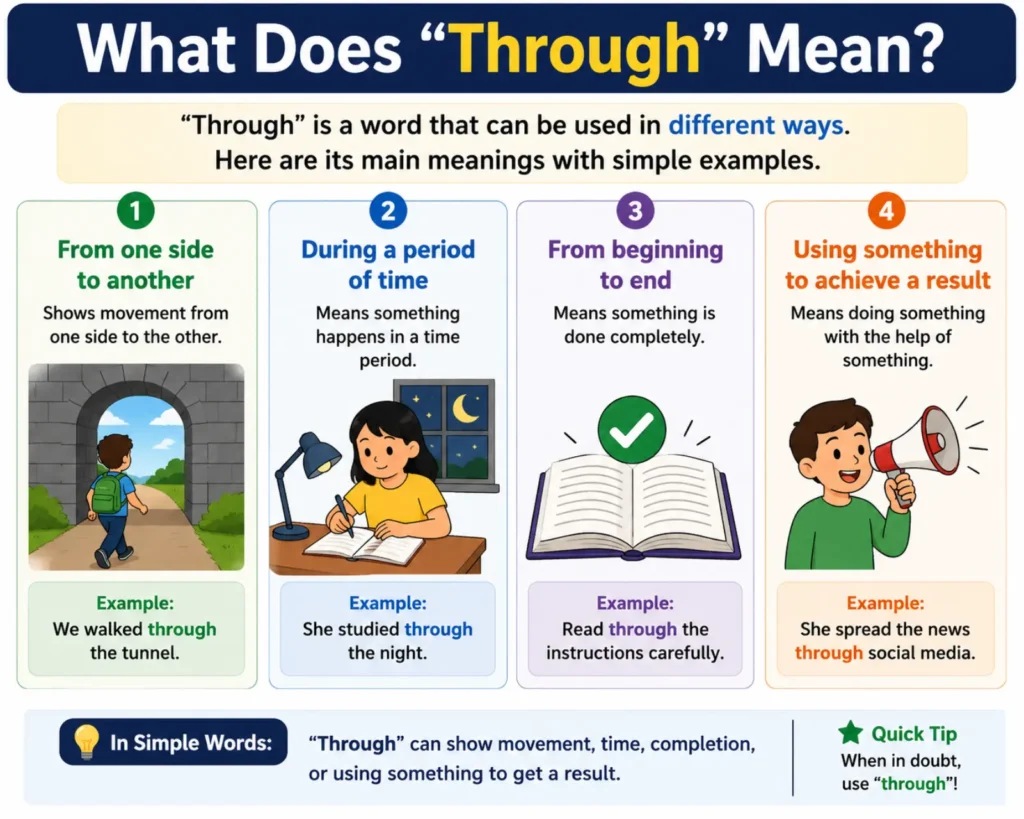
Through is the standard English word. It can work as a preposition, adverb, adjective, or part of a phrase.
It often describes movement from one side to another.
Example:
We walked through the tunnel.
It can also describe a period of time.
Example:
She worked through the night.
The word can also mean completion.
Example:
I am through with my homework.
In most formal writing, through is the correct choice.
Common meanings of “through”
- From one side to another
- During a period of time
- From beginning to end
- By using something
- Finished with something
The exact meaning depends on the sentence.
What Does “Thru” Mean?
Thru is an informal shortened form of through.
It has the same basic meaning. However, people use it less often in formal writing.
You may see thru in:
- Road signs
- Restaurant signs
- Business names
- Product labels
- Short messages
- Informal writing
For example:
- Drive-thru
- Walk-thru
- Pass-thru
- Thru traffic
The spelling saves space and looks shorter. However, it does not always sound professional.
Thru or Through: What Is the Difference?
The main difference involves style and context.
Through is the standard spelling. Thru is an informal alternative.
| Word | Meaning | Style | Best Use |
|---|---|---|---|
| Through | Standard form | Formal and neutral | Essays, emails, reports |
| Thru | Short form | Informal | Signs, labels, casual use |
Both words can refer to the same basic idea. The spelling changes based on the situation.
Simple rule
Use “through” when you want the safest choice.
Use thru only when the context clearly supports informal spelling.
When Should You Use “Through”?
Use through in most types of writing.
This includes:
- School assignments
- College papers
- Business emails
- Job applications
- News articles
- Formal reports
- Website content
- Legal documents
- Professional communication
Examples
- I read through the entire report.
- The train passed through the city.
- We worked through the problem together.
- She stayed awake through the night.
- He walked through the open door.
These sentences use the standard English spelling.
When Should You Use “Thru”?
Use thru in specific informal situations.
You may see it in common expressions or public signs.
Common examples
- Drive-thru
- Walk-thru
- Pass-thru
- Thruway
For example:
We stopped at the drive-thru.
Here, drive-thru is a widely recognized informal expression.
However, some style guides and organizations prefer drive-through in formal writing.
Therefore, context matters.
Is “Thru” a Correct Word?
Yes, thru is recognized as an informal spelling of through.
However, “correct” depends on the context.
A casual sign may use thru. A formal essay should usually use through.
Think of it this way:
Thru is acceptable in some informal contexts. Through is acceptable almost everywhere.
This makes through the safer choice for most writers.
Thru vs Through: Real-Life Examples
Here are simple examples from daily life.
Example 1: School writing
Correct:
We walked through the museum.
Less suitable:
We walked thru the museum.
The first version fits formal school writing better.
Example 2: Restaurant sign
Common:
Drive-thru open until midnight.
This short form works well on signs.
Example 3: Business email
Better:
I reviewed the document through the final section.
The full spelling looks more professional.
Example 4: Casual text
Someone may write:
I went thru all the messages.
This can appear in casual texting. However, through remains the standard spelling.
Thru or Through in Formal Writing
In formal writing, choose through.
Formal writing values clarity and standard spelling. Therefore, the full word usually works best.
Use “through” in:
- Academic essays
- Professional documents
- Cover letters
- Resumes
- Reports
- Research writing
- Official announcements
Example
Professional:
We reviewed the project through the final stage.
Informal:
We reviewed the project thru the final stage.
The first version sounds more polished.
Thru or Through in Text Messages
Text messages allow more flexibility.
People often shorten words to type faster. Therefore, thru may appear in casual messages.
For example:
I looked thru the photos.
This sentence is understandable.
However, you should still use through when you want polished writing.
Easy rule for texting
- Casual text: thru may be acceptable.
- Important message: through is safer.
- Formal message: Always prefer through.
Common Expressions With “Through”
Many English phrases use through.
Here are common examples:
Go through
Meaning: experience or examine something.
I need to go through these files.
Get through
Meaning: finish something or survive a difficult situation.
We will get through this challenge.
Look through
Meaning: examine something.
She looked through the book.
Walk through
Meaning: explain something step by step.
The teacher walked us through the process.
Follow through
Meaning: complete an action or promise.
He always follows through on his plans.
See through
Meaning: recognize the truth behind something.
She could see through the excuse.
These expressions usually require the standard spelling through.
Common Mistakes With Thru and Through
Writers often make a few simple mistakes.
Mistake 1: Using “thru” everywhere
Some people think thru is simply a shorter version for every sentence.
That approach can make formal writing look careless.
Better:
We drove through the mountains.
Mistake 2: Using “through” on every sign
Short signs often use thru to save space.
For example:
Drive-thru
This expression is widely recognized.
Mistake 3: Confusing “through” with “threw”
These words sound similar.
However, they have different meanings.
- Through = from one side to another
- Threw = past tense of throw
Example:
She walked through the door.
She threw the ball.
Mistake 4: Confusing “through” with “thorough”
These words also look similar.
- Through = from one side to another
- Thorough = complete and detailed
Example:
We walked through the tunnel.
She gave the report a thorough review.
Mistake 5: Using “thru” in academic writing
This mistake can reduce the professional tone of your writing.
When in doubt, use through.
How to Remember Thru or Through
Use this simple memory trick:
Through is the full word. Thru is the shortcut.
Imagine a formal writing situation.
You usually want the full word.
Imagine a short sign.
A shortened word may save space.
Quick memory rule
Formal = through
Informal or space-saving = thru
This rule works in most everyday situations.
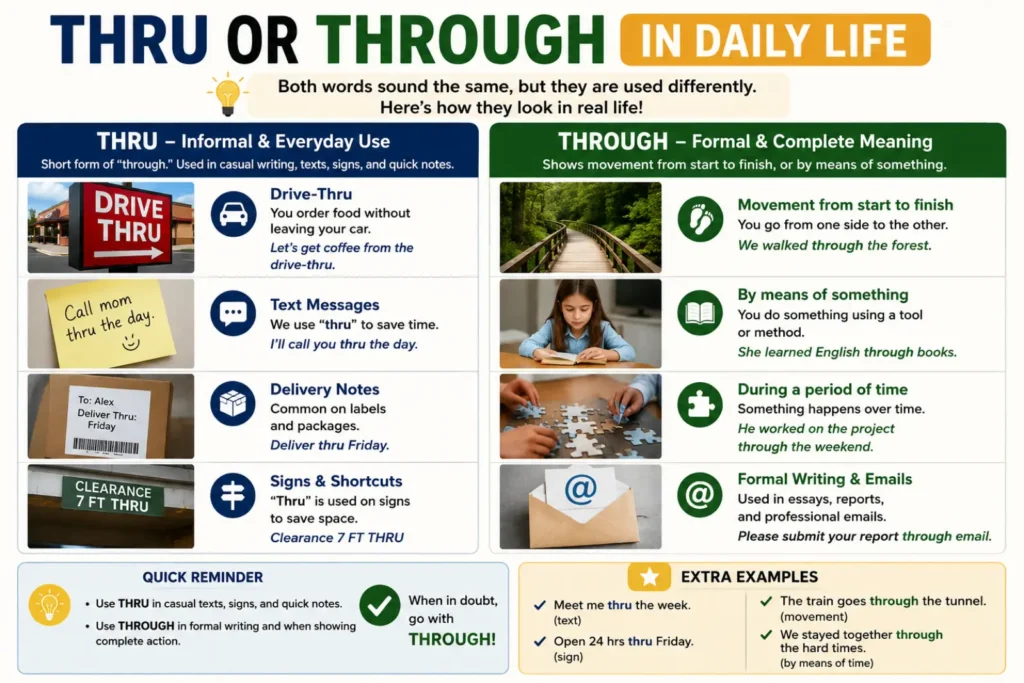
Thru or Through in Daily Life
You may see both spellings around you.
On roads
Signs may use short words. Therefore, thru can appear in directions.
At restaurants
“Drive-thru” is a common expression.
At work
Business writing usually uses through.
At school
Teachers generally expect through.
In texting
Both forms may appear.
The correct choice depends on your audience.
Synonyms and Related Words
The word through can have different meanings.
Therefore, its synonyms also change.
Meaning: From one side to another
- Across
- Via
- By way of
Example:
We traveled through the city.
Similar idea:
We traveled across the city.
Meaning: During a period
- During
- Throughout
- Over
Example:
She worked through the night.
Similar idea:
She worked throughout the night.
Meaning: Finished
- Done
- Finished
- Completed
Example:
I am through with the task.
Similar idea:
I am finished with the task.
Related SEO terms
These semantic keywords naturally connect with this topic:
- thru vs through
- through meaning
- thru meaning
- through definition
- when to use thru
- when to use through
- is thru a word
- drive-thru spelling
- drive-through spelling
- through vs threw
- through vs thorough
- English spelling differences
Expert Insights
Strong writing depends on more than grammar rules.
It also depends on context.
The word through gives your writing a standard, professional tone. The word thru often feels shorter and more casual.
Professional writers consider the reader first.
They also consider the writing platform.
A restaurant sign may favor short wording. A business report needs standard wording.
This small spelling choice can affect clarity and tone.
Expert tip
When you are unsure, choose through.
It works in formal, informal, academic, and professional writing.
SEO writing tip
Use the natural phrase your audience searches for. Avoid repeating thru or through unnaturally.
Google values helpful content and clear language.
Therefore, explain the difference naturally.
Frequently Asked Questions
Is “thru” the same as “through”?
Yes. Thru is an informal shortened spelling of through. However, through is the standard form.
Is “thru” proper English?
Yes, but it is mainly informal. You may see it in signs, labels, names, and casual writing.
Should I use “thru” in formal writing?
Usually, no. Use through in formal, academic, business, and professional writing.
Is “drive-thru” or “drive-through” correct?
Both forms appear in English. Drive-thru is a common informal form. Drive-through uses the standard spelling.
Which is better: “thru” or “through”?
Through is the safer choice in most situations. Use thru when an informal or shortened style fits.
Is “thru” acceptable in an email?
It depends on the email. Casual messages may use thru. Professional emails should usually use through.
What is the difference between “through” and “threw”?
Through describes movement, time, or completion. Threw is the past tense of throw.
What is the difference between “through” and “thorough”?
Through relates to movement or completion. Thorough means complete and detailed.
Conclusion
The difference between thru or through is mainly about spelling and style. Through is the standard English form. Use it in essays, reports, emails, business writing, and most other situations. Thru is a shorter, informal form. You may see it in signs, labels, names, and casual messages. The easiest rule is simple: choose through when you want the safest and most professional option. Choose thru only when the context clearly supports informal spelling. Once you understand this difference, the choice becomes easy. When in doubt, remember this simple takeaway: formal writing uses “through,” while informal shortcuts may use “thru.”