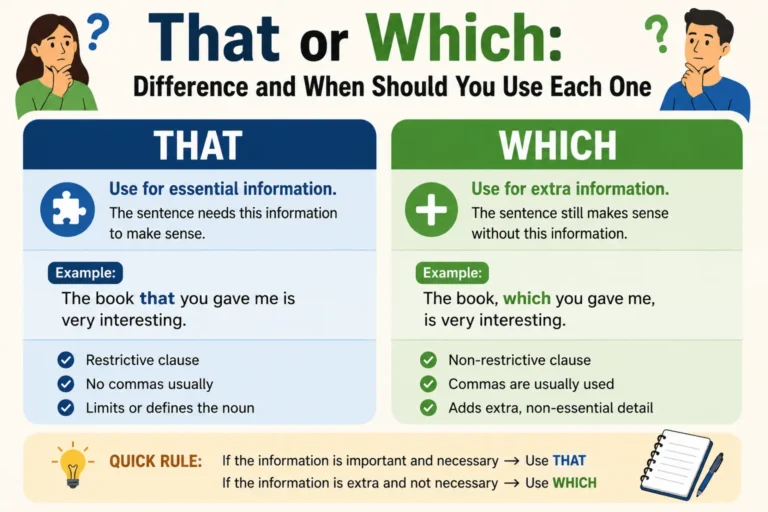
That or Which is one of the most common grammar questions in English. Many writers confuse these two words. However, learning the difference is easier than you think.
Both words connect extra information to a sentence. Yet they do not work the same way.
Using the correct word makes your writing clearer. It also helps readers understand your message quickly.
In this guide, you will learn the meaning of that and which, when to use each one, common mistakes to avoid, and easy examples from daily life.
By the end, you will know exactly which word fits your sentence.
Quick Summary Box
- That gives essential information.
- Which gives extra information.
- Use that when the sentence needs the information.
- Use which when the sentence still makes sense without it.
- Which usually follows a comma.
- That normally does not use a comma.
- Correct usage improves grammar and readability.
What Does “That or Which” Mean?
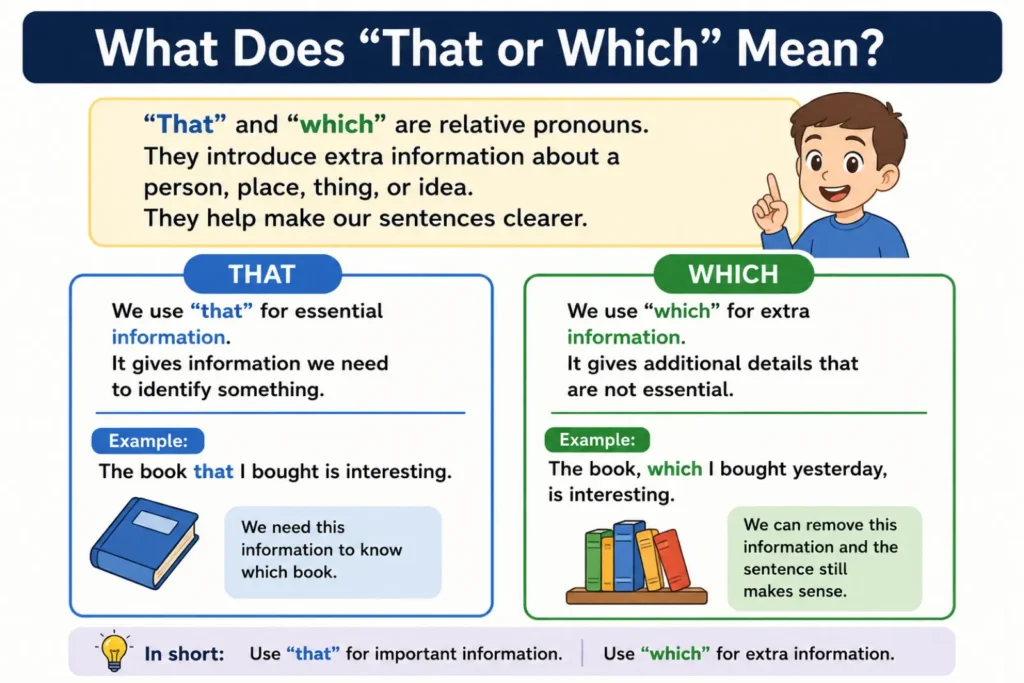
“That” and “which” are relative pronouns. They connect a noun to more information.
Examples:
- The phone that I bought works perfectly.
- My phone, which I bought last week, works perfectly.
Both sentences are correct. However, they serve different purposes.
Understanding the Difference Between That and Which
The main difference depends on whether the information is necessary.
Use That for Essential Information
The sentence needs the information to make sense.
Example:
- The book that has a blue cover is mine.
Without “that has a blue cover,” readers do not know which book you mean.
Use Which for Extra Information
The sentence still works without the added detail.
Example:
- My car, which is ten years old, still runs well.
The important message is “My car still runs well.” The age is only extra information.
That vs Which Comparison Table
| Feature | That | Which |
|---|---|---|
| Gives essential information | Yes | No |
| Gives extra details | No | Yes |
| Uses commas | Usually no | Usually yes |
| Can sentence survive without information? | No | Yes |
| Common in restrictive clauses | Yes | No |
| Common in nonrestrictive clauses | No | Yes |
Simple Rule to Remember
Ask yourself one question:
Can I remove the information without changing the meaning?
- No → Use “That”
- Yes → Use “Which”
Examples:
Essential
- The cookies that contain nuts are for Sarah.
Extra
- These cookies, which contain nuts, are for Sarah.
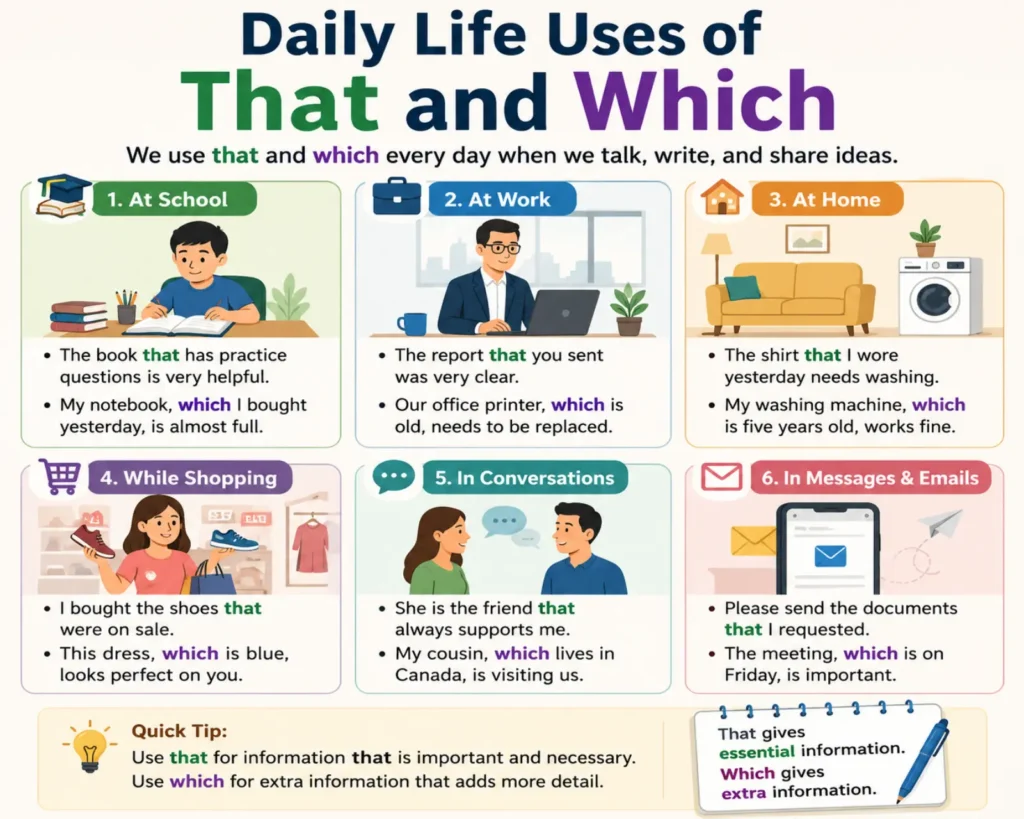
Real-Life Examples of That and Which
School
- Students that study regularly often perform better.
- My notebook, which I bought yesterday, is already full.
At Work
- The report that you sent looks great.
- Our office printer, which is old, needs replacement.
Home
- The shirt that I wore yesterday needs washing.
- My washing machine, which is five years old, works fine.
While Shopping
- I bought the shoes that were on sale.
- These shoes, which cost less than expected, feel comfortable.
Why Proper Usage Matters
Correct grammar creates clear communication.
Using “that” and “which” correctly helps:
- Improve readability.
- Avoid confusion.
- Build writing confidence.
- Create professional content.
- Enhance SEO-friendly articles.
Small grammar choices can make a big difference.
Common Mistakes People Make
Using “Which” Without Commas
Incorrect:
- My laptop which I bought yesterday is fast.
Correct:
- My laptop, which I bought yesterday, is fast.
Using “That” with Extra Information
Incorrect:
- My house that is near the park is very old.
If you own only one house, the location is extra information.
Correct:
- My house, which is near the park, is very old.
Adding Commas Around Essential Information
Incorrect:
- The movie, that I watched yesterday, was amazing.
Correct:
- The movie that I watched yesterday was amazing.
Easy Tips and Tricks
Remember This Formula
That = Needed
Which = Bonus Information
Another memory trick:
- No commas → That
- Commas → Which
This simple rule helps many writers.
Restrictive vs Nonrestrictive Clauses Explained
Restrictive Clause
A restrictive clause limits the meaning.
Example:
- People that exercise daily stay healthier.
The sentence needs the clause.
Nonrestrictive Clause
A nonrestrictive clause adds extra information.
Example:
- My brother, which many people know is incorrect for people, should actually use “who.”
Correct:
- My brother, who lives in London, visits often.
For things:
- The laptop, which costs less, is better.
American English vs British English
American English strongly prefers:
- That for essential clauses.
- Which for extra clauses.
British English sometimes uses “which” in places where Americans use “that.”
Example:
British style:
- The car which I bought is red.
American style:
- The car that I bought is red.
Both forms are acceptable, depending on style guides.
Daily Life Uses of That and Which
You use these words every day:
- Emails
- Blog posts
- School assignments
- Social media captions
- Business reports
- Text messages
Good grammar makes every type of writing stronger.
Synonyms and Related Grammar Terms
Related Keywords
- relative pronouns
- restrictive clause
- nonrestrictive clause
- grammar rules
- English writing tips
- punctuation rules
- comma usage
- that vs which grammar
Semantic Variations
- difference between that and which
- when to use that and which
- which vs that examples
- grammar mistakes with that and which
- English relative clauses
Expert Insight
Professional editors focus heavily on sentence clarity.
Using “that” and “which” correctly helps readers understand your message faster.
Search engines also favor content that users find easy to read.
Clear writing improves:
- User experience
- Time on page
- Trustworthiness
- Professional appearance
Strong grammar supports better communication.
Frequently Asked Questions
What is the difference between that and which?
“That” gives essential information. “Which” adds extra information.
Do I use commas with that?
Usually no. Essential clauses normally do not need commas.
Does which always require commas?
Most nonessential clauses use commas with “which.”
Can I remove a which clause?
Yes. The sentence should still make sense.
Is that more common in American English?
Yes. American English strongly prefers “that” for essential information.
Can I use which for people?
No. Use “who” for people.
Is using that or which important?
Yes. Proper usage improves clarity and professionalism.
Which is easier to remember?
Think of it this way:
- That = Necessary
- Which = Extra
Conclusion
Understanding that or which becomes simple once you know the basic rule. Use that for information your sentence cannot do without, and use which for extra details that add more context. Paying attention to commas and sentence meaning will help you choose the correct word every time.
Whether you are writing emails, essays, blog posts, or everyday messages, using that and which correctly makes your writing clearer and more professional. Remember this easy tip: if removing the information changes the meaning, use that; if the sentence still makes sense, use which. Mastering this small grammar rule can greatly improve your overall writing skills.