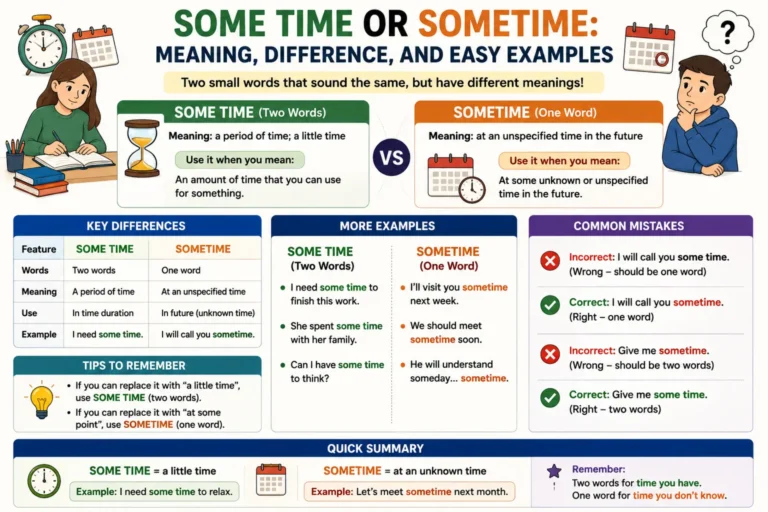
Some time or sometime can confuse even careful English writers. Both forms look almost the same. However, they have different meanings and uses. The space between the words changes the meaning.
Some time means an amount or period of time. Sometime means an unknown or unstated time. For example, “I need some time” means you need a period to do something. “I will call you sometime” means you will call at an unknown time.
This small difference matters in everyday English. It also matters in emails, schoolwork, messages, and professional writing. The good news is that the rule is simple. Once you understand the difference, you can choose the right form quickly.
In this guide, you will learn both meanings. You will also see clear examples and common mistakes.
Quick Summary: Some Time vs Sometime
- Some time means a period or amount of time.
- Sometime means at an unknown or unspecified time.
- Use some time when “a period of time” makes sense.
- Use sometime when you mean “at an unspecified time.”
- Sometimes means “occasionally” and has a different meaning.
- “I need some time” and “I will visit sometime” use different forms.
- The space between some time changes its grammatical role.
What Does “Some Time” Mean?
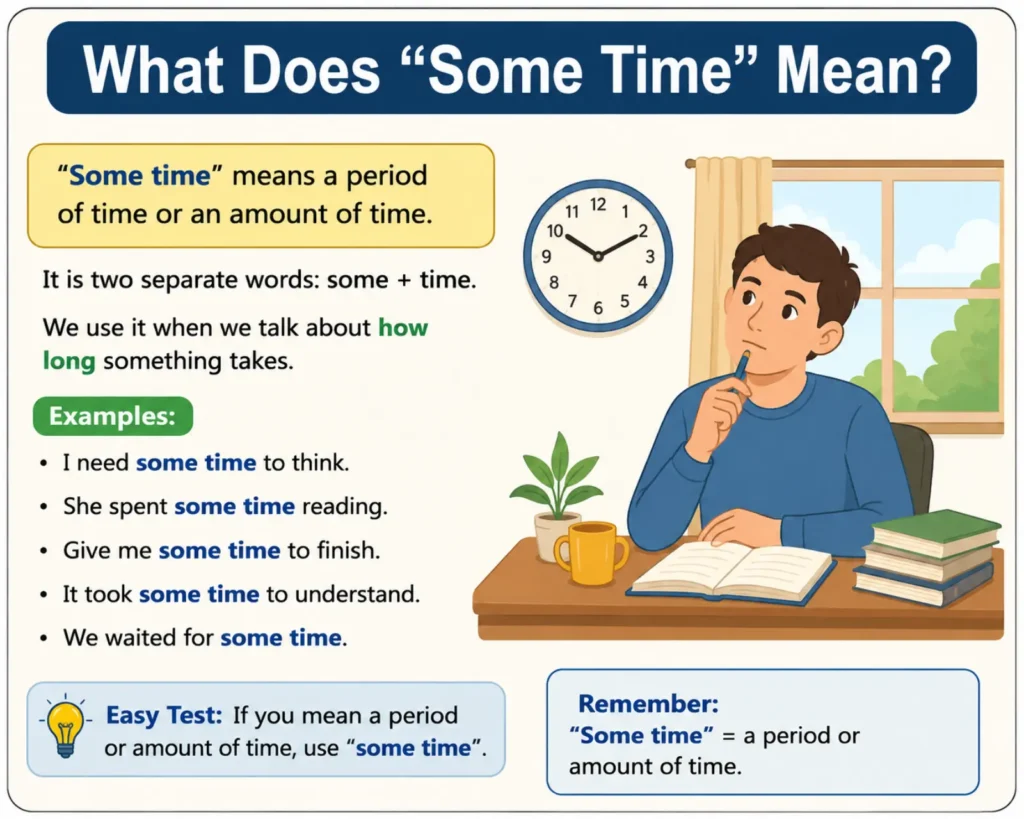
Some time means a certain amount or period of time.
Here, some describes the noun time. You can often replace “some time” with “a period of time.”
For example:
- I need some time to think.
- She spent some time reading.
- Give me some time to finish.
- We have some time before dinner.
- He stayed there for some time.
In each sentence, “some time” refers to a duration.
Easy Test
Try replacing some time with a period of time.
I need some time to decide.
This becomes:
I need a period of time to decide.
The meaning still works. Therefore, some time is correct.
What Does “Sometime” Mean?
Sometime means at an unknown, uncertain, or unstated time.
It usually refers to a time in the future or past.
Examples include:
- Let’s meet sometime next week.
- I saw him sometime last year.
- Please call me sometime tomorrow.
- We should visit that place sometime.
- She will arrive sometime this evening.
The exact time does not matter or remains unknown.
For example, “Let’s meet sometime next week” does not tell us the exact day or hour.
It could mean Monday, Wednesday, or Friday.
Some Time or Sometime: What Is the Difference?
The main difference involves duration versus an unspecified point in time.
| Expression | Meaning | Example |
|---|---|---|
| Some time | A period of time | I need some time to finish. |
| Sometime | At an unknown time | Let’s meet sometime next week. |
| Sometimes | Occasionally | I sometimes walk to school. |
Remember this simple rule:
Some time = a period of time.
Sometime = an unknown time.
Sometimes = occasionally.
This three-way comparison solves most usage questions.
Some Time vs Sometime: Real-Life Examples
Real-life examples make the difference easier to remember.
Example 1: Asking for more time
Please give me some time to think.
You need a period to think.
Therefore, some time is correct.
Example 2: Suggesting a future meeting
We should meet sometime next month.
You do not give an exact date.
Therefore, sometime is correct.
Example 3: Talking about an activity
I spent some time studying.
You are talking about the duration of your study.
Therefore, some time is correct.
Example 4: Talking about an unknown date
I visited Lahore sometime last year.
You do not mention the exact date.
Therefore, sometime is correct.
How to Remember the Difference Easily
Use the space test.
If you mean a period of time, use two words:
some time
If you mean an unspecified time, use one word:
sometime
You can also remember this question:
How much time? → some time
When? → sometime
For example:
How much time do you need?
I need some time.
Now consider:
When should we meet?
We can meet sometime next week.
This simple question method works well in everyday writing.
When Should You Use “Some Time”?
Use some time when you talk about duration.
It commonly appears with verbs such as:
- need
- spend
- take
- give
- have
- save
- waste
- find
Examples:
- I need some time.
- She spent some time practicing.
- Give him some time.
- We have some time before the meeting.
- You should take some time to rest.
- I want to save some time.
In these examples, the phrase refers to an amount or period.
When Should You Use “Sometime”?
Use sometime when the exact time remains unknown or unimportant.
It often appears with words such as:
- tomorrow
- next week
- next month
- soon
- later
- last year
- yesterday
Examples:
- Call me sometime tomorrow.
- Let’s talk sometime next week.
- I met her sometime last year.
- We should go there sometime soon.
- He arrived sometime yesterday.
The exact moment remains unclear.
That makes sometime the correct choice.
Some Time, Sometime, and Sometimes
Many people confuse three expressions:
some time, sometime, and sometimes.
They have different meanings.
| Word or phrase | Meaning | Example |
| some time | A period of time | I need some time. |
| sometime | At an unknown time | Come sometime next week. |
| sometimes | Occasionally | I sometimes read at night. |
What Does “Sometimes” Mean?
Sometimes means “occasionally” or “now and then.”
For example:
I sometimes drink tea.
This means you drink tea on some occasions.
It does not mean an unknown time.
Another example:
She sometimes visits her grandparents.
This means she visits them occasionally.
Therefore, do not use sometime when you mean “occasionally.”
Common Mistakes With Some Time or Sometime
Mistake 1: Using “sometime” for duration
Incorrect:
I need sometime to finish this.
Correct:
I need some time to finish this.
You need a period to finish the task.
Mistake 2: Using “some time” for an unknown future time
Incorrect:
Let’s meet some time next week.
This form can appear in informal writing, but sometime is usually clearer when you mean an unspecified occasion.
Better:
Let’s meet sometime next week.
Mistake 3: Confusing “sometime” with “sometimes”
Incorrect:
I sometime watch movies at night.
Correct:
I sometimes watch movies at night.
The meaning is “occasionally.”
Mistake 4: Forgetting the meaning of “time”
Do not focus only on spelling.
Instead, ask what you mean.
If you mean duration, choose some time.
If you mean an unknown point, choose sometime.
Tips and Tricks to Choose the Right Form
Here are five quick tricks.
1. Use “some time” for “a period”
I need some time.
Think:
I need a period of time.
2. Use “sometime” for “at an unknown time”
I will call sometime tomorrow.
Think:
I will call at an unspecified time tomorrow.
3. Use “sometimes” for “occasionally”
I sometimes play football.
Think:
I occasionally play football.
4. Look at the sentence meaning
Do not choose the form based only on pronunciation.
The meaning decides the spelling.
5. Check whether you can ask “how much?”
If you can ask how much time, use some time.
If you can ask when, use sometime.
How These Words Appear in Daily Life
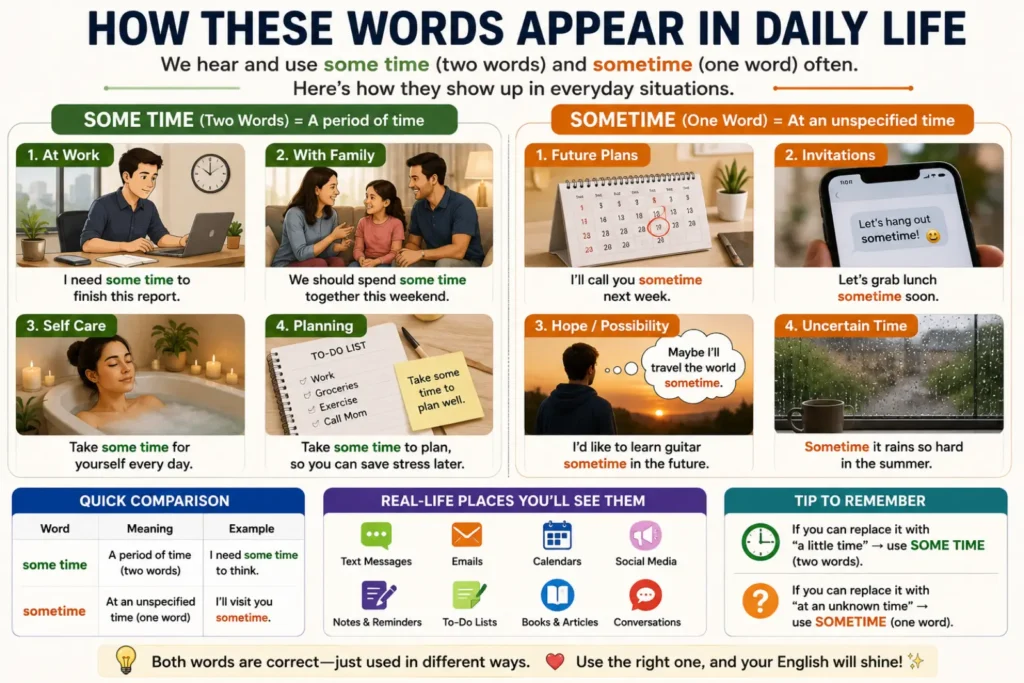
You will often see these expressions in everyday conversations.
At School
I need some time to complete my homework.
We can discuss it sometime after class.
At Work
Please give me some time to review the report.
Let’s schedule a call sometime next week.
In Messages
I need some time to decide.
Let’s catch up sometime soon.
In Travel Plans
We have some time before the train leaves.
We should visit that museum sometime.
These examples show how common both forms are.
Synonyms and Related Search Terms
Understanding related words can make the concept easier.
Synonyms for “Some Time”
Depending on context, you may use:
- a while
- a period
- a little time
- an amount of time
- a short period
Example:
I need some time.
Similar idea:
I need a while.
However, these alternatives do not work in every sentence.
Synonyms for “Sometime”
Depending on context, you may use:
- at some point
- at an unspecified time
- one day
- on an unknown occasion
Example:
We should meet sometime.
Similar idea:
We should meet at some point.
These semantic variations can help you understand the difference.
Is “Some Time” Always Two Words?
When some modifies the noun time, it normally appears as two words.
Example:
I spent some time studying.
Here, “some” describes “time.”
However, English also uses sometime as one word when it works as an adverb.
Example:
I will visit sometime next month.
The grammatical function helps determine the spelling.
Is “Sometime” Formal or Informal?
Sometime is standard English.
You can use it in both casual and formal writing when the meaning fits.
For example:
We should meet sometime next week.
This sentence works in a casual message.
You could also write:
We would be happy to discuss this sometime next week.
This works in a professional context.
However, formal writing may sometimes benefit from a more exact time.
For example:
We can meet on Tuesday at 3 p.m.
Specific timing can make professional communication clearer.
Expert Insights: Why This Small Difference Matters
Small grammar choices can change sentence meaning.
That makes some time or sometime more important than it first appears.
From an English-writing perspective, context should guide your word choice.
Use some time when your sentence focuses on duration.
Use sometime when your sentence focuses on an unspecified time.
Also remember that sometimes has a completely different meaning.
Strong writers do not simply memorize spellings. They understand the function of each word.
A useful editing habit is to replace the expression mentally.
Try:
- a period of time → some time
- at an unknown time → sometime
- occasionally → sometimes
If the replacement sounds natural, you have probably chosen the correct form.
Frequently Asked Questions
Is it “some time” or “sometime”?
Both are correct, but they have different meanings. Some time means a period of time. Sometime means at an unspecified time.
What is the difference between “some time” and “sometime”?
Some time refers to duration. Sometime refers to an unknown or unstated point in time.
Is “sometime next week” correct?
Yes. Sometime next week means at an unspecified time during next week.
Is “I need some time” correct?
Yes. It means you need a period or amount of time.
What is the difference between “sometime” and “sometimes”?
Sometime means at an unspecified time. Sometimes means occasionally.
Can “some time” mean “a while”?
Yes. In many contexts, some time can refer to a period or a while.
Example:
We waited for some time.
Is “some time ago” correct?
Yes. Some time ago means an unspecified period before now.
Example:
I met him some time ago.
What is an easy way to remember the rule?
Remember: some time = a period, sometime = an unknown time, and sometimes = occasionally.
Internal Linking Suggestions
For a broader English grammar website, consider linking this article to related pages such as:
- A Lot vs Alot
- Everyday vs Every Day
- Anytime vs Any Time
- Any More vs Anymore
- Everywhere vs Every Where
- Into vs In To
- Then vs Than
- Your vs You’re
- Its vs It’s
- Affect vs Effect
These topics share similar word-choice problems. They can also create useful topic clusters for an English grammar website.
Conclusion
The difference between some time or sometime is simple once you focus on meaning.
Use some time when you mean a period or amount of time. For example, “I need some time to decide.”
Use sometime when you mean an unknown or unspecified time. For example, “Let’s meet sometime next week.”
Also remember sometimes. It means “occasionally,” so it has a different purpose.
The easiest rule is this:
Some time = a period of time.
Sometime = an unspecified time.
Sometimes = occasionally.
When you are unsure, replace the word mentally. Try “a period,” “at an unknown time,” or “occasionally.” The correct choice will usually become clear.
With this simple test, you can avoid one of the most common English word-choice mistakes.