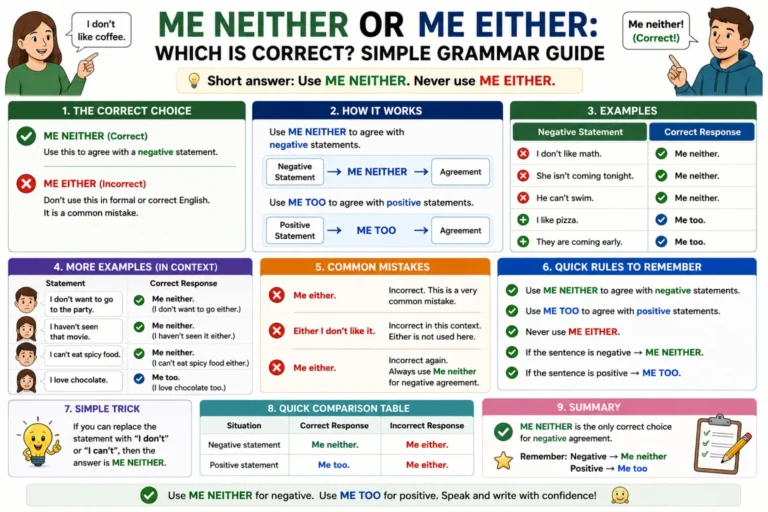
Me neither or me either is a common English grammar question. Both phrases can appear after a negative statement. However, they do not have the same status in standard English. “Me neither” is the traditional and widely accepted choice. “Me either” appears in informal speech, especially in some varieties of American English. You may hear native speakers use it in casual conversation. Still, it can sound less standard in formal writing. The good news is that the rule is simple. Use “me neither” when you agree with a negative statement. You can also use “I don’t either” in many situations. This guide explains the difference with simple rules and real-life examples. You will also learn common mistakes and easy ways to remember the correct form.
Quick Summary: Me Neither or Me Either?
- “Me neither” is the standard phrase for agreeing with a negative statement.
- “Me either” is common in informal speech but is less accepted in formal English.
- Use “me neither” after statements with words like “not,” “never,” or “nothing.”
- You can also say “I don’t either.”
- Use “me too” when agreeing with a positive statement.
- In formal writing, choose “me neither” or “I don’t either.”
- Example: “I don’t like coffee.” → “Me neither.”
- Example: “I don’t like coffee.” → “I don’t either.”
What Does “Me Neither” Mean?
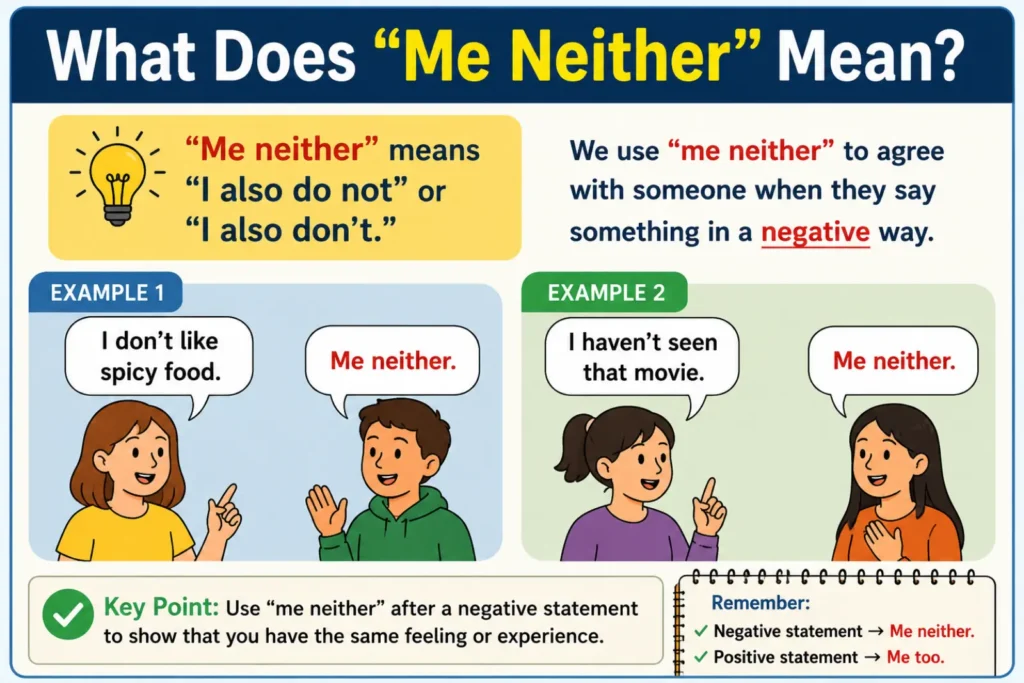
“Me neither” means “I also do not” or “I also don’t.”
People use it to agree with a negative statement.
For example:
“I don’t like scary movies.”
“Me neither.”
The second speaker agrees with the first speaker.
The hidden meaning is:
“I don’t like scary movies either.”
“Me neither” works as a short conversational response. It sounds natural and clear in everyday English.
You can use it after many negative statements.
For example:
- “I’m not hungry.” → “Me neither.”
- “I don’t watch TV often.” → “Me neither.”
- “I can’t swim.” → “Me neither.”
- “I’ve never visited Spain.” → “Me neither.”
What Does “Me Either” Mean?
“Me either” can also show agreement with a negative statement.
However, many grammar guides consider it less standard than “me neither.”
Native speakers may use “me either” in casual conversation. You may also hear it in movies, social media, and everyday speech.
For example:
“I don’t want pizza.”
“Me either.”
The meaning is clear.
However, “me either” may sound informal or nonstandard to some English speakers.
Therefore, it is safer to use “me neither” in schoolwork, formal writing, tests, and professional communication.
A simple rule works well:
Negative statement → “Me neither.”
Me Neither vs. Me Either: What Is the Difference?
The main difference involves standard usage and formality.
| Phrase | Meaning | Standard English | Best use |
|---|---|---|---|
| Me neither | I also do not | Yes | Everyday and formal contexts |
| Me either | I also do not | Informal/nonstandard for many speakers | Casual conversation |
| I don’t either | I also do not | Yes | Everyday and formal contexts |
| Me too | I also do | Yes | Positive statements |
Consider these examples:
Negative statement:
“I don’t like onions.”
“Me neither.”
Alternative standard form:
“I don’t like onions.”
“I don’t either.”
Positive statement:
“I like apples.”
“Me too.”
Notice the difference. “Me too” agrees with a positive idea. “Me neither” agrees with a negative idea.
When Should You Use “Me Neither”?
Use “me neither” when someone makes a negative statement and you have the same experience.
The first sentence usually contains a negative word or structure.
For example:
- “I’m not tired.” → “Me neither.”
- “I don’t understand this question.” → “Me neither.”
- “I haven’t finished my homework.” → “Me neither.”
- “I can’t drive.” → “Me neither.”
- “I never eat breakfast.” → “Me neither.”
The phrase works because neither carries the negative meaning.
You do not need to repeat the entire sentence.
Instead of saying:
“I don’t understand this question either.”
You can simply say:
“Me neither.”
This makes conversation shorter and more natural.
When Can You Use “Me Either”?
You may hear “me either” in casual English.
Some native speakers use it instead of “me neither.” The listener usually understands the meaning without difficulty.
For example:
“I don’t want to go.”
“Me either.”
This form appears more often in relaxed speech than formal writing.
Still, if you want the safest standard choice, use “me neither.”
This matters in:
- School assignments
- English tests
- Essays
- Formal emails
- Professional writing
- Academic work
In these situations, “me neither” or “I don’t either” is a better choice.
“Me Neither” in Real-Life Conversations
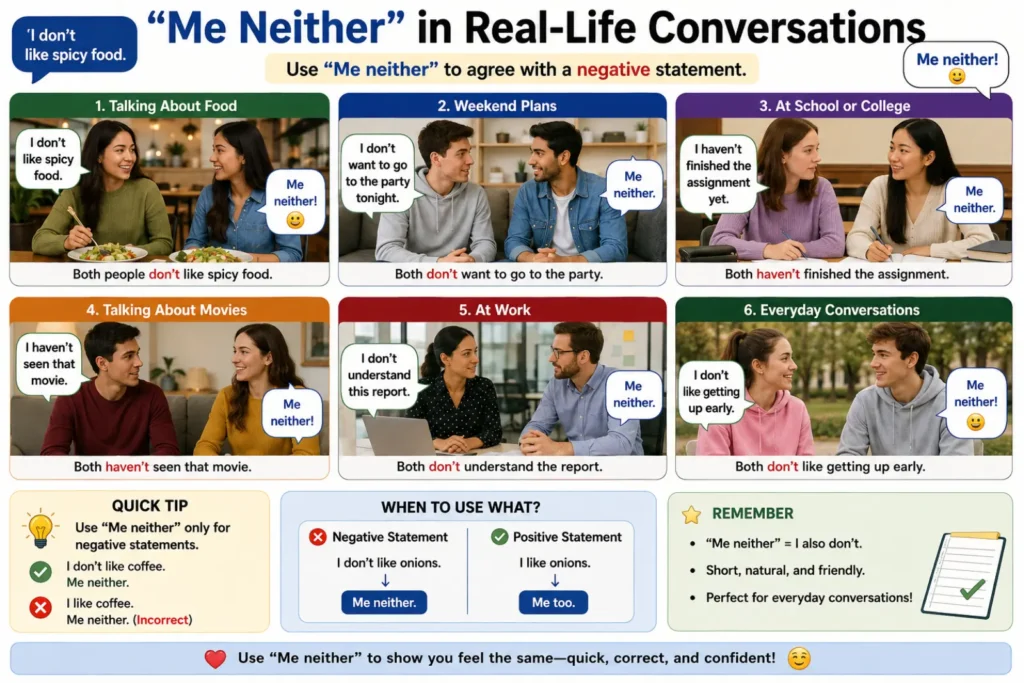
You will often hear “me neither” in everyday conversations.
Example 1: Food
“I don’t like spicy food.”
“Me neither.”
Both people dislike spicy food.
Example 2: Movies
“I haven’t seen that movie.”
“Me neither.”
Both people have not seen it.
Example 3: School
“I didn’t finish the project.”
“Me neither.”
Both speakers failed to finish it.
Example 4: Travel
“I’ve never been to Canada.”
“Me neither.”
Both speakers have never visited Canada.
Example 5: Abilities
“I can’t play the guitar.”
“Me neither.”
Both speakers cannot play the guitar.
These examples show how useful the phrase is in natural conversation.
“Me Neither” vs. “I Don’t Either”
Both forms can express the same basic idea.
Compare:
“I don’t like tea.”
“Me neither.”
You could also say:
“I don’t like tea.”
“I don’t either.”
Both responses communicate agreement.
The difference is style.
“Me neither” is shorter and conversational.
“I don’t either” is a complete sentence structure.
For example:
“I haven’t finished the book.”
“Me neither.”
Or:
“I haven’t finished the book.”
“I haven’t either.”
The second form repeats the auxiliary verb from the first sentence.
Me Too vs. Me Neither vs. Me Either
These phrases can confuse English learners.
The easiest way to understand them is to look at the first speaker’s sentence.
| First statement | Natural response |
| “I like chocolate.” | “Me too.” |
| “I don’t like chocolate.” | “Me neither.” |
| “I haven’t eaten.” | “Me neither.” |
| “I can swim.” | “Me too.” |
| “I can’t swim.” | “Me neither.” |
| “I’ve never been there.” | “Me neither.” |
Remember this simple pattern:
Positive → Me too.
Negative → Me neither.
This rule solves most everyday usage questions.
Common Mistakes With “Me Neither” and “Me Either”
English learners often make a few predictable mistakes.
Mistake 1: Using “Me too” after a negative statement
Incorrect for the intended meaning:
“I don’t like coffee.”
“Me too.”
This can create confusion.
Better:
“Me neither.”
Mistake 2: Using “Me neither” after a positive statement
For example:
“I love reading.”
“Me neither.”
This does not express agreement.
Better:
“Me too.”
Mistake 3: Choosing “Me either” in formal writing
Although some speakers use “me either” casually, it may look nonstandard.
Better:
“Me neither.”
Or:
“I don’t either.”
Mistake 4: Adding unnecessary negatives
Avoid creating a confusing double negative.
For example, do not try to build a response by randomly adding “not” to “neither.”
Use the simple phrase:
“Me neither.”
Easy Tricks to Remember the Difference
You do not need to memorize complicated grammar rules.
Use this simple memory trick:
Too = same positive idea.
Neither = same negative idea.
Think about these two examples:
“I like cats.” → “Me too.”
“I don’t like cats.” → “Me neither.”
Another useful trick is to remember that neither already carries a negative meaning.
So you do not need another negative word.
For formal situations, remember one extra option:
Negative + “I don’t either.”
That gives you two reliable choices:
- “Me neither.”
- “I don’t either.”
How “Either” Works in Negative Sentences
The word either has several uses in English.
One common use appears at the end of negative sentences.
For example:
“I don’t like coffee either.”
Here, “either” means that the speaker also does not like coffee.
You can often turn this into a shorter response:
“I don’t like coffee.”
“Me neither.”
So “either” itself is not wrong.
The issue is the short phrase “me either.”
In standard English, “I don’t either” is usually a safer structure than “me either.”
This distinction helps explain why learners may see both forms.
Usage in Daily English
English speakers often shorten sentences during conversations.
That is why expressions such as “me too” and “me neither” are so common.
They save time and avoid repetition.
Imagine two friends talking:
“I don’t want to study tonight.”
“Me neither.”
“I’m too tired.”
“Me too.”
These short responses sound natural because both speakers already understand the full context.
In casual speech, you may also hear “me either.”
However, standard written English favors “me neither.”
That makes “me neither” a useful choice for both learners and advanced speakers.
Synonyms and Related Grammar Terms
Several expressions relate to “me neither or me either.”
Useful semantic keywords and related phrases include:
- neither
- either
- me too
- I don’t either
- I haven’t either
- I can’t either
- I won’t either
- agreeing with a negative statement
- negative agreement
- English grammar
- English conversation
- common English phrases
- standard English
- informal English
- grammar rules
- English sentence patterns
These terms describe the same grammar topic from different angles.
They can also help you understand how native speakers form short agreement responses.
Expert Insight: Which Form Should You Choose?
From a standard English perspective, “me neither” is the safest answer.
It works naturally in conversation and remains acceptable in many formal contexts.
If you want a more complete grammatical structure, use:
“I don’t either.”
For example:
“I don’t enjoy horror movies.”
“Me neither.”
Or:
“I don’t enjoy horror movies.”
“I don’t either.”
Both communicate the same basic idea.
The main lesson is not to panic when you hear “me either.” English varies across regions and social settings.
However, learners should prioritize forms that work widely.
That is why “me neither” remains the best default choice.
Frequently Asked Questions
Is “me neither” grammatically correct?
Yes. “Me neither” is a standard and widely accepted way to agree with a negative statement.
Is “me either” correct English?
“Me either” occurs in informal speech, but many speakers consider it nonstandard. Use “me neither” in formal contexts.
Should I say “me neither” or “me either”?
Choose “me neither” when you want the safest standard form.
Can I say “I don’t either”?
Yes. “I don’t either” is a standard alternative to “me neither.”
What is the difference between “me too” and “me neither”?
Use “me too” after a positive statement. Use “me neither” after a negative statement.
Can “me neither” be used in formal writing?
It can appear in appropriate formal dialogue, but a complete sentence may sound more formal. “I don’t either” can work well.
Is “neither” always negative?
“Neither” commonly expresses a negative idea involving two choices or people. Its exact grammar depends on the sentence.
Why do people say “me either”?
Some English speakers use “me either” as an informal variation. Regional speech patterns can influence everyday English.ere.”
Conclusion
The answer to “me neither or me either” is simple. Use “me neither” when you agree with a negative statement. It is the safest standard choice for English learners and formal situations. You can also use “I don’t either” when you want a complete sentence structure. You may hear “me either” in casual conversation. Some native speakers use it naturally. However, it can sound informal or nonstandard to other speakers. The easiest rule is worth remembering: positive statement → “me too,” negative statement → “me neither.” Once you learn this pattern, the choice becomes much easier. When in doubt, choose “me neither.”