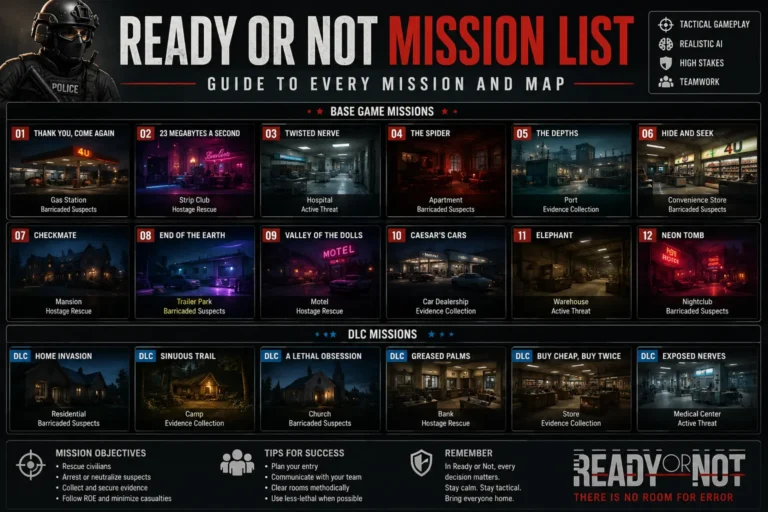
Ready or Not mission list searches are popular among players who want to know every mission in the tactical shooter. The game offers intense police operations across many locations. Each mission gives you a different challenge. Some missions focus on hostage rescue. Others involve suspects, evidence, or dangerous situations. This guide explains the full Ready or Not mission list in simple terms. You will learn the main missions, DLC content, mission types, and useful gameplay tips. You will also see how missions differ from each other. This guide helps new players plan their progress. It also helps returning players find missions they may have missed. Whether you play solo or with friends, knowing the mission list makes planning easier. So, let’s explore the missions and maps available in Ready or Not.
Quick Summary
- Ready or Not features tactical police missions across many locations.
- Missions include hostage rescue, arrests, evidence collection, and active threats.
- Every mission has different objectives and suspect behavior.
- The game rewards careful planning and teamwork.
- Mission performance depends on arrests, evidence, rescues, and rules.
- DLC packs add new locations and mission content.
- Players can replay missions to improve their score.
- Solo players can use AI teammates for support.
What Is the Ready or Not Mission List?
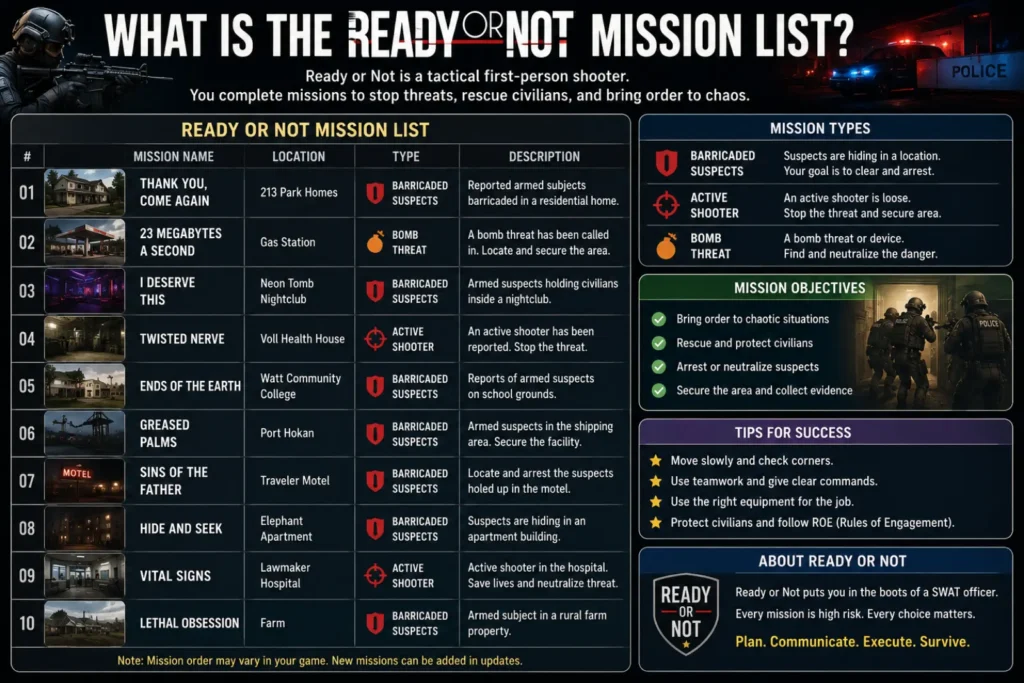
The Ready or Not mission list includes the playable operations and maps in the game.
Each mission places players in a dangerous law enforcement scenario.
You must enter the location and complete specific objectives.
These objectives can change between missions.
For example, one mission may focus on rescuing civilians.
Another mission may require you to arrest suspects.
Some missions also require evidence collection.
The game uses a scoring system after each operation.
Your score depends on how well you follow the rules.
This makes every mission more than a simple shooting challenge.
How Missions Work in Ready or Not
Every mission follows a basic tactical structure.
You receive an operation and enter a specific location.
Your team then searches the area.
You must identify threats and protect civilians.
You also need to follow proper police procedures.
The main goal usually involves completing all mission objectives.
However, the game also rewards careful and controlled gameplay.
Players should avoid unnecessary force.
They should also report evidence and secure suspects.
This approach creates a slower and more realistic tactical experience.
Main Ready or Not Missions and Maps
The game includes many missions across different locations.
Each location creates a unique tactical problem.
Below are some of the best-known mission types and locations.
Nightclub Operations
Nightclub missions can create difficult close-range encounters.
The area often includes many rooms and narrow spaces.
Players must move carefully through crowded areas.
Visibility can also create additional pressure.
Teams should clear rooms slowly and communicate often.
Gas Station Operations
Gas station missions often involve tight spaces.
They may also include civilians and armed suspects.
Players must check rooms and surrounding areas carefully.
Small locations can still create serious tactical challenges.
Hotel Operations
Hotel missions often include multiple rooms and hallways.
Players must clear areas systematically.
Doors can create surprise threats.
Teams should avoid rushing into unknown rooms.
Farm and Rural Operations
Rural locations offer different challenges.
They may include open areas and multiple buildings.
Players must watch both indoor and outdoor spaces.
Longer sightlines can change how teams approach the mission.
Residential Operations
Residential missions often feel more unpredictable.
Homes may contain civilians, suspects, or hidden evidence.
Players must search rooms carefully.
They should also check areas that appear empty.
Ready or Not Mission Types Explained
The mission list contains different operation types.
Each type requires a different approach.
Hostage Rescue Missions
Hostage rescue missions focus on civilian safety.
Players must locate and protect hostages.
They must also control suspects.
Speed matters, but careless movement creates danger.
Teams should communicate before entering high-risk areas.
Barricaded Suspect Missions
These missions involve suspects inside a location.
The suspects may refuse to surrender.
Players must carefully control the situation.
Tactical equipment can help create safer opportunities.
Active Threat Missions
Active threat missions create immediate pressure.
The situation may require quick action.
However, players should still avoid reckless movement.
Good communication helps the team respond effectively.
Arrest and Evidence Missions
Some missions focus more heavily on investigation.
Players must locate suspects and collect evidence.
They may also need to secure specific items.
These missions reward careful searching.
Ready or Not Mission List: Base Game vs DLC
The game includes both base content and additional content.
DLC missions can expand the overall mission list.
They often introduce new locations and scenarios.
| Content Type | Main Focus | Best For |
|---|---|---|
| Base game missions | Core tactical operations | New players |
| DLC missions | New scenarios and locations | Returning players |
| Multiplayer missions | Team coordination | Groups |
| Solo missions | AI-supported operations | Solo players |
| Replay missions | Better scores and ranks | Experienced players |
The exact mission availability can depend on your game version.
Updates may also change content over time.
Therefore, players should check the current game build.
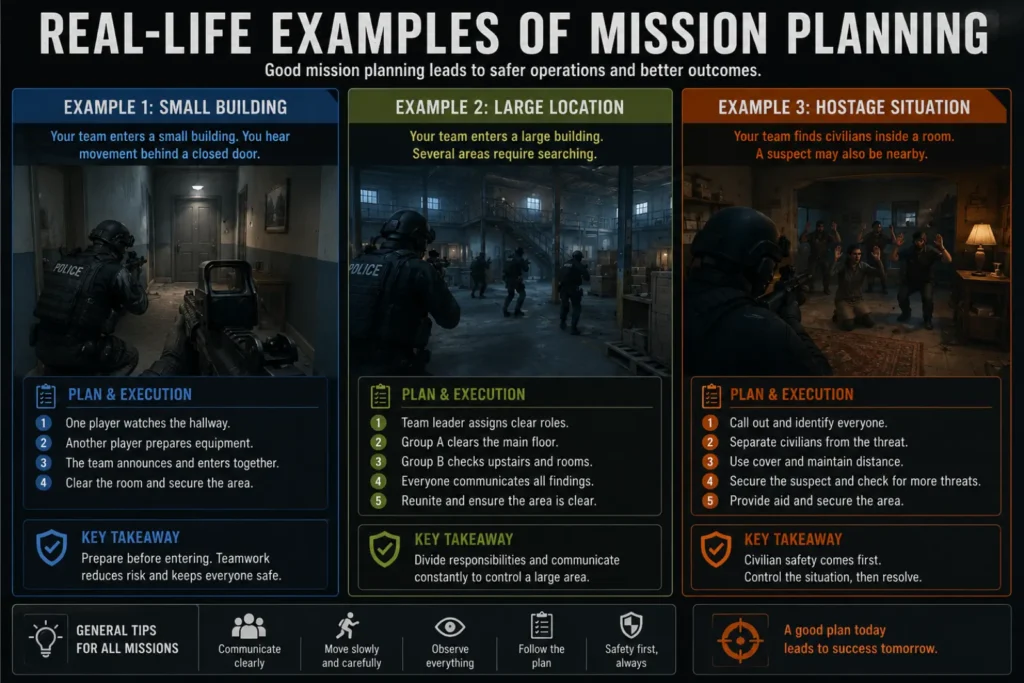
Real-Life Examples of Mission Planning
Understanding mission structure helps with planning.
Here are simple examples.
Example 1: A Small Building
Your team enters a small building.
You hear movement behind a closed door.
Instead of rushing inside, you prepare first.
One player watches the hallway.
Another player prepares equipment.
The team then enters together.
This approach reduces confusion.
Example 2: A Large Location
Your team enters a large building.
Several areas require searching.
The team divides responsibilities carefully.
One group clears the main floor.
Another group checks nearby rooms.
Everyone communicates important information.
This method helps prevent missed areas.
Example 3: A Hostage Situation
Your team finds civilians inside a room.
A suspect may also be nearby.
The team focuses on civilian safety first.
Players control the situation carefully.
They then secure the area.
This shows why patience matters.
How Many Main Missions Are in Ready or Not?
Ready or Not currently features 18 main missions in its base game. These missions place you in the role of a SWAT commander responding to high-risk situations such as hostage rescues, active shooter incidents, bomb threats, drug raids, and terrorist attacks. Each mission requires careful planning, teamwork, and the proper use of tactical equipment to complete objectives while minimizing civilian casualties.
The missions vary in size and difficulty. Some take place in small locations, like convenience stores, while others unfold across large environments such as hospitals, hotels, apartment complexes, and ports. Every mission includes multiple objectives, hidden evidence, armed suspects, and civilians, making each playthrough feel different.
Base Game Main Missions
The base game includes 18 primary operations, such as:
- Thank You, Come Again
- 23 Megabytes a Second
- Twisted Nerve
- The Spider
- A Lethal Obsession
- Ides of March
- Sins of the Father
- Ends of the Earth
- Greased Palms
- Valley of the Dolls
- Elephant
- Rust Belt
- Sinuous Trail
- Neon Tomb
- Buy Cheap, Buy Twice
- Carriers of the Vine
- Relapse
- Hide and Seek
How to Choose the Best Mission
The best mission depends on your experience.
New players should start with simpler layouts.
Smaller locations help players learn the controls.
They also teach basic team movement.
Experienced players may prefer larger missions.
These missions require stronger communication.
They also create more complicated situations.
Players who enjoy challenges should try harder operations.
You can also replay missions to improve your score.
Common Mistakes Players Make
Many players struggle because they rush.
Here are common mistakes to avoid.
Rushing Through Doors
Never assume a room is safe.
A suspect may wait behind a door.
Always prepare before entering.
Ignoring Evidence
Evidence can affect your final score.
Search important areas carefully.
Do not leave useful items behind.
Forgetting Civilians
Civilians can appear in unexpected locations.
Always identify people before using force.
This mistake can seriously hurt your mission result.
Splitting the Team Too Much
Large team gaps create serious problems.
Players can become isolated quickly.
Stay close enough to support each other.
Using Too Much Force
The game rewards controlled actions.
Unnecessary force can reduce your score.
Try to resolve situations carefully.
Tips and Tricks for Completing Missions
Use these tips to improve your results.
Communicate Constantly
Tell teammates what you see.
Share information about doors and suspects.
Clear communication improves team coordination.
Move Slowly
Slow movement gives you more control.
You can react better to new threats.
It also helps you notice evidence.
Check Every Area
Do not leave rooms unchecked.
Small areas may contain important objectives.
A careful search can improve your score.
Use Equipment Wisely
Different situations require different equipment.
Choose tools based on the mission.
Avoid using the same setup every time.
Learn the Map
Map knowledge provides a major advantage.
Remember entrances, rooms, and common danger areas.
This knowledge improves future attempts.
How the Mission List Helps in Daily Gameplay
The mission list helps players plan their gaming sessions.
You can choose a mission based on your available time.
A smaller operation may suit a short session.
A larger mission may require more time.
The list also helps teams choose suitable challenges.
Friends can select missions based on their skill level.
This makes multiplayer sessions more organized.
The mission list also supports replay value.
Players can return to older missions.
They can then improve their score.
Solo Missions vs Multiplayer Missions
Ready or Not supports both solo and multiplayer gameplay.
Solo players often use AI teammates.
These teammates can help with basic tasks.
However, human players offer better communication.
Multiplayer teams can coordinate strategies more effectively.
| Feature | Solo | Multiplayer |
|---|---|---|
| Team communication | Limited | Strong |
| Coordination | AI-based | Player-based |
| Learning curve | More predictable | More flexible |
| Social experience | Low | High |
| Tactical planning | Individual | Team-focused |
Both modes offer different experiences.
Choose the mode that fits your play style.
Ready or Not Mission List Synonyms and Related Keywords
Search engines connect this topic with several related phrases.
Useful semantic keywords include:
- Ready or Not missions
- Ready or Not map list
- Ready or Not levels
- Ready or Not mission guide
- Ready or Not all missions
- Ready or Not maps
- Ready or Not operations
- Ready or Not mission order
- Ready or Not DLC missions
- Ready or Not campaign missions
- Ready or Not complete mission list
- Ready or Not missions ranked
- Ready or Not best missions
- Ready or Not mission objectives
These terms can help create a stronger content cluster.
However, use them naturally.
Do not repeat keywords unnecessarily.
Expert Insights
A strong mission list improves the player experience.
It helps players understand the game’s content.
It also makes progression easier to plan.
From an SEO perspective, mission lists attract strong search intent.
Players often search before starting a new game.
They may also search after a new update.
That creates opportunities for helpful, updated content.
Expert tip: keep mission information current.
Game content can change through updates and DLC releases.
Another tip is to explain missions instead of listing names only.
Players want useful information.
They want to know what makes each mission different.
That is why detailed guides often provide more value.
Frequently Asked Questions
How many missions are in Ready or Not?
The total mission count depends on the game version and available DLC.
Updates and expansions can add new missions.
What is the first mission in Ready or Not?
The first mission depends on the available mission selection and game content.
New players should begin with a familiar, smaller location.
Can you replay missions in Ready or Not?
Yes.
Players can replay missions to improve their score.
Replay also helps players learn map layouts.
Is Ready or Not better with friends?
Many players enjoy multiplayer because teamwork improves coordination.
However, solo play also offers a strong tactical experience.
Are Ready or Not missions difficult?
Some missions can become very challenging.
Difficulty depends on the location, suspects, objectives, and player experience.
Does Ready or Not have DLC missions?
Yes.
Additional content can expand the mission and map selection.
Can you play Ready or Not missions solo?
Yes.
Solo players can complete missions with AI teammates.
What makes Ready or Not missions different?
Each mission creates a different tactical situation.
Locations, objectives, civilians, and suspects can change the experience.
conclusion
The Ready or Not mission list gives players a clear view of the game’s tactical content. Each mission offers a different challenge. Some focus on hostages. Others focus on arrests, evidence, or dangerous suspects. The best strategy depends on the location and mission objectives. Players should move carefully and communicate often. They should also search areas thoroughly. New players can start with smaller missions. Experienced players can try larger and more difficult operations. Replay also adds strong value to the game. You can return to completed missions and improve your performance. The simple takeaway is clear: learn the mission, plan your approach, and work as a team. That approach makes every Ready or Not operation more enjoyable.