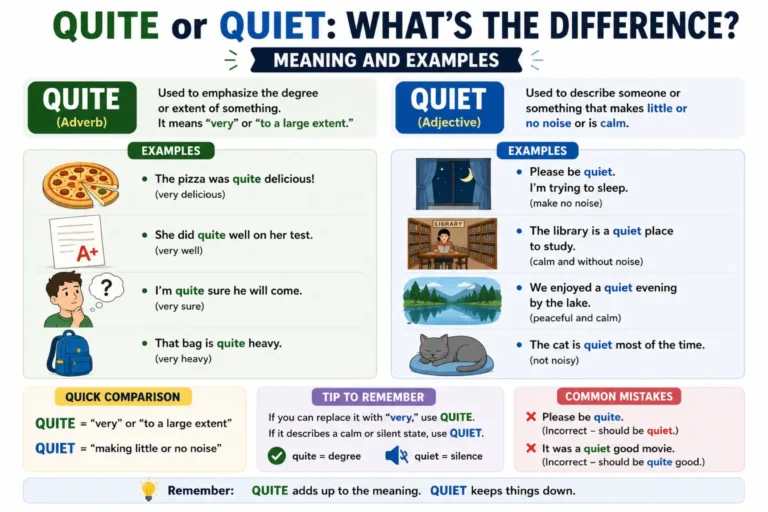
Quite or quiet is one of the most confusing word pairs in English. They look almost the same, but they have very different meanings. Many learners use the wrong word because they differ by only one letter.
The good news is that the difference is easy to learn. Once you know what each word means, you can use them correctly in speaking and writing. This helps you avoid common grammar mistakes and makes your English clearer.
In this guide, you will learn the meaning of quite and quiet in simple words. You will also see real-life examples, an easy comparison table, memory tricks, and common mistakes. By the end, you will know exactly when to use each word with confidence.
Quick Summary Box
- Quite means fairly, completely, or very, depending on the sentence.
- Quiet means silent, calm, or making little noise.
- Quite is an adverb.
- Quiet is usually an adjective but can also be a noun or verb.
- Use quite to describe the degree of something.
- Use quiet to describe a lack of noise.
- Remember: Quiet has the word “quiet place” inside it—it relates to silence.
What Does Quite Mean?
The word quite is an adverb. It changes or adds meaning to an adjective, another adverb, or a verb.
It often means fairly, rather, very, or completely. The exact meaning depends on the sentence and whether you use British or American English.
Simple Definition
Quite = Fairly, rather, very, or completely.
Real-Life Examples
- The movie was quite interesting.
- She is quite happy with her new job.
- I am quite sure about the answer.
- The test was quite easy.
- It is quite cold outside today.
- He speaks English quite well.
- That restaurant is quite popular.
In each sentence, quite changes the strength of the description.
Quite in British and American English
In British English, quite sometimes means completely.
Example:
- The room is quite empty.
In American English, it often means fairly or very.
Example:
- The movie was quite good.
Understanding the context helps you choose the correct meaning.
What Does Quiet Mean?
The word quiet usually describes something with little or no noise.
It can describe people, places, animals, or situations.
Simple Definition
Quiet = Silent, calm, or making little noise.
Real-Life Examples
- Please stay quiet during the meeting.
- The library is very quiet.
- We enjoyed a quiet evening at home.
- The baby became quiet after sleeping.
- They live in a quiet neighborhood.
- The classroom stayed quiet during the exam.
- The park feels peaceful and quiet in the morning.
Every example shows the idea of silence or calmness.
Quiet as Different Parts of Speech
Although quiet is mainly an adjective, it can also be used in other ways.
Adjective
- The room is quiet.
Noun
- We enjoyed the quiet of the countryside.
Verb
- The teacher quieted the noisy class.
Quite vs Quiet: Key Differences
Although these words look similar, they have different meanings, spellings, and uses.
| Feature | Quite | Quiet |
|---|---|---|
| Meaning | Fairly, very, rather, completely | Silent, calm, making little noise |
| Part of Speech | Adverb | Adjective, noun, verb |
| Used For | Describing degree or intensity | Describing silence or calmness |
| Example | She is quite tired. | The room is quiet. |
| Easy Memory Trick | Quite = Degree | Quiet = Silence |
Quick Rule
- Use quite when talking about how much or to what degree.
- Use quiet when talking about noise, silence, or calmness.
Side-by-Side Examples
Quite
- The cake is quite delicious.
- I feel quite confident today.
- She finished the work quite quickly.
Quiet
- Please keep the room quiet.
- We walked through a quiet street.
- The children became quiet after the story started.
Why Do People Confuse Quite and Quiet?
These words have similar spellings. The letters appear in almost the same order. Because of this, many English learners accidentally type or say the wrong word.
However, their meanings are completely different.
One simple way to remember them is this:
- Quite tells you how much.
- Quiet tells you how much noise there is.
Once you connect each word with its meaning, the confusion becomes much easier to avoid.
Easy Memory Tricks to Remember Quite and Quiet
Many English learners confuse quite and quiet because they look almost identical. Luckily, a few simple tricks can help you remember the difference.
Trick 1: Quiet Has “Quiet Place”
Think about a library.
A library is quiet because people do not make much noise.
Whenever you think about silence, remember the word quiet.
Examples
- Please be quiet in the library.
- The hospital was quiet during the night.
- We found a quiet place to study.
Trick 2: Quite Shows Degree
The word quite tells you how much or to what extent.
It often replaces words like very, fairly, or rather.
Examples
- The movie was quite exciting.
- I am quite confident.
- She runs quite fast.
If you can replace the word with very or fairly, then quite is usually correct.
Trick 3: Ask Yourself One Question
Before writing the word, ask yourself:
Am I talking about noise or about the amount of something?
- If you mean silence, use quiet.
- If you mean degree or intensity, use quite.
This simple habit helps prevent mistakes.
Real-Life Examples of Quite and Quiet
Understanding real situations makes these words much easier to remember.
At School
Quite
- The homework was quite easy.
- I felt quite nervous before the exam.
- The teacher explained the lesson quite clearly.
Quiet
- The classroom became quiet during the test.
- Students should remain quiet in the library.
- We enjoyed a quiet reading period.
At Work
Quite
- The meeting was quite productive.
- She is quite experienced.
- Our project is quite successful.
Quiet
- The office stayed quiet after everyone left.
- Please keep your phone quiet during meetings.
- We found a quiet room for the interview.
At Home
Quite
- Dinner was quite delicious.
- The weather feels quite warm today.
- My parents were quite happy with the results.
Quiet
- We spent a quiet evening together.
- The baby remained quiet all afternoon.
- Our neighborhood is very quiet.
While Traveling
Quite
- The journey was quite comfortable.
- The hotel was quite affordable.
- The view was quite beautiful.
Quiet
- We stayed in a quiet village.
- The beach was peaceful and quiet.
- Early mornings are usually quiet.
Common Mistakes People Make
Because these words look alike, many writers accidentally choose the wrong one.
Mistake 1
❌ The classroom was quite.
✅ The classroom was quiet.
Why?
The sentence talks about silence.
Mistake 2
❌ I am quiet sure.
✅ I am quite sure.
Why?
The sentence shows certainty, not silence.
Mistake 3
❌ Please be quite.
✅ Please be quiet.
Why?
You are asking someone to stop making noise.
Mistake 4
❌ The movie was quiet interesting.
✅ The movie was quite interesting.
Why?
The sentence describes the degree of interest.
Mistake 5
❌ We had a quite evening.
✅ We had a quiet evening.
Why?
The evening was peaceful, not “very.”
When Should You Use Quite?
Use quite whenever you want to describe how much, how strongly, or to what degree something is true.
You can often replace it with:
- Very
- Fairly
- Rather
- Completely
- Extremely (depending on the context)
Examples
- The food was quite tasty.
- She is quite talented.
- It is quite difficult.
- They finished quite early.
- I am quite certain about the answer.
When Should You Use Quiet?
Use quiet whenever you describe silence, calmness, or little noise.
It commonly describes:
- People
- Places
- Animals
- Weather
- Streets
- Classrooms
- Offices
- Parks
Examples
- The children stayed quiet.
- The room became quiet.
- She enjoys quiet mornings.
- The forest was quiet after sunset.
- Please keep your voice quiet.
Tips to Avoid Confusing Quite and Quiet
These simple habits can help you remember the correct spelling.
- Think about noise before writing quiet.
- Think about degree before writing quite.
- Read your sentence aloud.
- Replace quite with very to test the sentence.
- Ask whether the sentence talks about silence.
- Practice writing both words in different sentences.
- Review common grammar mistakes often.
The more you practice, the easier the difference becomes.
Why Are Quite and Quiet Confusing?
The two words differ by only one letter.
Their pronunciation is also similar, especially for English learners.
Many people type quickly and switch the letters by accident.
However, their meanings are completely different.
Remember this simple rule:
- Quite = Degree
- Quiet = Silence
Using this rule will help you avoid mistakes in emails, essays, business writing, and everyday conversations.
Synonyms and Related Words
Learning similar words helps you expand your vocabulary. It also makes your writing more natural.
Synonyms for Quite
The exact synonym depends on the sentence.
- Very
- Fairly
- Rather
- Completely
- Totally
- Extremely
- Moderately
- Remarkably
- Really
- Highly
Example Sentences
- The book was very interesting.
- She is fairly confident.
- The exam was rather difficult.
- I am completely ready.
Synonyms for Quiet
These words describe silence or calmness.
- Silent
- Peaceful
- Calm
- Still
- Tranquil
- Soft
- Gentle
- Soundless
- Serene
- Hushed
Example Sentences
- The lake looked peaceful.
- The room became silent.
- We enjoyed a calm evening.
- The park felt tranquil.
Related Search Terms (LSI Keywords)
Using related keywords helps search engines understand your content.
Include these naturally throughout your article:
- quite meaning
- quiet meaning
- quite vs quiet
- difference between quite and quiet
- when to use quite
- when to use quiet
- English grammar mistakes
- confusing English words
- English vocabulary
- grammar tips
- common homophones
- improve English writing
- easy grammar guide
- English language learning
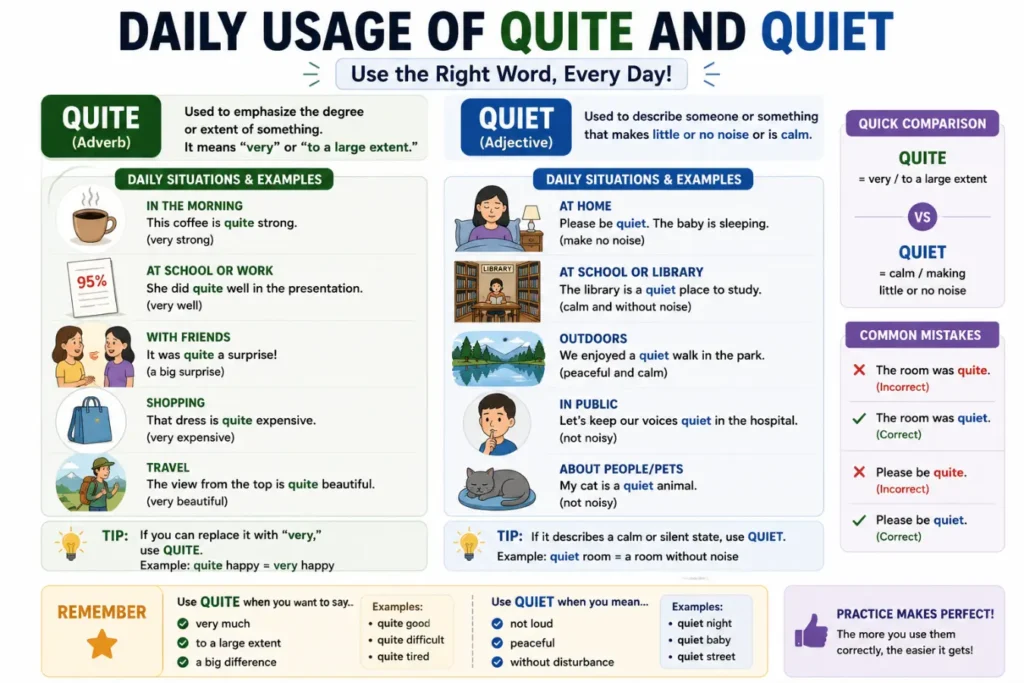
Daily Usage of Quite and Quiet
You will hear these words every day.
Here are some common situations.
Home
- The house is quiet today.
- Dinner was quite delicious.
School
- Please stay quiet during class.
- The lesson was quite easy to understand.
At Work
- The office is usually quiet in the morning.
- Our meeting was quite successful.
While Traveling
- We found a quiet hotel.
- The journey was quite comfortable.
Using these words correctly makes your communication clearer and more professional.
Expert Insights
Grammar experts suggest learning confusing words through context instead of memorizing definitions.
Read books, blogs, newspapers, and emails. Notice how native speakers use quite and quiet in real sentences.
Practice writing your own examples every day. Even a few minutes of practice improves your vocabulary over time.
Professional writers also proofread their work before publishing. A quick review helps catch spelling mistakes, especially with words that look alike.
Using the correct word builds trust with readers. It also improves your writing for school, business, and everyday communication.
Practice Quiz
Test what you have learned.
1. The library was very ______.
Answer: quiet
2. I am ______ happy with the results.
Answer: quite
3. Please keep ______ during the movie.
Answer: quiet
4. The food was ______ delicious.
Answer: quite
5. We enjoyed a ______ evening by the lake.
Answer: quiet
If you answered all five correctly, you understand the difference between quite and quiet.
(FAQs)
1. What is the difference between quite and quiet?
Quite means fairly, very, or completely. Quiet means silent or making little noise.
2. Is it “quite sure” or “quiet sure”?
The correct phrase is quite sure because it describes the degree of certainty.
3. Is it “please be quite” or “please be quiet”?
The correct sentence is Please be quiet because you are asking someone not to make noise.
4. Can quiet be a noun?
Yes. Example: We enjoyed the quiet of the countryside.
5. Can quite describe an adjective?
Yes. It commonly modifies adjectives.
Example: The movie was quite funny.
6. Why do people confuse quite and quiet?
They have similar spellings and similar pronunciation, but their meanings are different.
7. Which word refers to silence?
Quiet always relates to silence or calmness.
Conclusion
Understanding quite or quiet is simple once you know their meanings. Quite describes the degree or intensity of something. Quiet describes silence, calmness, or little noise. Although these words look similar, they serve completely different purposes in English.
A simple memory trick can help you remember the difference. Think of quite when talking about how much and quiet when talking about how much noise. Practice using both words in everyday conversations, emails, and writing exercises.
With regular practice, choosing the correct word becomes easy. Using quite and quiet correctly improves your grammar, builds confidence, and makes your writing clear, professional, and easy to understand.