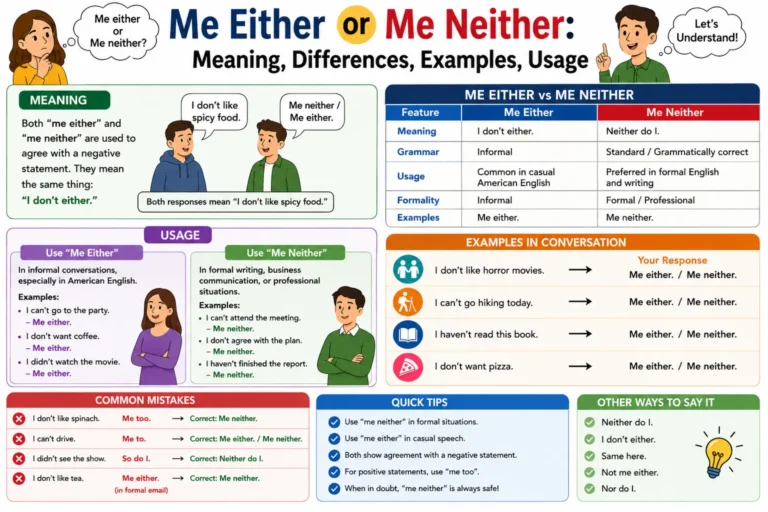
Me either or me neither is one of the most confusing grammar topics for English learners. Both expressions appear in everyday conversations, but many people wonder which one is correct. The answer depends on the sentence and the style of English you use.
In simple English, “me neither” is the grammatically standard response to a negative statement. However, “me either” is also very common in spoken American English. Native speakers use both expressions in casual conversations.
This guide explains the meaning of each phrase, their differences, grammar rules, examples, and common mistakes. By the end, you’ll know exactly when to use each one with confidence.
Quick Summary
Featured Snippet Answer
- “Me neither” is the grammatically correct response to a negative statement.
- “Me either” is common in informal American English.
- Both expressions mean “I don’t either.”
- Use me neither in formal writing.
- Use me either mainly in casual conversations.
- Both express agreement with a negative statement.
What Does “Me Either or Me Neither” Mean?
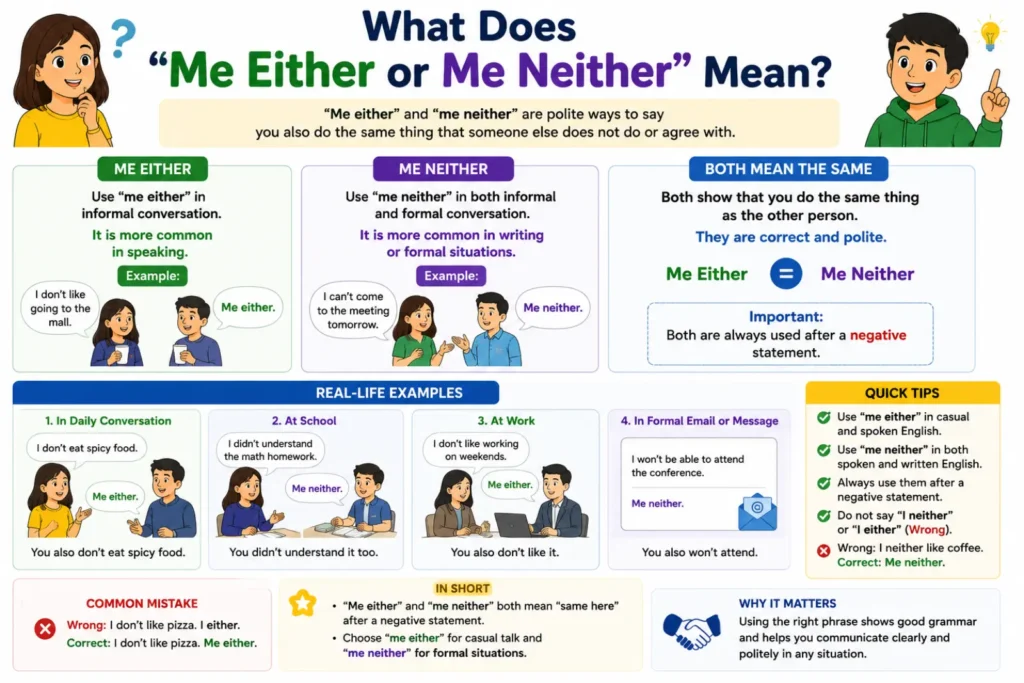
Both expressions show that you agree with someone’s negative statement.
Example
Person A: I don’t like spicy food.
Person B: Me neither.
or
Person B: Me either.
Both answers mean:
I don’t like spicy food either.
Although they have the same meaning, one is considered more grammatically standard.
Is “Me Either” or “Me Neither” Correct?
The short answer is:
| Expression | Correct? | Usage |
|---|---|---|
| Me neither | ✅ Yes | Standard English |
| Me either | ✅ Yes (informal) | Common in American English |
| I don’t either | ✅ Yes | Grammatically complete |
| Neither do I | ✅ Yes | Most formal |
If you’re writing an essay, email, or business document, choose me neither or neither do I.
If you’re chatting with friends, me either sounds natural in many parts of the United States.
Why Do People Say “Me Either”?
Many native English speakers shorten the sentence:
I don’t either.
They simply drop the words I don’t, leaving:
Me either.
Although grammar books once criticized this expression, it has become widely accepted in everyday American speech.
Why Is “Me Neither” Grammatically Correct?
The word neither already carries a negative meaning.
When someone says:
I don’t like coffee.
You can answer:
Me neither.
It means:
Neither do I.
This follows traditional English grammar.
Me Either vs Me Neither
Comparison Table
| Feature | Me Either | Me Neither |
|---|---|---|
| Meaning | I don’t either | Neither do I |
| Grammar | Informal | Standard |
| Formal writing | ❌ Not recommended | ✅ Recommended |
| Everyday speech | ✅ Very common | ✅ Common |
| American English | Very common | Common |
| British English | Less common | Preferred |
| Business writing | Avoid | Use |
Real-Life Examples
Example 1
Sarah: I can’t swim.
John: Me neither.
Example 2
Sarah: I can’t swim.
John: Me either.
Example 3
Emma: I don’t watch horror movies.
Lisa: Me neither.
Example 4
Dad: I didn’t enjoy the movie.
Son: Me either.
Example 5
Teacher: I don’t eat meat.
Student: Neither do I.
This is the most formal version.
When Should You Use “Me Neither”?
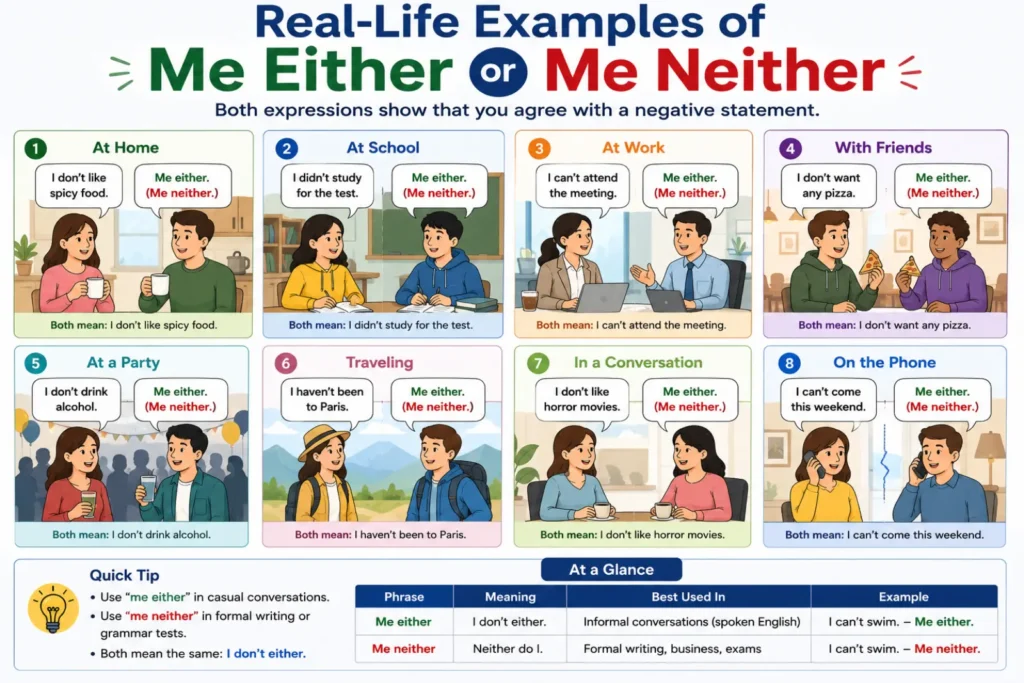
Use me neither when:
- Writing school assignments
- Writing emails
- Speaking in formal situations
- Taking English exams
- Writing professional documents
Examples
- I don’t drink coffee.
- Me neither.
- I haven’t visited Canada.
- Me neither.
- I can’t drive.
- Me neither.
When Should You Use “Me Either”?
Use me either when speaking casually with:
- Friends
- Family
- Classmates
- Coworkers
- Online chats
Examples
Friend: I don’t want pizza.
You: Me either.
Friend: I can’t stay late.
You: Me either.
Common Grammar Patterns
Here are the most common responses.
| Negative Statement | Correct Response |
|---|---|
| I don’t like it. | Me neither. |
| I don’t like it. | Me either. |
| I don’t like it. | Neither do I. |
| I can’t swim. | Me neither. |
| I haven’t finished. | Me either. |
Common Mistakes
Many learners make these mistakes.
Mistake 1
❌ Me too.
After a negative sentence.
Correct:
✅ Me neither.
Mistake 2
❌ Me either.
In formal writing.
Better:
✅ Me neither.
Mistake 3
❌ So do I.
After a negative sentence.
Correct:
✅ Neither do I.
Mistake 4
Using “either” without a negative sentence.
Incorrect:
I like pizza.
Me either.
Correct:
I like pizza.
Me too.
Tips to Remember
Here are easy tricks.
- Negative sentence → Think neither.
- Formal writing → Use me neither.
- Casual American English → Me either sounds natural.
- Positive sentence → Use me too.
- Negative sentence → Use me neither.
Me Either vs Me Too
| Me Too | Me Either |
|---|---|
| Positive agreement | Negative agreement |
| I love pizza. | I don’t like pizza. |
| Me too. | Me either. |
Me Neither vs Neither Do I
Both are correct.
Me neither
Casual but grammatically correct.
Neither do I
More formal.
Example:
Person A: I don’t enjoy cold weather.
Person B: Neither do I.
Everyday Conversations
At School
Friend: I didn’t study.
You: Me neither.
At Work
Coworker: I can’t attend the meeting.
You: Me neither.
At Home
Mom: I don’t feel hungry.
Dad: Me either.
At a Restaurant
Friend: I don’t want dessert.
You: Me neither.
Synonyms and Related Expressions
You can also use:
- Neither do I
- I don’t either
- Same here
- Not me either
- I can’t either
- I didn’t either
- Nor do I
- Nor can I
Related (LSI) Keywords
- me either meaning
- me neither meaning
- me either vs me neither
- neither do I
- I don’t either
- grammar difference
- English speaking phrases
- negative agreement
- common English expressions
- spoken English grammar
Expert Insight
Professional English teachers recommend learning both expressions.
Use me neither when grammar matters. It fits formal writing and exams.
Use me either when speaking naturally with American English speakers. Native speakers use it every day, so understanding it improves listening skills.
The best communicators know when to switch between formal and informal English. This makes your speech sound both correct and natural.
(FAQs)
Is “me either” grammatically correct?
It is accepted in informal American English. Formal grammar prefers me neither.
Which is more common, “me either” or “me neither”?
Both are common. “Me either” appears more often in casual American speech.
Can I use “me either” in an exam?
It is better to use me neither or neither do I.
What does “me neither” mean?
It means I don’t either or Neither do I.
Is “me neither” formal?
Yes. It is the preferred choice in formal English.
What is the opposite of “me neither”?
The opposite depends on the sentence. For positive agreement, use me too.
Can British English use “me either”?
Yes, but me neither is generally more common and preferred.
Which expression should English learners use?
Start with me neither because it follows standard grammar. Learn me either for everyday conversations.
Conclusion
Understanding me either or me neither helps you speak English more naturally and confidently. While me neither is the standard grammatical response to a negative statement, me either is widely used in informal American English and sounds natural in everyday conversations. The key is knowing your audience and the situation. Use me neither in formal writing, school assignments, and professional settings. Save me either for casual conversations with friends and family. By practicing both expressions and recognizing when each fits best, you’ll avoid common grammar mistakes and communicate like a fluent English speaker.