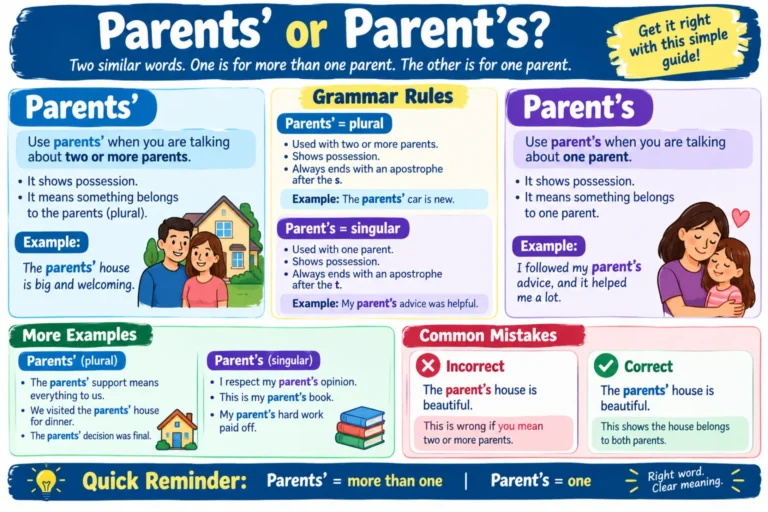
Parents’ or parent’s can look confusing at first. Both forms are correct, but they have different meanings. The key difference is the number of parents involved. Parent’s shows ownership by one parent. Parents’ shows ownership by two or more parents. This small apostrophe difference can change the meaning of a sentence. For example, “my parent’s car” means one parent owns the car. “My parents’ car” means the car belongs to both parents. The good news is that the rule is simple once you know it. In this guide, you will learn when to use parent’s and parents’. You will also see clear examples from daily life. By the end, you should feel confident using both forms in writing.
Quick Summary: Parents’ or Parent’s?
- Parent’s means something belongs to one parent.
- Parents’ means something belongs to two or more parents.
- The apostrophe comes before s in parent’s.
- The apostrophe comes after s in parents’.
- Use parent’s for one parent.
- Use parents’ for more than one parent.
- “My parent’s phone” means one parent owns the phone.
- “My parents’ house” means both parents own the house.
- The correct choice depends on the meaning of your sentence.
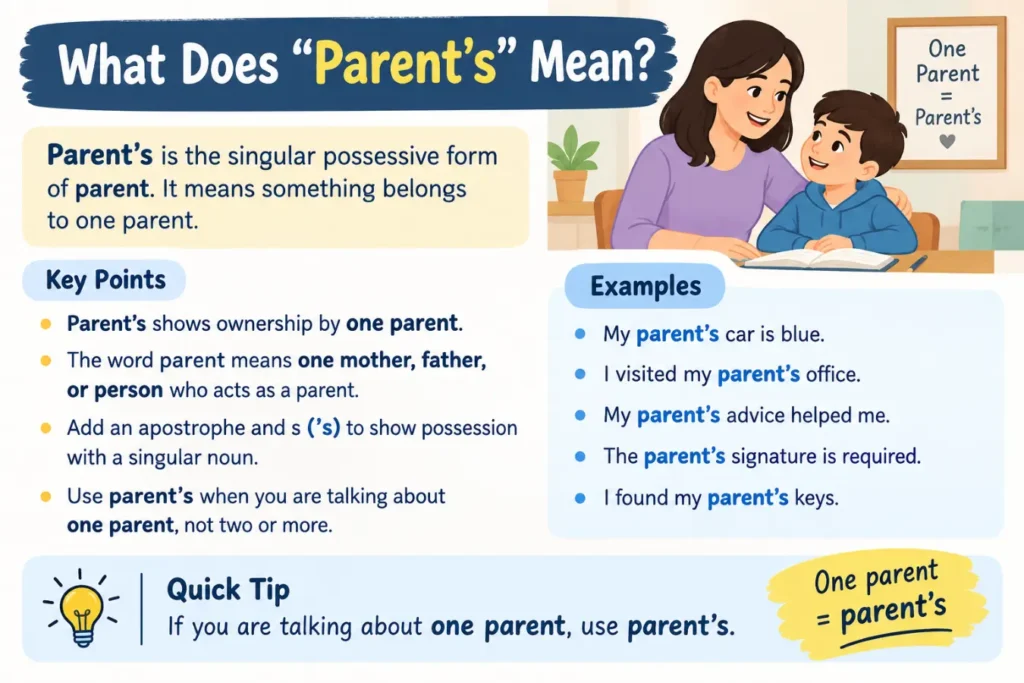
What Does “Parent’s” Mean?
Parent’s is the singular possessive form of parent.
It shows that one parent owns something or has a connection to something.
The word parent means one mother, father, or person who acts as a parent.
When you want to show possession, add an apostrophe and s.
Parent + ‘s = parent’s
For example:
- My parent’s car is blue.
- I visited my parent’s office.
- My parent’s advice helped me.
- The parent’s signature is required.
- I found my parent’s keys.
Each sentence refers to one parent.
The parent could be your mother, father, or another single parent.
Simple rule
Use parent’s when one parent owns or controls something.
Example:
My parent’s phone is on the table.
This means one parent owns the phone.
What Does “Parents’” Mean?
Parents’ is the plural possessive form of parent.
It shows that something belongs to two or more parents.
The plural form of parent is parents.
Because the plural word already ends in s, you only add an apostrophe.
Parents + ‘ = parents’
For example:
- My parents’ house is nearby.
- I followed my parents’ advice.
- My parents’ car needs repairs.
- The parents’ meeting starts at six.
- We attended the parents’ evening.
Each example refers to more than one parent.
Simple rule
Use parents’ when two or more parents own or share something.
Example:
My parents’ house is large.
This means the house belongs to both parents.
Parents’ vs. Parent’s: What Is the Difference?
The main difference is simple.
Parent’s refers to one parent.
Parents’ refers to two or more parents.
| Form | Number of parents | Meaning | Example |
|---|---|---|---|
| parent’s | One | Belonging to one parent | My parent’s car |
| parents’ | Two or more | Belonging to multiple parents | My parents’ car |
| parents | Two or more | More than one parent | The parents arrived |
| parent | One | One parent | The parent arrived |
The apostrophe tells readers who owns something.
Compare these two sentences:
My parent’s room is upstairs.
One parent has the room.
My parents’ room is upstairs.
Two or more parents have the room.
That tiny apostrophe changes the meaning.
When Should You Use “Parent’s”?
Use parent’s when the noun before the apostrophe means one parent.
Here are some common examples:
- The parent’s name is Sarah.
- I called the parent’s phone.
- The parent’s permission is needed.
- My parent’s birthday is tomorrow.
- The parent’s decision surprised us.
- The teacher spoke to the parent’s child.
In each example, only one parent is involved.
A quick test
Ask yourself:
“Am I talking about one parent?”
If the answer is yes, use parent’s.
For example:
I need my parent’s signature.
You mean the signature of one parent.
Therefore, parent’s is correct.
When Should You Use “Parents’”?
Use parents’ when you mean two or more parents.
Here are common examples:
- My parents’ home is in Lahore.
- The parents’ meeting starts at 5 p.m.
- We discussed the parents’ concerns.
- My parents’ advice was useful.
- The parents’ room is upstairs.
- The school needs the parents’ permission.
In these examples, the word refers to multiple parents.
A quick test
Ask yourself:
“Am I talking about more than one parent?”
If yes, use parents’.
For example:
I need my parents’ permission.
You mean permission from your mother and father, or from multiple parents.
Therefore, parents’ is correct.
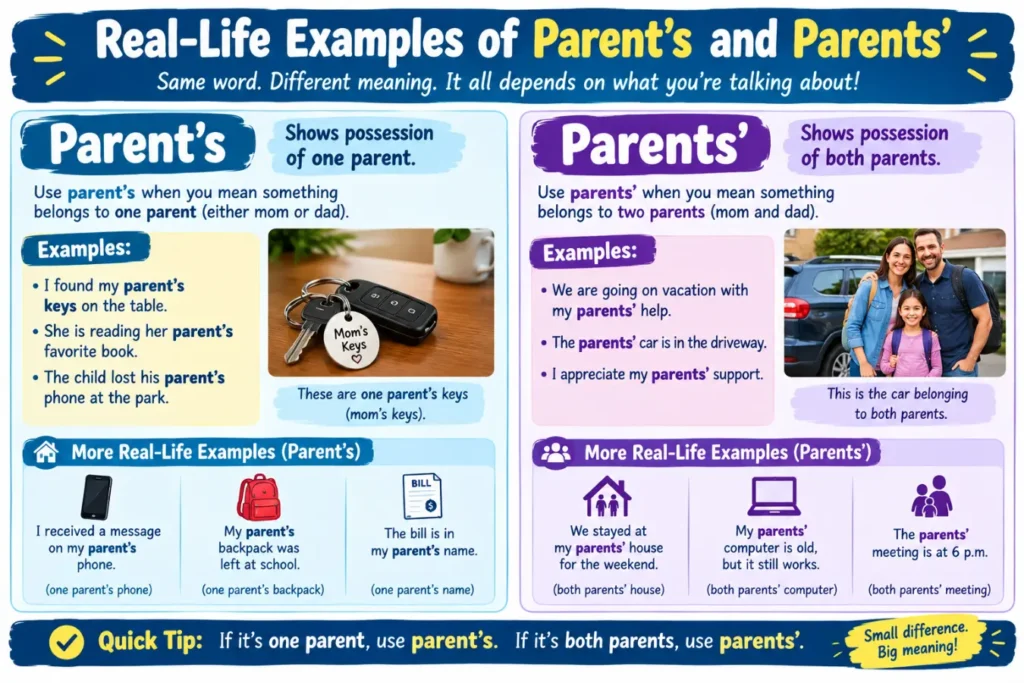
Real-Life Examples of Parent’s and Parents’
Seeing the forms in real situations makes the rule easier.
Example 1: A school form
The parent’s signature is required.
This refers to one parent signing the form.
If both parents must sign, you could write:
The parents’ signatures are required.
Notice the change from parent’s to parents’.
Example 2: A family home
My parent’s house is near the school.
This can mean the house belongs to one parent.
Now compare:
My parents’ house is near the school.
This normally means the house belongs to both parents.
Example 3: A school meeting
The parent’s meeting is tomorrow.
This wording usually suggests a meeting involving one parent.
For a meeting involving multiple parents, write:
The parents’ meeting is tomorrow.
This is the common form for school meetings with many parents.
Example 4: Advice
I followed my parent’s advice.
One parent gave the advice.
I followed my parents’ advice.
Both parents, or multiple parents, gave the advice.
Common Mistakes With Parent’s and Parents’
Many people make the same few mistakes.
Mistake 1: Using “parent’s” for multiple parents
Incorrect:
The parent’s meeting begins at 6 p.m.
If the meeting involves many parents, use:
The parents’ meeting begins at 6 p.m.
Mistake 2: Using “parents’” for one parent
Incorrect:
My parents’ name is Ali.
If only one parent has that name, write:
My parent’s name is Ali.
Mistake 3: Confusing “parents” with “parents’”
Parents is simply the plural of parent.
It does not show possession.
For example:
My parents live nearby.
There is no ownership.
But:
My parents’ house is nearby.
Here, the house belongs to the parents.
Mistake 4: Putting the apostrophe in the wrong place
Remember:
One parent: parent’s
More than one parent: parents’
The apostrophe changes position because of the plural form.
Parent vs. Parents vs. Parent’s vs. Parents’
These four forms can look similar.
However, they serve different purposes.
| Word | Meaning | Example |
|---|---|---|
| parent | One parent | The parent arrived. |
| parents | More than one parent | The parents arrived. |
| parent’s | Something belonging to one parent | The parent’s car is outside. |
| parents’ | Something belonging to multiple parents | The parents’ cars are outside. |
Think of the forms as two separate steps.
First, decide the number:
- One = parent
- More than one = parents
Then decide if you need possession:
- One + possession = parent’s
- More than one + possession = parents’
This simple method prevents most errors.
How to Remember the Apostrophe Rule
A useful memory trick is to look at the final s.
One parent
The word does not end in s.
Add ‘s:
parent → parent’s
Multiple parents
The word already ends in s.
Add only an apostrophe:
parents → parents’
You can remember it this way:
One parent gets ‘s. Multiple parents get s’.
This rule also works with many other plural nouns.
For example:
- teacher → teacher’s
- teachers → teachers’
- student → student’s
- students → students’
The same possessive pattern applies.
Does “Parents’” Always Mean Both Parents?
Not always.
Parents’ is the possessive form of plural parents.
It can refer to two parents or to a larger group of parents.
For example:
The parents’ concerns were discussed.
This could mean concerns shared by many parents.
It does not necessarily mean only mothers and fathers in one family.
The meaning depends on the sentence and context.
For a single family, my parents’ often refers to two parents.
For a group, the parents’ can refer to many parents.
What About “Parents’” With a Curly Apostrophe?
You may see parents’ instead of parents’.
Both forms represent the same grammatical idea.
The difference comes from typography.
- Straight apostrophe: parents’
- Curly apostrophe: parents’
Modern word processors often use curly apostrophes automatically.
The same applies to parent’s and parent’s.
For normal writing, either style can appear depending on the publishing system.
Consistency matters more than the shape of the apostrophe.
Synonyms and Related Grammar Terms
When learning parents’ or parent’s, it helps to know related grammar terms.
Possessive noun
A possessive noun shows ownership or association.
Examples include:
- John’s book
- Mary’s phone
- the teacher’s desk
- the students’ classroom
- my parents’ house
Singular possessive
A singular possessive noun refers to one person or thing.
Example:
My parent’s car is new.
Plural possessive
A plural possessive noun refers to multiple people or things.
Example:
My parents’ car is new.
Related search terms
People often search for these related questions:
- parent’s vs parents’
- parent or parents
- parents’ meaning
- parent’s meaning
- parents apostrophe
- parent’s apostrophe
- plural possessive nouns
- singular possessive nouns
- parents’ grammar
- parent possessive form
- parents possessive form
- parents or parent’s grammar
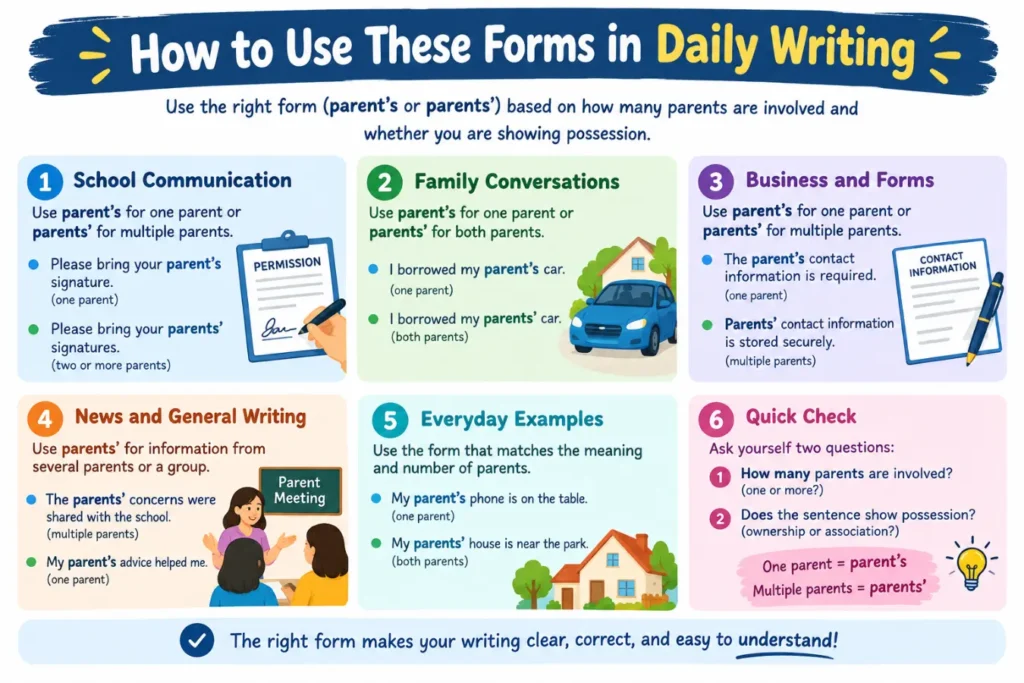
How to Use These Forms in Daily Writing
You will see parent’s and parents’ in many types of writing.
School communication
Please bring your parent’s signature.
Use this when one parent’s signature is enough.
For multiple parents:
Please bring your parents’ signatures.
Family conversations
I borrowed my parent’s car.
One parent owns the car.
I borrowed my parents’ car.
The car belongs to both parents.
Business and forms
The parent’s contact information is required.
This refers to one parent.
For a group:
Parents’ contact information is stored securely.
The phrase refers to information from multiple parents.
News and general writing
The parents’ concerns were shared with the school.
This refers to concerns from several parents.
Using the correct possessive form makes the sentence clearer.
Expert Grammar Tips for Better Writing
Good grammar often comes down to checking meaning first.
Do not choose an apostrophe based only on how the word sounds.
Instead, ask three questions.
1. How many parents do I mean?
One parent or multiple parents?
2. Does the sentence show possession?
Are you showing ownership or association?
3. Where does the plural “s” appear?
If the noun is singular, use ‘s.
If the noun is a regular plural ending in s, use s’.
This method works far beyond the word parent.
For example:
The child’s toy
One child.
The children’s toys
Multiple children.
The apostrophe rules depend on the noun’s form.
FAQs About Parents’ or Parent’s
Is it “parents’” or “parent’s”?
Both are correct, but they have different meanings. Parent’s means one parent. Parents’ means two or more parents.
Is “parents’” plural or possessive?
Parents’ is a plural possessive form. Parents is plural, while the apostrophe shows possession.
Is “parent’s” singular possessive?
Yes. Parent’s is the singular possessive form of parent.
Which is correct: “my parent’s house” or “my parents’ house”?
Both can be correct. Use my parent’s house for one parent. Use my parents’ house when the house belongs to multiple parents.
What is the plural of “parent’s”?
The plural of parent is parents. The plural possessive form is parents’.
Where does the apostrophe go in “parents”?
For possessive parents, put the apostrophe after the s:
parents’
Is “parents” possessive without an apostrophe?
No. Parents is simply the plural form. Add an apostrophe when you need to show possession.
How can I quickly remember the difference?
Use this rule:
One parent = parent’s.
Two or more parents = parents’.
Conclusion
Understanding parents’ or parent’s becomes easy once you focus on number and possession. Parent’s refers to one parent. Parents’ refers to two or more parents. The apostrophe also tells readers where possession occurs. one parent, use ‘s. For regular plural parents, place the apostrophe after the final s. For example, “my parent’s car” means one parent’s car. “My parents’ car” usually means the car belongs to both parents. These forms appear often in school, family, business, and everyday writing. When you feel unsure, ask how many parents you mean. Then check whether the sentence shows possession. That quick check will help you choose the correct form every time.