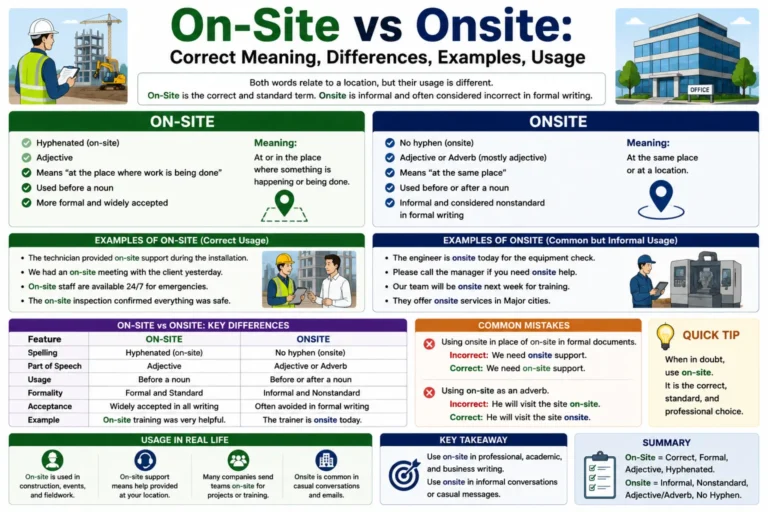
On-site vs onsite is a common question for writers, marketers, business owners, and students. Many people wonder which spelling is correct. The answer depends on how you use the word.
Both forms appear online. However, they do not always follow the same grammar rules. Using the correct version makes your writing look more professional. It also helps readers understand your message.
This guide explains the difference in simple words. You will learn when to use on-site and when onsite works. You will also see real-life examples, common mistakes, expert tips, and SEO advice.
By the end of this article, you will know the correct spelling for every situation.
Quick Summary
- On-site is the traditional and most widely accepted spelling.
- Onsite is becoming more common, especially in business and technology.
- Use on-site as an adjective before a noun.
- Use on site as an adverb after a verb.
- Many style guides still recommend on-site.
- Consistency is more important than mixing spellings.
- Both versions can rank well in search engines.
Featured Snippet
On-site is the traditional hyphenated form used as an adjective before a noun, such as “on-site training.” On site is used after a verb, such as “employees work on site.” Onsite is an accepted closed compound in many modern business and technology contexts, but on-site remains the safest choice for formal writing.
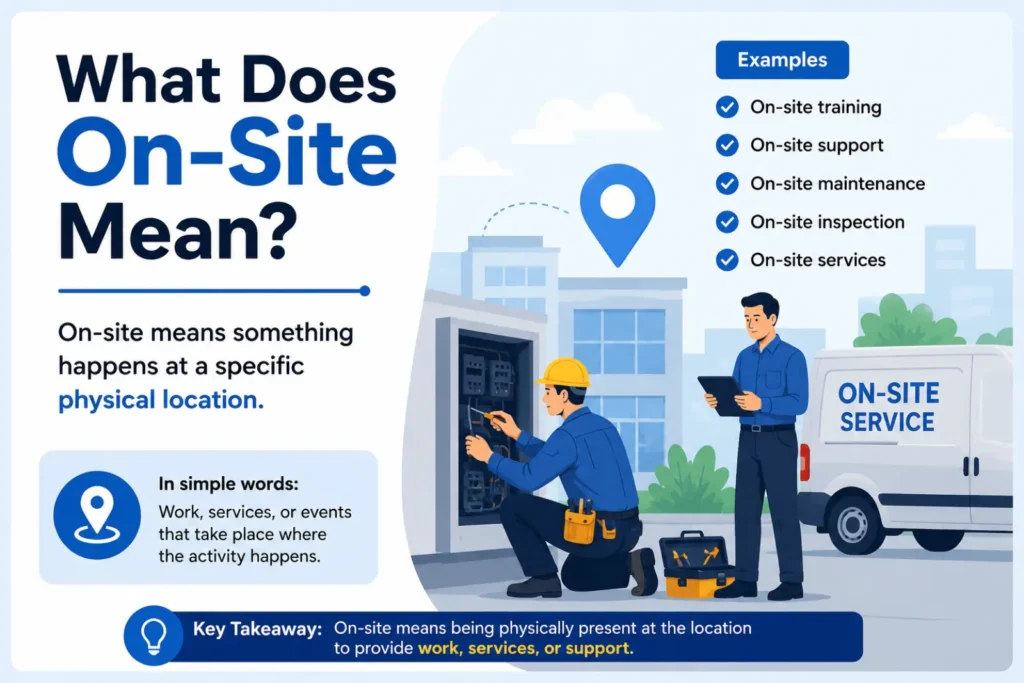
What Does On-Site Mean?
On-site means something happens at a specific physical location.
It describes work, services, meetings, repairs, training, or events that take place where the activity happens.
Examples
- The company offers on-site training.
- We provide on-site support.
- The hotel has on-site parking.
- The technician completed an on-site inspection.
In each sentence, the word describes a noun.
What Does Onsite Mean?
Onsite has the same meaning as on-site.
The difference is only the spelling.
Many companies use onsite because modern branding prefers shorter words. Technology companies also use it frequently.
Examples include:
- Onsite support
- Onsite engineer
- Onsite interview
- Onsite services
Although many readers accept this spelling, some editors still prefer the hyphenated version.
On-Site vs Onsite: What’s the Difference?
The meaning is the same.
The main difference is grammar, style, and editorial preference.
| Feature | On-Site | Onsite |
|---|---|---|
| Traditional spelling | ✅ Yes | ❌ No |
| Modern spelling | Yes | ✅ Yes |
| Formal writing | ✅ Best choice | Sometimes |
| Business websites | Common | Very common |
| Technology industry | Common | ✅ Very common |
| AP Style friendly | ✅ Yes | Usually No |
| Easy for branding | Good | ✅ Better |
Recommendation: If you write for a broad audience, choose on-site.
On-Site vs On Site
Many people confuse these two forms.
They are not always interchangeable.
Use on-site before a noun.
Examples
- On-site maintenance
- On-site security
- On-site technician
- On-site services
Use on site after a verb.
Examples
- The engineer works on site.
- Employees stayed on site.
- Contractors arrived on site early.
- The team remained on site overnight.
This follows standard English grammar.
When Should You Use On-Site?
Use on-site when it describes another word.
Examples include:
- on-site support
- on-site repair
- on-site consultation
- on-site inspection
- on-site meeting
- on-site assistance
- on-site installation
- on-site maintenance
This is the safest choice for business writing.
When Is Onsite Acceptable?
Many companies now use onsite in:
- Software documentation
- IT companies
- Job listings
- HR documents
- Product pages
- Marketing content
Examples
- Onsite interview
- Onsite engineer
- Onsite consultant
- Onsite service team
If your company style guide uses onsite, stay consistent throughout your content.
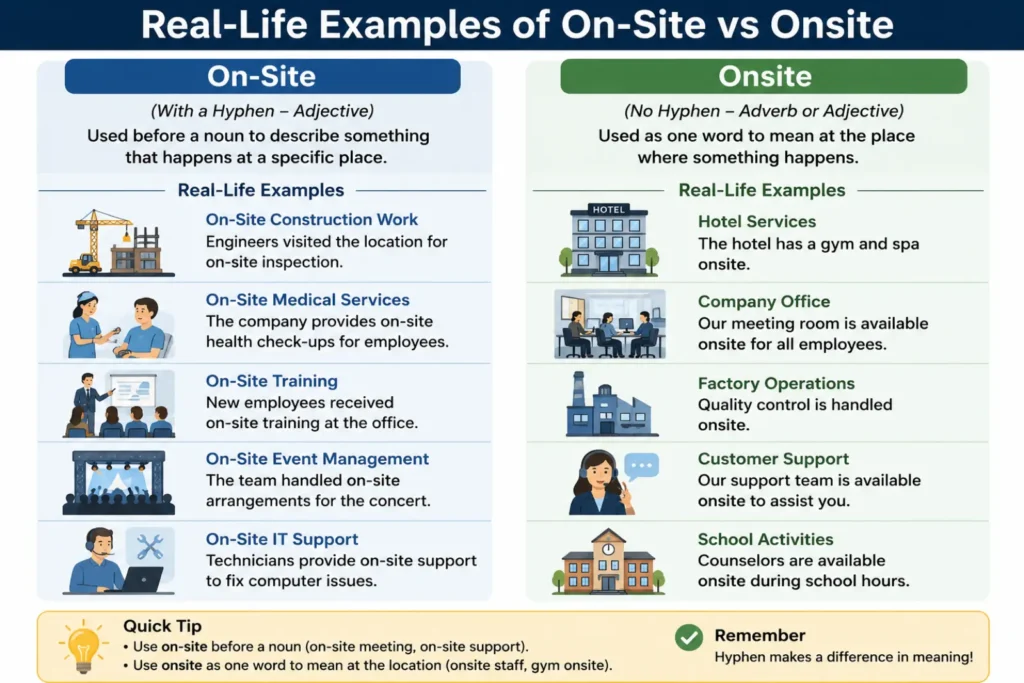
Real-Life Examples
Business
“Our company provides on-site consulting.”
Healthcare
“The clinic offers on-site testing.”
Education
“The school arranged on-site workshops.”
Construction
“The manager stayed on site all day.”
Technology
“The client requested onsite support.”
Common Mistakes
Many writers make these mistakes.
Mixing spellings
❌ Onsite support and on-site maintenance in one article.
Choose one style.
Using on-site after a verb
❌ The engineer stayed on-site.
Better:
✅ The engineer stayed on site.
Forgetting grammar
Remember:
- On-site = adjective
- On site = adverb
- Onsite = modern compound adjective
Tips for Choosing the Right Spelling
Follow these tips.
- Use on-site for formal content.
- Use onsite if your brand already prefers it.
- Follow your company’s style guide.
- Stay consistent throughout the article.
- Check client requirements before publishing.
- Use one spelling in headings and body text.
Consistency improves readability.
How Businesses Use On-Site Every Day
Many industries use this word daily.
Examples include:
- On-site repairs
- On-site customer support
- On-site inspections
- On-site meetings
- On-site healthcare
- On-site childcare
- On-site training
- On-site maintenance
- On-site security
- On-site installation
These services help customers receive support at their location.
Synonyms and Related Keywords
Use these naturally throughout your content.
Synonyms
- at the location
- at the premises
- in person
- locally
- physically present
LSI Keywords
- on-site services
- onsite services
- on-site support
- onsite support
- on-site inspection
- onsite engineer
- on-site maintenance
- remote vs on-site
- on-site work
- on-site employee
- field service
- workplace location
- physical location
- office-based work
These related terms improve topical relevance without keyword stuffing.
Expert Insights
Language changes over time.
Many closed compounds begin with a hyphen before becoming one word. Examples include:
- e-mail → email
- online
- website
Some experts believe onsite may eventually become the standard spelling.
Today, however, on-site remains the safest choice for formal writing, academic work, legal documents, and professional websites.
If SEO is your goal, include both spellings naturally. This helps capture different search queries while keeping the content readable.
Frequently Asked Questions
Is on-site or onsite correct?
Both are correct. On-site is the traditional spelling. Onsite is common in modern business writing.
Which spelling is better?
For formal writing, use on-site.
Does Google treat onsite and on-site differently?
Google understands both spellings. It recognizes them as closely related terms.
Is onsite one word?
Yes. Many companies now write it as one word.
What is the difference between on-site and on site?
On-site comes before a noun.
On site follows a verb.
Which spelling should businesses use?
Follow your brand style guide. If none exists, choose on-site for consistency.
Can I use both spellings in one article?
It is better to stay consistent unless you are explaining the difference.
Conclusion
Understanding on-site vs onsite helps you write with confidence. Both spellings share the same meaning, but their use depends on grammar, style, and audience. On-site remains the preferred choice for formal writing because it follows traditional style guides. Onsite has become popular in technology, marketing, and business communication. If you use one version consistently, readers will find your content easier to follow. For SEO, include both spellings naturally where they fit the context. This approach helps search engines understand your topic while keeping your writing clear and professional. Whether you write for a blog, business website, or academic audience, choosing the right form will improve readability, credibility, and user