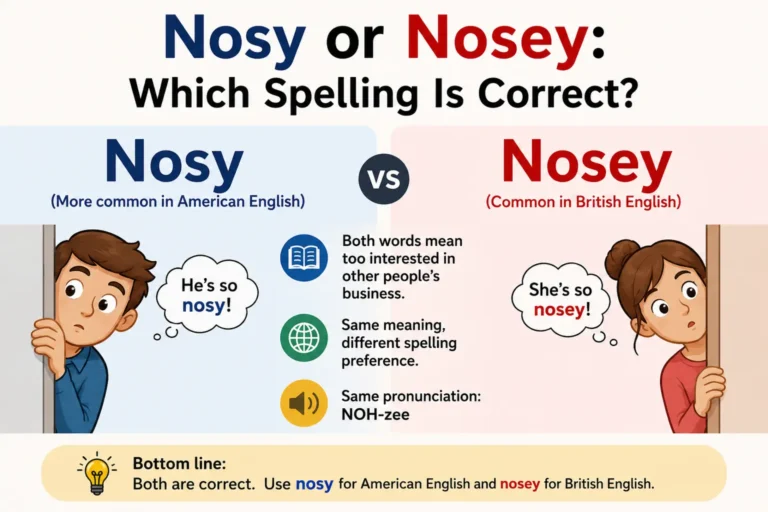
Nosy or nosey both mean the same thing. They describe someone who asks too many personal questions or shows too much interest in other people’s business. The main difference comes from spelling preference. Nosy is more common in American English. Nosey is also correct and appears often in British English. Both forms work in everyday writing. However, your audience can guide your choice. This guide explains the meaning, spelling, pronunciation, examples, and common mistakes. You will also learn which version works best for different types of writing. By the end, you will know exactly when to use nosy or nosey. You will also understand related words like curious, inquisitive, and prying.
Quick Summary
- Nosy and nosey have the same meaning.
- Both spellings describe unwanted interest in private matters.
- Nosy appears more often in American English.
- Nosey is common in British English.
- Both forms work as adjectives.
- The noun form is usually nosiness or noseyness.
- Use nosy for a widely recognized spelling.
- Use nosey when following British spelling preferences.
What Does “Nosy or Nosey” Mean?
Nosy or nosey means overly interested in other people’s private lives.
A nosy person often asks personal questions. They may also try to learn information that does not concern them.
For example:
“Why are you being so nosy?”
This sentence means someone is asking questions about private matters.
The word can sound playful, annoyed, or insulting. The meaning depends on the situation and tone.
Simple definition
Nosy or nosey means too interested in other people’s personal business.
The word usually describes behavior. It does not always describe a person’s entire personality.
Someone may act nosy once. That does not mean they are always nosy.
Nosy vs Nosey: Which Spelling Is Correct?
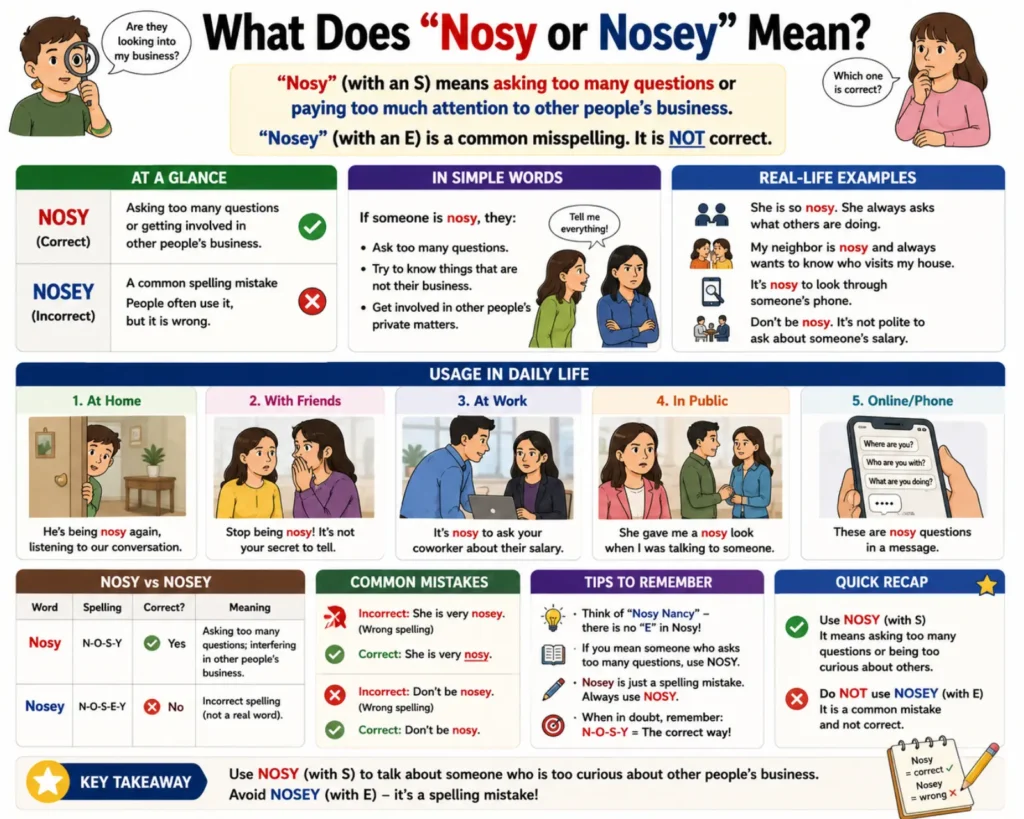
Both nosy and nosey are correct spellings.
They have the same meaning and pronunciation. The main difference involves regional spelling preferences.
| Spelling | Meaning | Common usage |
|---|---|---|
| Nosy | Too interested in private matters | More common in American English |
| Nosey | Too interested in private matters | Common in British English |
You can use either spelling in most informal situations.
However, consistency matters. Choose one spelling and use it throughout your article or document.
Is “Nosy” or “Nosey” More Common?
Nosy is generally the more common spelling in modern English.
Many American dictionaries and style guides prefer nosy. British writers often use nosey.
The choice may also depend on the publication, audience, or country.
For example:
- A US blog may prefer nosy neighbor.
- A UK article may prefer nosey neighbour.
- A global website may choose nosy for wider recognition.
If you need one default spelling, nosy offers a simple choice.
What Is the Difference Between Nosy and Nosey?
There is no major difference in meaning.
Both words describe someone who interferes in private matters.
The difference mainly involves spelling and regional preference.
Think of them as two versions of the same word.
Example
- My nosy neighbor asked about my salary.
- My nosey neighbour asked about my salary.
Both sentences express the same idea.
The first version follows a common American style. The second version follows a common British style.
How Do You Pronounce Nosy and Nosey?
Nosy and nosey sound the same.
The pronunciation is usually:
NOH-zee
The first part sounds like nose. The ending sounds like the letter E.
The spelling does not change the pronunciation.
That makes this word easy to understand in speech. However, writers often wonder which spelling they should choose.
Real-Life Examples of Nosy or Nosey
The word appears in many everyday situations.
Example 1: A personal question
“Why does your friend keep asking about your relationship?”
“She is being nosy.”
Here, the person asks questions about private matters.
Example 2: A neighbor
“Our nosy neighbor always wants to know who visits us.”
The neighbor shows too much interest in someone else’s life.
Example 3: A workplace
“A nosey coworker asked about my salary.”
The coworker asks a question that may feel too personal.
Example 4: A family conversation
“My aunt can be very nosy during family gatherings.”
The aunt asks many personal questions.
Example 5: A playful situation
“You are so nosy! I wanted the surprise to stay secret.”
Here, nosy sounds playful rather than harsh.
When Should You Use “Nosy” in Daily Life?
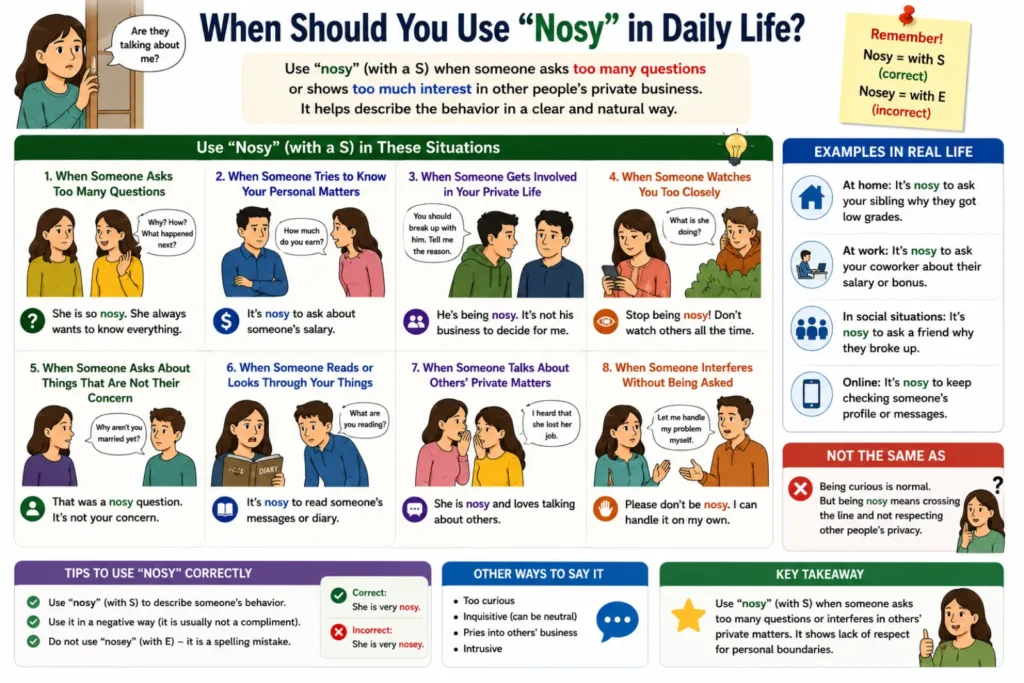
You can use nosy when someone asks unwanted personal questions.
Common situations include:
- Asking about someone’s salary
- Asking about private relationships
- Reading someone else’s messages
- Listening to private conversations
- Asking about personal problems
- Investigating someone’s family matters
- Wanting details about private decisions
However, context matters.
A person can ask a personal question without being nosy. The word usually suggests that the question crosses a boundary.
Example
A close friend asks:
“Are you feeling okay?”
That question usually sounds caring.
A stranger asks:
“Why did you break up with your partner?”
That question may sound nosy.
Nosy vs Curious: What Is the Difference?
Curious and nosy both describe interest.
However, they do not have the same tone.
| Word | Meaning | Tone |
|---|---|---|
| Curious | Wanting to learn something | Usually positive or neutral |
| Nosy | Wanting private information | Usually negative |
| Nosey | Same meaning as nosy | Usually negative |
Compare these examples
Curious:
“I am curious about how this machine works.”
This shows a healthy desire to learn.
Nosy:
“Why did you quit your job?”
This may sound too personal.
Therefore, curious often sounds polite. Nosy often suggests poor boundaries.
Nosy vs Inquisitive vs Prying
These words share similar meanings. Yet, each word has a different tone.
Curious
A curious person wants to understand something.
Example:
“She was curious about the new project.”
Inquisitive
An inquisitive person asks many questions.
This word often sounds more positive than nosy.
Example:
“The inquisitive student asked thoughtful questions.”
Nosy or Nosey
A nosy person asks about private matters.
Example:
“My nosy neighbor asked about my finances.”
Prying
A prying person tries to discover private information.
This word often sounds stronger than nosy.
Example:
“His prying questions made everyone uncomfortable.”
Common Mistakes With “Nosy or Nosey”
Many writers make small mistakes with these words.
Mistake 1: Thinking only one spelling is correct
Both nosy and nosey are accepted spellings.
Do not assume one form is always wrong.
Mistake 2: Confusing “nosy” with “curious”
These words can overlap. However, nosy usually carries a negative meaning.
Mistake 3: Using “nosey” as a noun
The word usually works as an adjective.
Correct:
“She is nosy.”
Incorrect:
“She is a nosy.”
You can say:
“She is a nosy person.”
Mistake 4: Overusing the word
Do not call every question nosy.
Some questions show care, interest, or genuine curiosity.
Mistake 5: Ignoring your audience
Choose spelling based on your target readers.
American readers may expect nosy. British readers may prefer nosey.
Tips for Choosing Nosy or Nosey
Use these simple tips when choosing the correct spelling.
Choose “nosy” when:
- You write for American readers.
- You want the more widely recognized form.
- You follow American English style.
- You write general online content.
Choose “nosey” when:
- You write for British readers.
- Your publication follows British English.
- You want consistent British spelling.
- Your surrounding text uses British spelling.
Best general tip
When no regional style guide exists, nosy is a safe default.
Most readers understand both spellings.
Synonyms and Related Words for Nosy
You can replace nosy with several related words.
Common synonyms
- Inquisitive
- Curious
- Prying
- Intrusive
- Meddlesome
- Interfering
- Snooping
- Personal
- Overly curious
Each word has a slightly different meaning.
Stronger alternatives
Intrusive suggests unwanted involvement.
Prying suggests an attempt to discover private information.
Meddlesome suggests interference in other people’s affairs.
Snooping suggests secretly looking for information.
Softer alternatives
Curious sounds more polite.
Inquisitive often sounds intelligent or positive.
This difference matters when choosing the right word.
NLP and LSI Keywords Related to Nosy or Nosey
Search engines understand related phrases and semantic meaning.
Useful related keywords include:
- nosy meaning
- nosey meaning
- nosy definition
- nosey definition
- nosy or nosey spelling
- is nosy correct
- is nosey correct
- difference between nosy and nosey
- nosy person meaning
- what does nosy mean
- what does nosey mean
- nosy synonym
- nosey synonym
- curious vs nosy
- prying meaning
- intrusive questions
- personal questions
- American spelling of nosy
- British spelling of nosey
Use these terms naturally. Avoid repeating them in every paragraph.
Expert Insights
Strong writing depends on more than correct spelling.
It also depends on audience, tone, and context.
Here are useful expert tips:
1. Match your audience
Use regional spelling consistently.
This approach improves clarity and reader trust.
2. Consider tone
Curious sounds softer than nosy.
Choose the word that matches your intended meaning.
3. Avoid unnecessary judgment
Someone may ask personal questions without bad intentions.
Context helps determine whether the behavior seems nosy.
4. Use natural language
Search engines now understand meaning and context.
Write for readers first.
Then include related terms naturally.
5. Build topical authority
Explain spelling, meaning, examples, synonyms, and related terms.
This creates a complete resource for readers.
Frequently Asked Questions About Nosy or Nosey
Is “nosy” or “nosey” correct?
Both nosy and nosey are correct spellings. They have the same meaning.
Is “nosy” more common than “nosey”?
Yes. Nosy is generally more common, especially in American English.
Is “nosey” a British spelling?
Yes. Nosey is commonly used in British English.
What does nosy mean?
Nosy means showing too much interest in another person’s private business.
Is being nosy always bad?
Not always. The word usually sounds negative, but people sometimes use it playfully.
What is a synonym for nosy?
Common synonyms include prying, intrusive, inquisitive, and overly curious.
Is curious the same as nosy?
No. Curious often sounds neutral or positive. Nosy usually suggests unwanted interest.
How do you use nosy in a sentence?
You can say, “My nosy neighbor asked me several personal questions.”
Conclusion
Nosy or nosey are both correct spellings. Both words describe someone who shows too much interest in another person’s private business. The main difference involves regional preference. Nosy appears more often in American English. Nosey remains common in British English. Both forms have the same meaning and pronunciation. When choosing between them, consider your audience and writing style. If you need one widely recognized option, nosy makes a strong default choice. Remember the difference between curious and nosy. Curiosity often sounds positive. Nosiness usually suggests unwanted interest. The simple takeaway is clear: use either spelling, but stay consistent throughout your writing.