Have you ever wondered whether you should write no where or nowhere? You are not alone. Many students and English learners make this mistake because both versions seem possible. However, only one spelling is correct in standard English.
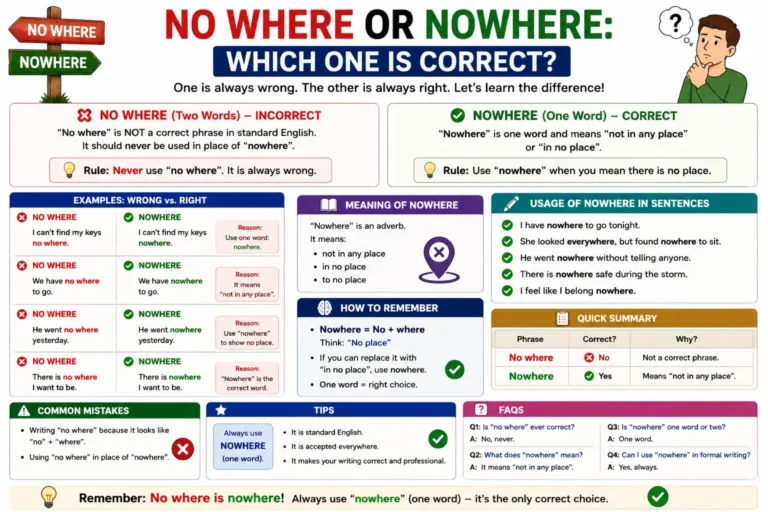
The correct form is nowhere. It is written as one word and means “not in any place.” The spelling “no where” is almost always incorrect in modern English.
Knowing this small grammar rule can improve your writing. It also helps you avoid common spelling mistakes in school assignments, emails, exams, and everyday communication.
This guide explains everything you need to know. You will learn the meaning of nowhere, see real-life examples, compare the two spellings, and discover simple tricks to remember the correct form.
Quick Summary
Featured Snippet Answer
- Nowhere is the correct spelling.
- No where is incorrect in modern English.
- Nowhere means “not in any place.
- Always use nowhere in formal and informal writing.
- Remember: one word, one meaning.
What Does “Nowhere” Mean?
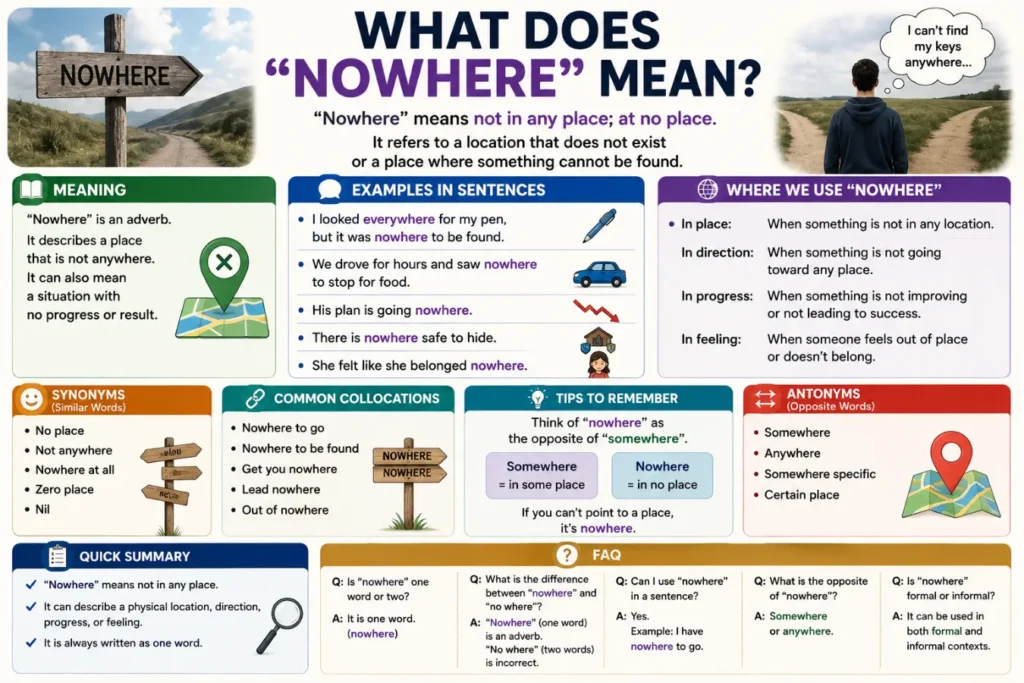
The word nowhere means not in any place.
It describes a situation where something or someone cannot be found.
Examples
- My notebook is nowhere in my bag.
- The answer is nowhere on this page.
- We are nowhere near the finish line.
- The missing file is nowhere to be found.
In each sentence, nowhere tells us that something does not exist in any location.
Is “No Where” a Real Word?
The simple answer is no.
Modern English dictionaries do not accept no where as the standard spelling.
Although you may see it because of typing mistakes or old texts, you should never use it in normal writing.
Wrong
❌ I can find it no where.
Correct
✅ I can find it nowhere.
No Where or Nowhere: What’s the Difference?
Many students search for no where or nowhere because the two versions look similar.
The difference is easy to understand.
| Feature | No Where | Nowhere |
|---|---|---|
| Standard English | ❌ No | ✅ Yes |
| Correct Spelling | ❌ No | ✅ Yes |
| Found in Dictionaries | ❌ No | ✅ Yes |
| Suitable for Exams | ❌ No | ✅ Yes |
| Used in Professional Writing | ❌ No | ✅ Yes |
Final Answer: Always choose nowhere.
Why Do Students Make This Mistake?
Many learners separate the word because it contains no and where.
This seems logical, but English has many compound words.
Here are a few examples.
- Everywhere
- Somewhere
- Anywhere
- Nowhere
Each word is written together.
That is why nowhere also stays as one word.
Real-Life Examples
Learning becomes easier with examples.
At School
Incorrect:
❌ My homework is no where.
Correct:
✅ My homework is nowhere.
During an Exam
Incorrect:
❌ The answer is no where in the passage.
Correct:
✅ The answer is nowhere in the passage.
At Home
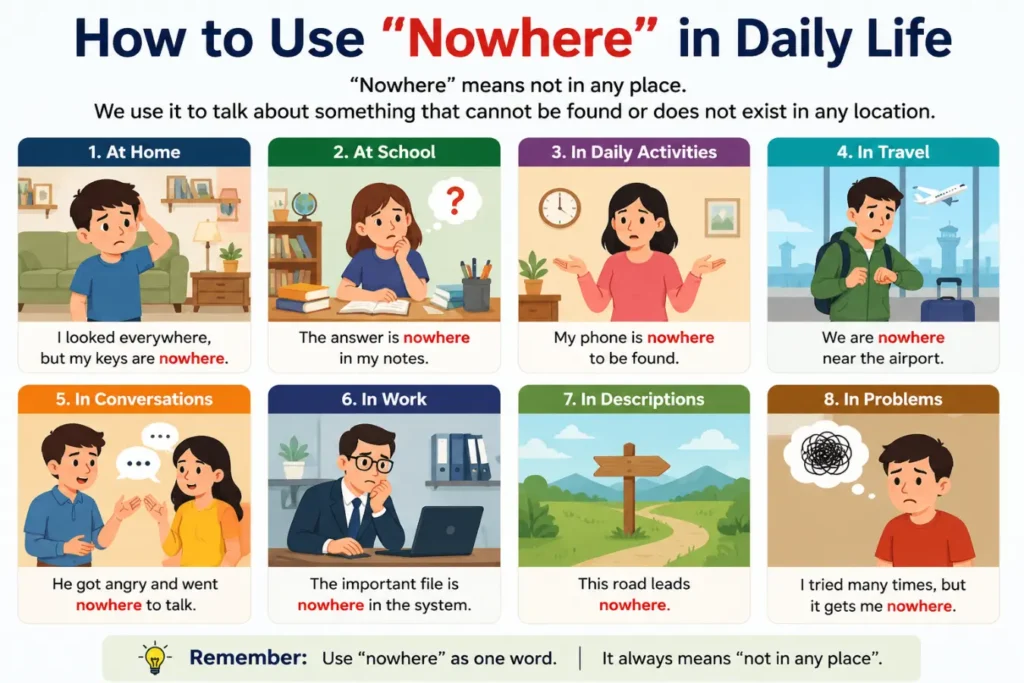
- My shoes are nowhere.
- My charger is nowhere to be found.
- The TV remote is nowhere on the table.
At Work
- The report is nowhere in the folder.
- Your name is nowhere on the list.
Common Expressions Using “Nowhere”
English speakers often use these phrases.
- nowhere to be found
- nowhere near
- nowhere else
- nowhere in sight
- nowhere around
- came from nowhere
- leads nowhere
- gets nowhere
These expressions appear in books, newspapers, websites, and conversations.
Common Mistakes to Avoid
Mistake 1
Writing no where instead of nowhere.
Always write one word.
Mistake 2
Using extra spaces while typing.
Check your work before submitting it.
Mistake 3
Ignoring spell-check suggestions.
Most writing tools will recommend nowhere.
Mistake 4
Copying incorrect spelling from social media.
Always trust dictionaries instead of random posts.
Easy Tricks to Remember
Here are simple memory tips.
Think About Similar Words
- somewhere
- anywhere
- everywhere
- nowhere
They all follow the same pattern.
Read the Sentence
If it means not in any place, write nowhere.
Practice Daily
Write five sentences using nowhere every day.
Practice helps you remember faster.
How to Use “Nowhere” in Daily Life
You will use this word in many situations.
Examples include:
- School essays
- Classroom discussions
- Emails
- Text messages
- Blog writing
- Business communication
- Social media posts
Correct spelling creates a better impression.
Synonyms and Related Words
These words have similar meanings.
Synonyms
- not anywhere
- absent
- missing
- gone
- unavailable
- in no place
Related Search Terms
- nowhere grammar
- nowhere definition
- no where vs nowhere
- nowhere meaning
- English grammar guide
- spelling mistakes
- English vocabulary
- grammar rules
- common writing errors
Expert Insight
Professional editors agree on one important rule.
Always write nowhere as one word.
Using the correct spelling improves your writing quality. It also helps teachers, employers, and readers trust your work.
Search engines reward useful, accurate, and well-written content. Small grammar mistakes can reduce credibility. Learning correct spellings makes your writing stronger and easier to understand.
Why Learning This Rule Matters
Good grammar is more than passing exams.
Correct spelling helps you:
- Write better assignments.
- Score higher in English tests.
- Create professional emails.
- Improve communication.
- Build confidence in writing.
Even one small spelling mistake can change how people judge your work.
Frequently Asked Questions
Is “no where” correct?
No. The correct spelling is nowhere.
What does “nowhere” mean?
It means not in any place.
Why is “nowhere” one word?
English treats it as a compound word, just like somewhere and everywhere.
Can I use “no where” in school assignments?
No. Teachers expect the correct spelling nowhere.
Is “nowhere” an adverb?
Yes. It usually functions as an adverb of place.
How can I remember the spelling?
Remember this sentence:
Somewhere, anywhere, everywhere, nowhere.
All four words stay together.
Do dictionaries accept “no where”?
No. Standard dictionaries list only nowhere.
Quick Grammar Quiz
Choose the correct answer.
- My wallet is ________.
- A. no where
- B. nowhere ✅
- The answer is ________ in the book.
- A. nowhere ✅
- B. no where
- We are ________ near the airport.
- A. nowhere ✅
- B. no where
Final Tips for Students
Before submitting your homework:
- Check spelling carefully.
- Read each sentence aloud.
- Use a grammar checker.
- Look for accidental spaces.
- Learn common compound words.
These habits improve your English over time.
Conclusion
The confusion between no where or nowhere is easy to solve. The correct spelling is nowhere, and it should always be written as one word. It means not in any place and appears in everyday conversations, books, websites, and school assignments. The form no where is considered incorrect in modern English and should be avoided. By remembering this simple rule and practicing it regularly, you can improve your grammar, write with confidence, and avoid one of the most common English spelling mistakes. Good writing starts with small details, and using nowhere correctly is one of them.