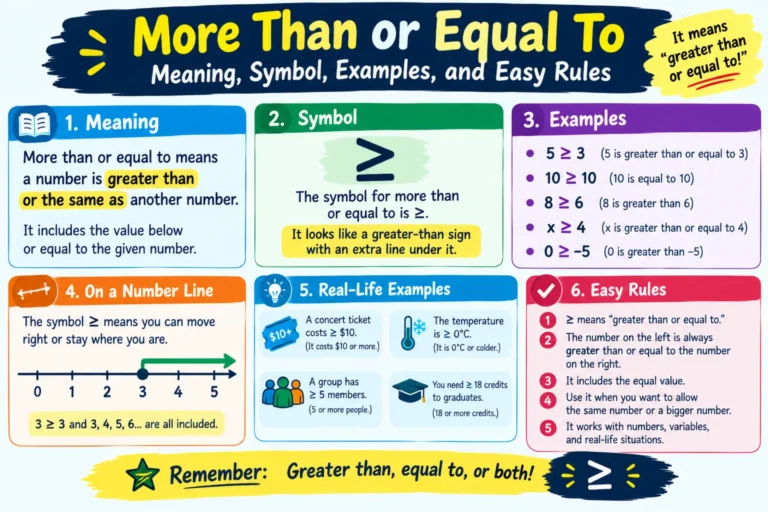
More than or equal to is a common math phrase that means one number is greater than another number or equal to it. It uses the symbol ≥. This symbol combines two ideas: “more than” and “equal to.” You will often see it in math problems, inequalities, graphs, and real-life rules. Learning this simple symbol can make many math questions easier. It also helps you understand limits, ranges, scores, ages, prices, and measurements. In this guide, you will learn what more than or equal to means. You will also learn how to use ≥ correctly. Simple examples will help you understand the idea quickly. By the end, you should feel comfortable reading and writing this inequality.
Quick Summary: More Than or Equal To
- More than or equal to means greater than or the same as another value.
- The mathematical symbol is ≥.
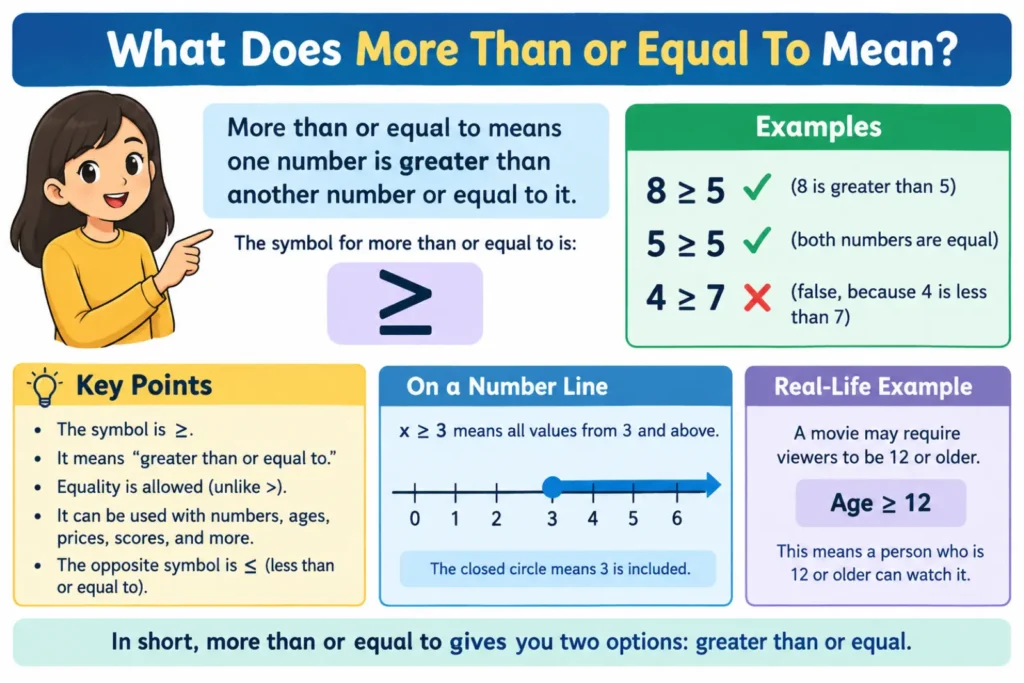
- 8 ≥ 5 means 8 is more than or equal to 5.
- 5 ≥ 5 is also true because both numbers are equal.
- The statement 4 ≥ 7 is false because 4 is less than 7.
- The symbol ≥ allows two possible cases: greater than or equal.
- You can use it with numbers, ages, prices, scores, distances, and measurements.
- The opposite symbol is ≤, which means less than or equal to.
What Does More Than or Equal To Mean?
More than or equal to means that one value can be greater than another value or exactly the same.
For example:
10 ≥ 6
This statement is true because 10 is greater than 6.
Now look at this example:
6 ≥ 6
This statement is also true because both numbers are equal.
So, “more than or equal to” gives us two choices:
- The first number is greater.
- Both numbers are equal.
This makes it different from more than, which does not allow equality.
For example, 6 > 6 is false.
However, 6 ≥ 6 is true.
What Is the Symbol for More Than or Equal To?
The symbol for more than or equal to is:
≥
It has two parts.
- > means more than.
- = means equal to.
Together, they create ≥.
You can read 9 ≥ 7 as:
“9 is more than or equal to 7.”
You can also say:
“9 is greater than or equal to 7.”
Both phrases have the same mathematical meaning.
The symbol points toward the smaller value.
The open side faces the larger value.
The line underneath shows that equality is allowed.
How to Read the ≥ Symbol
Reading the symbol ≥ becomes easy with practice.
Consider:
12 ≥ 8
You can read it as:
- 12 is greater than or equal to 8.
- 12 is more than or equal to 8.
Both readings are correct.
Now consider:
8 ≥ 8
You can read it as:
- 8 is greater than or equal to 8.
- 8 is equal to 8.
The second part matters because equality makes the statement true.
A Simple Memory Trick
Think of ≥ as a mouth.
The open side faces the larger number.
The small point faces the smaller number.
For example:
10 ≥ 3
The open side faces 10.
The point faces 3.
This trick also works for the basic greater-than symbol.
More Than vs More Than or Equal To
These phrases look similar.
However, they have an important difference.
| Phrase | Symbol | Equality Allowed? | Example |
|---|---|---|---|
| More than | > | No | 8 > 5 |
| More than or equal to | ≥ | Yes | 8 ≥ 5 |
| Less than | < | No | 5 < 8 |
| Less than or equal to | ≤ | Yes | 5 ≤ 8 |
The key difference is equality.
For example, consider the number 10.
More than 10 means values such as:
11, 12, 13, 14…
But it does not include 10.
More than or equal to 10 includes:
10, 11, 12, 13, 14…
That small difference can change the answer to a math problem.
Real-Life Examples of More Than or Equal To
You can find more than or equal to in everyday situations.
Example 1: Age
A movie may require viewers to be 12 or older.
This means:
Age ≥ 12
A person aged 12 can watch it.
A person aged 13 can also watch it.
A person aged 11 does not meet the rule.
Example 2: Minimum Score
A test may require a score of 70 or higher.
This means:
Score ≥ 70
A score of 70 qualifies.
So do scores of 75, 80, and 95.
A score of 69 does not qualify.
Example 3: Minimum Price
A store may offer free delivery for orders of $50 or more.
This means:
Order total ≥ $50
An order worth exactly $50 qualifies.
An order worth $60 also qualifies.
An order worth $49 does not qualify.
Example 4: Minimum Height
A ride may require riders to be at least 120 cm tall.
This means:
Height ≥ 120 cm
A child who is exactly 120 cm meets the requirement.
A child who is 125 cm also meets it.
A child who is 119 cm does not.
More Than or Equal To in Math Inequalities
An inequality compares two values.
The symbol ≥ creates one type of inequality.
For example:
x ≥ 5
This means:
x is greater than or equal to 5.
Possible values include:
5, 6, 7, 8, 9, 10…
The value can also include decimals.
Examples include:
5.1, 5.5, 6.25, 10.75
The important rule is simple:
x cannot be less than 5.
Another Example
Consider:
x + 3 ≥ 10
Subtract 3 from both sides:
x ≥ 7
Therefore, x can equal 7 or any number greater than 7.
For example:
- x = 7
- x = 8
- x = 10
- x = 15
All these values work.
How to Solve More Than or Equal To Problems
Solving these inequalities follows many of the same rules as regular equations.
Consider:
x + 5 ≥ 12
Subtract 5 from both sides.
x ≥ 7
That is the answer.
Now consider:
x – 4 ≥ 9
Add 4 to both sides.
x ≥ 13
The answer is:
x ≥ 13
Important Rule When Multiplying or Dividing
There is one special rule to remember.
When you multiply or divide both sides by a negative number, reverse the inequality sign.
For example:
-2x ≥ 10
Divide both sides by -2.
Because you divide by a negative number, reverse ≥ to ≤.
So:
x ≤ -5
This rule is one of the most common sources of mistakes.
How to Show ≥ on a Number Line
You can also show an inequality on a number line.
Consider:
x ≥ 3
Start at 3.
Because 3 is included, use a closed circle.
Then shade or draw the line toward the right.
Why right?
Because values greater than 3 appear to the right.
So the number line represents:
3, 4, 5, 6, 7…
Now compare this with:
x > 3
Use an open circle at 3.
The difference is simple:
- ≥ uses a closed circle.
- > uses an open circle.
The closed circle means the starting number counts.
More Than or Equal To vs Less Than or Equal To
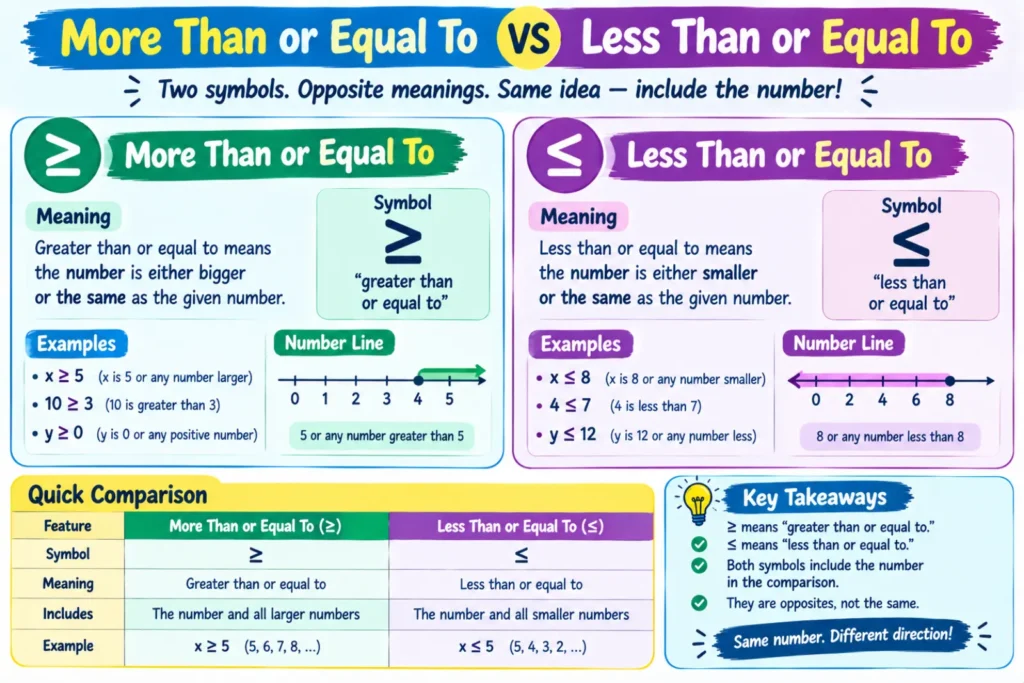
The opposite of more than or equal to is less than or equal to.
The symbols are:
- More than or equal to: ≥
- Less than or equal to: ≤
For example:
x ≥ 10
means x can be 10 or any number above 10.
On the other hand:
x ≤ 10
means x can be 10 or any number below 10.
Notice that both symbols include equality.
Therefore:
10 ≥ 10 is true.
And:
10 ≤ 10 is also true.
Common Mistakes With the ≥ Symbol
Many learners make the same mistakes.
Here are some common errors to avoid.
Mistake 1: Forgetting Equality
Some people think ≥ only means greater than.
That is incorrect.
It also includes equal values.
Therefore:
7 ≥ 7 is true.
Mistake 2: Confusing ≥ With >
The symbols look similar.
However, > does not include equality.
For example:
5 > 5 is false.
But:
5 ≥ 5 is true.
Mistake 3: Reversing the Symbol
Learners sometimes confuse ≥ and ≤.
Remember the open side faces the larger value.
For example:
9 ≥ 4
The open side faces 9.
Mistake 4: Forgetting to Reverse the Sign
When solving an inequality, you must reverse the sign after multiplying or dividing by a negative number.
For example:
-x ≥ 4
Multiply both sides by -1.
The sign changes:
x ≤ -4
Mistake 5: Ignoring the Context
Words can change how you write an inequality.
For example:
“5 or more” means:
x ≥ 5
But “more than 5” means:
x > 5
The word “or equal” matters.
Tips for Remembering More Than or Equal To
These simple tips can help.
Tip 1: Look for Key Words
Words such as these often mean ≥:
- at least
- more than or equal to
- no less than
- minimum of
- 5 or more
- 5 and above
For example:
“At least 20” means:
x ≥ 20
Tip 2: Check the Equality Line
The extra line under > creates ≥.
That line means equality counts.
Tip 3: Test the Boundary
When unsure, test the exact number.
Suppose the statement says:
x ≥ 10
Ask:
“Can x equal 10?”
Yes.
Therefore, 10 is included.
Tip 4: Watch Negative Numbers
Negative numbers can make comparisons harder.
Remember that numbers farther right on a number line are greater.
For example:
-2 ≥ -5
is true.
Although both numbers are negative, -2 is greater than -5.
Synonyms and Related Terms
Several phrases have the same or similar meaning.
Common variations include:
- greater than or equal to
- more than or equal to
- at least
- no less than
- equal to or greater than
- minimum of
- not less than
- greater than or equal
These phrases can appear in math questions.
For example:
“A student must score at least 60.”
This means:
Score ≥ 60
Another example is:
“The box must weigh no less than 10 kg.”
This means:
Weight ≥ 10 kg
Learning these phrases can help you translate word problems into symbols.
How More Than or Equal To Is Used in Daily Life
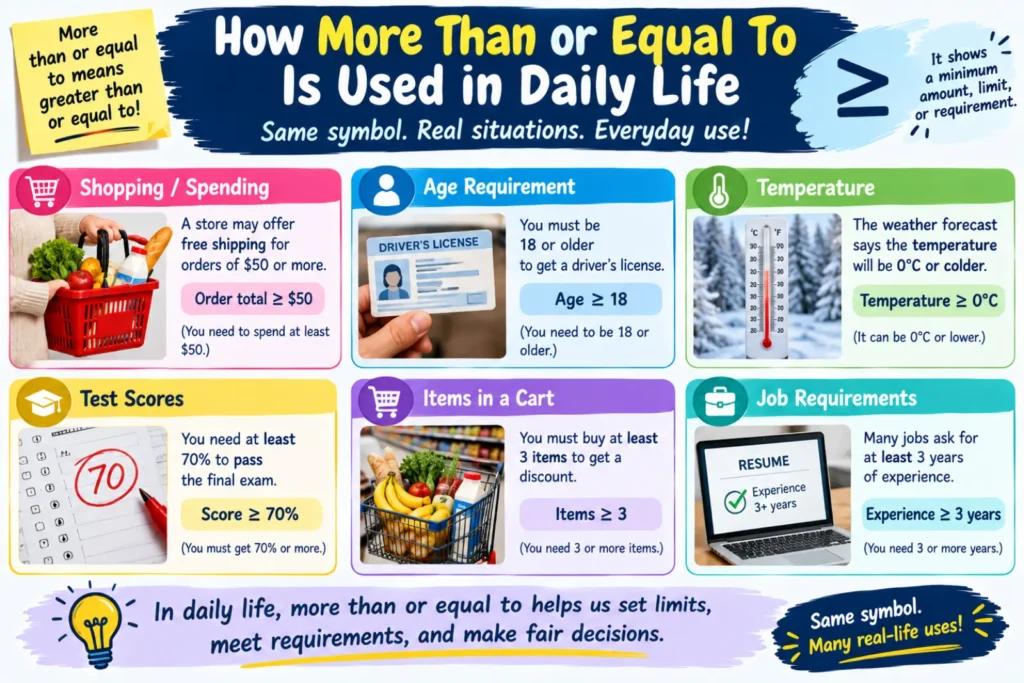
The concept appears in many daily decisions.
Schools use minimum grades.
Employers may list minimum experience.
Stores use minimum order values.
Airlines use age or size requirements.
Sports use minimum scores or times.
Apps can use minimum system requirements.
For example, a website might say:
“Your password must contain at least 8 characters.”
That means:
Characters ≥ 8
A job listing might require:
“Applicants need 2 years of experience or more.”
That means:
Experience ≥ 2 years
The math stays the same.
Only the context changes.
Expert Insights: Why This Simple Symbol Matters
The ≥ symbol looks simple.
Yet it plays an important role in mathematics.
It helps describe ranges instead of one exact value.
For example:
x = 5
gives one possible value.
But:
x ≥ 5
gives many possible values.
This makes inequalities useful in algebra, statistics, science, economics, and computer programming.
The symbol also helps explain real-world limits.
Minimum age, minimum score, minimum speed, and minimum weight all use similar ideas.
A strong understanding of ≥ can therefore make more advanced topics easier.
SEO and Content Tip
When explaining mathematical symbols online, clarity matters.
Start with a direct definition.
Then show the symbol.
Follow it with simple examples.
Use tables for quick comparisons.
Finally, answer common questions.
This structure helps readers scan the page quickly.
Frequently Asked Questions About More Than or Equal To
What does more than or equal to mean?
More than or equal to means a value is greater than another value or exactly the same.
The symbol is ≥.
What is the symbol for more than or equal to?
The symbol is ≥.
For example, 10 ≥ 5 means 10 is more than or equal to 5.
Is 5 more than or equal to 5?
Yes.
5 ≥ 5 is true because both values are equal.
What is the difference between > and ≥?
The symbol > means more than.
The symbol ≥ means more than or equal to.
The second symbol allows equality.
What does at least mean in math?
“At least” usually means greater than or equal to.
For example, “at least 10” means:
x ≥ 10
What does no less than mean?
“No less than” means greater than or equal to.
For example, “no less than 50” means:
x ≥ 50
Is 3 ≥ 7 true?
No.
3 is less than 7.
Therefore, 3 ≥ 7 is false.
What is the opposite of ≥?
The opposite comparison symbol is ≤, which means less than or equal to.
For example:
x ≥ 5
and
x ≤ 5
describe opposite directions around the same boundary.
Conclusion
The phrase more than or equal to has a simple meaning. It says that one value is greater than another value or equal to it. The mathematical symbol is ≥. The symbol is useful in equations, inequalities, graphs, and everyday rules. You can use it for ages, prices, scores, measurements, and limits. Remember that equality counts with ≥. For example, 8 ≥ 8 is true. Also remember the special negative-number rule. Reverse the inequality when multiplying or dividing by a negative number. Once you learn these basic rules, the symbol becomes easy to use. When you see phrases like “at least” or “no less than,” think ≥. That simple connection can help you solve many math problems faster.