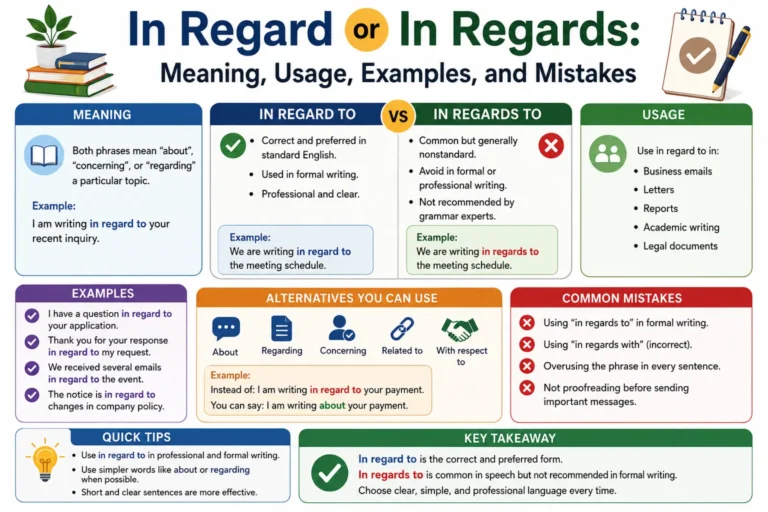
In regard or in regards is a common question for English learners and writers. Many people use these phrases in emails, letters, and formal writing. However, only one form is correct in standard English.
Knowing the right phrase helps you write clearly and professionally. It also helps you avoid common grammar mistakes. In this guide, you will learn the meaning, correct usage, real-life examples, and simple grammar rules.
By the end of this article, you will know when to use in regard to and why in regards to is often considered incorrect. The explanations are simple, practical, and easy to remember.
Quick Summary
- “In regard to” is the standard and correct phrase.
- “In regards to” is common but not preferred in formal English.
- Both phrases mean about, concerning, or regarding.
- Use in regard to in business writing, academic papers, and professional emails.
- Choose simpler alternatives like about or regarding when possible.
What Does “In Regard” Mean?
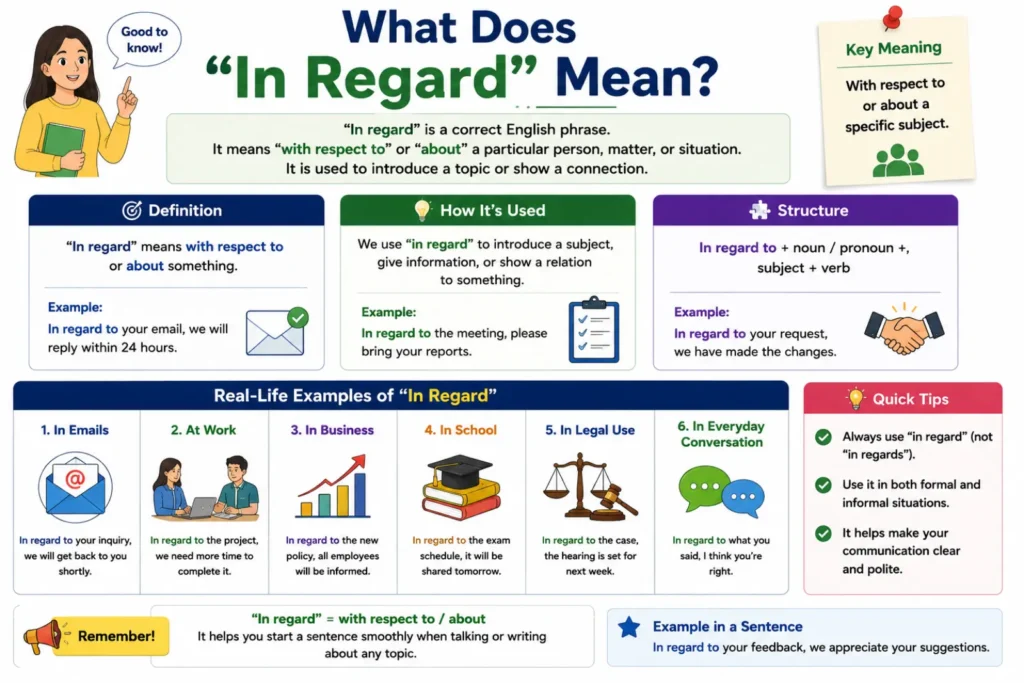
In regard to means about, concerning, or relating to a particular subject.
It introduces the topic you are discussing.
Simple Definition
In regard to means about a specific topic or issue.
Examples
- I have a question in regard to your application.
- She spoke in regard to the new company policy.
- We received several emails in regard to the event.
Is It “In Regard” or “In Regards”?
This is one of the most common grammar questions.
| In Regard To | In Regards To |
|---|---|
| Standard English | Common but generally nonstandard |
| Preferred in formal writing | Often avoided in professional writing |
| Recommended by style guides | Better replaced with “in regard to” |
Which One Should You Use?
Use:
✅ In regard to
Avoid in formal writing:
❌ In regards to
Although many native speakers say in regards to, editors and grammar experts usually recommend in regard to.
Why Is “In Regards To” Considered Incorrect?
The noun regard already expresses the intended meaning.
Adding s creates a phrase that is widely used in conversation but lacks strong support in formal grammar.
Professional writers usually choose:
- In regard to
- Regarding
- About
- Concerning
These options sound cleaner and more natural.
Meaning in Simple Words
Think of in regard to as another way to say:
- About
- On the subject of
- Related to
- Concerning
Example
Instead of:
“I am writing in regard to your order.”
You could write:
“I am writing about your order.”
Both mean the same thing.
Real-Life Examples
Here are examples you may see every day.
Business Email
I am contacting you in regard to your recent purchase.
School
The teacher spoke in regard to the final exam.
Customer Service
We received your message in regard to the refund.
Workplace
The manager held a meeting in regard to workplace safety.
Government Letter
This notice is in regard to your tax records.
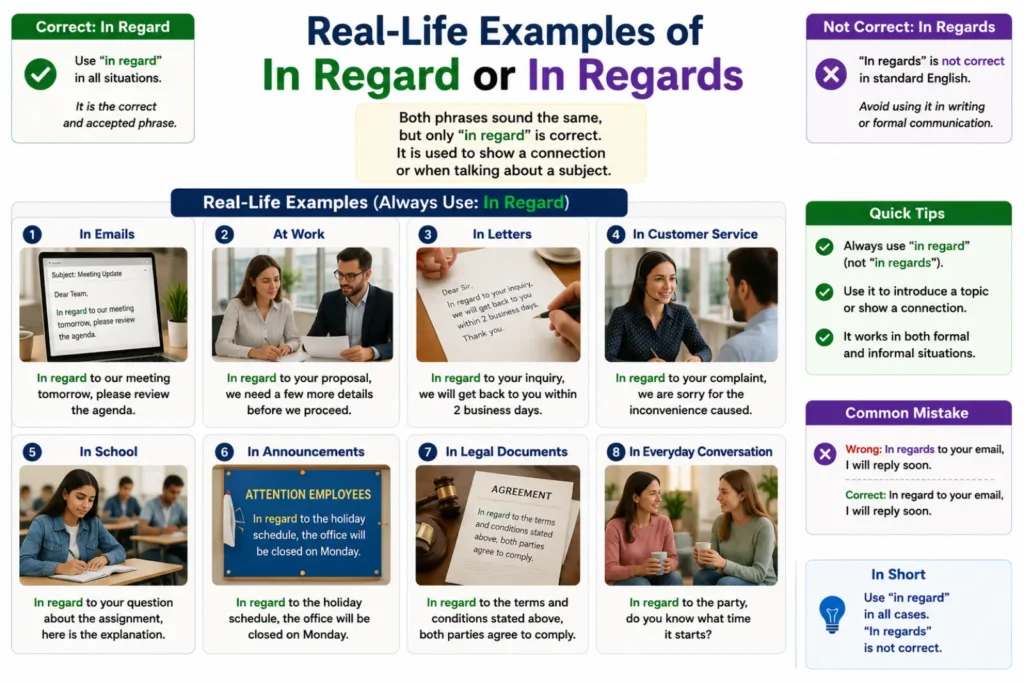
When Should You Use “In Regard To”?
Use it when writing:
- Professional emails
- Business letters
- Academic papers
- Legal documents
- Official notices
- Reports
It creates a formal and respectful tone.
When Should You Avoid It?
Sometimes the phrase sounds too formal.
In casual conversations, use simpler words.
Instead of:
“I called in regard to the party.”
Say:
“I called about the party.”
Shorter sentences are easier to read.
Common Mistakes
Many writers confuse these phrases.
Mistake 1
❌ In regards to your request…
✅ In regard to your request…
Mistake 2
❌ In regards with
✅ In regard to
Mistake 3
Using the phrase too often.
Instead, vary your writing.
Use:
- About
- Regarding
- Concerning
- Related to
Tips to Remember the Correct Phrase
These tricks make it easy.
Tip 1
Remember:
One topic = one regard.
Tip 2
If writing for work, always choose:
In regard to
Tip 3
If the sentence sounds too formal, replace it with:
About
Tip 4
Proofread your emails before sending them.
In Regard To vs Regarding
Both expressions are correct.
| In Regard To | Regarding |
| Formal | Formal |
| Slightly longer | Shorter |
| Common in letters | Common in all writing |
| Very professional | Very natural |
Example
In regard to your payment…
Regarding your payment…
Both are correct.
In Regard To vs About
| In Regard To | About |
| Formal | Informal |
| Business writing | Daily conversation |
| Official documents | Casual writing |
Example
Formal:
I am writing in regard to your application.
Casual:
I am writing about your application.
Synonyms and Related Keywords
Using different words improves readability.
Synonyms
- About
- Regarding
- Concerning
- Related to
- In connection with
- Pertaining to
- With respect to
- As for
Related Search Terms
- in regard to meaning
- in regard or in regards
- in regards to grammar
- regarding vs in regard to
- correct grammar in regard to
- formal alternatives to regarding
- business writing phrases
- grammar mistakes in English
Usage in Daily Life
You can use in regard to in many situations.
At Work
I have a question in regard to today’s meeting.
At School
The teacher sent a notice in regard to homework.
Banking
The bank contacted me in regard to my account.
Healthcare
The doctor called in regard to my test results.
Customer Support
I emailed them in regard to my missing package.
Expert Insights
Professional writing values clarity.
Most grammar experts recommend in regard to because it follows standard English usage.
Many style guides also suggest using shorter words like about when possible.
Simple writing helps readers understand your message faster.
Good grammar also builds trust.
Whether you write blog posts, emails, or reports, choosing the correct phrase makes your writing look more polished.
Featured Snippet: In Regard or In Regards?
Correct Answer:
“In regard to” is the preferred and grammatically accepted phrase in standard English.
Although many people say “in regards to,” most grammar experts recommend using “in regard to” in formal writing. Both mean about or concerning, but in regard to is considered more professional.
Frequently Asked Questions
Is “in regards to” grammatically correct?
It is widely used, but in regard to is preferred in formal English.
Which is better, “in regard to” or “regarding”?
Both are correct. Regarding is shorter, while in regard to sounds slightly more formal.
Can I use “in regards to” in business emails?
It is better to use in regard to or regarding.
What does “in regard to” mean?
It means about, concerning, or related to something.
Is “about” better than “in regard to”?
In casual writing, yes. In professional writing, in regard to often sounds more appropriate.
Why do people say “in regards to”?
It has become common through everyday speech, even though many grammar experts prefer the singular form.
Is “with regard to” also correct?
Yes. With regard to is another correct and formal expression.
Conclusion
Understanding in regard or in regards can improve your English writing. While many people use in regards to, professional writers and grammar experts usually recommend in regard to. It is the standard choice for formal communication, academic writing, and business documents.
If your goal is clear and professional writing, choose in regard to whenever possible. In casual conversations, you can often replace it with simple words like about or regarding. Using the correct phrase helps your message sound polished and trustworthy. The next time you write an email, report, or letter, remember this simple rule: use “in regard to” for accuracy and confidence.