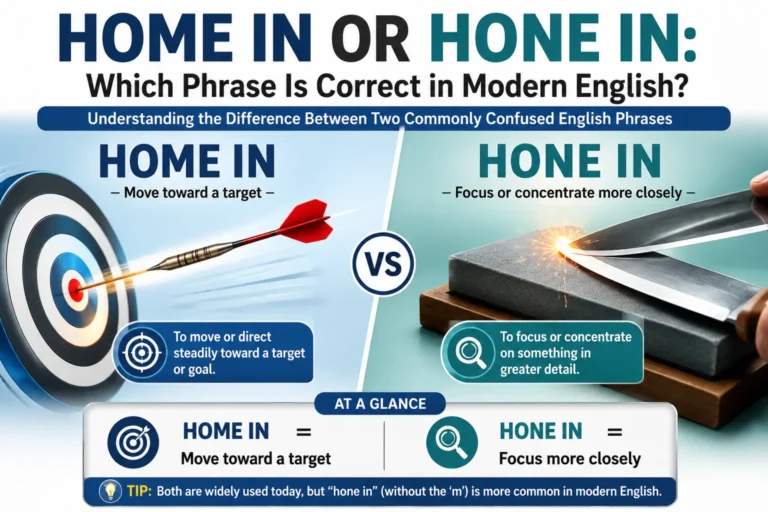
Home in or hone in is a grammar question that confuses many English speakers. Both phrases appear in books, websites, and conversations. However, they do not always mean the same thing.
Many people wonder which version is correct. Some believe only one phrase is acceptable. Others think both are interchangeable.
The truth is more interesting. Language experts recognize both expressions today. Still, each phrase has a different history and slightly different meaning.
This guide explains everything in simple English. You will learn the meaning, differences, examples, common mistakes, and expert tips. By the end, you will know exactly when to use each phrase with confidence.
Quick Summary Box
- Home in is the original phrase.
- Hone in developed later through common usage.
- Both expressions are accepted by many dictionaries.
- “Home in” means move toward a target.
- “Hone in” means sharpen focus on something.
- Modern English often accepts both forms.
- Formal writing usually favors home in on.
Featured Snippet Answer
“Home in” is the original expression and means to move toward a target. “Hone in” developed later and means to focus or sharpen attention. Many modern dictionaries accept both phrases, but formal writing often prefers “home in on.”
What Does “Home In or Hone In” Mean?
This question asks which phrase should be used when talking about focusing on something.
People commonly say:
- home in on a problem
- hone in on a problem
Today, both expressions appear in everyday English. However, they came from different origins.

Meaning of “Home In”
The phrase home in comes from navigation.
It describes moving toward a target.
Examples:
- The missile homed in on its target.
- The dog homed in on the scent.
- Detectives homed in on the suspect.
The word “home” refers to reaching the intended destination.
Meaning of “Hone In”
The word hone means to sharpen.
Examples:
- hone your skills
- hone your writing ability
- hone your focus
Because people connect sharpening with focusing, the expression hone in on became popular.
Examples:
- Let’s hone in on the main issue.
- We need to hone in on customer needs.
Home In vs Hone In Comparison Table
| Feature | Home In | Hone In |
|---|---|---|
| Original phrase | Yes | No |
| Meaning | Move toward a target | Sharpen focus |
| Historical usage | Older | Newer |
| Formal writing | Preferred | Accepted by many editors |
| Everyday speech | Common | Very common |
| Dictionary acceptance | Yes | Yes |
Which Phrase Is More Correct?
Traditionally, grammar experts preferred home in on.
Example:
✔ The team homed in on the cause of the problem.
Some editors once rejected hone in on.
However, language changes over time. Today, major dictionaries recognize both forms.
Still, academic and professional writing often favors home in on.
Why Did “Hone In” Become Popular?
People naturally combine ideas.
The verb hone means sharpen.
The phrase home in means target.
Over time, speakers blended both meanings.
As a result, hone in on became common in American English.
This process happens often in language.
Real-Life Examples of Home In
Business
The company homed in on customer feedback.
Science
Researchers homed in on the source of the disease.
Sports
The player homed in on the goal.
Technology
Engineers homed in on the software issue.
Real-Life Examples of Hone In
Marketing
The team honed in on younger buyers.
Education
Teachers honed in on student weaknesses.
Personal Growth
She honed in on improving communication skills.
Writing
Editors honed in on grammar errors.

Common Mistakes People Make
Mistake 1: Thinking Hone In Is Always Wrong
Many dictionaries now accept it.
Mistake 2: Assuming Both Have Different Meanings
In modern usage, people often use them the same way.
Mistake 3: Ignoring Audience
Formal readers may prefer home in on.
Mistake 4: Using Hone Instead of Home in Navigation
Missiles and tracking systems traditionally home in.
Tips for Choosing the Right Phrase
Use “Home In” for Formal Writing
Academic papers often prefer the traditional phrase.
Use “Hone In” for Casual Writing
Modern readers understand it easily.
Think About Meaning
- Targeting → home in
- Sharpening focus → hone in
Stay Consistent
Choose one style and use it throughout your article.
Usage in Daily Life
People use these phrases in many situations.
At Work
“We need to home in on the main problem.”
At School
“Students should hone in on important topics.”
In Sports
“The striker homed in on the ball.”
In Conversations
“Let’s hone in on what really matters.”
Synonyms and Related Terms
Synonyms
- focus on
- concentrate on
- target
- pinpoint
- zero in on
- narrow down
- emphasize
LSI Keywords
- home in meaning
- hone in meaning
- home in vs hone in
- focus on something
- zero in on
- grammar differences
- common English phrases
- phrase usage guide
Why Dictionaries Accept Both Forms
Language changes over time.
When millions of speakers use a phrase consistently, dictionaries record that usage.
Major dictionaries now include both:
- home in on
- hone in on
This acceptance reflects real-world language use.
Expert Insight
Professional editors usually recommend understanding your audience.
For business reports and academic work, home in on remains the safer choice.
For blogs and everyday communication, both expressions work.
Clear communication matters more than strict tradition.
Using the phrase naturally improves readability and reader trust.
Frequently Asked Questions
Is it home in or hone in?
Both forms are accepted today.
Which phrase came first?
Home in came first.
Is hone in grammatically correct?
Yes. Modern dictionaries recognize it.
Which phrase should I use in formal writing?
Most editors prefer home in on.
What does home in mean?
It means move toward a target.
What does hone in mean?
It means sharpen focus on something.
Do Americans use hone in?
Yes. It is very common in American English.
Are both phrases interchangeable?
In many situations, yes.
Internal Linking Suggestions
Link this article to:
- Common English Grammar Mistakes
- Home vs House Explained
- Affect vs Effect Guide
- Historic vs Historical Difference
- A vs An Grammar Rules
Conclusion
The debate over home in or hone in shows how language evolves. Traditionally, home in on was the original expression. It referred to moving toward a target.
Over time, speakers created hone in on by connecting focus with sharpening. Today, most dictionaries recognize both forms.
If you write formally, choose home in on. If you write casually, either phrase works.
The most important goal is clarity. Readers should understand your message easily. When used correctly, both expressions help you communicate with confidence.