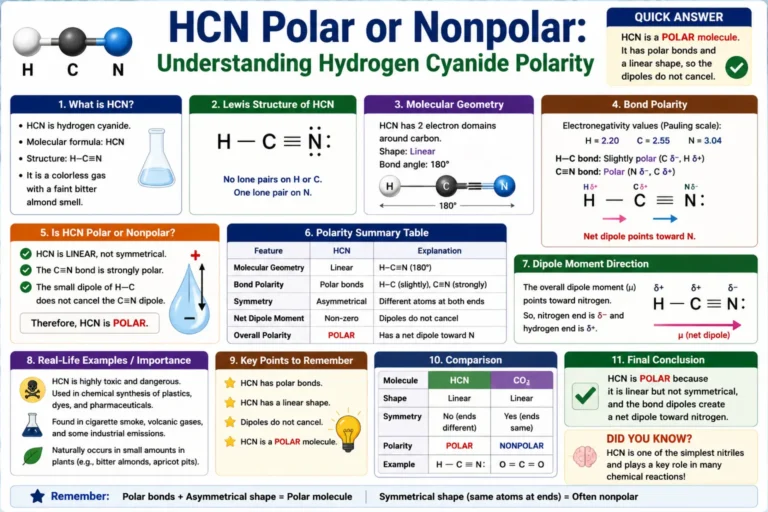
HCN polar or nonpolar is one of the most common chemistry questions students ask. The answer is simple once you understand molecular polarity. HCN, also called hydrogen cyanide, is a polar molecule. Its atoms share electrons unevenly. This creates an uneven distribution of electrical charge.
Many students confuse molecular shape with bond polarity. However, both factors work together. Understanding HCN polarity also helps you learn dipole moments, electronegativity, and chemical bonding.
In this guide, you will learn why HCN is polar. You will also see simple examples, comparison tables, common mistakes, and expert tips. By the end, you will understand the topic with confidence.
Quick Summary Box
Featured Snippet Answer
- HCN (hydrogen cyanide) is a polar molecule.
- It contains one hydrogen atom, one carbon atom, and one nitrogen atom.
- Nitrogen attracts electrons more strongly than carbon and hydrogen.
- This unequal sharing creates a permanent dipole.
- The molecule has a linear shape.
- The dipole does not cancel out.
- Therefore, HCN is classified as polar.
What Is HCN?
HCN stands for hydrogen cyanide.
Its chemical formula is:
HCN
It contains:
- One hydrogen (H)
- One carbon (C)
- One nitrogen (N)
HCN is a colorless chemical compound. It has many industrial uses. However, it is also highly toxic.
Scientists use HCN in:
- Chemical manufacturing
- Mining processes
- Organic synthesis
- Laboratory research
Is HCN Polar or Nonpolar?
The simple answer is:
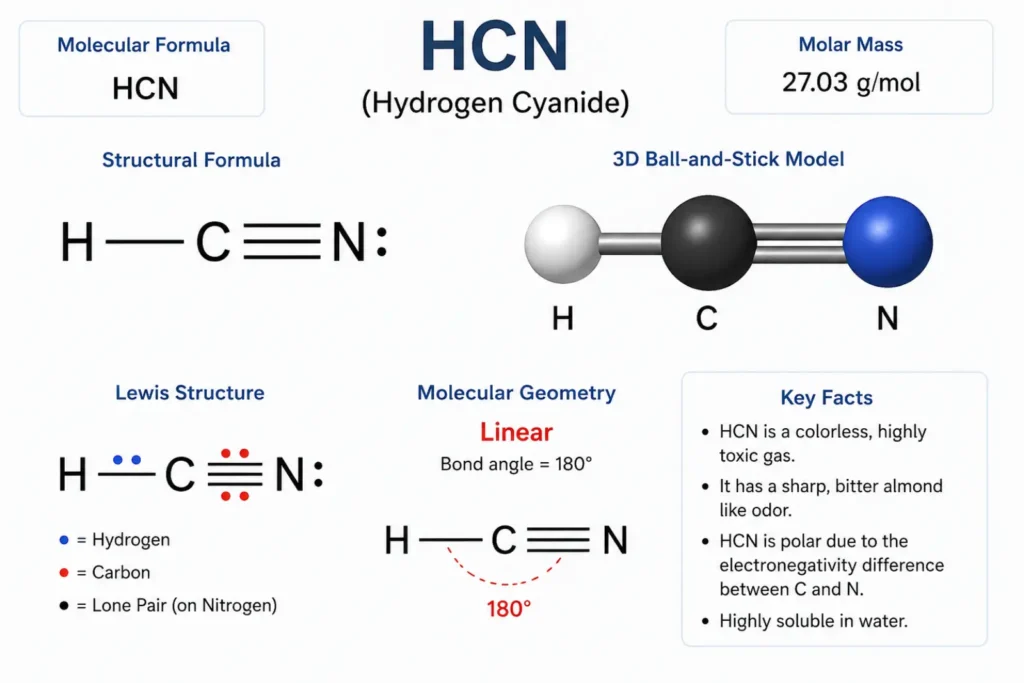
HCN is a polar molecule.
This happens because:
- Nitrogen is much more electronegative.
- Electrons move closer to nitrogen.
- The molecule develops positive and negative ends.
- The dipole moment remains because the bond dipoles do not cancel.
Therefore, hydrogen cyanide has a permanent dipole moment.
What Does Polar Mean?
A polar molecule has an uneven distribution of electrons.
One side becomes slightly positive.
The other side becomes slightly negative.
Scientists call these charges:
- δ+ (partial positive)
- δ− (partial negative)
Water is another famous polar molecule.
Examples of polar molecules include:
- Water (H₂O)
- Ammonia (NH₃)
- Hydrogen fluoride (HF)
- Hydrogen cyanide (HCN)
Why Is HCN Polar?
Three main factors explain the polarity of HCN.
1. Difference in Electronegativity
Nitrogen has a much higher electronegativity.
Approximate values:
- Hydrogen = 2.20
- Carbon = 2.55
- Nitrogen = 3.04
Nitrogen pulls bonding electrons toward itself.
This creates charge separation.
2. Molecular Shape
HCN has a linear molecular geometry.
Structure:
H—C≡N
The bond angle is about 180°.
Although the molecule is linear, the electron pull points strongly toward nitrogen.
The dipole remains.
3. Net Dipole Moment
Every polar bond creates a dipole.
In HCN, these dipoles do not cancel.
Instead, they combine into one overall dipole pointing toward nitrogen.
This makes HCN polar.
Lewis Structure of HCN
The Lewis structure is:
H — C ≡ N:Features include:
- Single bond between H and C
- Triple bond between C and N
- One lone pair on nitrogen
- Linear arrangement
The triple bond strengthens electron attraction toward nitrogen.
Electronegativity and HCN Polarity
Electronegativity measures how strongly an atom attracts electrons.
| Atom | Electronegativity |
|---|---|
| Hydrogen | 2.20 |
| Carbon | 2.55 |
| Nitrogen | 3.04 |
Nitrogen attracts electrons much more strongly.
This creates:
- Partial positive hydrogen
- Partial positive carbon
- Partial negative nitrogen
That uneven charge makes HCN polar.
HCN Polar vs Nonpolar Molecules
| Feature | Polar Molecules | Nonpolar Molecules |
|---|---|---|
| Electron distribution | Uneven | Even |
| Dipole moment | Present | Zero |
| Charge separation | Yes | No |
| Example | HCN | CO₂ |
| Solubility | Often dissolve in water | Usually dissolve in oils |
HCN belongs in the polar category.
Real-Life Examples of Polarity
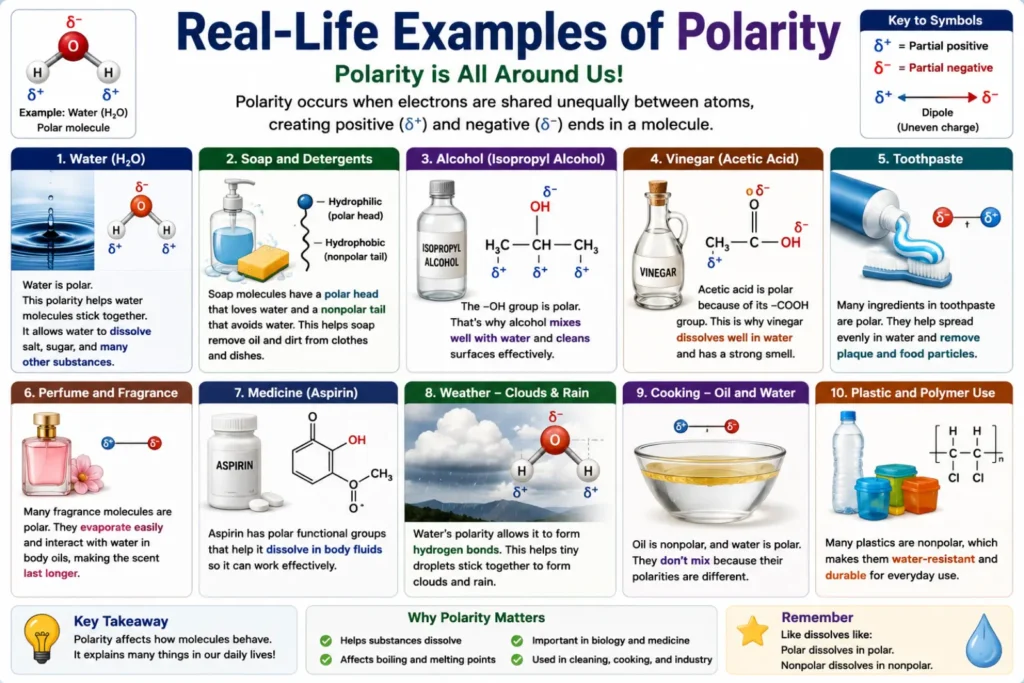
Polarity affects many everyday substances.
Water
Water is polar.
It dissolves salt and sugar easily.
Cooking Oil
Oil is nonpolar.
Water and oil do not mix.
Soap
Soap has both polar and nonpolar ends.
It removes grease effectively.
Hydrogen Cyanide
HCN is polar.
Its polarity influences how it interacts with other chemicals.
How to Tell If a Molecule Is Polar
Follow these simple steps.
Step 1
Draw the Lewis structure.
Step 2
Identify the molecular shape.
Step 3
Check electronegativity differences.
Step 4
Determine whether dipoles cancel.
Step 5
If the dipoles remain, the molecule is polar.
HCN passes every step.
Therefore, it is polar.
Common Mistakes Students Make
Many learners misunderstand molecular polarity.
Here are common mistakes.
Thinking all linear molecules are nonpolar
This is false.
HCN is linear but still polar.
Ignoring electronegativity
Electronegativity is one of the biggest factors.
Always compare atom values.
Looking only at bond type
Bond polarity matters.
However, molecular shape also matters.
Forgetting the overall dipole
Individual bond dipoles may cancel.
Always check the net dipole.
Tips to Remember HCN Polarity
Use these memory tricks.
- Nitrogen pulls electrons strongly.
- The dipole points toward nitrogen.
- Linear shape does not always mean nonpolar.
- Unequal electron sharing creates polarity.
- HCN has a permanent dipole.
A simple shortcut:
High electronegativity + unequal charge = Polar molecule
HCN in Daily Life
Most people never handle HCN directly.
However, it appears in:
- Chemical manufacturing
- Mining industries
- Organic chemistry research
- Material production
- Laboratory experiments
Because HCN is toxic, trained professionals handle it carefully.
Its polarity helps scientists predict chemical behavior.
Synonyms and Related Terms (LSI Keywords)
Search engines associate these terms with HCN polarity.
- Hydrogen cyanide polarity
- Is HCN polar
- HCN molecular geometry
- HCN Lewis structure
- HCN dipole moment
- Bond polarity
- Polar covalent molecule
- Molecular polarity
- Electronegativity
- Chemical bonding
- Linear molecules
- Polar vs nonpolar molecules
- Covalent compounds
- VSEPR theory
- Electron distribution
Expert Insights
Chemistry experts recommend studying polarity in a logical order.
Start with the Lewis structure.
Next, determine molecular geometry.
Then compare electronegativity values.
Finally, evaluate the overall dipole moment.
This method works for HCN and nearly every covalent molecule.
Understanding polarity also helps with:
- Predicting solubility
- Understanding intermolecular forces
- Learning molecular geometry
- Explaining chemical reactions
These concepts appear often in high school and college chemistry.
(FAQs)
Is HCN polar or nonpolar?
HCN is a polar molecule because nitrogen attracts electrons more strongly.
Why is HCN considered polar?
Its electrons are unevenly distributed. This creates a permanent dipole.
Is HCN linear?
Yes. HCN has a linear molecular geometry with a bond angle of 180°.
Does HCN have a dipole moment?
Yes. HCN has a permanent dipole moment directed toward nitrogen.
Is the C≡N bond polar?
Yes. Nitrogen is more electronegative than carbon.
Can a linear molecule be polar?
Yes. HCN proves that linear molecules can be polar if dipoles do not cancel.
Does HCN dissolve in water?
HCN is soluble in water because of its polarity.
What makes HCN different from CO₂?
CO₂ is linear but symmetrical. Its dipoles cancel.
HCN is linear but asymmetrical. Its dipoles remain.
Conclusion
The answer to HCN polar or nonpolar is clear. Hydrogen cyanide is a polar molecule because nitrogen attracts electrons more strongly than carbon and hydrogen. This unequal electron distribution creates a permanent dipole. Although HCN has a linear shape, its dipoles do not cancel because the molecule is not symmetrical. Understanding polarity becomes much easier when you first examine the Lewis structure, then compare electronegativity values, and finally evaluate the molecule’s geometry. These steps work for HCN and many other covalent compounds. If you remember that shape and electronegativity both determine polarity, you will solve similar chemistry questions with greater confidence and accuracy.