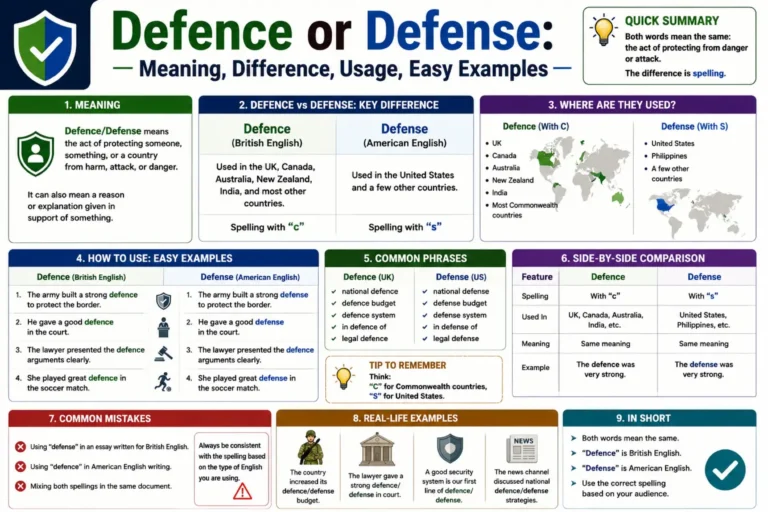
Defence or defense is a common spelling question in English. Both words have the same meaning. The main difference comes from the type of English you use. Defence is the standard spelling in British English. Defense is the standard spelling in American English. The word describes protection against attack, harm, or criticism. It can also describe a team or player that stops an opponent from scoring. You may see this word in news, sports, law, military topics, and daily speech. Choosing the right spelling can make your writing look more natural. It also helps you follow the style used by your readers. In this guide, you will learn the meaning, spelling difference, examples, and common mistakes. You will also learn which form to use in different countries.
Quick Summary
- Defence is the British English spelling.
- Defense is the American English spelling.
- Both words have the same meaning.
- Both forms describe protection from attack, harm, or criticism.
- British, Australian, and many Commonwealth sources use defence.
- American sources usually use defense.
- The same spelling rule applies to words like offence/offense.
- Use one spelling style consistently throughout your writing.
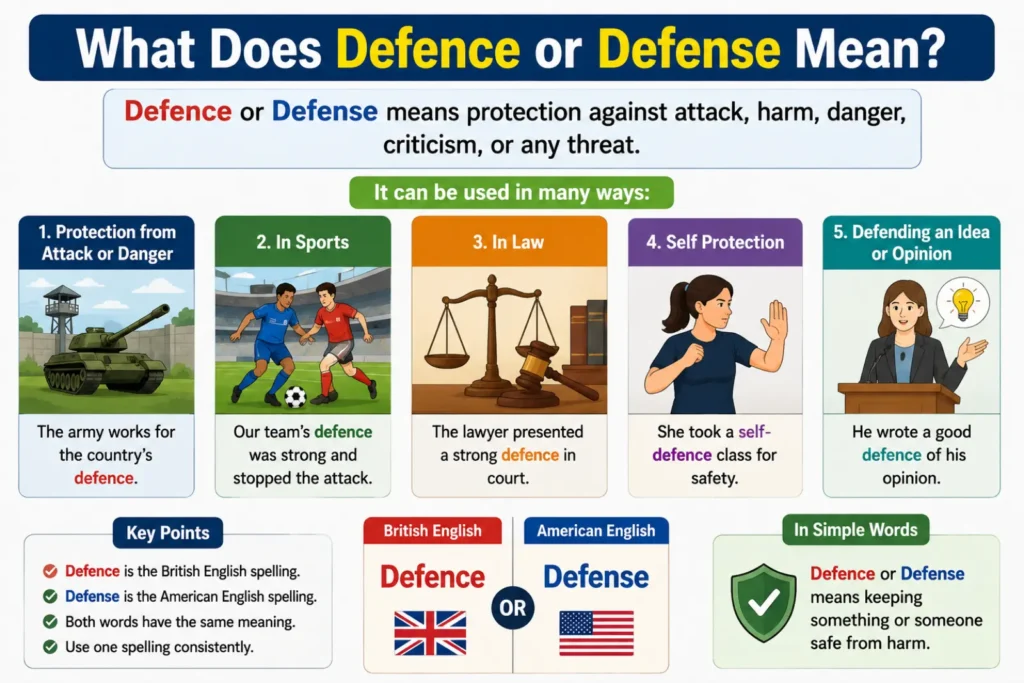
What Does Defence or Defense Mean?
Defence or defense means protection against danger, attack, harm, or criticism.
The word can describe physical protection. It can also describe an argument against an accusation.
For example:
- The army protects the country through national defence.
- The lawyer prepared a strong defense.
- The football team improved its defence.
- She gave a good defense of her decision.
The meaning stays the same in both British and American English.
The spelling changes because English developed different regional writing conventions.
Defence vs Defense: What Is the Difference?
The main difference is regional spelling.
| Feature | Defence | Defense |
|---|---|---|
| Main English variety | British English | American English |
| Meaning | Protection or support | Protection or support |
| Pronunciation | Usually the same | Usually the same |
| Common in the UK | Yes | No |
| Common in the US | No | Yes |
| Common in Australia | Yes | Usually no |
| Common in Canada | Often yes | Sometimes used |
| Military use | Defence | Defense |
| Sports use | Defence | Defense |
So, there is no major difference in meaning.
The correct choice depends on your target audience and writing style.
Why Does British English Use “Defence”?
British English often keeps the -ce ending in words influenced by French spelling.
This pattern appears in several English words.
For example:
- defence
- offence
- licence
- pretence
American English changed some of these spellings over time.
It often uses -se instead.
Therefore, American English uses:
- defense
- offense
- license
- pretense
These differences do not change the basic meaning of the words.
Why Does American English Use “Defense”?
American English often prefers simpler or more standardized spellings.
Many words ending in -ce in British English use -se in American English.
The spelling defense became the standard American form.
You can see the same pattern in offense.
However, spelling rules can vary between individual words.
That means you should not change every -ce ending into -se.
Always check the accepted spelling for the word you are using.
Defence or Defense in British English
Use defence when you follow British English conventions.
This style appears in the United Kingdom and many other countries.
Examples include:
- The country increased its defence budget.
- The player has excellent defensive skills.
- The lawyer prepared a strong defence.
- The ministry announced a new defence policy.
British English also uses related forms such as defensive and defend.
Notice that these related words do not change in the same way.
For example:
defence → defensive → defend
Defence or Defense in American English
Use defense when you follow American English conventions.
Examples include:
- The country increased its defense budget.
- The team needs better defense.
- The lawyer prepared a strong defense.
- The company created a new defense strategy.
American English also uses defensive and defend.
The noun changes spelling, but these related forms stay familiar.
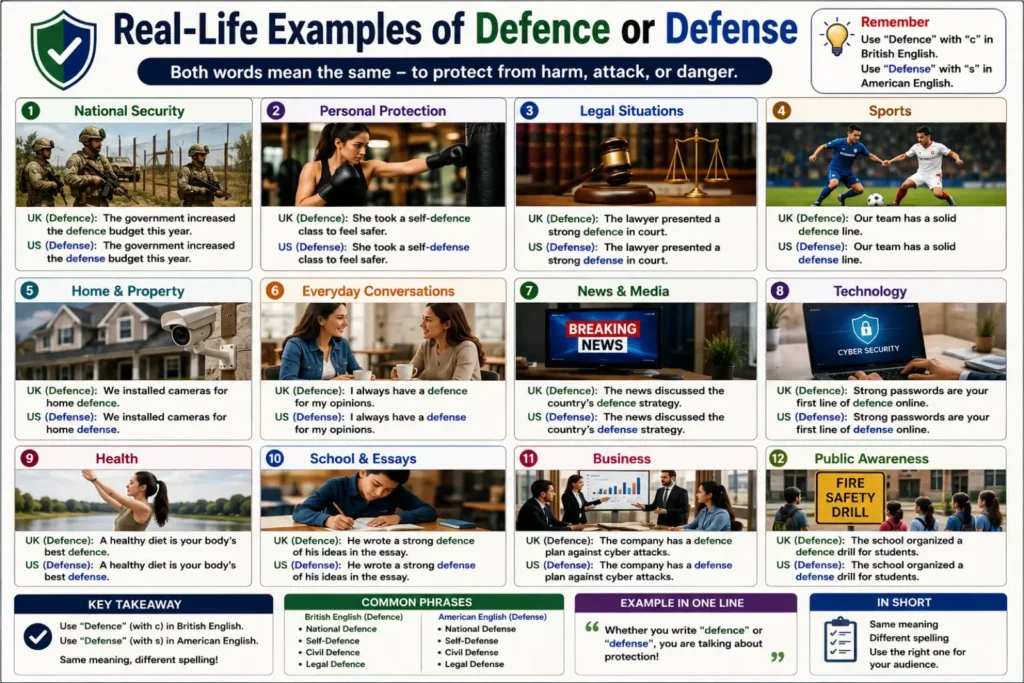
Real-Life Examples of Defence or Defense
The word appears in many areas of life.
1. Military
A country may build military systems for national defence or defense.
Example:
The government announced a new national defense policy.
2. Sports
Sports teams use defense to stop opponents from scoring.
Example:
The team’s defense stopped three attacks.
British sports writing may use defence instead.
3. Law
A lawyer may provide a defense against an accusation.
Example:
The attorney presented a strong defense in court.
4. Personal Protection
People can use the word when discussing personal safety.
Example:
The course teaches basic self-defense skills.
5. Arguments and Opinions
A person can defend an idea or decision.
Example:
She wrote a detailed defense of her proposal.
These examples show why the word has several related uses.
Defence or Defense in Sports
Sports use defence and defense very often.
The word can describe players, tactics, or a team’s ability to stop an opponent.
British English:
The team’s defence was excellent.
American English:
The team’s defense was excellent.
The meaning remains identical.
You may also see defender, defensive, and defend.
These words describe people, actions, or qualities connected with protection.
Defence or Defense in Law
Legal writing uses the word in another important way.
A defence or defense can mean an argument used to challenge an accusation.
For example:
The defense argued that the evidence was unreliable.
British legal writing commonly uses defence.
American legal writing commonly uses defense.
The difference reflects the English variety rather than a difference in legal meaning.
Common Mistakes With Defence and Defense
Several mistakes appear often in online writing.
Mistake 1: Mixing Both Spellings
Avoid switching between defence and defense in the same article.
Choose one style and stay consistent.
Mistake 2: Using American Spelling in British Content
If your audience expects British English, defence usually fits better.
This matters for professional and academic writing.
Mistake 3: Assuming One Form Is Always Correct
Neither spelling is universally correct.
The correct choice depends on the English variety.
Mistake 4: Changing Related Words Incorrectly
Do not assume every related word follows the same spelling pattern.
For example, defensive remains standard in both varieties.
Mistake 5: Ignoring Your Publication Style
Businesses and publications may have their own style guides.
Follow the required guide when one exists.
Tips for Choosing the Right Spelling
Use these simple rules.
Tip 1: Know your audience.
Write defence for British English audiences.
Write defense for American English audiences.
Tip 2: Check your style guide.
Many companies use a fixed editorial style.
Tip 3: Stay consistent.
Do not switch spelling halfway through a document.
Tip 4: Check regional vocabulary.
Some related words also have regional spelling differences.
Tip 5: Consider your website audience.
International websites may choose one variety for consistency.
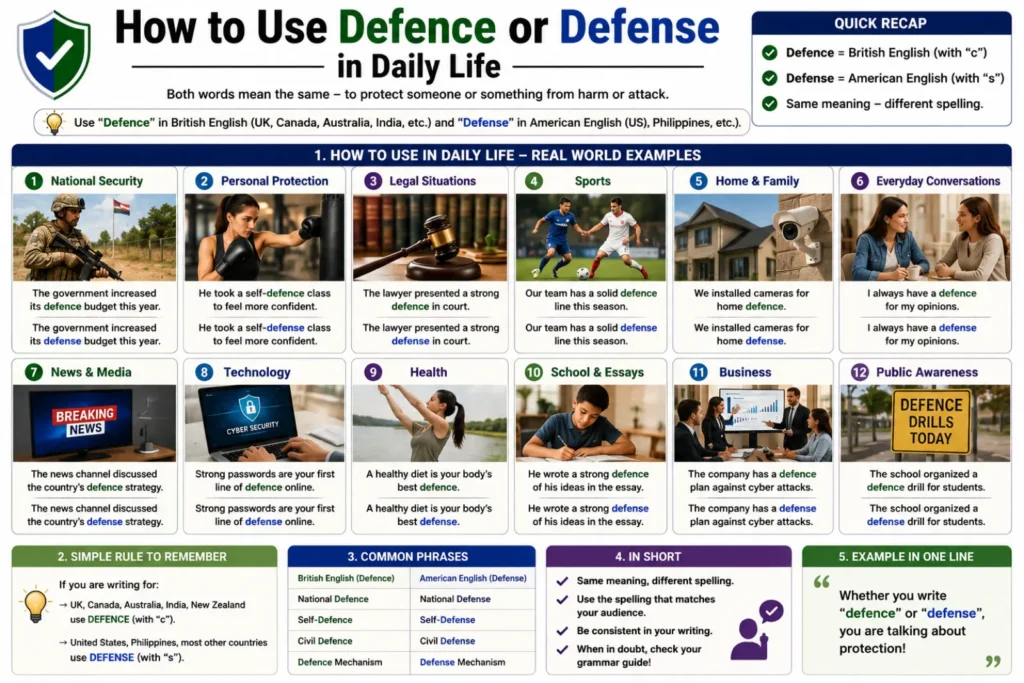
How to Use Defence or Defense in Daily Life
You can encounter the word in many everyday situations.
might read about national defense in a newspaper.
You might hear about a team’s defense during a sports match.
might see self-defense in a safety course.
You might read about a lawyer’s defense in a court report.
You might also see defence in British websites, books, and government documents.
The context usually makes the meaning clear.
The spelling mainly tells you which English variety the writer follows.
Defence or Defense: Synonyms and Related Words
Several words have similar meanings.
Synonyms
- protection
- security
- safeguard
- resistance
- shield
- support
- justification
The best synonym depends on context.
For example, protection works well for physical safety.
Justification may work better when defending an opinion.
Related SEO and LSI Keywords
Useful semantic terms include:
- defence meaning
- defense meaning
- defence vs defense
- British English spelling
- American English spelling
- defence definition
- defense definition
- defence and defense difference
- how to spell defense
- how to spell defence
- national defence
- national defense
- self-defense
- defensive strategy
- defensive position
- military defense
- sports defense
- legal defense
These terms help cover different search intents naturally.
Expert Insights: Why the Difference Matters
Good writing does more than use correct grammar.
It also matches the expectations of its audience.
If you write for readers in the United Kingdom, defence feels natural.
If you write for readers in the United States, defense feels natural.
This choice can improve consistency and editorial quality.
It also supports a clear brand voice.
For SEO content, avoid forcing both spellings into every paragraph.
Google can understand related spelling variations and search intent.
Focus first on useful information and natural language.
Then use your chosen spelling consistently.
Expert tip: Set your document’s language to British or American English before proofreading.
This can help your writing software detect regional spelling differences.
Defence or Defense: Which One Should You Use?
Use defence if you write in British English.
Use defense if you write in American English.
If you write for an international audience, choose one main style.
Then apply it consistently.
For example, a UK-focused website should normally use:
national defence
A US-focused website should normally use:
national defense
Neither form has a higher level of correctness.
The important point is regional consistency.
Frequently Asked Questions
Is defence or defense correct?
Both are correct. Defence is British English, while defense is American English.
What is the difference between defence and defense?
There is no difference in basic meaning. The difference comes from regional spelling conventions.
Is defence British or American?
Defence is the standard British English spelling.
Is defense British or American?
Defense is the standard American English spelling.
Which spelling should I use for a US audience?
Use defense for a US audience.
Which spelling should I use for a UK audience?
Use defence for a UK audience.
Is self defence British spelling?
Yes. British English normally writes self-defence.
American English normally writes self-defense.
Are defence and defense pronounced differently?
Usually, they have the same pronunciation. The main difference is their written form.
Conclusion
Defence or defense refers to protection, resistance, or support against an attack or criticism. Both spellings are correct. The key difference is regional English usage. Defence is the standard British English spelling. Defense is the standard American English spelling. You may see these forms in military, legal, sports, and everyday contexts. Your choice should match your audience and writing style. Most importantly, stay consistent throughout your content. Do not mix British and American spelling without a clear reason. If you write for UK readers, choose defence. If you write for US readers, choose defense. The simple takeaway is this: the meaning stays the same, but the spelling changes by English variety.