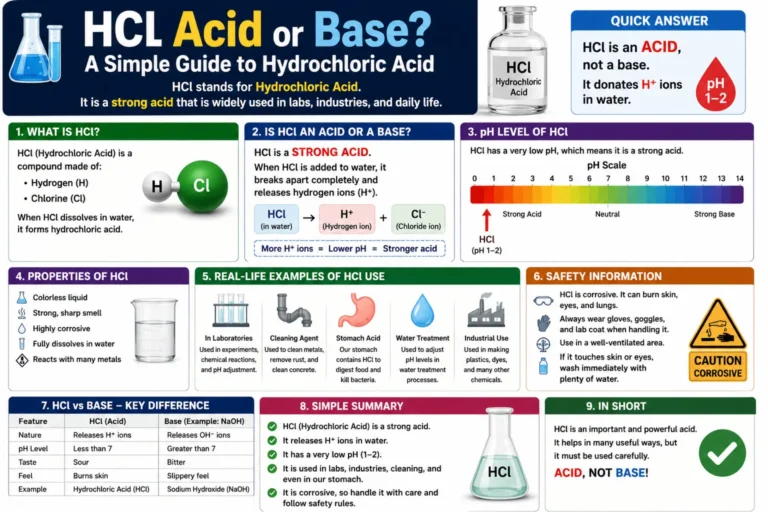
HCl acid or base? it is an acid, not a base. HCl stands for hydrogen chloride. When HCl dissolves in water, it forms hydrochloric acid. It releases hydrogen ions, written as H⁺. This behavior makes HCl a strong acid.
You may see HCl in chemistry labs, factories, and the human stomach. It plays an important role in chemical reactions. However, concentrated HCl can cause severe burns and tissue damage.
Understanding HCl helps you identify acids and bases with confidence. It also helps with pH, chemical equations, and neutralization reactions.
In this guide, you will learn why HCl is an acid. You will also see simple examples and common mistakes. By the end, the answer should be clear.
Quick Summary: Is HCl an Acid or Base?
- HCl is an acid.
- HCl means hydrogen chloride.
- HCl becomes hydrochloric acid when dissolved in water.
- It is a strong acid in aqueous solution.
- HCl releases H⁺ ions in water.
- Its aqueous solution has a low pH.
- HCl reacts with bases during neutralization.
- HCl can react with metals and some carbonates.
- Concentrated HCl is corrosive and hazardous.
- A simple example is: HCl + NaOH → NaCl + H₂O.
What Does HCl Mean?
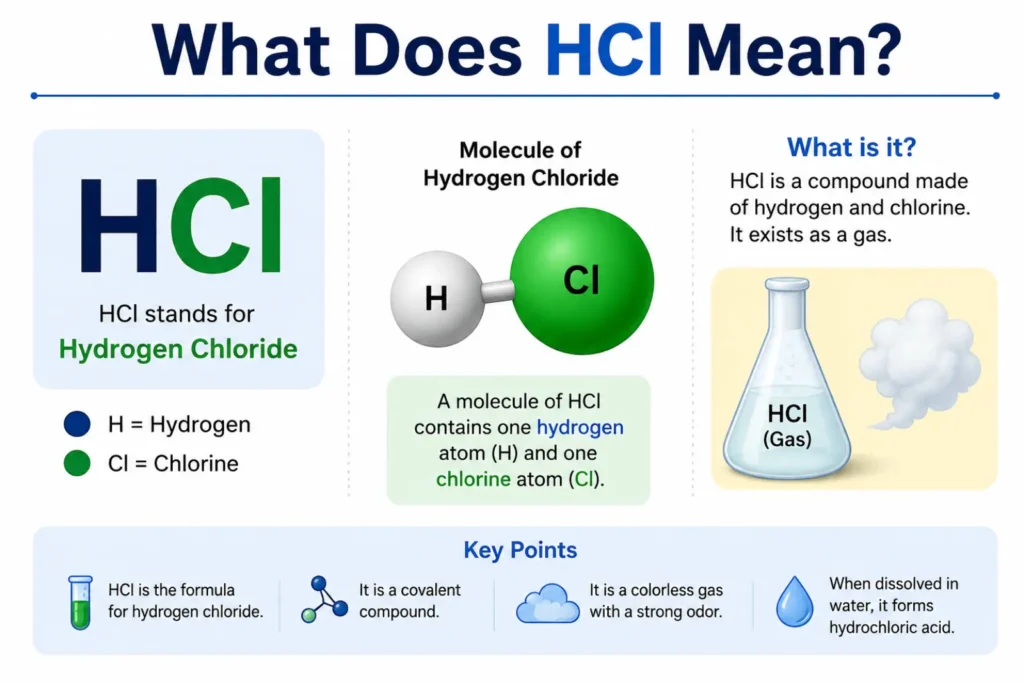
HCl is the chemical formula for hydrogen chloride.
The formula contains two elements:
- H = hydrogen
- Cl = chlorine
A molecule of HCl contains one hydrogen atom and one chlorine atom.
HCl can exist as hydrogen chloride gas. It can also dissolve in water.
When it dissolves in water, it forms hydrochloric acid.
This difference matters in chemistry.
The name hydrogen chloride usually describes the compound itself. The term hydrochloric acid describes HCl in an aqueous solution.
Therefore, people often use “HCl” and “hydrochloric acid” interchangeably in basic chemistry. The exact meaning depends on the context.
Is HCl an Acid or a Base?
HCl is an acid. More specifically, HCl is a strong acid in water.
The reason comes from its behavior in water.
HCl reacts with water and produces hydronium ions:
HCl + H₂O → H₃O⁺ + Cl⁻
The formation of H₃O⁺ makes the solution acidic.
Chemists often simplify this reaction as:
HCl → H⁺ + Cl⁻
In water, free H⁺ does not exist alone for long. It associates with water molecules and forms H₃O⁺.
This reaction explains why HCl has acidic properties.
Why Is HCl Called a Strong Acid?
HCl is called a strong acid because it ionizes almost completely in water.
This means most dissolved HCl produces ions.
The main ions are:
- H₃O⁺
- Cl⁻
Compare this with a weak acid such as acetic acid.
Acetic acid only partly ionizes in water.
So, acid strength does not simply mean that a chemical feels more dangerous. It refers to how strongly the substance ionizes in water.
HCl has a very strong tendency to donate a proton.
That property gives HCl its strong-acid classification.
How Does HCl Behave in Water?
Water allows HCl to show its acidic nature.
When HCl enters water, it transfers a proton to a water molecule.
This produces hydronium ions and chloride ions.
The reaction is:
HCl + H₂O → H₃O⁺ + Cl⁻
More H₃O⁺ means a lower pH.
A solution containing enough HCl can therefore have a very low pH.
This makes HCl useful for studying acid-base chemistry.
The chloride ion does not cause the acidity. The hydronium ions do.
This distinction helps explain why HCl is an acid.
HCl vs Base: What Is the Difference?
Acids and bases behave differently in water.
An acid increases the concentration of hydrogen-related ions in water. A base accepts protons or produces hydroxide ions, depending on the definition used.
Here is a simple comparison:
| Property | HCl | Typical Base |
|---|---|---|
| Classification | Strong acid | Base |
| Main behavior | Donates H⁺ | Accepts H⁺ |
| Aqueous effect | Increases H₃O⁺ | Often increases OH⁻ |
| pH | Below 7 | Above 7 |
| Example | Hydrochloric acid | Sodium hydroxide |
| Reaction type | Neutralization with bases | Neutralization with acids |
For example, HCl reacts with sodium hydroxide:
HCl + NaOH → NaCl + H₂O
This is a neutralization reaction.
The acid and base react to form salt and water.
HCl and pH
pH measures how acidic or basic an aqueous solution is.
The pH scale commonly runs from about 0 to 14.
- A pH below 7 indicates an acidic solution.
- A pH of 7 indicates neutrality under standard conditions.
- A pH above 7 indicates a basic solution.
HCl produces hydronium ions.
Therefore, an HCl solution has an acidic pH.
The exact pH depends on the solution’s concentration and other conditions.
You should not identify HCl only by its pH. Its chemical behavior also confirms its acid classification.
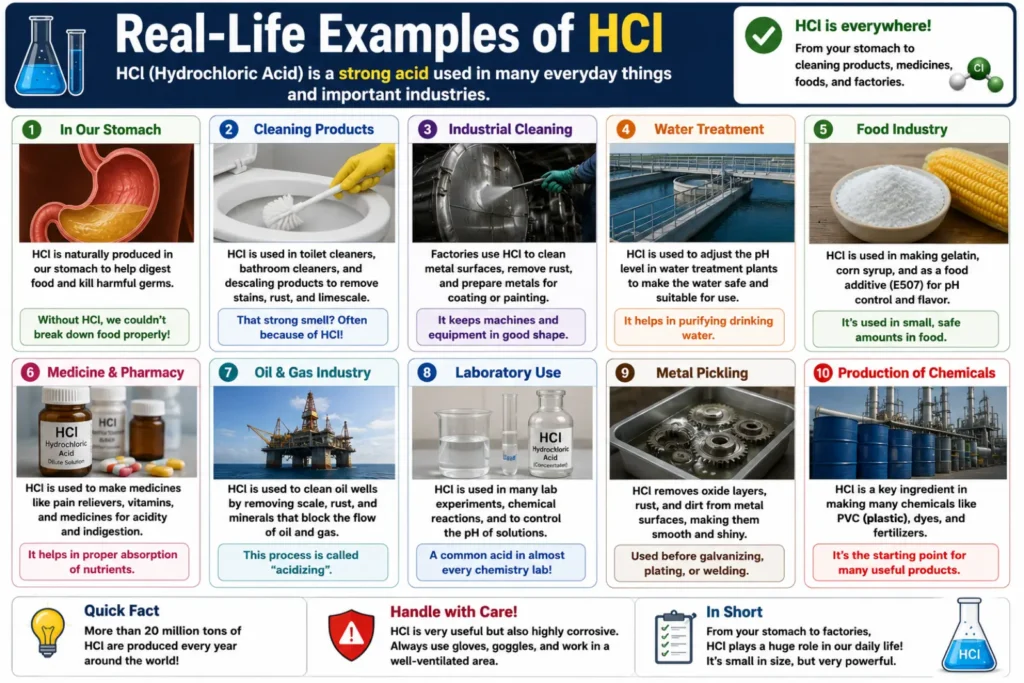
Real-Life Examples of HCl
HCl has many real-world uses.
1. Human Stomach
The stomach naturally contains hydrochloric acid.
This acid helps create a highly acidic environment. It supports digestion and helps activate certain digestive enzymes.
The stomach also has protective mechanisms that help shield its tissues from acid.
2. Cleaning and Industrial Work
Hydrochloric acid can remove mineral deposits and certain residues.
Industries may use it for metal treatment and chemical processing.
However, concentrated HCl is dangerous.
Only trained people should handle it with suitable safety controls.
3. Laboratory Chemistry
HCl is common in chemistry laboratories.
Students and scientists use it in acid-base reactions, titrations, and chemical preparation.
Its strong-acid behavior makes it useful for many experiments.
4. Metal Processing
Industries can use hydrochloric acid to clean metal surfaces.
This process can remove oxides and other unwanted materials.
The process requires careful control because HCl can also attack some metals.
HCl Neutralization Reaction
A neutralization reaction occurs when an acid reacts with a base.
HCl provides a classic example.
Consider sodium hydroxide:
HCl + NaOH → NaCl + H₂O
Here:
- HCl is the acid.
- NaOH is the base.
- NaCl is sodium chloride.
- H₂O is water.
The hydrogen and hydroxide ions combine to form water.
This reaction demonstrates why HCl belongs to the acid group.
Another common reaction involves calcium carbonate:
2HCl + CaCO₃ → CaCl₂ + H₂O + CO₂
This reaction produces carbon dioxide gas.
You may notice bubbling during this type of reaction.
Common Mistakes About HCl
Several mistakes appear often when people study HCl.
Mistake 1: Calling HCl a Base
HCl is not a base.
It acts as an acid because it donates a proton and increases hydronium concentration in water.
Mistake 2: Confusing Chloride With Chlorine
The Cl⁻ ion is called chloride.
Chlorine is the element with the symbol Cl.
These terms describe different chemical forms.
Mistake 3: Thinking All HCl Is a Gas
Pure hydrogen chloride can exist as a gas.
When HCl dissolves in water, the solution is called hydrochloric acid.
The physical state and solution context matter.
Mistake 4: Assuming Strong Means Concentrated
“Strong acid” and “concentrated acid” have different meanings.
Acid strength describes ionization behavior.
Concentration describes how much solute exists in a given amount of solution.
A strong acid can exist in a dilute solution.
Mistake 5: Thinking Acids Always Have the Same Strength
Different acids have different strengths.
HCl is a strong acid in water.
Acetic acid, by comparison, is a weak acid.
Tips for Remembering That HCl Is an Acid
Use these simple memory tricks.
Tip 1: Think H⁺.
HCl produces hydrogen-related ions in water.
That points toward acid behavior.
Tip 2: Remember the neutralization reaction.
HCl reacts with NaOH to produce water and salt.
Tip 3: Connect HCl with hydrochloric acid.
The name itself gives you a useful reminder.
Tip 4: Remember the pH.
An aqueous HCl solution has a low pH.
Tip 5: Watch the chemical equation.
HCl transfers a proton to water.
That is classic Brønsted-Lowry acid behavior.
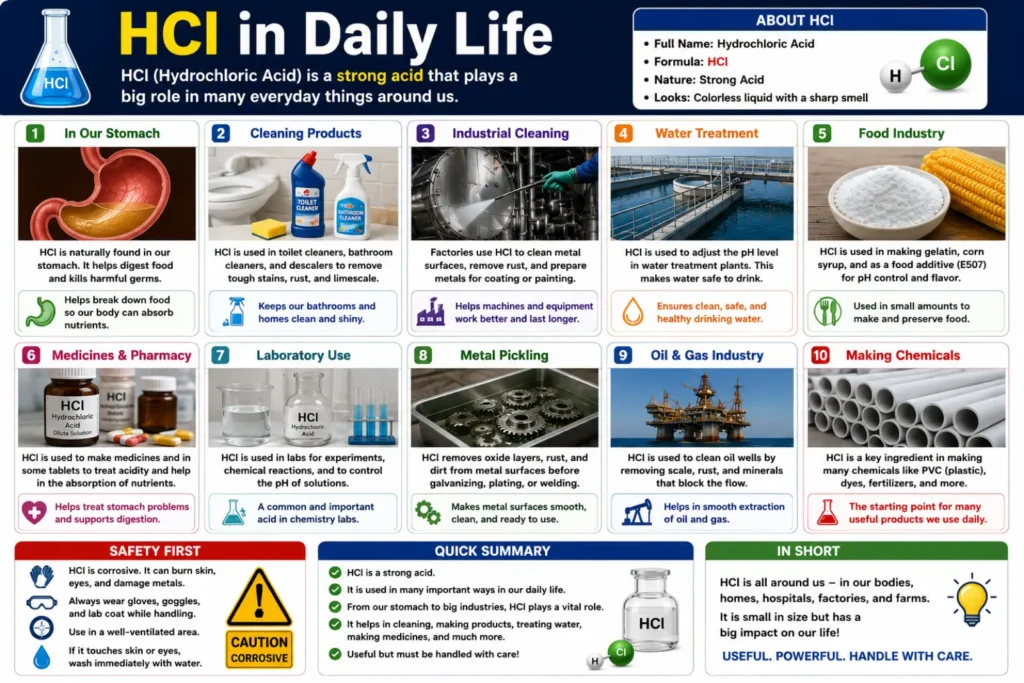
HCl in Daily Life
You may not handle pure HCl in daily life, but hydrochloric acid has practical importance.
Your stomach naturally produces hydrochloric acid.
Some industrial cleaning processes use hydrochloric acid.
Water treatment and chemical manufacturing can also involve HCl.
Laboratories use HCl for controlled chemical reactions.
However, household use requires special caution.
Do not mix hydrochloric acid with other cleaners.
In particular, mixing acids with certain chlorine-containing products can release dangerous gases.
Always follow the product label and safety instructions.
HCl Safety: What Should You Know?
Hydrochloric acid can cause serious chemical burns.
Its fumes can also irritate the eyes, skin, and respiratory system.
Concentrated solutions require appropriate protective equipment and ventilation.
Never taste or deliberately smell HCl.
Never mix it with unknown chemicals.
If an accidental exposure occurs, follow the relevant safety procedure and seek professional medical advice when needed.
For laboratory work, consult the chemical’s current Safety Data Sheet before handling it.
Safety matters because chemical classification does not tell you the safe amount to use.
HCl Synonyms and Related Keywords
Understanding related terms can improve your chemistry vocabulary.
Common names and semantic terms include:
- Hydrogen chloride
- Hydrochloric acid
- HCl acid
- Strong acid
- Mineral acid
- Aqueous HCl
- H⁺ donor
- Proton donor
- Chloride ion
- Acidic solution
- Acid-base reaction
- Neutralization reaction
- HCl pH
- HCl chemical formula
- HCl acid or base
- Is HCl a strong acid?
- Is hydrochloric acid an acid or base?
These terms often appear in chemistry questions and search queries.
Expert Insights: Why HCl Matters
HCl provides a simple example of acid behavior.
It helps students understand several important chemistry ideas at once.
First, HCl demonstrates the Brønsted-Lowry definition of an acid. It donates a proton to water.
Second, HCl demonstrates strong-acid behavior. It ionizes almost completely in aqueous solution.
Third, HCl helps explain neutralization.
It reacts with bases and can form water and salts.
Finally, HCl shows why chemical names and formulas need context.
Hydrogen chloride refers to HCl as a compound. Hydrochloric acid refers to its aqueous solution.
This distinction can improve accuracy in chemistry writing and exams.
Frequently Asked Questions About HCl
Is HCl an acid or a base?
HCl is an acid. It is a strong acid in aqueous solution.
Why is HCl an acid?
HCl donates a proton to water. This produces hydronium ions and makes the solution acidic.
Is HCl a strong acid?
Yes. HCl is a strong acid in water because it ionizes almost completely.
Is hydrochloric acid the same as HCl?
Hydrochloric acid is an aqueous solution of hydrogen chloride. The formula HCl represents hydrogen chloride.
Is HCl a Brønsted-Lowry acid?
Yes. HCl acts as a Brønsted-Lowry acid because it donates a proton.
Is HCl a Lewis acid?
Yes. HCl can act as a Lewis acid because it can participate in electron-pair accepting reactions. Its Brønsted-Lowry behavior is more commonly taught at this level.
What happens when HCl reacts with NaOH?
HCl reacts with sodium hydroxide to produce sodium chloride and water.
HCl + NaOH → NaCl + H₂O
Does HCl have a high or low pH?
An aqueous HCl solution has a low pH. The exact value depends on its concentration.
Quick Chemistry Test: Is HCl Acid or Base?
Use this simple test when solving chemistry questions.
Question: HCl is classified as what?
Answer: A strong acid.
Why? It donates H⁺ and produces H₃O⁺ in water.
Example reaction:
HCl + H₂O → H₃O⁺ + Cl⁻
This single equation provides strong evidence for its acid behavior.
If an exam asks whether HCl is acidic or basic, choose acidic.
If it asks whether HCl is strong or weak, choose strong acid in aqueous solution.
Conclusion
So, HCl acid or base? HCl is an acid. More specifically, it is a strong acid in aqueous solution.
HCl means hydrogen chloride. When it dissolves in water, it forms hydrochloric acid. It transfers a proton to water and creates hydronium ions.
This reaction gives HCl its acidic properties.
HCl also reacts with bases through neutralization. For example, HCl reacts with NaOH to form sodium chloride and water.
You can remember the answer with three ideas: HCl is an acid, it produces H₃O⁺, and it has a low pH in water.
The key takeaway is simple: HCl is a strong acid, not a base.