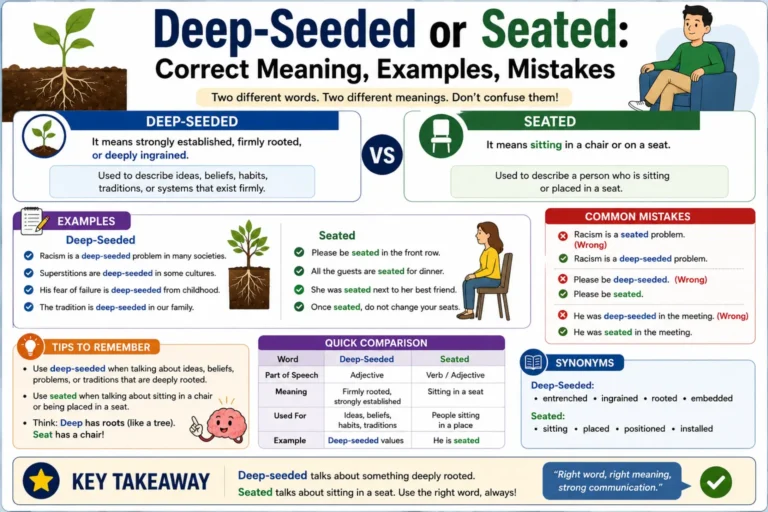
Deep seeded or seated is a common question because many people use both phrases. However, only one is correct in standard English. Many writers, students, and professionals confuse these words because they sound alike. This mistake appears in emails, blogs, books, and social media posts.
The correct phrase is deep-seated. It describes something that is firmly established and difficult to change. People often write deep-seeded by mistake because they connect the idea with seeds growing deep in the ground. While that image makes sense, it is not the accepted expression.
This guide explains the difference in simple words. You will also learn the meaning, correct usage, examples, common mistakes, and expert writing tips.
Quick Summary
- Correct phrase: Deep-seated
- Incorrect phrase: Deep-seeded
- Meaning: Strongly established and difficult to change
- Common use: Deep-seated beliefs, fears, habits, or problems
- Reason for confusion: “Seated” and “seeded” sound similar
- Best writing tip: Always use deep-seated in formal and informal writing
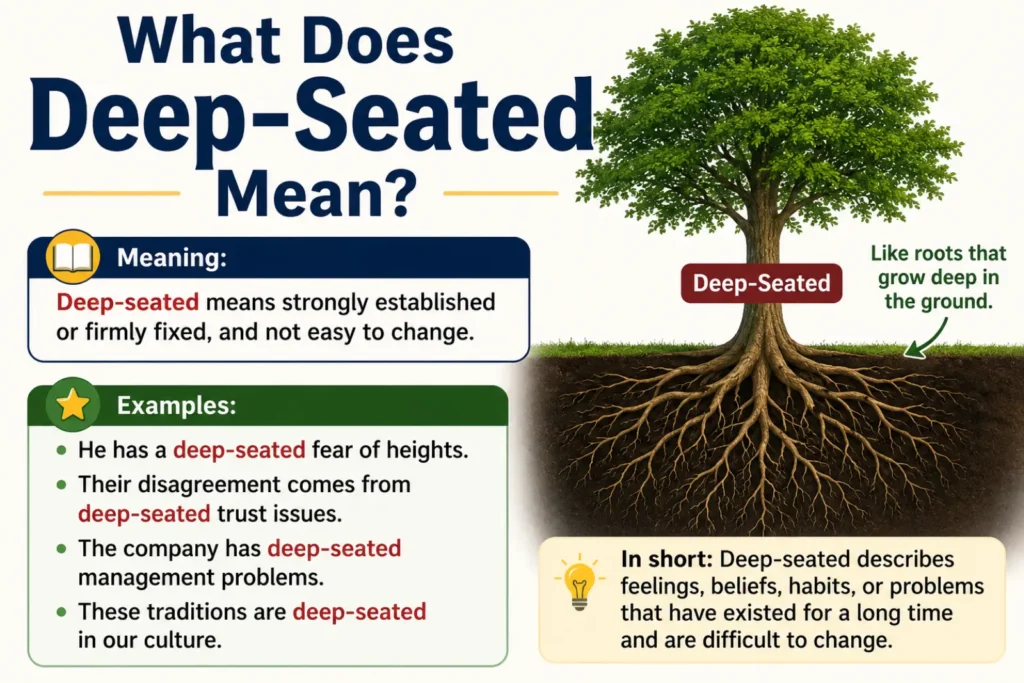
What Does Deep-Seated Mean?
Deep-seated means something is firmly fixed or strongly rooted over a long time.
It often describes emotions, opinions, traditions, habits, or problems that are difficult to change.
Examples
- She has a deep-seated fear of heights.
- Their family has deep-seated traditions.
- The company faced deep-seated management issues.
- He showed deep-seated loyalty to his team.
The phrase suggests that something exists far below the surface.
Is Deep-Seeded Correct?
No.
Deep-seeded is considered a common mistake in modern English.
Many people think it is correct because seeds grow underground. That mental picture seems logical. However, dictionaries and style guides recognize deep-seated as the standard expression.
Incorrect Examples
Deep-seeded beliefs
problems
anger
Correct Versions
Deep-seated beliefs
✅ Deep-seated problems
✅ Deep-seated anger
Why Do People Say Deep-Seeded?
The confusion happens because of pronunciation.
When people hear deep-seated, they sometimes think they hear deep-seeded.
Another reason is the image of planting seeds deep in the ground. Since beliefs and habits can “grow,” many assume “seeded” makes sense.
However, English idioms do not always follow literal logic.
Deep-Seated vs Deep-Seeded
| Feature | Deep-Seated | Deep-Seeded |
|---|---|---|
| Standard English | ✅ Yes | ❌ No |
| Found in dictionaries | ✅ Yes | Rarely, only as a common error |
| Means firmly established | ✅ Yes | ❌ No accepted meaning |
| Suitable for academic writing | ✅ Yes | ❌ No |
| Recommended for SEO content | ✅ Yes | ❌ No |
Winner
Always use deep-seated.
Where Did Deep-Seated Come From?
The word seated comes from the idea of something being firmly placed in a seat or position.
Over time, English speakers used it to describe ideas or emotions that became firmly established.
The phrase has existed for centuries and appears in respected dictionaries and literature.
Although deep-seeded appears online, language experts still treat it as an error.
Real-Life Examples of Deep-Seated
Here are common situations where the phrase fits naturally.
Personal Feelings
She has a deep-seated fear of public speaking.
Workplace
The company struggles with deep-seated communication problems.
Relationships
Their disagreement came from deep-seated trust issues.
Health
Stress can come from deep-seated emotional concerns.
Society
Some communities face deep-seated social challenges.
Common Mistakes Writers Make
Many writers accidentally replace seated with seeded.
Mistake 1
❌ Deep-seeded hatred
✅ Deep-seated hatred
Mistake 2
❌ Deep-seeded values
✅ Deep-seated values
Mistake 3
❌ Deep-seeded concern
✅ Deep-seated concern
Mistake 4
Using both forms in the same article.
Choose deep-seated every time for consistency.
Tips to Remember the Correct Phrase
Learning one simple trick can help.
Think About Position
Imagine an idea sitting firmly in place.
It is seated, not planted.
Remember Dictionaries
Major dictionaries use deep-seated.
They do not recommend deep-seeded.
Proofread Carefully
Spell-check tools may not always catch this mistake.
Read your work before publishing.
Learn Common Expressions
Many English phrases have unusual origins.
Accept them as standard usage.
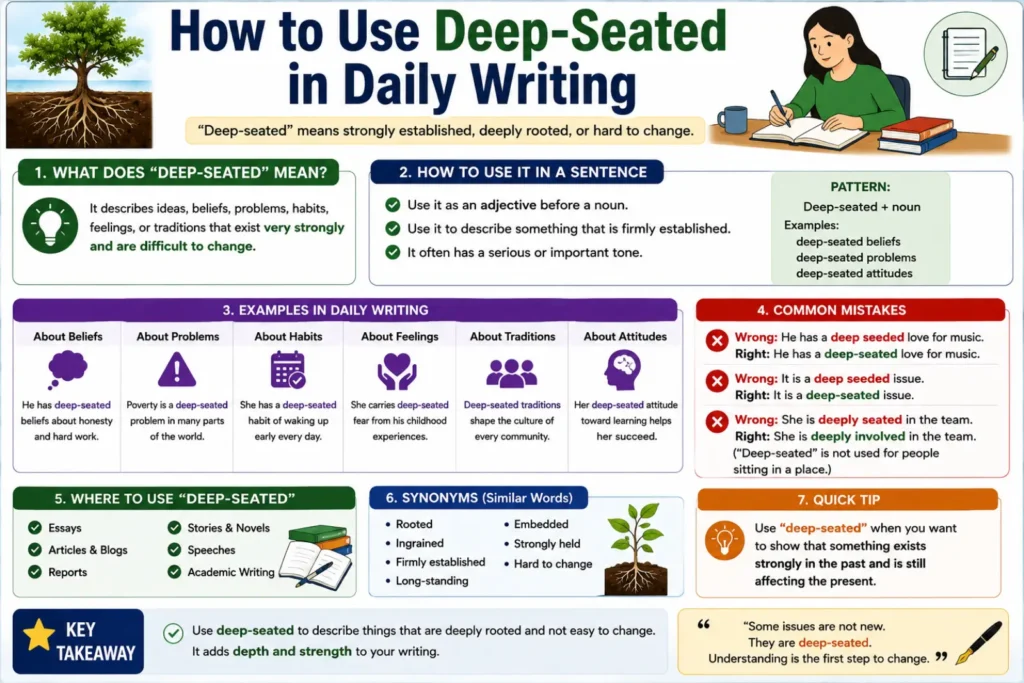
How to Use Deep-Seated in Daily Writing
You can use the phrase in many situations.
Emails
“We need to solve the deep-seated issue.”
Essays
“The country has deep-seated economic problems.”
News Articles
“The investigation revealed deep-seated corruption.”
Business Reports
“The survey found deep-seated customer concerns.”
Personal Writing
“I realized my deep-seated fear held me back.”
Synonyms and Related Keywords
Using related words improves readability and SEO.
Synonyms
- Deep-rooted
- Firmly established
- Strongly held
- Entrenched
- Long-standing
- Fixed
- Lasting
- Ingrained
- Embedded
- Persistent
LSI Keywords
- deep-rooted meaning
- deep-seated definition
- deep-seated beliefs
- deep-seated emotions
- deep-seated fear
- common English mistakes
- seated vs seeded
- English idioms
- grammar mistakes
- correct English phrases
Expert Insights
Professional editors, teachers, and dictionary publishers agree on one rule.
Always use deep-seated in standard English.
Many search engines show results for deep seeded because people search for the mistake. However, authoritative sources consistently explain that deep-seated is the accepted form.
Using the correct phrase improves writing quality. It also builds trust with readers and supports strong EEAT signals. Accurate language shows attention to detail and strengthens your credibility.
Featured Snippet Answer
Is it deep seeded or deep seated?
The correct phrase is deep-seated. It means firmly established or difficult to change. Deep-seeded is a common mistake caused by similar pronunciation. Use deep-seated in professional, academic, and everyday writing.
Frequently Asked Questions
Is deep-seeded ever correct?
No. Standard English uses deep-seated.
What does deep-seated mean?
It means something is firmly established or difficult to change.
Why do people write deep-seeded?
The words sound alike. Many people also think about seeds growing underground.
Is deep-seated formal English?
Yes. It works well in formal and informal writing.
Can I use deep-seated in business writing?
Yes. It is common in reports, presentations, and professional communication.
What is another word for deep-seated?
You can use deep-rooted, ingrained, entrenched, or firmly established.
Is deep-seated an idiom?
Yes. It is an established English expression with a figurative meaning.
Which phrase should I use for SEO writing?
Use deep-seated in your content. You may mention deep seeded only when explaining the common mistake, as this article does.
Conclusion
Many people search for deep seeded or seated because the phrases sound almost identical. Still, standard English recognizes only deep-seated as the correct expression. It describes beliefs, emotions, habits, or problems that are firmly established and hard to change. Although deep-seeded seems logical, dictionaries and language experts treat it as a common mistake rather than an accepted alternative.
Remember a simple rule: if something is firmly fixed, it is deep-seated. Using the correct phrase makes your writing clearer, more professional, and more trustworthy. Whether you are writing a blog post, business report, academic paper, or email, choosing deep-seated helps you communicate with confidence.