Comma Before or After However? The Correct Rule Explained
Comma before or after however is a question many writers ask. The answer depends on how you use the word however in a sentence. Sometimes you need a comma before however. Other times, you need …
Written by: George Hail
Published on:
Comma before or after however is a question many writers ask. The answer depends on how you use the word however in a sentence.
Sometimes you need a comma before however. Other times, you need one after it. In some cases, you need commas on both sides.
These rules often confuse students, bloggers, and professionals. Small punctuation mistakes can make writing unclear.
Fortunately, the rules are easy to learn.
This guide explains everything in simple English. You will see examples, common mistakes, and expert tips. By the end, you will know exactly where commas belong when using however.
Quick Summary Box
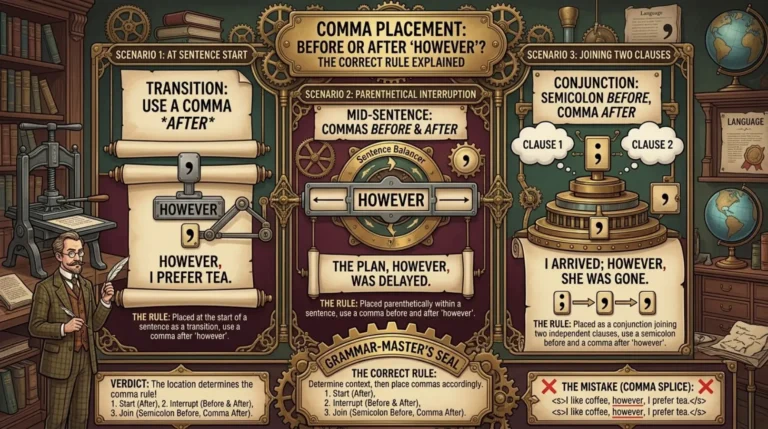
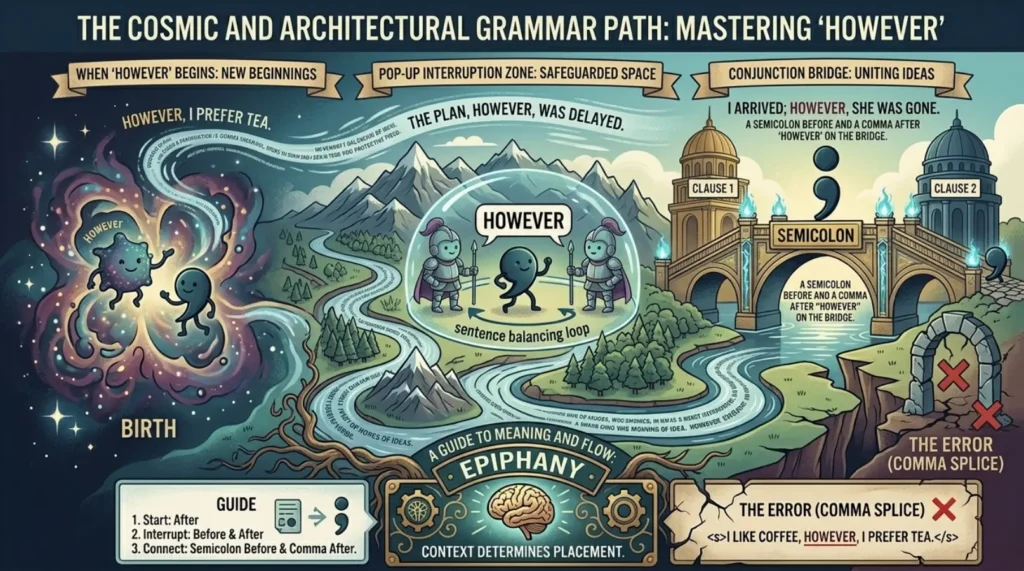
Use a comma after however when it starts a sentence.
Use a semicolon before however when joining two complete sentences.
Add a comma after however in the middle of a sentence.
Sometimes however needs commas on both sides.
The correct punctuation depends on the sentence structure.
Never join two full sentences with only a comma and however.
What Does “Comma Before or After However” Mean?
This question asks where punctuation should go when using the word however.
The answer depends on whether however acts as:
A transition word
An interrupter
A connector between ideas
Because however has several uses, punctuation rules change.
What Does However Mean?
However usually shows contrast.
It means:
nevertheless
despite that
on the other hand
even so
Example:
I felt tired. However, I finished my work.
The second sentence contrasts with the first one.
Rule 1: Use a Comma After However at the Beginning of a Sentence
When however starts a sentence, place a comma after it.
Correct Examples
However, I agreed with the decision.
However, the weather changed quickly.
However, she finished the project.
Incorrect Examples
❌ However I agreed with the decision.
❌ However the weather changed quickly.
Rule 2: Use a Semicolon Before However Between Two Sentences
Many people make mistakes here.
If both parts are complete sentences, use:
Sentence + semicolon + however + comma + sentence
Correct
I wanted to leave early; however, the meeting continued.
She studied hard; however, she missed one question.
They planned carefully; however, problems appeared.
Incorrect
❌ I wanted to leave early, however, the meeting continued.
This mistake creates a comma splice.
Rule 3: Use Commas Around However in the Middle of a Sentence
Sometimes however interrupts the sentence.
In these cases, place commas on both sides.
Examples
The movie, however, was disappointing.
My brother, however, disagreed.
The results, however, surprised everyone.
These commas show a pause.
Rule 4: No Comma After However When It Means “In Whatever Way”
Sometimes however means “no matter how.”
Examples
However hard you try, mistakes happen.
However carefully she drove, traffic delayed her.
However much they practiced, they felt nervous.
Here, however does not work as a transition word.
Comma Before or After However Comparison Table
Situation
Correct Punctuation
Example
Beginning of sentence
Comma after however
However, I stayed home.
Between two sentences
Semicolon before and comma after
I stayed home; however, I called my friend.
Middle of sentence
Commas on both sides
My friend, however, disagreed.
Means “no matter how”
Usually no comma after however
However hard you try, success takes time.
Real-Life Examples of Using However
At Work
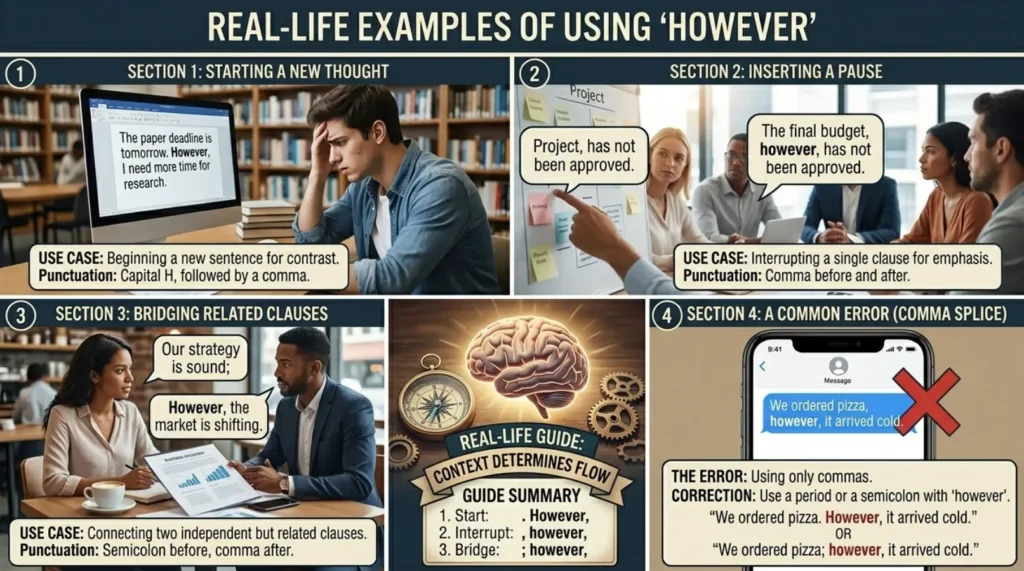
The deadline changed; however, the team finished on time.
In School
However, many students preferred online classes.
In Emails
Thank you for your message. However, we cannot approve the request.
In Blogging
The product looked great. However, it lacked important features.
Common Mistakes People Make
Mistake 1: Using Only a Comma Before However
Incorrect:
❌ I wanted coffee, however, the café was closed.
Correct:
✔ I wanted coffee; however, the café was closed.
Mistake 2: Forgetting the Comma After However
Incorrect:
❌ However I decided to continue.
Correct:
✔ However, I decided to continue.
Mistake 3: Overusing However
Too many transitions make writing sound repetitive.
Instead, use other transition words sometimes.
Similar Words to However
Here are useful alternatives:
nevertheless
nonetheless
still
yet
even so
on the other hand
despite that
regardless
Using different transition words improves readability.
Usage in Daily Life
You see however everywhere:
Emails
Text messages
School essays
Blog posts
Newspapers
Books
Business reports
Examples:
However, I appreciate your help.
We expected rain; however, the sky remained clear.
The plan looked perfect. The results, however, differed.
Expert Writing Tips
Professional editors follow these rules:
Read the Sentence Aloud
Pauses often reveal where commas belong.
Check for Complete Sentences
If both sides stand alone, use a semicolon before however.
Avoid Comma Splices
Comma splices create grammar errors and hurt readability.
Keep Sentences Simple
Short sentences improve user experience and SEO.
Why Proper Punctuation Matters
Correct punctuation:
Improves readability
Makes writing professional
Builds trust with readers
Helps students earn better grades
Creates clearer communication
Good grammar also improves user engagement. Readers stay longer when content feels easy to understand.
Related Keywords and LSI Terms
Use these naturally throughout your content:
Primary Keyword
comma before or after however
Secondary Keywords
punctuation with however
comma rules for however
semicolon before however
how to use however in a sentence
grammar rules for however
when to put a comma after however
however punctuation examples
Internal Linking Suggestions
Link this article to:
Comma Before Because Explained
Semicolon vs Colon Rules
Common Comma Mistakes
Transition Words in English
How to Use Nevertheless Correctly
Frequently Asked Questions
Do you put a comma before or after however?
Usually after however. If it joins two sentences, use a semicolon before it and a comma after it.
Can however have commas on both sides?
Yes. This happens when however interrupts a sentence.
Is “, however,” correct?
Yes. It is correct when however appears in the middle of a sentence.
Should I use a semicolon before however?
Yes, when both clauses are complete sentences.
Can I start a sentence with however?
Yes. Add a comma after it.
Is a comma before however always wrong?
No. A comma before however can appear in the middle of a sentence. But two complete sentences need a semicolon.
Why is however confusing?
Because it performs different grammatical functions.
What is the easiest rule to remember?
When however starts a sentence, always place a comma after it.
Conclusion
Understanding comma before or after however becomes easy once you know the sentence structure. Most of the time, you need a comma after however. If it connects two complete sentences, use a semicolon before it and a comma after it.
Writers often make mistakes because they focus only on the word itself. Instead, focus on how the sentence works.
Using the correct punctuation improves clarity and makes your writing look professional.
The simplest takeaway is this:
When in doubt, check whether both parts can stand alone. That rule will guide your punctuation choices.
George Hail is a language and content writer passionate about creating simple, clear, and helpful educational content. He specializes in word meanings, comparisons, grammar insights, and easy-to-understand explanations for everyday readers. Through his writing, he helps people improve their understanding of English with practical and reader-friendly content.
George Hail is a language and content writer passionate about creating simple, clear, and helpful educational content. He specializes in word meanings, comparisons, grammar insights, and easy-to-understand explanations for everyday readers. Through his writing, he helps people improve their understanding of English with practical and reader-friendly content.