CC’d or cc’ed often confuses writers. Many people see both forms online and wonder which one is right. The good news is simple. Both spellings exist, but one appears more often in modern writing. People …
Written by: Lily Watson
Published on:
CC’d or cc’ed often confuses writers. Many people see both forms online and wonder which one is right.
The good news is simple. Both spellings exist, but one appears more often in modern writing.
People use “CC” in emails every day. However, turning the abbreviation into a past tense verb creates spelling questions.
This guide explains the difference in simple words. You will learn which form experts prefer, when to use each spelling, and how to avoid common mistakes.
By the end, you will feel confident using CC correctly in emails and business writing.
Quick Summary
CC means “carbon copy.”
Both CC’d and CC’ed are accepted spellings.
CC’d is more common in business writing.
CC’ed looks clearer to some readers.
Both forms mean “included someone in an email copy.”
Context matters more than strict grammar rules.
What Does CC Mean?
CC stands for carbon copy.
People use it when sending an email to additional recipients. These people receive a copy of the message.
Example:
I CC my manager on important emails.
Sarah was CC’d on the meeting invitation.
What Does CC’d Mean?
CC’d is the past tense form of CC.
It means someone received a copy of an email.
Examples
I CC’d my supervisor yesterday.
Jake CC’d the entire team.
She CC’d the client on the project update.
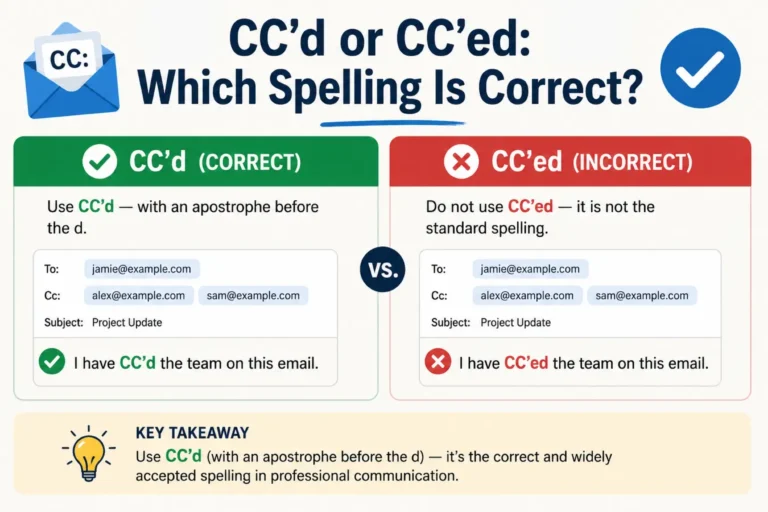
This spelling uses an apostrophe before the “d.”
What Does CC’ed Mean?
CC’ed means exactly the same thing.
Some writers add -ed because it follows normal English verb patterns.
Examples
Maria CC’ed the department head.
We CC’ed accounting on the invoice.
Many style guides accept this spelling.
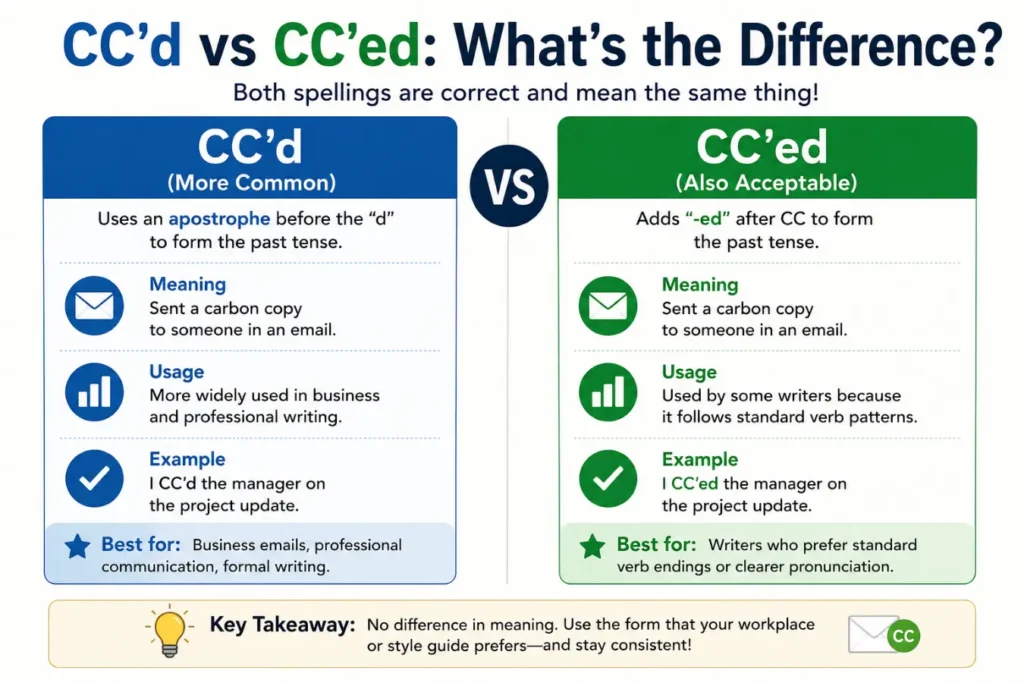
CC’d vs CC’ed: What’s the Difference?
There is no difference in meaning.
Both words describe the action of copying someone on an email.
The difference only involves spelling style.
CC’d vs CC’ed Comparison Table
Feature
CC’d
CC’ed
Meaning
Sent a carbon copy
Sent a carbon copy
Grammar
Accepted
Accepted
Common in business emails
Yes
Less common
Easier to read
Sometimes
Often
Preferred by many writers
Yes
Depends on style
Which Spelling Is More Common?
Most professionals prefer CC’d.
It appears more often in:
Business emails
Corporate communication
Workplace messages
Informal writing
Examples:
I CC’d legal on the email.
Please note that John was CC’d.
However, some people prefer CC’ed because it looks more natural.
Why Do Both Spellings Exist?
CC began as an abbreviation.
English does not have one fixed rule for converting abbreviations into verbs.
Writers use different methods:
OK → OK’d
RSVP → RSVP’d
CC → CC’d
Others add -ed:
CC’ed
OKed
Because of this flexibility, both forms remain acceptable.
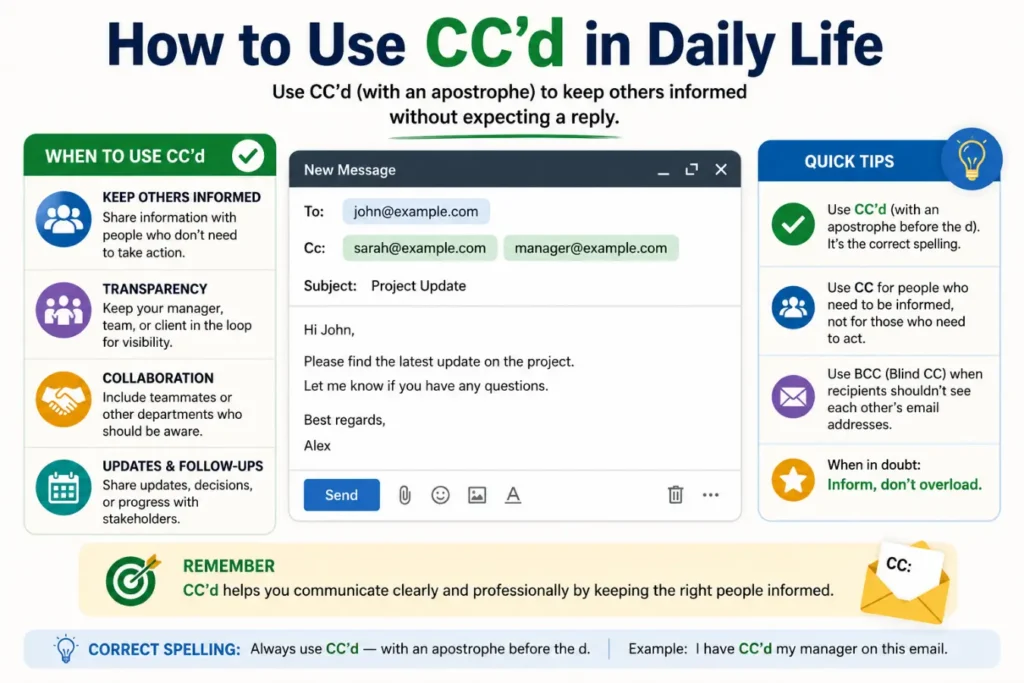
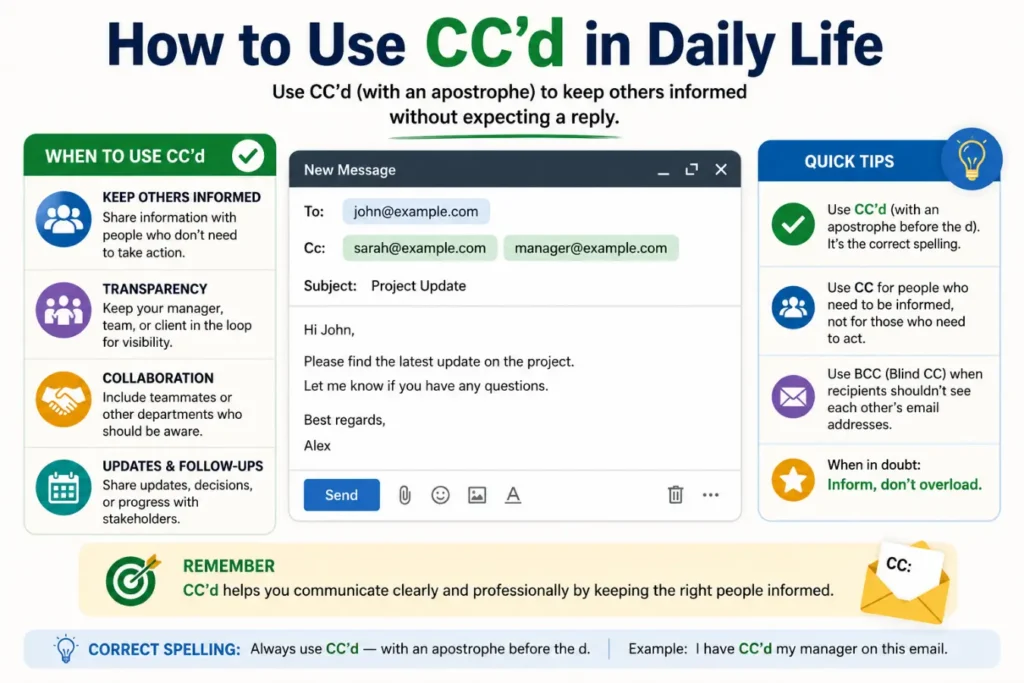
How to Use CC’d in Daily Life
People use CC’d mostly in workplace communication.
Examples
Office Email
I CC’d the project manager for visibility.
School
The teacher CC’d parents on the announcement.
Customer Service
We CC’d our support team to help resolve the issue.
Freelance Work
I CC’d the client and designer together.
Real-Life Email Examples
Example 1
Correct:
I CC’d Emma on the contract email.
Example 2
Correct:
Please check whether finance was CC’d.
Example 3
Correct:
The assistant CC’ed the department head.
Example 4
Correct:
Everyone was CC’d before the meeting started.
Common Mistakes People Make
1. Writing “CCed”
Incorrect:
I CCed the manager.
Better:
I CC’d the manager.
I CC’ed the manager.
2. Using Lowercase Inconsistently
Incorrect:
I cc’d him.
Better:
I CC’d him.
Although lowercase appears in casual messages, uppercase looks more professional.
3. Confusing CC With BCC
CC recipients can see each other.
BCC recipients stay hidden.
These two email functions serve different purposes.
Tips for Remembering the Correct Form
Use CC’d if:
You write business emails.
You want the most common form.
Your workplace already uses it.
Use CC’ed if:
You prefer standard verb endings.
Your style guide accepts it.
Most importantly, stay consistent.
Is CC’d Used in Formal Writing?
Yes.
Modern business writing accepts CC’d.
Examples include:
Internal company emails
Reports
Client communication
Project documentation
However, highly formal documents sometimes avoid the abbreviation entirely.
Instead, writers may say:
copied on the email
included in the email thread
sent a copy to
Synonyms and Related Terms
Synonyms
copied
included
notified
forwarded to
sent a copy to
Related Keywords
CC meaning in email
carbon copy email
CC versus BCC
email etiquette
copied on email
email recipient list
email communication terms
Expert Insight
Language changes over time.
Many email terms started as abbreviations. Later, people turned them into verbs.
That is why forms like CC’d, BCC’d, and RSVP’d became common.
Professional writers usually choose one style and keep it consistent.
Consistency improves readability and creates a polished appearance.
For most readers, CC’d feels more familiar and natural.
Common Email Etiquette Tips
CC only people who need the information.
Avoid copying unnecessary recipients.
Use BCC for privacy.
Keep email lists organized.
Review recipients before sending.
Good email habits improve communication and reduce confusion.
Frequently Asked Questions
Is CC’d grammatically correct?
Yes. CC’d is grammatically acceptable and widely used.
Is CC’ed also correct?
Yes. Both spellings are accepted.
Which spelling is more common?
CC’d appears more often in business communication.
What does CC stand for?
CC means carbon copy.
Should I capitalize CC?
Yes. Capital letters are standard because CC is an abbreviation.
What is the difference between CC and BCC?
CC recipients are visible. BCC recipients remain hidden.
Can I use CC’d in professional emails?
Yes. Most workplaces accept it.
Is “CCed” correct?
Most writers avoid this form. CC’d or CC’ed are clearer choices.
Internal Linking Suggestions
You can internally link this article to:
Email Etiquette Guide
CC vs BCC Explained
Professional Email Writing Tips
Common Grammar Mistakes
Business Communication Best Practices
Conclusion
When choosing between CC’d or CC’ed, remember that both spellings are correct. They carry the same meaning and describe adding someone to an email copy.
Still, CC’d appears more often in modern business writing. Many professionals prefer it because it looks familiar and concise.
If your organization uses CC’ed, that choice also works. The key is consistency.
Whether you write emails at work, school, or home, understanding these forms helps you communicate clearly and professionally. When in doubt, use CC’d, since most readers recognize it immediately.
Lily Watson is a content writer and digital researcher who specializes in creating simple, helpful, and reader-focused content. She writes about compression tools, file optimization, and practical online solutions with clarity and accuracy. Her goal is to make technical topics easy to understand for everyday users.
Lily Watson is a content writer and digital researcher who specializes in creating simple, helpful, and reader-focused content. She writes about compression tools, file optimization, and practical online solutions with clarity and accuracy. Her goal is to make technical topics easy to understand for everyday users.