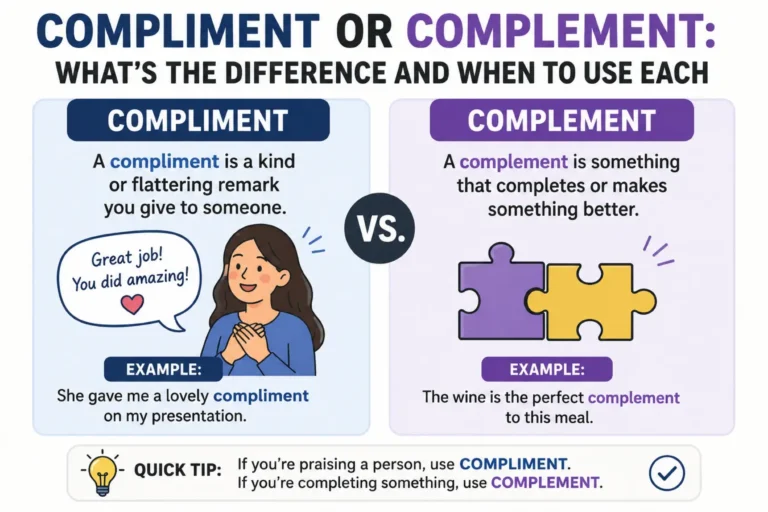
Compliment or complement is one of the most common word pairs that people confuse. The two words sound alike, but they have different meanings.
A compliment is a kind word or praise. A complement is something that completes or improves something else.
Many writers, students, and professionals mix them up. However, learning the difference is easier than you think.
In this guide, you will learn what each word means, how to use them correctly, and simple tricks to remember the difference. You will also see real-life examples, common mistakes, and expert tips.
By the end, you will never confuse compliment or complement again.
Quick Summary Box
- Compliment = praise, admiration, or a nice comment
- Complement = something that completes, matches, or improves another thing
- Compliment relates to kind words
- Complement relates to completion
- They sound the same but have different meanings
- Remember: I like to give a compliment
- Remember: A complement completes something
What Does Compliment Mean?
A compliment is a polite expression of praise, admiration, or approval.
People give compliments to make others feel appreciated.
Examples of Compliment
- She gave me a compliment about my presentation.
- Your new haircut looks great.
- The teacher complimented the student for hard work.
- He received many compliments on his speech.
In each example, someone is expressing praise.
Simple Definition
Compliment = a nice thing you say about someone.
What Does Complement Mean?
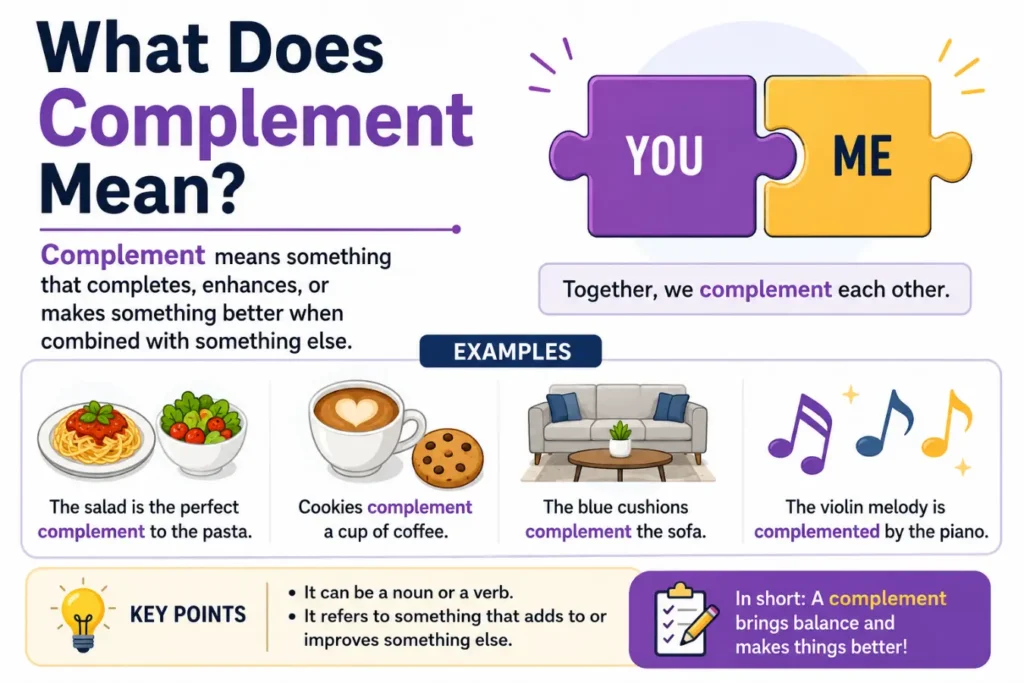
A complement is something that completes, enhances, or goes well with something else.
It often describes things that work together.
Examples of Complement
- The red tie complements his suit.
- This sauce complements the pasta perfectly.
- Her skills complement the team’s strengths.
- The furniture complements the room design.
In these examples, one thing improves or completes another.
Simple Definition
Complement = something that makes another thing better or complete.
Compliment or Complement: Key Difference
Many people struggle because both words sound identical.
The difference comes down to meaning.
| Word | Meaning | Example |
|---|---|---|
| Compliment | Praise or admiration | She complimented my writing. |
| Complement | Something that completes or improves | The curtains complement the walls. |
Easy Rule
- If it involves praise, use compliment.
- If it involves matching or completing, use complement.
Why Do People Confuse Compliment and Complement?
The words are homophones.
Homophones sound the same but have different meanings and spellings.
Other examples include:
- Their, There, They’re
- To, Too, Two
- Flour, Flower
Since compliment and complement are pronounced alike, many people choose the wrong spelling.
Real-Life Examples of Compliment and Complement
Understanding real situations makes the difference clearer.
Compliment Examples
- “You did an excellent job.”
- “I love your shoes.”
- “Your article was very helpful.”
- “You have a great sense of humor.”
Complement Examples
- A belt complements an outfit.
- Good communication complements leadership skills.
- Fresh herbs complement the flavor of soup.
- Technology complements modern education.
Notice how one word involves praise while the other involves improvement or completion.
Compliment vs Complement in Daily Life
You probably encounter both words every day.
At Work
Compliment
- Your manager compliments your performance.
Complement
- Your skills complement your coworker’s expertise.
In Fashion
Compliment
- Someone compliments your jacket.
Complement
- Your shoes complement your outfit.
In Relationships
Compliment
- Partners exchange compliments.
Complement
- Their personalities complement each other.
Memory Trick to Remember the Difference
A simple trick can help.
Compliment Has an “I”
Think:
“I like compliments.”
The letter I appears in both words.
Complement Has an “E”
Think:
“E means enhance.”
A complement enhances or completes something.
Another Trick
- Compliment = Praise
- Complement = Complete
Both words start with the same letters.
Common Mistakes People Make
Many writers use the wrong word in everyday sentences.
Incorrect
- Your scarf really compliments your coat.
Correct
- Your scarf really complements your coat.
Why?
The scarf improves the coat’s appearance. It is not praising it.
Incorrect
- She complemented me on my speech.
Correct
- She complimented me on my speech.
Why?
She praised the speech.
Compliment and Complement as Verbs
Both words can also be verbs.
Compliment as a Verb
Meaning: to praise someone.
Examples:
- I complimented her presentation.
- They complimented the chef.
Complement as a Verb
Meaning: to complete or improve.
Examples:
- The artwork complements the room.
- His experience complements his education.
The meaning remains the same whether used as nouns or verbs.
Compliment and Complement in Professional Writing
Using the correct word improves credibility.
Employers, teachers, and clients notice writing mistakes.
Professional Example
Correct:
- The new software complements our existing systems.
Incorrect:
- The new software compliments our existing systems.
Business Example
Correct:
- The departments complement each other’s functions.
Using the right word shows attention to detail.
Synonyms of Compliment
These words have similar meanings:
- Praise
- Admiration
- Approval
- Appreciation
- Flattery
- Commendation
- Tribute
- Encouragement
Example
Instead of:
- She gave me a compliment.
You can say:
- She gave me praise.
Synonyms of Complement
These words share related meanings:
- Complete
- Enhance
- Improve
- Match
- Accompany
- Support
- Strengthen
- Balance
Example
Instead of:
- The colors complement each other.
You can say:
- The colors match each other.
Expert Insights: Why This Difference Matters
Grammar mistakes can affect credibility.
Readers often judge expertise based on writing quality.
Understanding compliment or complement helps you:
- Write more professionally
- Avoid common grammar errors
- Improve communication
- Build trust with readers
- Create polished content
Language experts recommend learning commonly confused words because they appear frequently in business, education, and digital communication.
Small corrections often create a stronger impression.
Tips for Using Compliment and Complement Correctly
Tip 1: Identify the Meaning First
Ask yourself:
Is someone giving praise?
Use compliment.
Is something completing or improving another thing?
Use complement.
Tip 2: Use Memory Associations
- Compliment = “I like praise”
- Complement = “Complete”
Tip 3: Proofread Carefully
Look for these words during editing.
A quick review can catch mistakes.
Tip 4: Practice with Examples
The more examples you read, the easier it becomes.
Frequently Asked Questions (FAQs)
Is it compliment or complement someone?
Use compliment when you praise someone.
Example: I complimented her work.
Is it complement or compliment an outfit?
Use complement when something matches or enhances an outfit.
Example: The shoes complement the dress.
Why do compliment and complement sound the same?
They are homophones. Homophones share pronunciation but differ in meaning and spelling.
Can compliment and complement be used as verbs?
Yes. Both words function as nouns and verbs.
What is the easiest way to remember the difference?
Remember:
- Compliment = praise
- Complement = complete
Is “You complement me” correct?
Yes, if you mean someone completes or improves your life.
Is “You compliment me” correct?
Yes, if you mean someone praises you.
Which word is more commonly misused?
Complement is often confused with compliment because both words sound identical.
Featured Snippet Answer
What Is the Difference Between Compliment and Complement?
A compliment is a statement of praise or admiration. A complement is something that completes, improves, or matches something else. For example, “She complimented my work” means she praised it, while “The colors complement each other” means they work well together.
Internal Linking Suggestions
Consider linking this article to:
- Commonly confused words in English
- Affect vs Effect
- Then vs Than
- Their vs There vs They’re
- Grammar tips for better writing
- English vocabulary improvement guides
Conclusion
Understanding compliment or complement is easier when you focus on the meaning. A compliment is praise or admiration. A complement is something that completes, improves, or matches another thing. Although they sound the same, their uses are very different.
The best way to remember them is simple. Use compliment when talking about kind words. Use complement when talking about things that work well together.
With a little practice, you can avoid one of the most common English language mistakes. The next time you write or speak, take a moment to choose the correct word. Your communication will become clearer, more professional, and more accurate.