
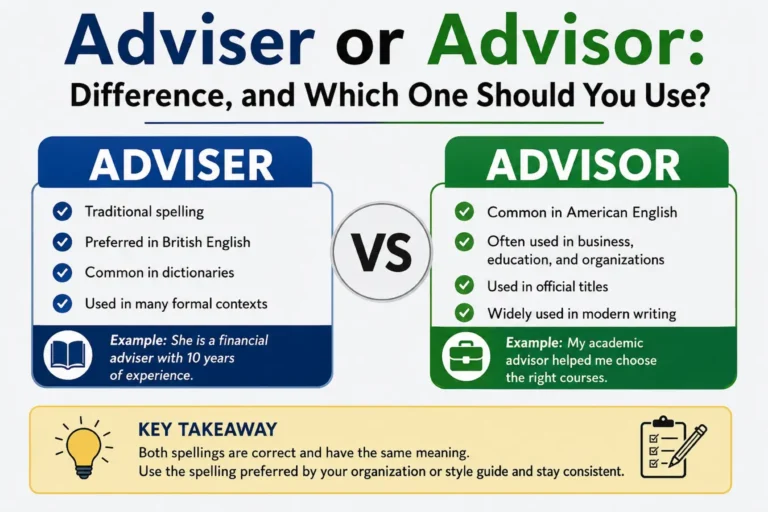
Adviser or advisor are two correct spellings of the same word. Many people wonder which one they should use. The good news is that both words have the same meaning. However, their usage depends on the country, organization, or style guide.
Some companies prefer advisor, while many dictionaries list adviser as the traditional spelling. This small spelling difference often causes confusion in writing, business, education, and government.
In this guide, you will learn the meaning of both words, their differences, real-life examples, common mistakes, and simple tips to remember the correct spelling. By the end, you will know exactly when to use adviser or advisor with confidence.
Quick Summary Box
- Adviser and advisor mean the same thing.
- Both words describe someone who gives advice.
- Adviser is the traditional English spelling.
- Advisor is common in business and American organizations.
- Both spellings are correct.
- Use the spelling preferred by your employer, school, or style guide.
- Stay consistent throughout your writing.
Adviser or Advisor Meaning
An adviser or advisor is a person who gives advice or guidance to others.
They help people make better decisions based on knowledge and experience.
Simple Definition
An adviser or advisor is someone who offers advice about work, education, money, law, or other important matters.
Examples include:
- Financial adviser
- Academic advisor
- Legal adviser
- Career advisor
- Investment adviser
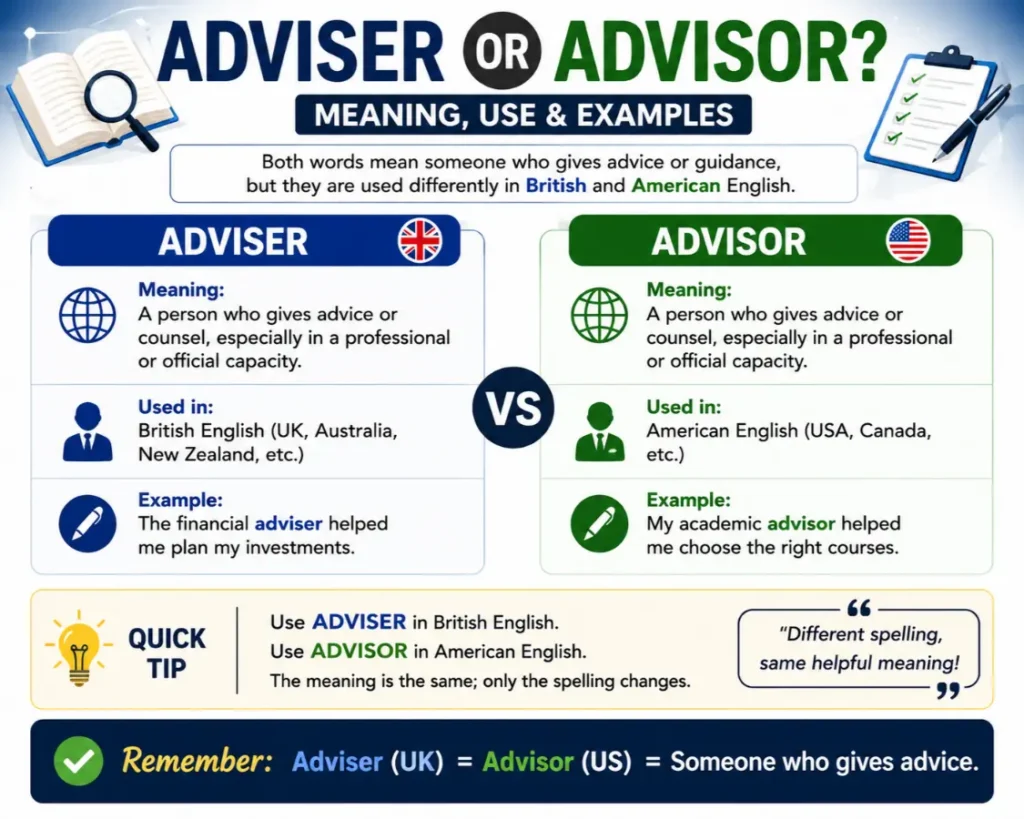
Adviser vs Advisor: What’s the Difference?
The biggest difference is spelling, not meaning.
Both words refer to the same role.
| Feature | Adviser | Advisor |
|---|---|---|
| Meaning | Gives advice | Gives advice |
| Correct? | Yes | Yes |
| Traditional spelling | Yes | No |
| Common in American organizations | Sometimes | Yes |
| Preferred by many dictionaries | Yes | Less often |
| Meaning changes? | No | No |
Key Point
There is no difference in meaning.
Only the spelling changes.
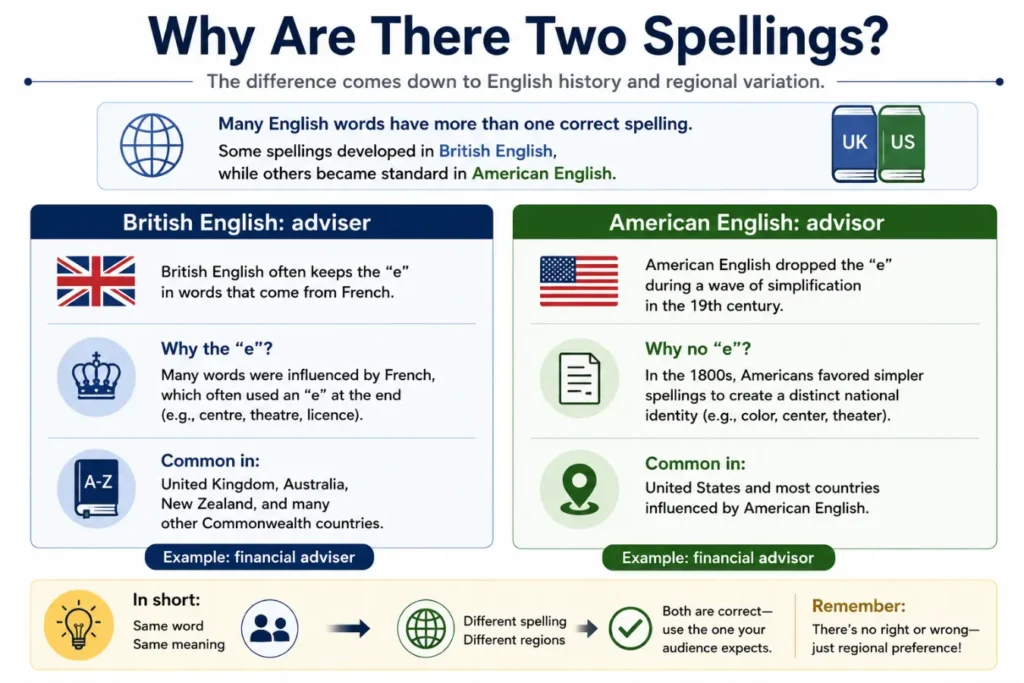
Why Are There Two Spellings?
English has changed over many years.
Many words have developed two accepted spellings.
Examples include:
- Adviser / Advisor
- Judgement / Judgment
- Cancelled / Canceled
- Grey / Gray
Originally, adviser appeared first.
Later, advisor became popular, especially in business, universities, and government agencies in the United States.
Today, both spellings are widely accepted.
Adviser in Simple Words
Think of an adviser as someone who helps you make smart choices.
Examples:
- A teacher helps students choose classes.
- A financial expert helps people save money.
- A lawyer explains legal problems.
- A mentor guides a young employee.
All of these people are advisers.
Real-Life Examples of Adviser and Advisor
Example 1
My financial adviser helped me plan for retirement.
Example 2
The university assigned each student an academic advisor.
Example 3
She works as a legal adviser for the company.
Example 4
Our travel advisor planned our vacation.
Example 5
The president met with senior economic advisers.
When Should You Use Adviser?
Use adviser when:
- Following traditional English spelling
- Writing for publications that prefer it
- Following dictionary recommendations
- Using British English in many cases
Example:
“The company hired a tax adviser.”
When Should You Use Advisor?
Use advisor when:
- Your employer uses it
- A university officially uses “Academic Advisor”
- A business title includes “Advisor”
- A government agency prefers it
Example:
“Contact your academic advisor before registering.”
Always match the official title.
Adviser or Advisor in Daily Life
You probably see these words often.
Examples include:
School
Academic advisor
Banking
Financial adviser
Business
Business advisor
Healthcare
Medical adviser
Law
Legal adviser
Career
Career advisor
Both spellings appear every day.

Common Mistakes People Make
1. Thinking One Is Wrong
Many people believe only one spelling is correct.
Both are correct.
2. Mixing Spellings
Avoid writing:
“Our adviser met the new advisor.”
Choose one spelling unless official job titles require otherwise.
3. Ignoring Official Titles
If someone’s business card says “Senior Advisor,” keep that spelling.
Do not change it.
4. Assuming British and American English Always Differ
Both countries use both spellings.
The preferred version simply varies by organization.
Easy Tips to Remember
Here are simple tricks.
Choose Adviser If:
- You follow traditional dictionary spelling.
- You write general English.
- Your style guide prefers it.
Choose Advisor If:
- It is part of a job title.
- Your organization uses it.
- You work in American business settings.
Best Tip
Stay consistent throughout your document.
Adviser vs Advisor in Different Industries
| Industry | Common Spelling |
| Schools | Advisor |
| Universities | Advisor |
| Finance | Adviser or Advisor |
| Government | Both |
| Law | Adviser |
| Business | Advisor |
| Military | Adviser |
| Publishing | Adviser |
Synonyms for Adviser or Advisor
Using related words improves writing and SEO.
Common synonyms include:
- Consultant
- Mentor
- Guide
- Counselor
- Coach
- Expert
- Specialist
- Planner
- Instructor
- Professional consultant
Related LSI Keywords
- financial adviser
- financial advisor
- academic advisor
- legal adviser
- career advisor
- investment adviser
- trusted adviser
- business advisor
- personal adviser
- professional advisor
Expert Insights
Language experts agree that adviser and advisor have identical meanings.
Many major dictionaries list adviser as the preferred traditional spelling.
However, businesses, universities, and government offices often choose advisor for official titles.
The most important rule is consistency.
If an organization officially uses advisor, keep that spelling.
If your style guide prefers adviser, use it throughout your writing.
Consistency makes your content look professional and trustworthy.
(FAQs)
Is adviser or advisor correct?
Both spellings are correct. They have the same meaning.
Which spelling is more common?
Advisor appears more often in business and education, while adviser remains the traditional dictionary spelling.
Is adviser British and advisor American?
Not exactly.
Both countries use both spellings, although preferences differ by organization.
Which spelling should I use in formal writing?
Use the spelling recommended by your employer, publisher, or style guide.
Why do universities often use advisor?
Many universities adopted advisor as the official job title.
Is financial adviser correct?
Yes.
Both financial adviser and financial advisor are correct.
Use the official title of the company or professional.
Can I switch between adviser and advisor?
No.
Choose one spelling and use it consistently unless quoting official job titles.
Featured Snippet Answer
Adviser and advisor are both correct spellings of a person who gives advice. They have the same meaning. Adviser is the traditional spelling preferred by many dictionaries, while advisor is commonly used in business, education, and official job titles. Choose the spelling preferred by your organization and stay consistent.
Conclusion
Understanding adviser or advisor is much easier than many people think. Both spellings describe someone who gives advice and guidance. The difference lies only in spelling, not meaning.
In general, adviser is the traditional form found in many dictionaries, while advisor appears frequently in business, universities, and official job titles. Before writing, check your organization’s preferred spelling or follow your chosen style guide. Most importantly, use the same spelling throughout your document.
Now that you know the difference between adviser and advisor, you can write with confidence and avoid one of English’s most common spelling questions.

