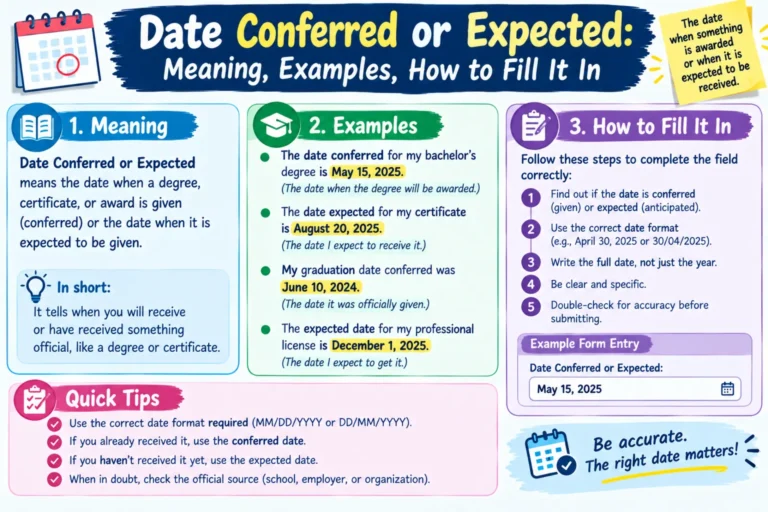
Date conferred or expected is the date you received your degree or expect to receive it. You often see this phrase on job applications, resumes, college forms, and professional profiles. It may look confusing at first. However, the meaning is quite simple. If you already finished your degree, enter the date your school awarded it. If you are still studying, enter your expected graduation date. This guide explains the term in simple words. You will also see real-life examples and common mistakes. By the end, you will know exactly what date to enter. You will also learn how to use the term on forms, resumes, and applications.
Quick Summary: What Does Date Conferred or Expected Mean?
- Date conferred means the date your school officially awarded your degree.
- Date expected means the date you expect to complete your degree.
- Graduates should use their actual degree award date.
- Current students should use their expected graduation date.
- Do not confuse graduation day with the official degree award date.
- Check your transcript or school records when unsure.
- Use the date format requested by the form.
What Does “Date Conferred or Expected” Mean?
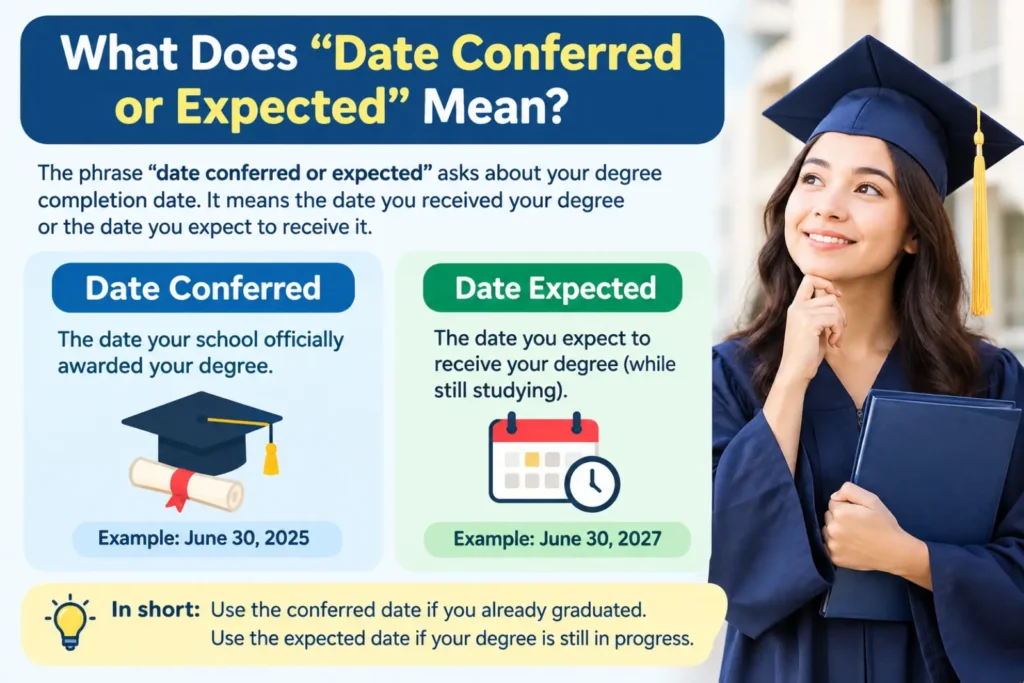
The phrase date conferred or expected asks about your degree completion date.
The word conferred means officially awarded.
For example, suppose your university awarded your bachelor’s degree on June 30, 2025. Your date conferred is June 30, 2025.
Now suppose you are still studying. Your university expects you to finish on June 30, 2027. Your date expected is June 30, 2027.
So, the basic rule is simple:
Finished degree = date conferred.
Unfinished degree = expected completion date.
This field helps schools and employers understand your education status.
What Is a Degree’s Conferred Date?
A degree conferred date is the official date your institution awards your degree.
It may differ from your graduation ceremony date.
For example, your graduation ceremony may happen on May 15. However, your university may officially award your degree on May 30.
In that case, May 30 is the conferred date.
Your transcript may show this date. Your diploma may also provide useful information.
If the form asks specifically for the date conferred, use the official award date.
What Is an Expected Degree Date?
An expected degree date applies when you have not completed your degree.
It usually means the date you expect to graduate or complete your program.
For example:
- You started a bachelor’s degree in 2023.
- Your program lasts four years.
- You expect to finish in May 2027.
- Your expected degree date is May 2027.
Some forms may ask for an exact date.
Other forms may accept only the month and year.
Always follow the format shown on the form.
Date Conferred vs. Date Expected
These terms describe different education statuses.
| Term | Meaning | Who Uses It? | Example |
|---|---|---|---|
| Date conferred | Degree already awarded | Graduates | June 30, 2025 |
| Date expected | Degree not yet awarded | Current students | June 30, 2027 |
| Graduation date | Date linked to graduation | Graduates and students | May 2027 |
| Completion date | Date program requirements finish | Students or graduates | May 2027 |
The key difference is simple.
Conferred means completed and officially awarded.
Expected means not completed yet.
What Date Should You Enter on a Form?
First, check whether you already received your degree.
If you did, enter your official conferred date.
If you have not finished your degree, enter your expected completion date.
For example:
1: Degree completed
Degree: Bachelor of Science
Date conferred: June 30, 2025
2: Degree in progress
Degree: Bachelor of Science
Date expected: June 30, 2027
3: Exact date unknown
If you only know the expected month and year, use the information allowed by the form.
For example:
Expected: May 2027
Do not create an exact date if your school has not provided one.
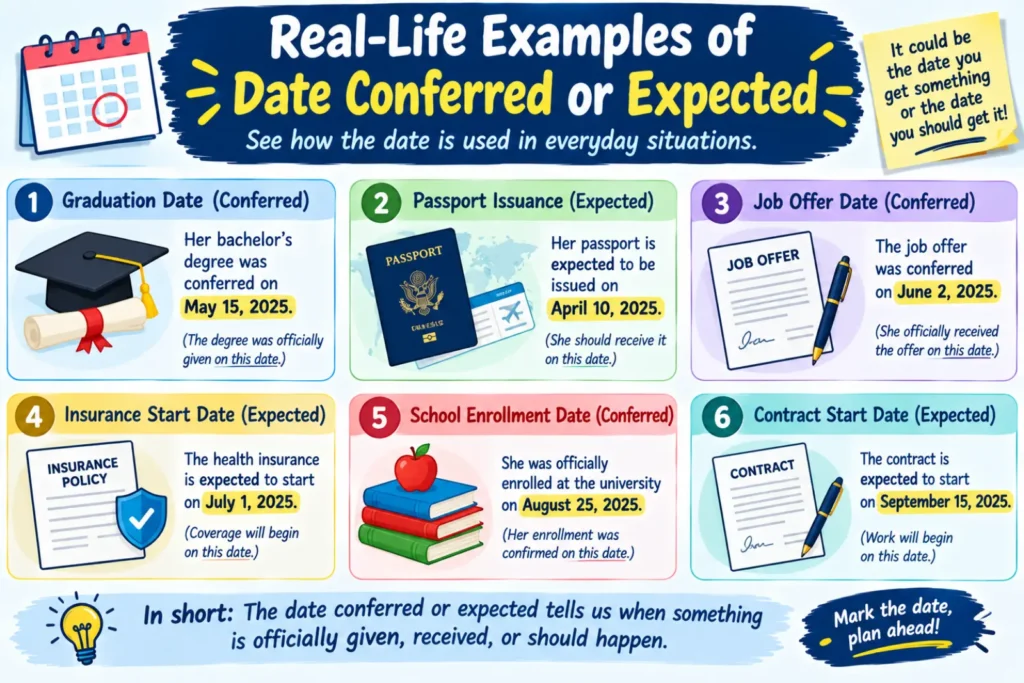
Real-Life Examples of Date Conferred or Expected
Example 1: Recent Graduate
Sarah completed her bachelor’s degree in May 2025.
Her university officially awarded the degree on June 1, 2025.
She should enter:
June 1, 2025
She should not automatically enter her ceremony date.
Example 2: Current College Student
Ali is studying for a master’s degree.
His program should finish in December 2026.
He should enter:
December 2026
If the form requires a full date, he should use the expected date provided by his university.
Example 3: Final-Year Student
Maria has completed most of her courses.
She expects to finish her degree in June 2027.
Her form could show:
Expected degree date: June 2027
She should not mark the degree as conferred yet.
Example 4: Degree Already Awarded
John received his diploma several years ago.
His transcript states that his degree was conferred on July 15, 2022.
He should enter:
July 15, 2022
The fact that his graduation ceremony happened earlier does not change the official award date.
Is the Date Conferred the Same as Graduation Date?
Not always.
People often use these terms as if they mean the same thing.
However, schools may treat them differently.
A graduation date may refer to a ceremony or completion event.
A conferred date refers to the official award of the degree.
For some schools, both dates may match.
For others, they may differ by days or weeks.
When a form specifically asks for date conferred, use your institution’s official award date.
Your academic transcript is often the best place to check.
Where Can You Find Your Conferred Date?
You can usually find your degree date in your academic records.
Check these sources:
- Official academic transcript
- Degree certificate
- Diploma
- Student portal
- University records
- Graduation documents
- Registrar’s office
Your transcript is especially useful.
It may list your degree and the date it was awarded.
If you cannot find the date, contact your school’s registrar or academic office.
How to Write the Date Correctly
Different forms use different date formats.
Common formats include:
- June 30, 2025
- 30 June 2025
- 06/30/2025
- 2025-06-30
Always follow the format requested by the form.
This matters because date formats can vary between countries.
For example, 06/07/2025 can create confusion.
Some readers may understand it as June 7.
Others may understand it as July 6.
Writing June 7, 2025 removes that confusion.
Common Mistakes When Entering a Date Conferred or Expected
1. Using the Application Date
The date you submit an application is not your degree date.
Use your degree’s official or expected date instead.
2. Using Your Birth Date
This field has nothing to do with your birth date.
It relates to your education.
3. Using the Wrong Graduation Year
Check your records before entering the year.
A small error can create problems during verification.
4. Marking an Expected Date as Conferred
Do not say a degree was conferred if you have not received it.
Use the expected date instead.
5. Guessing an Exact Date
Avoid inventing an exact date.
Use the expected month and year when that is all you know.
6. Confusing Ceremony and Award Dates
Your ceremony date may not equal your official degree date.
Check your transcript when the dates differ.
7. Ignoring the Form’s Date Format
Always follow the format requested by the application.
This reduces errors and confusion.
Tips for Filling Out “Date Conferred or Expected”
Use these simple tips:
- Check your transcript first.
- Find the official degree award date.
- Use the conferred date for completed degrees.
- Use the expected date for unfinished degrees.
- Follow the form’s date format.
- Do not guess an exact date.
- Keep your information consistent across applications.
- Contact your school when records are unclear.
Consistency also matters on resumes.
If your resume says you graduated in 2025, your application should not say 2024.
How to Use the Term on a Resume
Most resumes do not need the exact phrase date conferred or expected.
You can list your education in a simple format.
For example:
Bachelor of Science in Computer Science
ABC University
Degree conferred: June 2025
For a current student, you can write:
Bachelor of Science in Computer Science
ABC University
Expected: June 2027
This approach clearly shows your education status.
How to Use It on a Job Application
Job applications often ask for education details.
A form might include fields such as:
- School name
- Degree
- Major
- Start date
- Date conferred or expected
If your degree is complete, enter the conferred date.
If you are still enrolled, enter the expected completion date.
For example:
School: ABC University
Degree: Bachelor of Business Administration
Date conferred or expected: May 2027
This tells the employer that the degree is still in progress.
How to Use It for Graduate School Applications
Graduate school applications may also request education dates.
The same basic rule applies.
Completed degree:
Degree conferred: May 2025
Current degree:
Degree expected: May 2027
Some applications may request a month and year.
Others may request a specific date.
Use the information provided by your institution whenever possible.
How to Use It in Daily Life
You may encounter this phrase in many places.
It can appear on:
- Job applications
- Scholarship forms
- University applications
- Professional registrations
- Licensing forms
- Background checks
- Academic profiles
- Online career profiles
The purpose stays the same.
The form wants to know when you received your degree.
If you have not received it, the form wants your expected completion date.
Synonyms and Related Search Terms
People may search for this topic using different phrases.
Common related terms include:
- date degree conferred
- degree conferred date
- degree awarded date
- graduation date
- expected graduation date
- expected degree date
- degree completion date
- date of degree
- date degree awarded
- degree award date
- expected graduation month
- graduation date meaning
- conferred degree meaning
- what does conferred mean on a degree
- degree date on application
- education date conferred
These terms have similar meanings.
However, the exact meaning can depend on the form.
Expert Insight: Why the Conferred Date Matters
An official degree date can matter during verification.
Employers and institutions may compare your application with academic records.
Therefore, accuracy matters.
Use official records whenever possible.
Do not assume your ceremony date equals your degree award date.
Also, do not claim a degree before your school officially awards it.
For students, an expected date should reflect a realistic completion date.
If your expected date changes, update future applications when needed.
This simple approach supports accurate academic records.
FAQs About Date Conferred or Expected
What does “date conferred or expected” mean?
It means the date your degree was awarded or should be awarded. Use the conferred date after graduation. Use the expected date while studying.
What does “degree conferred” mean?
A degree is conferred when an educational institution officially awards it. The date may appear on your transcript or academic record.
What should I enter if I am still studying?
Enter your expected graduation or degree completion date. Follow the date format requested by the form.
Is the conferred date the same as the graduation date?
Not always. Your ceremony date and official degree award date can differ.
Where can I find my degree conferred date?
Check your official transcript, diploma, degree certificate, or student portal. You can also contact your registrar.
Can I use my graduation ceremony date?
Only if it matches the official date requested by the form. If the form asks for the conferred date, check your academic record.
What if I do not know my expected graduation date?
Check your academic plan or student portal. You can also ask your academic advisor or university office.
Should I use the month or the exact day?
Follow the form’s instructions. If it asks for a full date, provide the official or expected date. Otherwise, month and year may be enough.
Conclusion
The phrase date conferred or expected is simple once you know the difference. A conferred date applies to a degree you already received. An expected date applies to a degree you are still working toward. Your official transcript can help you find the correct date. It can also prevent mistakes between your ceremony date and degree award date. Always follow the date format shown on the form. Avoid guessing when you do not know an exact date. If your degree is still in progress, use your school’s expected completion date. If your degree is complete, use the official award date. In short, conferred means awarded, while expected means planned. Knowing this difference makes job, school, and professional applications easier to complete.