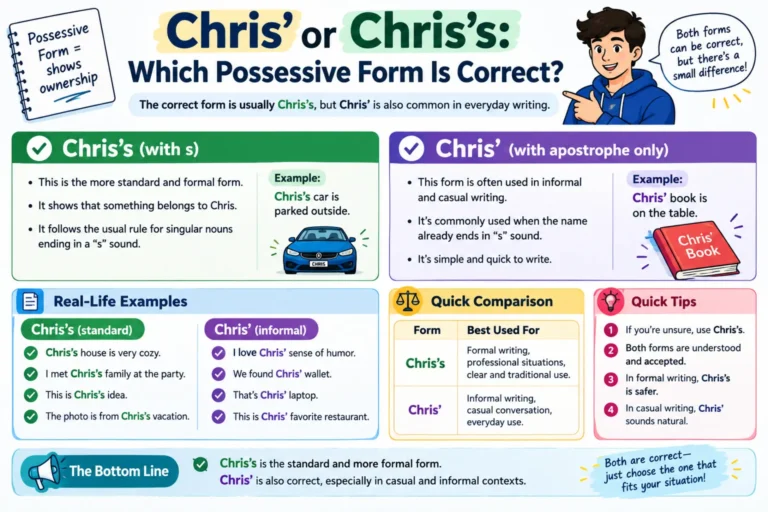
Chris’ or Chris’s can both look correct, but the right choice depends on the style you follow. Both forms show possession. The main difference comes from how English style guides handle names ending in s. Some guides prefer Chris’s. Others allow or prefer Chris’. The pronunciation can also help you understand the difference. This simple guide explains when to use each form. You will see clear rules, examples, and common mistakes. You will also learn how American and British styles may differ. By the end, you can choose the correct form with confidence. Whether you are writing an email, essay, report, or blog post, this rule matters. Good grammar makes your writing easier to read and understand.
Quick Summary
- Chris’s is the possessive form preferred by many modern style guides.
- Chris’ is also accepted by some style guides.
- Both forms can show that something belongs to Chris.
- Use Chris’s when following a style that adds ‘s to singular names.
- Use Chris’ when your chosen style omits the extra s.
- Consistency matters more than mixing both forms.
- The same issue appears with names such as James, Charles, and Lucas.
What Does “Chris’ or Chris’s” Mean?
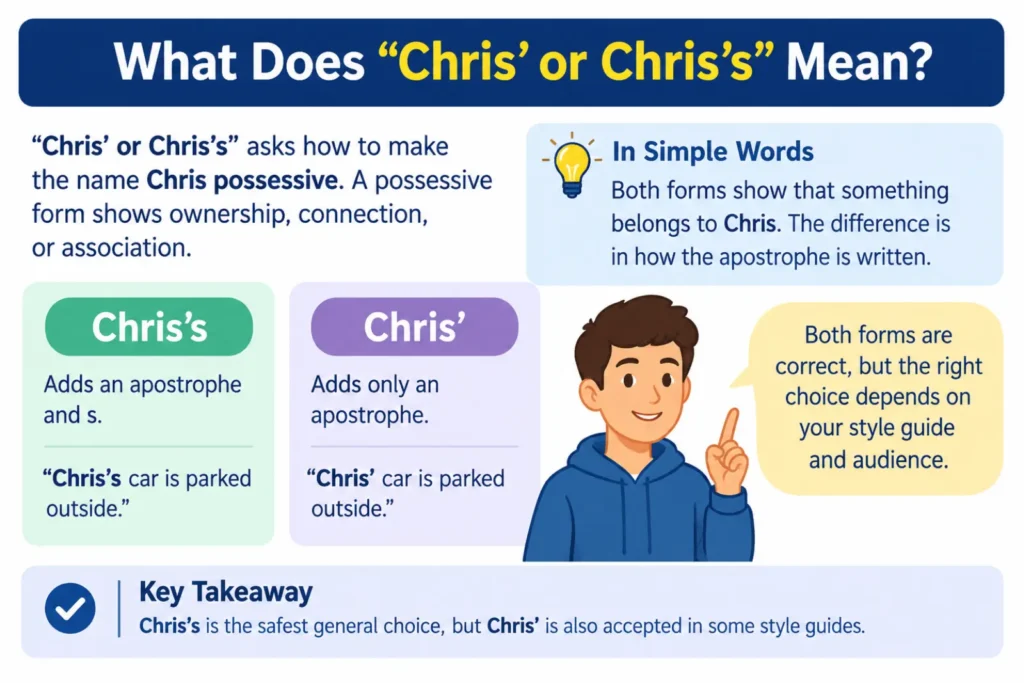
The question “Chris’ or Chris’s?” asks how to make the name Chris possessive.
A possessive form shows ownership, connection, or association.
For example:
- Chris’s car
- Chris’ car
Both examples mean that the car belongs to Chris.
The difference is the apostrophe placement.
Chris’s adds an apostrophe and s.
Chris’ adds only an apostrophe.
This creates a style difference rather than a major difference in meaning.
Is Chris’ or Chris’s Correct?
Chris’s is the safest choice in many forms of modern English writing.
For example:
Chris’s phone is on the desk.
Many style systems form the possessive of a singular name by adding ‘s.
However, Chris’ also appears in published English.
For example:
Chris’ phone is on the desk.
Some style guides allow this shorter form for names that already end in s.
Therefore, you should not assume that one form is always wrong.
The best choice depends on your writing style and audience.
Why Do We Add ‘S to Chris?
English often forms singular possessives by adding ‘s.
Consider these examples:
- Sarah → Sarah’s book
- John → John’s car
- Alex → Alex’s desk
- Chris → Chris’s phone
The same basic rule applies to Chris.
The name is singular.
Therefore, adding ‘s creates the possessive form.
This rule makes Chris’s a clear and consistent choice.
It also makes the written form easier to connect with the standard possessive pattern.
Why Do Some People Write Chris’?
Some writers follow a different possessive style.
They use only an apostrophe after a singular name ending in s.
That produces:
Chris’
This style is especially familiar because traditional writing has used similar forms.
For example:
- James’ house
- Charles’ car
- Lucas’ book
- Chris’ office
Some style guides accept these forms.
Other guides prefer James’s, Charles’s, Lucas’s, and Chris’s.
The important point is consistency.
If your school, workplace, publisher, or client follows a specific style guide, follow that guide.
Chris’ vs. Chris’s: Comparison Table
| Form | Example | Common use | Main point |
|---|---|---|---|
| Chris’s | Chris’s car | Modern general writing | Adds ‘s to a singular name |
| Chris’ | Chris’ car | Certain style systems | Uses only an apostrophe |
| Chris | Chris has a car | Non-possessive | No apostrophe is needed |
The biggest difference is the writing convention.
Both Chris’s and Chris’ can communicate possession.
However, Chris’s is often the safer choice for general writing.
Chris’ or Chris’s: Real-Life Examples
Seeing the forms in context makes the rule easier.
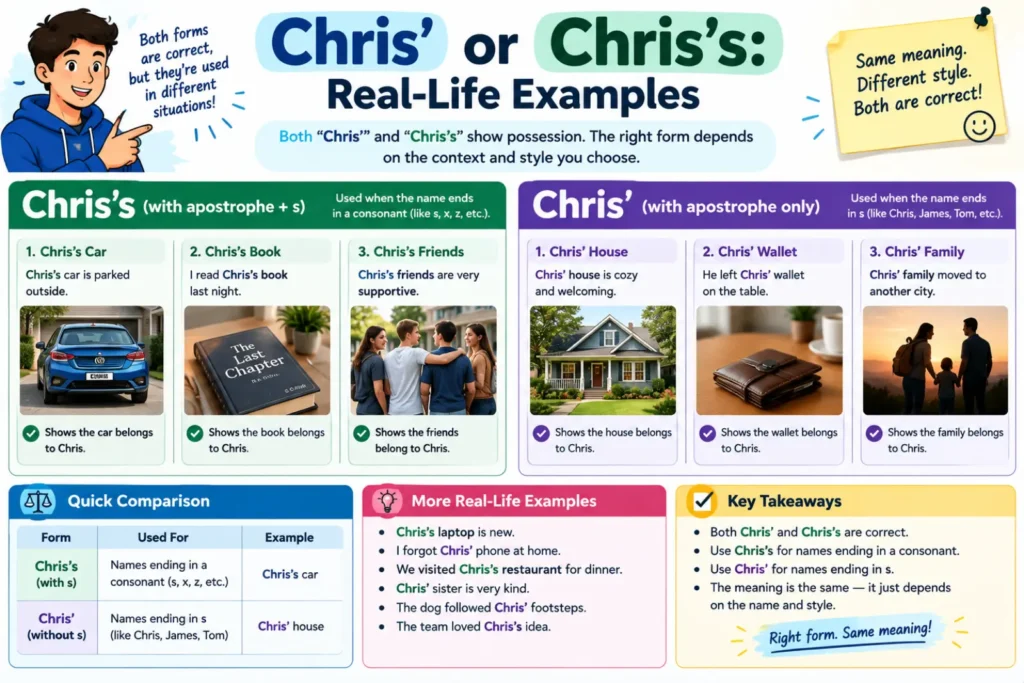
Example 1: A Car
Chris’s car is parked outside.
This follows the style that adds ‘s to singular names.
You may also see:
Chris’ car is parked outside.
Both forms communicate the same basic meaning.
Example 2: A Book
I borrowed Chris’s book.
Here, the book belongs to Chris.
The possessive form is Chris’s.
Example 3: A Desk
Chris’s desk is near the window.
Again, Chris’s shows possession.
Example 4: A Presentation
Chris’s presentation was excellent.
The presentation is associated with Chris.
Example 5: A Decision
We respected Chris’s decision.
The word does not always describe physical ownership.
Possessive forms can also show relationships or associations.
How Do You Pronounce Chris’s?
The pronunciation can help explain why many writers prefer Chris’s.
In ordinary speech, Chris’s usually has an extra syllable.
For example, the ending sounds similar to the s sound in “bus’s.”
This means the possessive ending is normally heard.
That is one reason many modern style guides write the full ‘s form.
With Chris’, writers may still pronounce the possessive ending.
The spelling simply leaves out the extra written s.
So, pronunciation and spelling do not always match perfectly.
Chris’ or Chris’s in American English
American English style can vary.
Many American style guides use ‘s for singular proper names.
Under this approach, you would write:
- Chris’s
- James’s
- Charles’s
- Lucas’s
For example:
Chris’s report was submitted yesterday.
This approach creates a simple rule.
A singular name gets ‘s, even when the name ends in s.
However, some organizations may use a different house style.
Always check the required style when writing for a specific publication.
Chris’ or Chris’s in British English
British English also allows variation.
Some British writing uses Chris’s.
Other writing uses Chris’.
The choice can depend on the style guide, publisher, or personal convention.
Therefore, it is not accurate to say that British English always requires one form.
The same principle applies across many English-speaking regions.
When in doubt, use the style required by your audience.
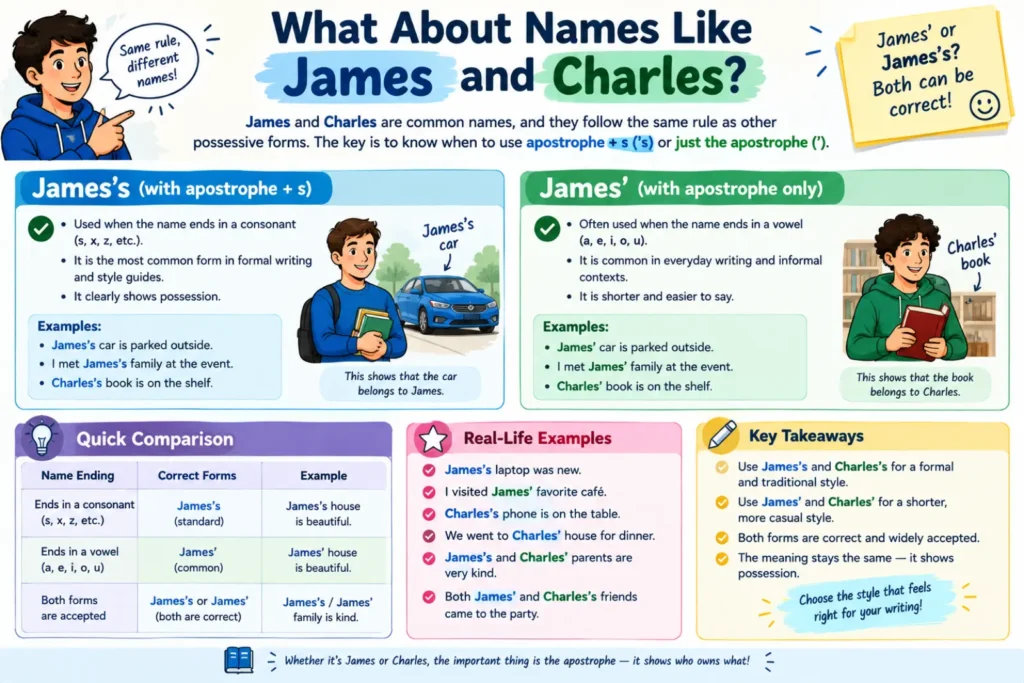
What About Names Like James and Charles?
The Chris’ or Chris’s question applies to many names.
Consider these examples:
- James’s car
- James’ car
- Charles’s house
- Charles’ house
- Lucas’s phone
- Lucas’ phone
The same style difference appears.
If your style adds ‘s to singular names, use:
James’s
If your style uses only an apostrophe for names ending in s, use:
James’
The key is to follow one consistent system.
Common Mistakes With Chris’ and Chris’s
Writers often make a few simple errors.
Mistake 1: Using an Apostrophe for a Normal Plural
Do not write:
Two Chris’s attended the meeting.
If you mean more than one person named Chris, the plural is usually:
Two Chrises attended the meeting.
The apostrophe does not normally create a plural.
Mistake 2: Confusing Possession With Contraction
Chris’s can sometimes look confusing because ‘s can also form a contraction.
For example:
Chris’s going home.
Here, Chris’s means Chris is.
But:
Chris’s phone is ringing.
Here, Chris’s shows possession.
Context tells the reader which meaning applies.
Mistake 3: Mixing Styles
Avoid switching between Chris’ and Chris’s without a reason.
For example:
Chris’s car was outside. Chris’ jacket was inside.
This looks inconsistent.
Choose one style and use it throughout your document.
Mistake 4: Removing the Apostrophe Completely
Do not write:
Chris car is outside.
The possessive needs an apostrophe.
Use either:
Chris’s car is outside.
or:
Chris’ car is outside.
Mistake 5: Assuming One Form Is Always Wrong
Grammar rules can depend on style guides.
Therefore, calling Chris’ universally wrong is too broad.
Likewise, saying Chris’s is always the only acceptable form ignores established style differences.
How to Choose Between Chris’ and Chris’s
Use this simple process.
Step 1: Check Your Style Guide
If you are writing for school, work, or publication, check the required style.
The guide may specify how to handle singular names ending in s.
Step 2: Look at Similar Names
Check how the same document handles names such as James or Charles.
This can reveal the preferred style.
Step 3: Stay Consistent
Once you choose a system, use it throughout the document.
Consistency improves readability.
Step 4: Use Chris’s for General Writing
If no style guide applies, Chris’s is often a clear and safe choice.
It follows the common rule of adding ‘s to a singular name.
Tips and Tricks to Remember the Rule
Here are some easy ways to remember the difference.
Tip 1: Think “one person.”
Chris is one person.
A common possessive pattern is:
Chris + ‘s = Chris’s
Tip 2: Think about your style guide.
Your style guide may prefer the shorter Chris’ form.
Tip 3: Do not use apostrophes for normal plurals.
“Chrises” refers to multiple people named Chris.
“Chris’s” usually shows possession.
Tip 4: Look for consistency.
Check other names ending in s.
Your document should normally follow the same pattern.
Usage in Daily Life
You may need this rule more often than you expect.
You could use the possessive form in:
- Emails
- School assignments
- Business reports
- Social media posts
- Blog articles
- Newsletters
- Presentations
- Invitations
- Personal messages
- Customer communications
For example:
Chris’s appointment starts at nine.
Or:
Chris’ appointment starts at nine.
The meaning stays clear.
Your choice mainly reflects the style system you follow.
Synonyms and Related Grammar Terms
The keyword “chris’ or chris’s” connects with several useful grammar terms.
Possessive Noun
A possessive noun shows ownership or association.
Example:
Chris’s laptop
Singular Possessive
A singular possessive refers to one person, place, or thing.
Example:
Chris’s office
Apostrophe
An apostrophe helps form possessives.
Example:
Chris’s
Proper Noun
Chris is a proper noun because it names a specific person.
Possessive Apostrophe
This term describes an apostrophe used to show possession.
Singular Names Ending in S
This phrase describes names such as:
- Chris
- James
- Charles
- Lucas
- Alexis
These names can create questions about apostrophe use.
Expert Insight: Why This Small Rule Matters
Good grammar does more than prevent mistakes.
It creates consistency and builds reader trust.
A reader may not notice a correct possessive form.
However, inconsistent punctuation can make writing look careless.
For professional content, consistency becomes even more important.
Editors often follow a house style.
Schools may require a specific academic style.
Publishers may have their own editorial rules.
Therefore, the best grammar choice is not always about memorizing one universal answer.
It is about understanding the rule and applying it consistently.
For general-purpose writing, Chris’s offers a clear and familiar pattern.
If a publication specifically prefers Chris’, follow that requirement.
Frequently Asked Questions
Is Chris’ grammatically correct?
Yes, Chris’ can be grammatically acceptable under certain style conventions. Some style guides prefer this shorter possessive form.
Is Chris’s grammatically correct?
Yes. Chris’s is widely accepted and follows the common rule for singular possessives.
Should I write Chris’ or Chris’s?
Use Chris’s when no specific style guide tells you otherwise. Use Chris’ if your chosen style follows that convention.
Is Chris’s more correct than Chris’?
Not universally. Chris’s is preferred by many style guides, but Chris’ is also accepted in some styles.
How do you make Chris possessive?
A common method is to add ‘s:
Chris’s
Some style guides instead use:
Chris’
Is Chris’s pronounced with an extra syllable?
Usually, yes. The possessive ending is commonly pronounced as an additional syllable in natural speech.
Is Chris’s a contraction?
It can be. In Chris’s car, it shows possession. In Chris’s happy, it could mean Chris is happy. Context determines the meaning.
What is the plural of Chris?
The plural is generally Chrises when referring to multiple people named Chris. The apostrophe does not normally create the plural.
conclusion: Chris’ or Chris’s?
The choice between Chris’ or Chris’s depends mainly on your style guide. Both forms can show possession. Chris’s follows the common modern pattern for singular possessive names. It is often the best choice when you have no specific style requirement. Chris’ remains acceptable in some editorial styles. The most important rule is consistency. Do not switch between the two forms without a clear reason. Also, remember that possessive forms differ from normal plurals. If you mean that something belongs to Chris, use a possessive form. If you mean several people named Chris, use the plural Chrises. When in doubt, choose Chris’s for general writing. Then use the same rule throughout your document.