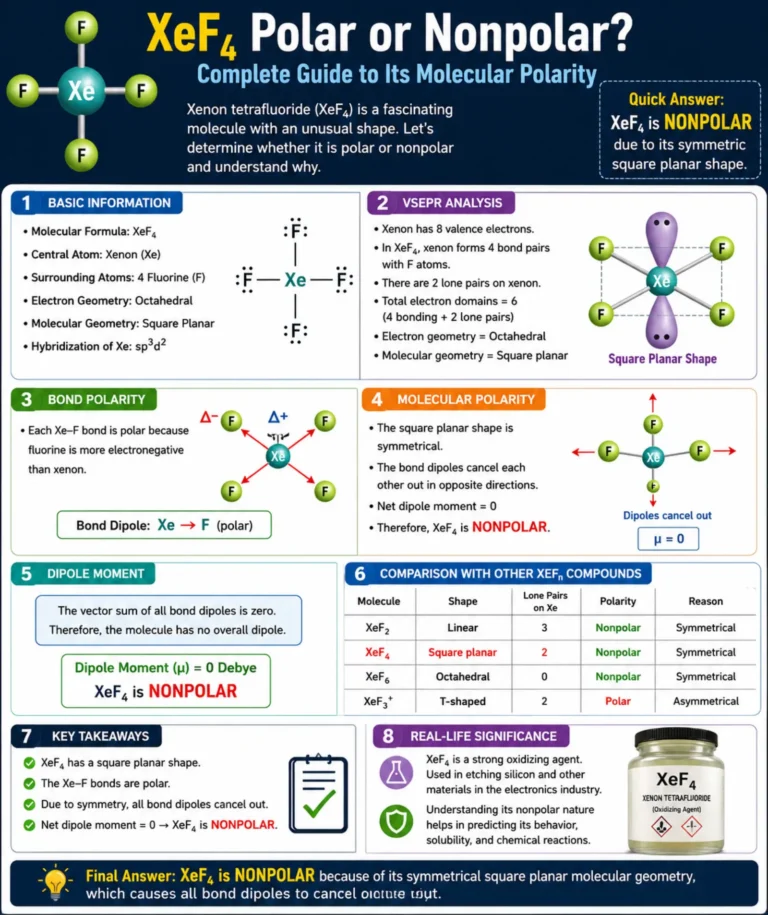
XEF4 polar or nonpolar is a common chemistry question about molecular shape and bond polarity. The correct answer is simple: XeF₄ is nonpolar. But why is it nonpolar when Xe–F bonds are polar?
The answer comes from its molecular geometry. XeF₄ has a square planar shape. Its four fluorine atoms sit evenly around the central xenon atom. The Xe–F bonds pull electrons toward fluorine. However, these bond dipoles point in opposite directions and cancel each other.
This guide explains XeF₄ polarity in simple terms. You will learn its Lewis structure, shape, bond angles, and symmetry. You will also see why lone pairs matter. By the end, you can quickly decide whether XeF₄ is polar or nonpolar.
Quick Summary
- XeF₄ is a nonpolar molecule.
- Its central atom is xenon (Xe).
- It contains four fluorine (F) atoms.
- XeF₄ has two lone pairs on xenon.
- Its molecular geometry is square planar.
- Its bond angles are mainly 90° and 180°.
- Xe–F bonds are individually polar.
- The bond dipoles cancel because of the molecule’s symmetry.
- Therefore, the overall dipole moment is zero.
What Does XeF₄ Mean?
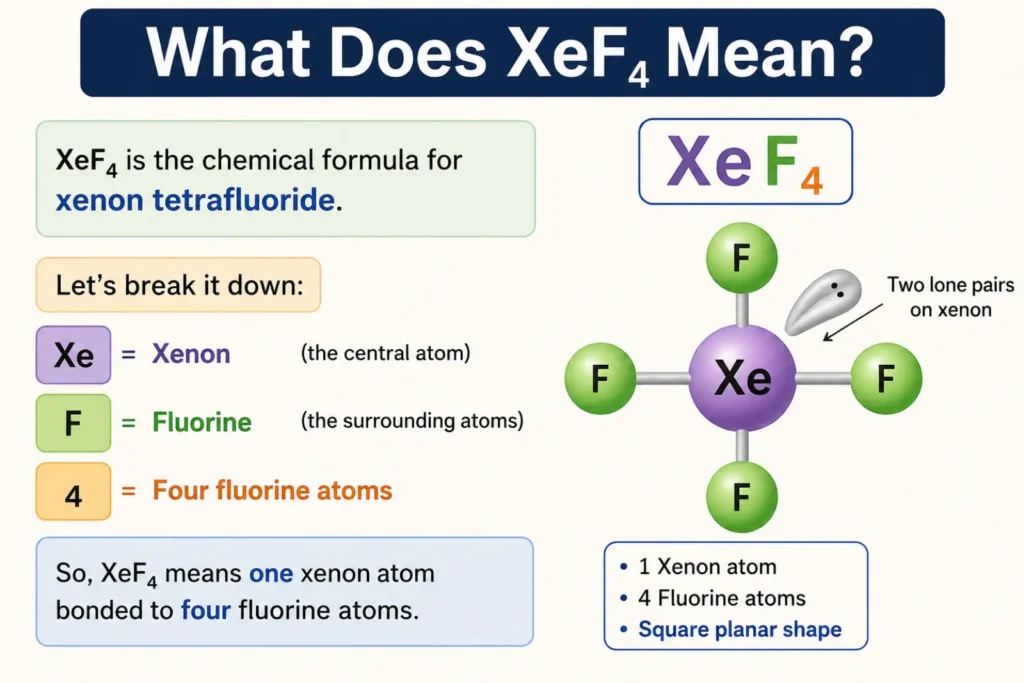
XeF₄ is the chemical formula for xenon tetrafluoride.
The formula contains one xenon atom and four fluorine atoms. Xenon acts as the central atom. The four fluorine atoms form bonds with xenon.
XeF₄ belongs to the group of xenon fluorides. These compounds contain xenon bonded to fluorine.
The name also gives useful information:
- Xe means xenon.
- F means fluorine.
- ₄ means four fluorine atoms.
The molecule has a total of 36 valence electrons. These electrons form four Xe–F bonds and two lone pairs on xenon.
Is XeF₄ Polar or Nonpolar?
XeF₄ is nonpolar.
This result may seem confusing at first. Each Xe–F bond is polar because fluorine attracts electrons more strongly than xenon.
However, molecular polarity depends on the whole molecule.
XeF₄ has a symmetrical square planar structure. The four Xe–F bonds point in balanced directions.
Two bonds point along one axis. The other two point along the perpendicular axis. Their dipoles cancel each other.
The two lone pairs also sit opposite each other. This arrangement keeps the molecule symmetrical.
Therefore, XeF₄ has no net molecular dipole moment.
Why Is XeF₄ Nonpolar?
The main reason is symmetry.
Imagine four people pulling a box from four balanced sides. Each person applies force, but the box does not move.
XeF₄ works in a similar way.
Each Xe–F bond creates a dipole. Fluorine pulls electron density toward itself. However, the four bond dipoles balance one another.
The molecule therefore has no overall direction of charge separation.
This gives XeF₄ a net dipole moment of approximately zero.
So, remember this simple rule:
Polar bonds do not always make a polar molecule.
The molecular shape determines whether the bond dipoles cancel.
XeF₄ Lewis Structure
The Lewis structure helps explain the molecule’s polarity.
Start with the valence electrons:
- Xenon has 8 valence electrons.
- Each fluorine has 7 valence electrons.
- Four fluorine atoms contribute 28 electrons.
- Total valence electrons = 36 electrons.
Xenon forms four single bonds with fluorine. These bonds use eight electrons.
Each fluorine then receives three lone pairs. This uses another 24 electrons.
The remaining four electrons stay on xenon. They form two lone pairs.
A simplified structure looks like this:
          F
          |
      F — Xe — F
          |
          F

      Two lone pairs
      occupy positions
      above and below
      the molecular plane.
The actual electron arrangement is three-dimensional. The two lone pairs occupy opposite positions around xenon.
What Is the Shape of XeF₄?
XeF₄ has a square planar molecular geometry.
The four fluorine atoms form the corners of a square. Xenon sits in the center.
The molecule is flat at the molecular level. The four fluorine atoms lie in the same plane.
The two lone pairs occupy positions above and below that plane.
This geometry creates strong symmetry.
The square planar shape explains why the bond dipoles cancel.
What Is the Electron Geometry of XeF₄?
XeF₄ has an octahedral electron-domain geometry.
Around xenon, there are six electron regions:
- Four Xe–F bonding regions
- Two lone-pair regions
Six electron regions produce an octahedral electron arrangement.
The two lone pairs sit opposite each other. This leaves the four fluorine atoms in one plane.
Therefore:
| Property | XeF₄ |
|---|---|
| Central atom | Xenon |
| Bonding pairs | 4 |
| Lone pairs | 2 |
| Electron geometry | Octahedral |
| Molecular geometry | Square planar |
| Bond angle | 90° and 180° |
| Overall polarity | Nonpolar |
Are Xe–F Bonds Polar?
Yes, Xe–F bonds are polar.
Fluorine has a higher electronegativity than xenon. It pulls shared electrons closer to itself.
This creates a partial negative charge near fluorine. Xenon develops a partial positive character.
So, each Xe–F bond has a bond dipole.
However, the molecule contains four such bonds. Their directions balance because of the square planar structure.
This distinction matters:
Polar bonds + symmetrical shape = potentially nonpolar molecule.
XeF₄ provides a classic example of this principle.
XeF₄ vs Other Common Molecules
Comparing XeF₄ with other molecules makes polarity easier to understand.
| Molecule | Shape | Polar bonds? | Overall polarity |
|---|---|---|---|
| XeF₄ | Square planar | Yes | Nonpolar |
| CO₂ | Linear | Yes | Nonpolar |
| H₂O | Bent | Yes | Polar |
| NH₃ | Trigonal pyramidal | Yes | Polar |
| BF₃ | Trigonal planar | Yes | Nonpolar |
| CH₄ | Tetrahedral | Nearly nonpolar | Nonpolar |
Notice the pattern.
CO₂ has polar C=O bonds. Yet its linear shape makes the dipoles cancel.
H₂O has polar O–H bonds. Its bent shape prevents complete cancellation.
XeF₄ behaves more like CO₂ and BF₃ in this respect.
Real-Life and Chemistry Examples
XeF₄ is mainly important in chemistry and chemical research. It is not a common household substance.
Students often encounter XeF₄ when studying:
- Molecular polarity
- Lewis structures
- VSEPR theory
- Molecular geometry
- Bond dipoles
- Electronegativity
- Noble gas compounds
- Chemical bonding
For example, a chemistry exam might ask:
“Is XeF₄ polar or nonpolar?”
A strong answer should mention both its shape and dipole cancellation.
You can write:
“XeF₄ is nonpolar because it has a symmetrical square planar shape. Its polar Xe–F bond dipoles cancel.”
That answer directly addresses the key reason.
Common Mistakes When Finding XeF₄ Polarity
Students often make the same mistakes with this molecule.
Mistake 1: Looking Only at Bond Polarity
Some students see polar Xe–F bonds and immediately call XeF₄ polar.
That approach ignores molecular geometry.
Always consider the entire molecule.
Mistake 2: Forgetting the Lone Pairs
Xenon has two lone pairs in XeF₄.
These lone pairs strongly affect the molecular shape.
Ignoring them can lead to the wrong geometry.
Mistake 3: Calling XeF₄ Tetrahedral
Four bonds do not automatically mean tetrahedral geometry.
XeF₄ also has two lone pairs. Therefore, it has six electron domains.
Its electron geometry is octahedral.
Its molecular geometry is square planar.
Mistake 4: Confusing Electron and Molecular Geometry
These terms describe different things.
Electron geometry includes bonds and lone pairs.
Molecular geometry considers the positions of atoms.
For XeF₄:
- Electron geometry = octahedral
- Molecular geometry = square planar
Mistake 5: Ignoring Symmetry
Symmetry plays a major role in molecular polarity.
XeF₄ has a highly symmetrical arrangement. This symmetry allows the bond dipoles to cancel.
Tips to Quickly Determine If XeF₄ Is Polar
Use this simple five-step method.
Step 1: Draw the Lewis Structure
Place xenon in the center.
Connect four fluorine atoms to xenon.
Step 2: Count Electron Domains
XeF₄ has six electron regions.
Four come from bonds. Two come from lone pairs.
Step 3: Find the Molecular Geometry
Six electron regions give an octahedral electron arrangement.
Two opposite lone pairs leave a square planar molecular shape.
Step 4: Check Bond Polarity
Xe–F bonds are polar because fluorine is more electronegative.
Step 5: Check Dipole Cancellation
The square planar structure is symmetrical.
The four bond dipoles cancel.
Final answer: XeF₄ is nonpolar.
How VSEPR Theory Explains XeF₄
VSEPR stands for Valence Shell Electron Pair Repulsion.
This theory says electron pairs repel each other. They arrange themselves to reduce repulsion.
XeF₄ has six electron domains around xenon.
The six domains arrange in an octahedral pattern.
The two lone pairs prefer opposite positions. This arrangement reduces repulsion between them.
The four fluorine atoms then occupy the remaining four positions.
These positions form a square plane.
That structure gives XeF₄ its characteristic symmetry.
XeF₄ Polarity: The Key Concept
The most important idea is the difference between bond polarity and molecular polarity.
Bond polarity describes an individual bond.
Molecular polarity describes the entire molecule.
A molecule can contain polar bonds but still remain nonpolar.
XeF₄ is a perfect example.
Each Xe–F bond has a dipole. However, the four dipoles point in balanced directions.
Their vector sum equals zero.
Therefore, the molecule has no net dipole moment.
This concept appears frequently in chemistry exams and molecular structure questions.
Synonyms and LSI Keywords for XeF₄ Polarity
Search engines may connect this topic with several related terms.
Useful semantic keywords include:
- XeF₄ polar or nonpolar
- xenon tetrafluoride polarity
- is XeF₄ polar
- XeF4 molecular geometry
- XeF4 Lewis structure
- XeF4 shape
- XeF4 bond angle
- XeF4 electron geometry
- XeF4 dipole moment
- square planar molecules
- polar and nonpolar molecules
- Xe–F bond polarity
- VSEPR theory
- molecular polarity
- bond dipoles
- electronegativity
- lone pairs in XeF₄
These terms describe closely related chemistry concepts. They help readers find the right information.
Expert Insights: Why XeF₄ Matters
XeF₄ is useful because it shows why molecular shape matters more than individual bond polarity.
A common chemistry shortcut says that polar bonds make polar molecules. That shortcut can fail.
Instead, use this expert approach:
- Find the central atom.
- Count bonding and lone-pair regions.
- Determine the molecular geometry.
- Identify polar bonds.
- Check whether their dipoles cancel.
This method works for XeF₄ and many other molecules.
It also reduces mistakes in chemistry tests.
For content creators, explaining the reason behind the answer adds more value than simply saying “nonpolar.”
FAQs About XeF₄ Polar or Nonpolar
Is XeF₄ polar or nonpolar?
XeF₄ is nonpolar. Its square planar structure causes the Xe–F bond dipoles to cancel.
Why is XeF₄ nonpolar?
XeF₄ is nonpolar because its four polar Xe–F bonds have a symmetrical arrangement. Their dipoles cancel.
Does XeF₄ have polar bonds?
Yes. The Xe–F bonds are polar because fluorine attracts electrons more strongly than xenon.
What is the shape of XeF₄?
XeF₄ has a square planar molecular geometry.
What is the electron geometry of XeF₄?
Its electron-domain geometry is octahedral because xenon has six electron regions.
How many lone pairs does XeF₄ have?
The central xenon atom has two lone pairs.
What are the bond angles in XeF₄?
The main F–Xe–F bond angles are 90° and 180°.
Does symmetry make XeF₄ nonpolar?
Yes. Its symmetrical square planar structure causes the bond dipoles to cancel.
Conclusion: Is XeF₄ Polar or Nonpolar?
XeF₄ is nonpolar. Its four Xe–F bonds are individually polar, but the molecule itself has no overall polarity.
The key is its square planar molecular geometry. Xenon has four bonding pairs and two lone pairs. The lone pairs occupy opposite positions in the octahedral electron arrangement. This leaves the four fluorine atoms in a symmetrical square plane.
Because of this symmetry, the four Xe–F bond dipoles cancel. The molecule therefore has a net dipole moment of zero.
When answering “XeF₄ polar or nonpolar?”, remember three words: polar bonds, symmetrical shape, cancellation.
That simple method can help you solve many molecular polarity questions.