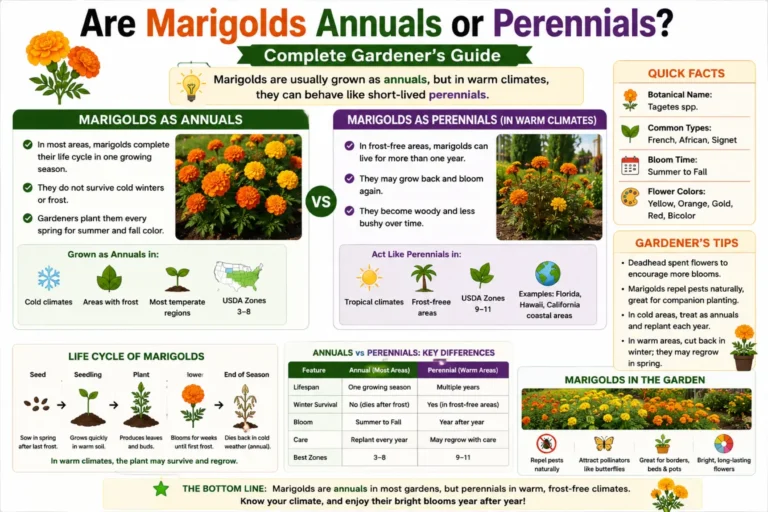
Are marigolds annuals or perennials? Most garden marigolds are annual flowers that live for one growing season. They grow quickly, bloom for months, and die after frost. However, some marigold species can behave as perennials in warm climates. The answer depends on the type of marigold and your local weather. Common garden marigolds, such as French and African marigolds, usually grow as annuals. They cannot survive freezing temperatures for long. Some less common species can live for several years. Gardeners can also save marigold seeds for the next season. This makes annual marigolds easy to grow year after year. In this guide, you will learn how marigolds grow, when they return, and how to keep them blooming. You will also learn about common mistakes and easy care tips.
Quick Summary: Are Marigolds Annuals or Perennials?
- Most common garden marigolds are annuals.
- Annual marigolds usually live for one growing season.
- Frost often kills common marigold plants.
- French and African marigolds usually grow as annuals.
- Some marigold species can grow as perennials.
- Warm climates may allow some types to survive for years.
- Saving seeds lets you grow marigolds again next year.
- “Pot marigold” usually means calendula, not a true Tagetes marigold.
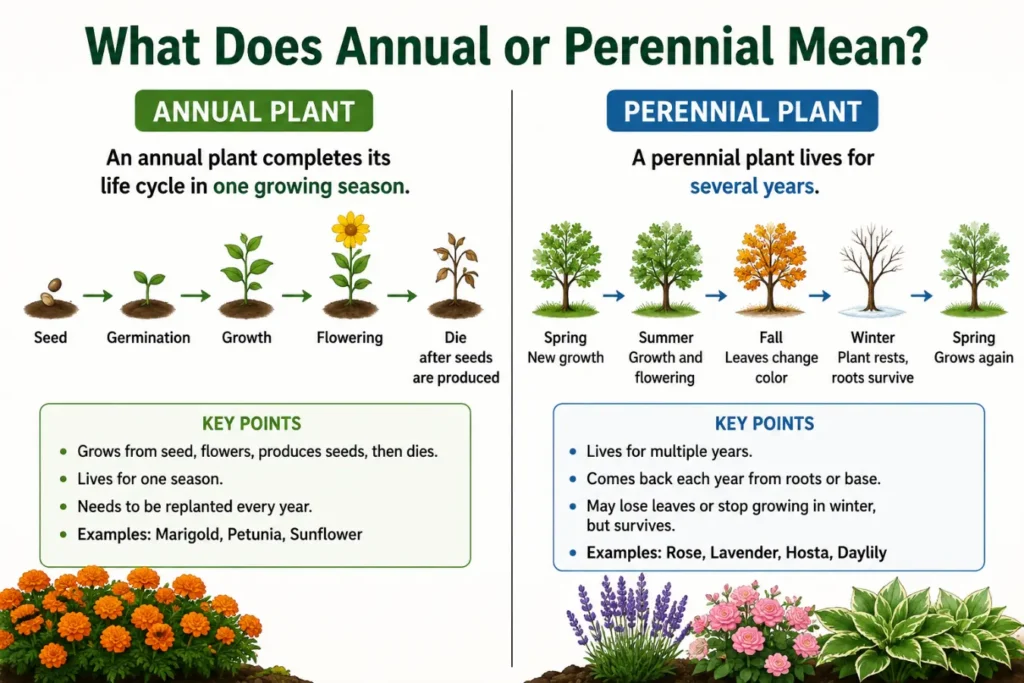
What Does Annual or Perennial Mean?
An annual plant completes its life cycle within one growing season.
It grows from a seed, produces flowers, makes seeds, and then dies.
A perennial plant lives for several years.
It may lose leaves or stop growing during cold weather. However, its roots or stems can survive.
Marigolds show both growth habits across different species.
Most familiar bedding marigolds belong to the Tagetes genus. Gardeners commonly grow French, African, and signet marigolds.
These plants usually grow as annuals.
Some other Tagetes species can survive for several years in suitable climates.
Therefore, “marigolds are annuals” gives the simplest answer. Yet, it does not cover every marigold species.
Are Common Garden Marigolds Annuals?
Yes, most common garden marigolds are annuals.
Garden centers often sell three popular types:
- French marigolds
- African marigolds
- Signet marigolds
These plants usually complete their life cycle in one year.
They grow rapidly during warm weather. Then, they flower and produce seeds.
Cold temperatures can end their growth.
In areas with freezing winters, gardeners usually grow new plants each spring.
However, marigolds may reseed themselves.
Dropped seeds can sprout during the following warm season. This can make annual marigolds appear perennial.
The original plant still died. New plants simply grew from its seeds.
Are French Marigolds Annuals or Perennials?
French marigolds are generally annuals.
They belong mainly to Tagetes patula and related forms.
French marigolds stay fairly compact. They often produce many small flowers.
Their blooms can appear in yellow, orange, red, and mixed shades.
They work well in:
- Flower beds
- Vegetable gardens
- Containers
- Borders
- Window boxes
French marigolds usually cannot survive hard frost.
In warm weather, however, they can flower for a long time.
Deadheading spent flowers can encourage continued blooming.
Are African Marigolds Annuals or Perennials?
African marigolds are usually grown as annuals.
Despite their name, African marigolds originated in the Americas.
They often grow taller than French marigolds.
Their large flowers make them popular for borders and flower beds.
They need warm weather and plenty of sunlight.
Frost can quickly damage or kill them.
In frost-free areas, plants may survive longer. Yet, gardeners still commonly treat them as annuals.
Their large flowers also make them useful as cut flowers.
Are Signet Marigolds Annuals or Perennials?
Signet marigolds are generally annuals.
They belong to species such as Tagetes tenuifolia.
These marigolds usually produce smaller flowers than African types.
Their leaves look delicate and finely divided.
Many gardeners grow them around vegetables or herbs.
Some signet marigolds also have edible flowers and citrus-like foliage.
Always confirm the variety before eating any flower.
Avoid flowers treated with pesticides or other garden chemicals.
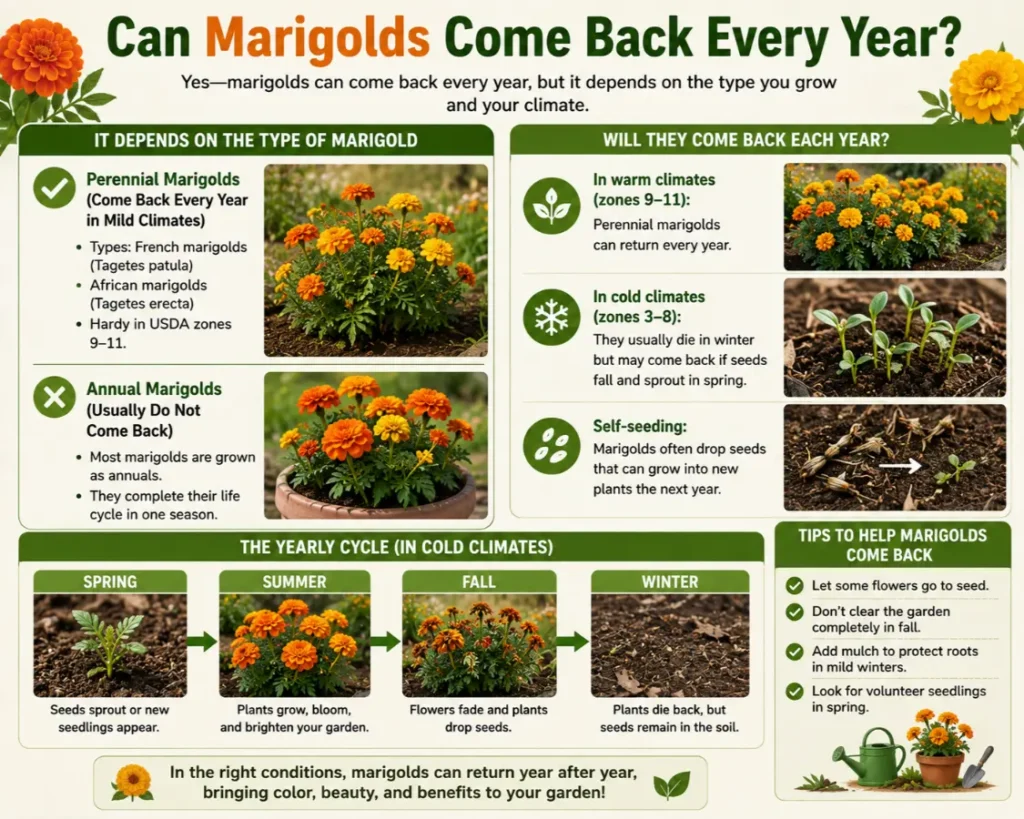
Can Marigolds Come Back Every Year?
Yes, but usually not from the same plant.
Annual marigolds can return through self-seeding.
The plant produces seeds after flowering. Some seeds fall onto the soil.
Those seeds may survive the winter in mild conditions.
They can then sprout when temperatures rise.
This process can create new marigold plants without planting fresh seeds.
However, self-seeding depends on several factors.
These include winter temperature, soil conditions, moisture, and seed production.
Some gardeners welcome this natural process.
Others remove old flowers before they produce seeds.
So, a marigold returning next year does not always mean it is perennial.
What Is the Difference Between Annual and Perennial Marigolds?
| Feature | Annual Marigolds | Perennial Marigolds |
|---|---|---|
| Life span | Usually one growing season | Several years |
| Cold tolerance | Usually low | Often higher in suitable climates |
| Winter survival | Usually poor | Possible in warm climates |
| Common garden types | French, African, signet | Certain less common Tagetes species |
| Flowering | Often heavy during warm months | Can flower across multiple seasons |
| Replanting | Usually needed | Often not needed |
| Seed saving | Easy | Also possible |
| Best climate | Warm growing season | Depends on species |
The key difference involves how the plant survives winter.
An annual completes its life cycle before dying.
A perennial survives and grows again from existing plant tissue.
Climate also matters.
A plant can act as a perennial in one region but an annual in another.
What About Pot Marigold?
“Pot marigold” can cause confusion.
Pot marigold usually refers to Calendula officinalis.
Calendula is not a true Tagetes marigold.
It belongs to the Calendula genus.
Calendula can grow as an annual or short-lived perennial, depending on climate and conditions.
It also has a different appearance from common garden marigolds.
Therefore, check the botanical name when buying plants.
Tagetes usually refers to true garden marigolds.
Calendula usually refers to pot marigold.
This simple distinction prevents many gardening mistakes.
Can Marigolds Survive Winter?
Most common marigolds do not handle freezing weather well.
They prefer warm growing conditions.
Frost can damage their leaves, stems, and flowers.
A hard freeze can kill the entire plant.
However, gardeners in warm regions may enjoy longer plant life.
Some species can survive mild winters without major damage.
Container-grown marigolds may also face different conditions.
You can move containers indoors before frost arrives.
Give the plants strong sunlight and avoid overwatering.
Still, common annual marigolds usually perform best as seasonal plants.
How to Make Marigolds Return Next Year
You cannot turn a typical annual marigold into a true perennial.
However, you can grow new plants from saved seeds.
Follow these simple steps:
- Let some flowers remain on the plant.
- Wait for the flower heads to dry.
- Remove the dry flower heads.
- Separate the seeds from the flower material.
- Store the seeds in a cool, dry place.
- Label the seeds with the plant variety.
- Plant them after the risk of frost passes.
You can also allow some flowers to drop seeds naturally.
This method works best when the local climate supports seed survival.
Remember that hybrid plants may not produce offspring identical to the parent plant.
Common Mistakes Gardeners Make With Marigolds
Several mistakes can cause confusion about marigold growth.
Mistake 1: Assuming Every Marigold Is Perennial
Most popular bedding marigolds are annuals.
Always check the plant species or variety.
Mistake 2: Confusing Self-Seeding With Perennial Growth
New plants may appear next year from dropped seeds.
That does not mean the original plant survived.
Mistake 3: Planting Too Early
Marigolds dislike cold soil and frost.
Wait until the weather becomes reliably warm.
Mistake 4: Giving Too Much Water
Marigolds generally prefer well-drained soil.
Waterlogged roots can cause problems.
Mistake 5: Growing Them in Too Much Shade
Marigolds usually flower best with plenty of sunlight.
Insufficient light can reduce flowering.
Mistake 6: Removing Every Spent Flower
Deadheading can improve the plant’s appearance.
However, leave a few flowers if you want to collect seeds.
Tips for Growing Healthy Marigolds
Marigolds are among the easier flowers for beginners.
Use these simple care tips for stronger plants.
Give Them Plenty of Sun
Choose a location with several hours of direct sunlight.
More light usually supports better flowering.
Use Well-Drained Soil
Marigolds do not enjoy constantly wet roots.
Improve heavy soil with suitable organic material if needed.
Water When Needed
Water deeply when the soil becomes dry.
Avoid keeping the soil constantly soaked.
Remove Faded Flowers
Deadheading can encourage more blooms.
It also keeps the plant looking tidy.
Avoid Excess Fertilizer
Too much nitrogen can encourage leaves instead of flowers.
Use fertilizer carefully and follow the product instructions.
Provide Good Airflow
Do not overcrowd plants.
Good spacing helps foliage dry after watering or rain.
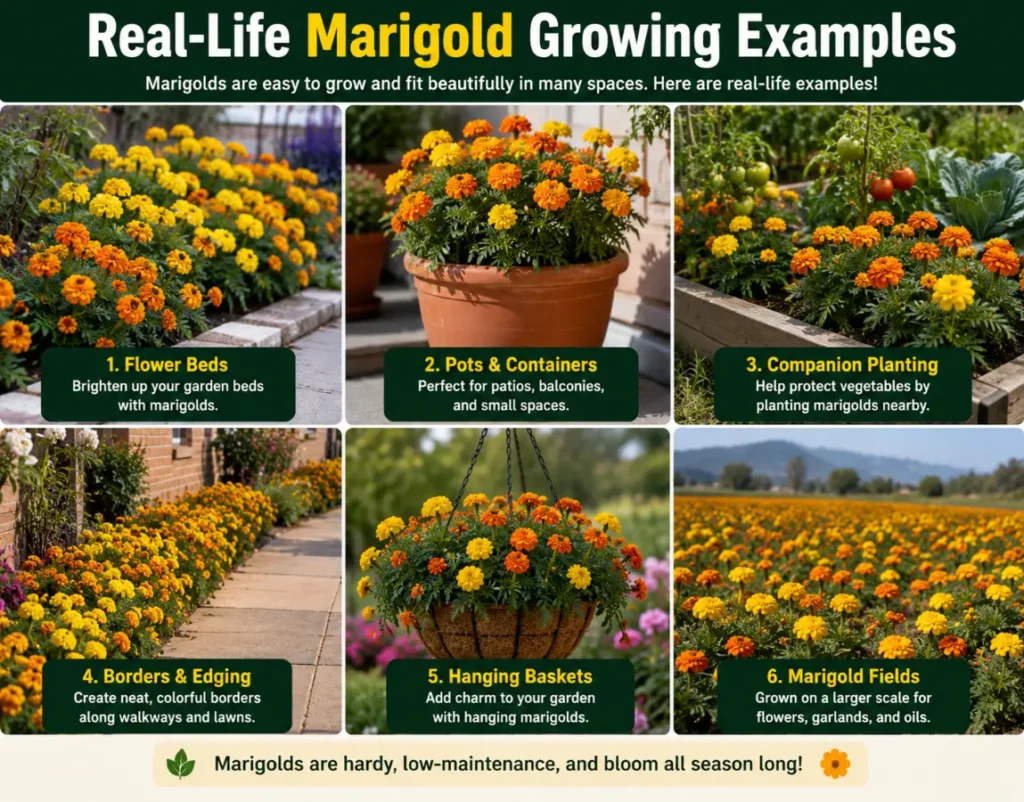
Where Are Marigolds Used in Everyday Gardening?
Marigolds have many practical garden uses.
Gardeners often plant them around vegetable beds for their bright flowers.
They also work well in containers and hanging displays.
Their strong scent can also make them popular companion plants.
However, gardeners should avoid claiming that marigolds provide guaranteed pest control.
Research shows that their effects vary by pest, species, and growing conditions.
Marigolds also attract pollinators when their flowers provide accessible nectar and pollen.
Some varieties produce edible flowers.
Always identify the variety correctly before eating any plant.
Never eat flowers exposed to ornamental pesticides.
Marigold Synonyms, LSI Keywords, and Related Search Terms
Search engines understand related terms beyond the main keyword.
These phrases naturally support the topic:
- marigold annual or perennial
- are marigolds annual plants
- are marigolds perennial flowers
- do marigolds come back every year
- marigold life cycle
- marigolds in winter
- can marigolds survive winter
- French marigold annual or perennial
- African marigold annual or perennial
- signet marigold
- Tagetes annual
- perennial marigold varieties
- growing marigolds
- marigold care
- marigold seeds
- self-seeding marigolds
- pot marigold
- Calendula officinalis
- marigold frost tolerance
- annual flowers
Use these terms naturally rather than repeating them excessively.
Real-Life Marigold Growing Examples
Example 1: A Gardener in a Cold Climate
A gardener plants French marigolds in spring.
The plants flower throughout summer.
The first hard frost kills them in autumn.
The gardener collects seeds for next year.
The marigolds are annuals.
Example 2: A Gardener in a Warm Climate
Another gardener lives where winters remain mild.
The marigolds continue growing through winter.
They may survive for longer than one season.
However, the exact species still matters.
Example 3: A Marigold Returns Naturally
A gardener removes old marigolds in autumn.
Several seedlings appear the following spring.
The gardener assumes the old plants survived.
Actually, the new plants grew from dropped seeds.
This is called self-seeding.
Expert Insights: What Gardeners Should Know
The most important detail involves plant identification.
“Marigold” describes several plants with different growth habits.
The common bedding marigolds sold in garden centers usually belong to Tagetes.
Most popular Tagetes marigolds grow as annuals in temperate climates.
However, some Tagetes species have perennial growth habits.
Climate also changes the answer.
A plant’s growth habit describes its biology under suitable conditions. Your climate determines whether it can survive outdoors.
For accurate identification, check the botanical name on the plant label.
Also check your area’s frost dates before planting.
This approach gives gardeners a much more reliable answer than using the word “marigold” alone.
FAQs About Marigolds
Are marigolds annuals or perennials?
Most common garden marigolds are annuals. They usually grow, flower, produce seeds, and die within one season.
Do marigolds come back every year?
They can return through self-seeding. New plants may grow from seeds dropped by the previous season’s flowers.
Can marigolds survive winter?
Most common marigolds cannot survive hard frost. Some species may survive mild winters in warm climates.
Are French marigolds annuals or perennials?
French marigolds are generally grown as annuals. They usually die after frost in cold climates.
Are African marigolds annuals or perennials?
African marigolds are generally annuals. They prefer warm weather and usually cannot tolerate freezing temperatures.
Should I cut back marigolds in winter?
In cold climates, common annual marigolds usually die naturally after frost. You can remove the plants and save mature seeds.
Can I grow marigolds from last year’s seeds?
Yes. Properly stored marigold seeds can grow into new plants the following season.
Is Calendula the same as a marigold?
Calendula is commonly called pot marigold. However, it belongs to a different genus from true Tagetes marigolds.
Final Verdict: Are Marigolds Annuals or Perennials?
So, are marigolds annuals or perennials? The simplest answer is that most common garden marigolds are annuals. French, African, and signet marigolds usually complete their life cycle within one growing season. Frost often kills them before winter.
However, not every plant called a marigold behaves the same way. Some Tagetes species can live for several years in warm climates. Calendula, often called pot marigold, also has a different growth habit.
Marigolds may also appear to return because they self-seed. New seedlings can grow from seeds left by the previous plants.
The best approach is simple. Check the botanical name, consider your climate, and understand frost risk. If you grow common annual marigolds, save some seeds for next year. That way, you can enjoy their bright flowers season after season.