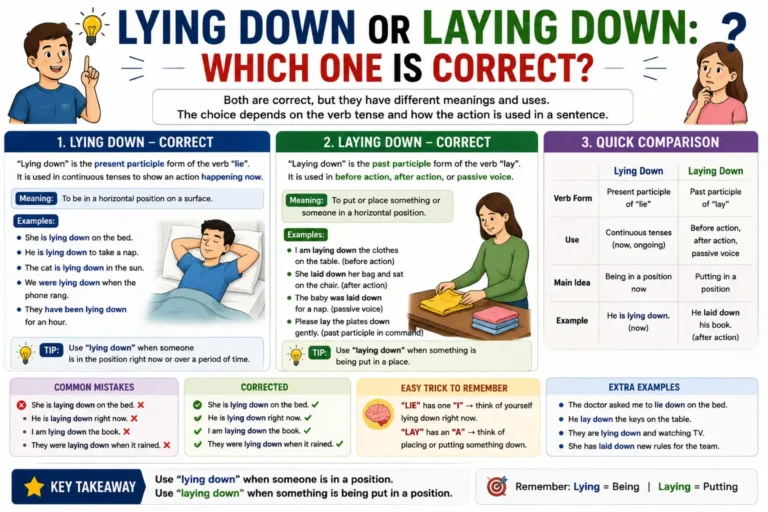
Lying down or laying down can confuse even strong English speakers. The two phrases look almost the same. However, they follow different grammar rules. The key difference is whether you act on yourself or on something else.
Use lying down when you mean resting your body in a flat position. Use laying down when you put something somewhere. For example, you can say, “I am lying down.” You can also say, “I am laying down the book.”
This small difference becomes easier once you understand lie and lay. Their past forms also add to the confusion. In this guide, you will learn the rules with simple examples. You will also see common mistakes and easy memory tricks. By the end, you will know which phrase fits each situation.
Quick Summary
- Lying down means resting your body in a flat position.
- Laying down means putting something down.
- Lie usually does not take a direct object.
- Lay usually takes a direct object.
- “I am lying down” is correct for resting.
- “I am laying down the phone” is correct for placing the phone.
- “I am laying down” can sound incomplete without an object.
- The past tense of lie is lay.
- The past tense of lay is laid.
What Does “Lying Down” Mean?
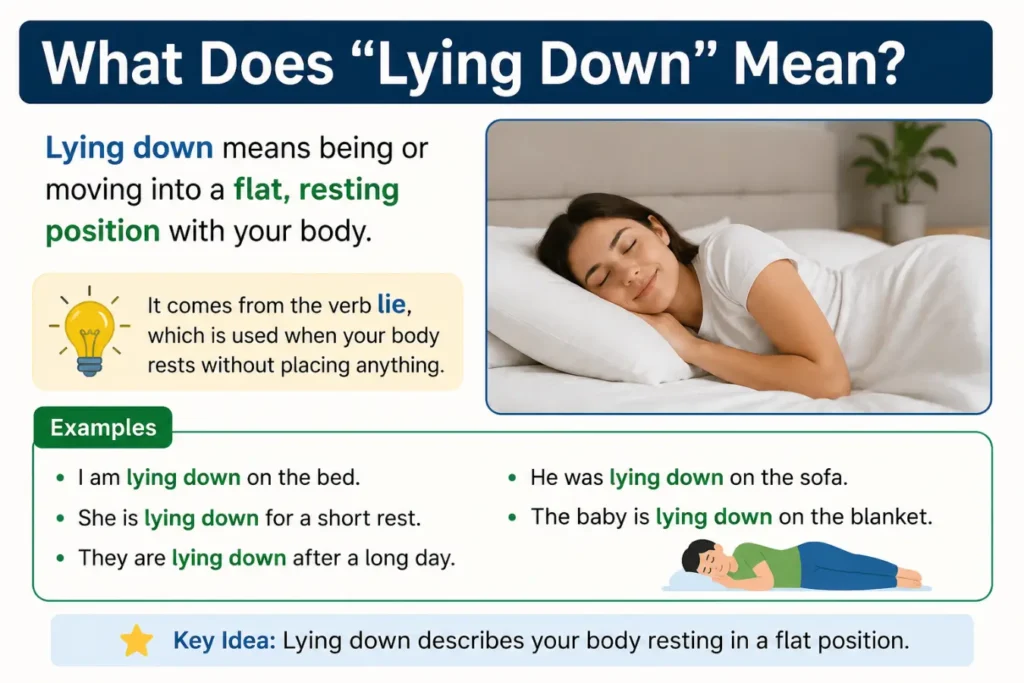
Lying down means being or moving into a flat resting position.
The verb comes from lie.
Here, lie does not normally take a direct object. Your body performs the action itself.
For example:
- I am lying down.
- She is lying on the bed.
- They are lying down for a short rest.
- He was lying on the sofa.
- The baby is lying on the blanket.
In each example, the person or animal rests without placing another object somewhere.
The word lying is the present participle of lie.
So, when you describe someone resting, lying down is normally the correct phrase.
What Does “Laying Down” Mean?
Laying down means putting or placing something in a particular position.
The verb comes from lay.
Unlike lie, lay normally needs a direct object.
For example:
- I am laying down the book.
- She is laying down her bag.
- He is laying down the rules.
- They are laying down a blanket.
- We are laying down the cards.
Notice the objects after laying.
You are laying what?
The answer might be a book, bag, blanket, card, or rule.
That object helps complete the meaning.
Therefore, laying down is correct when someone places something down.
Lying Down vs Laying Down: The Main Difference
The easiest rule is simple.
Lie = your body rests.
Lay = you place something.
Compare these sentences:
| Phrase | Meaning | Example |
|---|---|---|
| Lying down | Resting your body | I am lying down. |
| Laying down | Placing something | I am laying down my phone. |
| Lie down | Move into a resting position | Please lie down. |
| Lay down | Place something somewhere | Lay down the book. |
The object test can help.
If you can ask “lay what?”, you probably need lay.
For example:
I am laying down the keys.
You are laying what?
The answer is the keys.
Now consider:
I am lying down.
You are not placing an object somewhere. You are resting your body.
So lying fits.
Lie Down or Lay Down: Which Is Correct?
This question causes even more confusion.
Use lie down when telling someone to rest.
For example:
- Lie down and relax.
- I need to lie down.
- Please lie down for a few minutes.
- The dog wants to lie down.
Use lay down when telling someone to place something somewhere.
For example:
- Lay down the book.
- Lay down your bag.
- Lay down the cards.
- Please lay down the tools.
The difference depends on the object.
Lie down describes your position.
Lay down describes placing something.
Why Are These Words So Confusing?
The confusion comes from their forms.
The present tense of lie is lie.
Its past tense is lay.
Its past participle is lain.
The verb lay has a different pattern.
present tense is lay.
Its past tense is laid.
Its past participle is also laid.
Here is the basic pattern:
| Verb | Present | Past | Past Participle |
| Lie | lie | lay | lain |
| Lay | lay | laid | laid |
This means lay can be both a present-tense verb and the past tense of lie.
That overlap causes many grammar mistakes.
Real-Life Examples of “Lying Down”
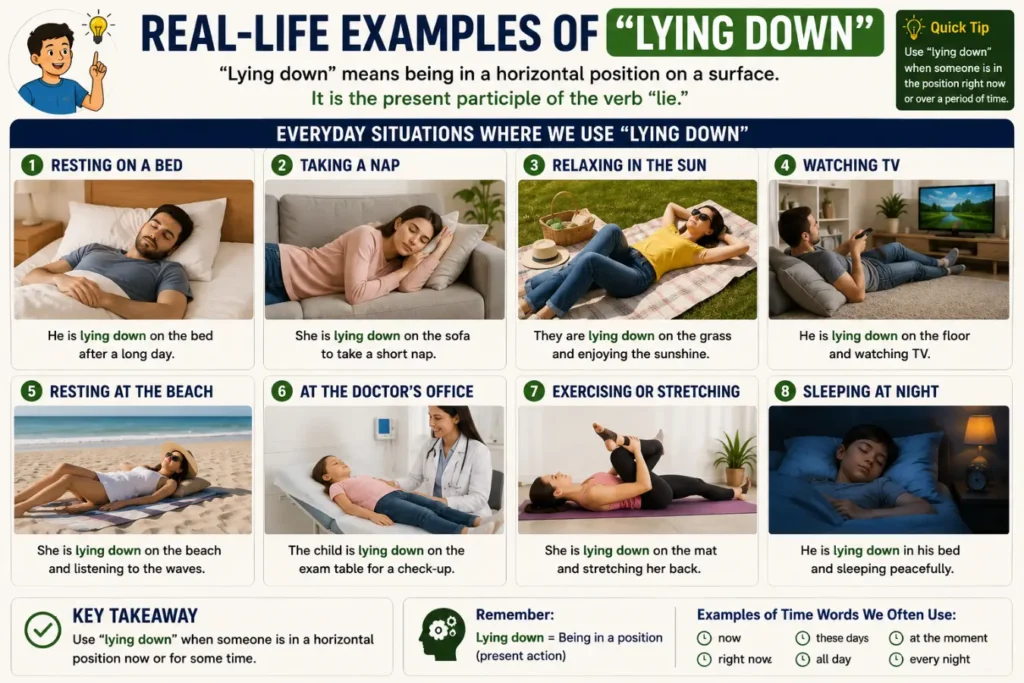
You use lying down in many everyday situations.
At home
I am lying down on the couch.
You are describing your own resting position.
At bedtime
The children are lying down in their beds.
They are resting in a flat position.
During a break
I am lying down for ten minutes.
Again, the person is resting.
When feeling tired
She is lying down because she feels tired.
The phrase describes her physical position.
With animals
The cat is lying down near the window.
The cat is resting.
These examples all describe a person or animal resting.
Real-Life Examples of “Laying Down”
Use laying down when someone places something.
With a phone
I am laying down my phone.
The phone receives the action.
With a book
She is laying down her book.
She places the book somewhere.
With a blanket
They are laying down a blanket.
They place the blanket on a surface.
With rules
The coach is laying down new rules.
Here, the phrase has a figurative meaning. The coach establishes or states rules.
With objects
He is laying down the tools.
He places the tools down.
These examples all have an object after laying.
Common Mistakes With Lying and Laying
Many people use these words interchangeably. That can change the grammar of a sentence.
Mistake 1: “I am laying down.”
In standard English, this usually sounds incomplete if you mean resting.
Better:
I am lying down.
However, I am laying down the blanket is correct.
Mistake 2: “Please lay down.”
If you mean “rest your body,” use:
Please lie down.
If you mean “place something down,” use:
Please lay down the book.
Mistake 3: “I was laying on the bed.”
If you mean resting, the standard form is:
I was lying on the bed.
Mistake 4: “She is laying down.”
This sentence may be unclear.
If she is resting, say:
She is lying down.
If she is placing something, include the object:
She is laying down the clothes.
Mistake 5: Forgetting the past-tense rule
Consider this sentence:
Yesterday, I lay down for an hour.
This is correct.
Why?
Because lay is the past tense of lie.
Do not automatically change it to laid.
A Simple Trick to Remember the Difference
Try this memory trick:
Lie = recline.
Lay = place.
Think about what happens in the sentence.
If a person rests, choose lie.
If a person places an object, choose lay.
You can also use the object test.
Ask:
“What is being placed?”
If the sentence has an answer, lay often works.
For example:
I am laying down the newspaper.
What is being placed?
The newspaper.
Therefore, laying is correct.
Now try:
I am lying down.
What is being placed?
Nothing.
You are simply resting.
Therefore, lying is correct.
Lying Down or Laying Down in Daily English
In everyday speech, people often hear both forms.
You may hear someone say:
“I am laying down.”
Many speakers use this form casually. However, formal standard English usually prefers I am lying down when the person means resting.
This distinction matters most in writing.
You should use the standard form in:
- School assignments
- Professional writing
- Blog posts
- Formal emails
- Reports
- Academic work
Casual speech often contains grammar shortcuts. That does not always make those forms correct in formal writing.
Lying Down or Laying Down: Quick Decision Guide
Use this three-step method.
Step 1: Decide what you mean.
Are you resting your body?
If yes, think lie.
Step 2: Check for an object.
Are you placing something?
If yes, think lay.
Step 3: Check the time.
Are you talking about the past?
Remember that the past tense of lie is lay.
For example:
- Now: I lie down.
- Now: I am lying down.
- Yesterday: I lay down.
- Perfect tense: I have lain down.
For lay:
- Now: I lay down the book.
- Now: I am laying down the book.
- Yesterday: I laid down the book.
- Perfect tense: I have laid down the book.
Synonyms and Related Search Terms
Understanding related words can improve your vocabulary.
Common alternatives for lying down include:
- resting
- reclining
- relaxing
- lying flat
- resting horizontally
Related terms for laying down include:
- placing
- putting down
- setting down
- positioning
- arranging
Searchers may also use phrases such as:
- lie down or lay down
- lying vs laying
- lie vs lay
- is lying down correct
- is laying down correct
- lying down grammar
- laying down grammar
- when to use lie and lay
These phrases all connect to the same core grammar rule.
Expert Insight: Why the Rule Matters
Good grammar helps readers understand your meaning quickly.
The lie/lay distinction matters because these verbs describe different actions.
Grammar experts often teach the verbs through their objects.
Lie describes a person or thing resting.
Lay describes someone placing something.
This rule works well for present-tense sentences.
Past tense creates the biggest challenge.
Remember this key pattern:
Lie → lay → lain
And:
Lay → laid → laid
Learning these patterns gives you a strong foundation.
You do not need to memorize dozens of sentences. Learn the verb forms and apply the object test.
Frequently Asked Questions
Is “lying down” correct?
Yes. Lying down is correct when you mean resting in a flat position.
Example: “I am lying down on the sofa.”
Is “laying down” correct?
Yes, but it usually needs an object.
Example: “I am laying down the book.”
Should I say “lie down” or “lay down”?
Use lie down when someone rests their body.
Use lay down when someone places an object.
Is “I am laying down” grammatically correct?
It can be correct if an object follows or the context clearly supplies one.
For resting, use I am lying down.
What is the past tense of “lie down”?
The past tense is lay down.
Example: “I lay down after dinner.”
What is the past tense of “lay down”?
The past tense is laid down.
Example: “I laid down the book.”
Is “laying on the bed” correct?
Use lying on the bed when you mean resting on the bed.
Use laying when you mean placing something.
How can I remember lie versus lay?
Remember:
Lie = rest.
Lay = place something.
Then check whether the sentence has a direct object.
Conclusion
Choosing lying down or laying down becomes simple once you understand the verbs.
Use lying down when someone rests their body. Use laying down when someone places something somewhere.
For example, say:
“I am lying down.”
But say:
“I am laying down the book.”
The biggest challenge comes from the past tense. Remember that lay is the past tense of lie. Meanwhile, laid is the past tense of lay.
When you feel unsure, use the object test. Ask whether someone places something. If they do, lay usually fits. If they simply rest, lie is the better choice.