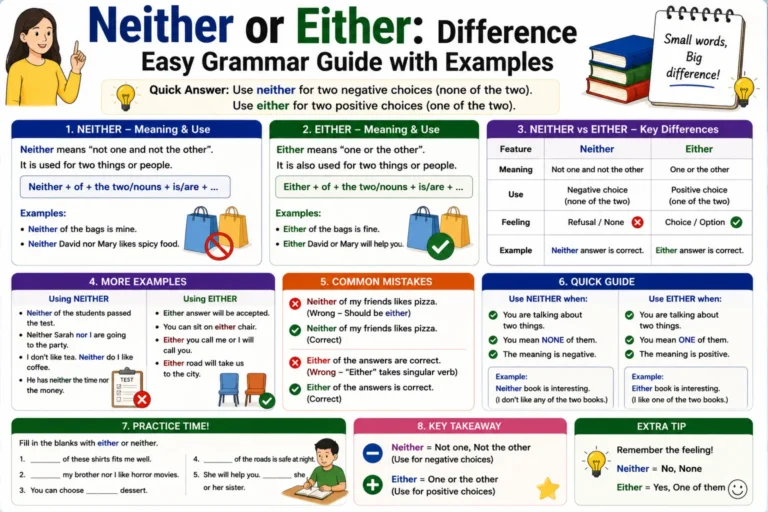
Neither or either is a common grammar topic that confuses many English learners. These two words look similar, but they have different meanings. Knowing when to use each one helps you speak and write clearly.
Many people use either when they should use neither. Others mix them up in everyday conversations. The good news is that the rules are simple.
In this guide, you will learn the meaning of neither and either in easy English. You will also see comparison tables, grammar rules, real-life examples, common mistakes, and expert tips. By the end, you will know exactly when to use each word with confidence.
Quick Summary
Featured Snippet
- Either means one of two choices.
- Neither means not one and not the other.
- Use either when at least one option is possible.
- Use neither when both options are rejected.
- Both words usually refer to two people, places, or things.
What Does Either Mean?
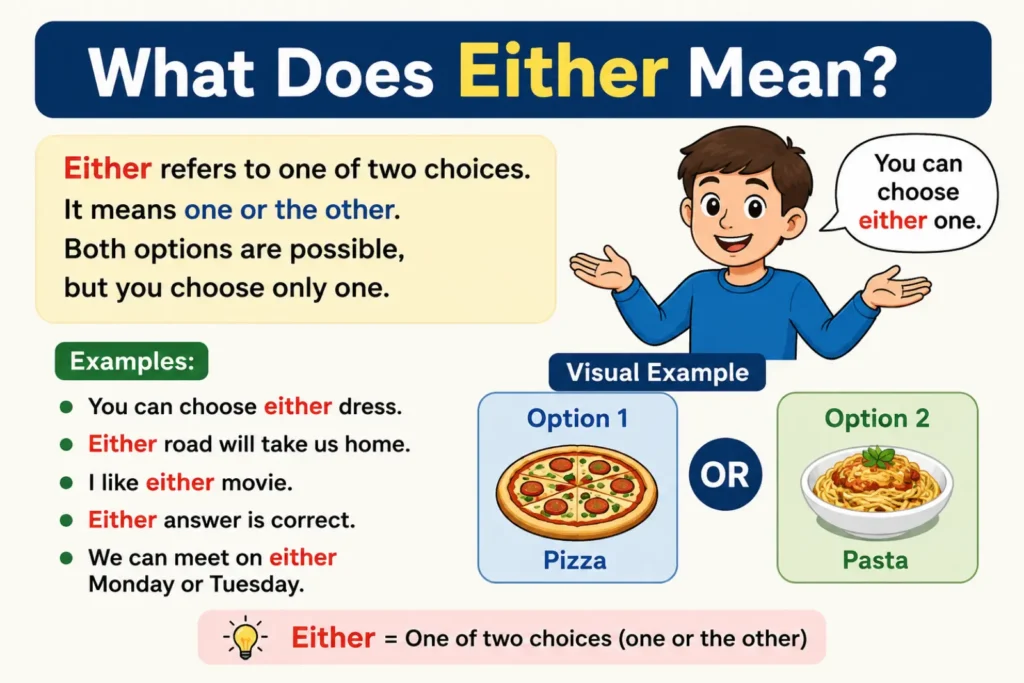
Either refers to one of two choices. It tells the reader that both options are possible, but only one is chosen.
Examples
- You can choose either dress.
- Either road will take us home.
- I like either movie.
- Either answer is correct.
- We can meet on either Monday or Tuesday.
In simple words, either means one or the other.
What Does Neither Mean?
Neither means not one and not the other. It rejects both choices.
Examples
- Neither answer is correct.
- Neither student arrived on time.
- I like neither color.
- Neither restaurant is open today.
- Neither option works for me.
Simply remember:
Neither = not this one and not that one.
Neither vs Either: Comparison Table
| Feature | Either | Neither |
|---|---|---|
| Meaning | One of two | Not one and not the other |
| Positive or Negative | Positive | Negative |
| Number of Choices | Two | Two |
| Used When | One choice is possible | Both choices are rejected |
| Example | Either book is fine. | Neither book is interesting. |
When Should You Use Either?
Use either when you have two choices and both are acceptable.
Examples
- You may sit in either chair.
- Either hotel offers free breakfast.
- We can travel by either bus or train.
- Choose either pen.
- Either player can win.
These sentences show that one option will work.
When Should You Use Neither?
Use neither when both choices are unacceptable.
Examples
- Neither car is available.
- I know neither answer.
- Neither child wanted dessert.
- Neither plan solved the problem.
- Neither teacher was absent.
These examples reject both choices.
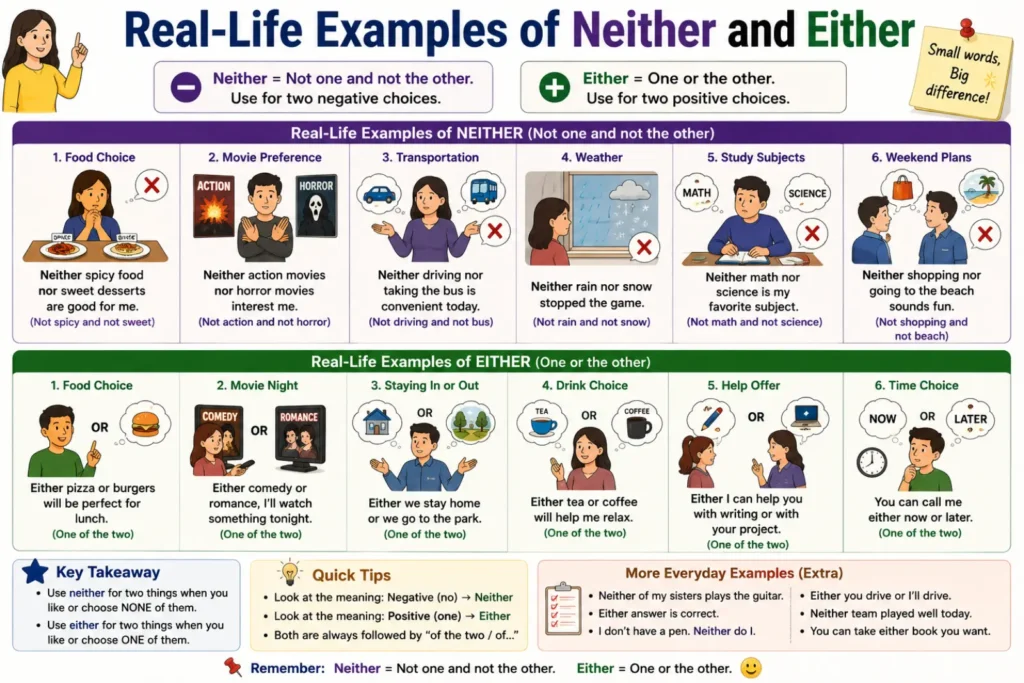
Real-Life Examples of Neither and Either
Here are common situations.
At a Restaurant
Either
- You can order either pizza or pasta.
Neither
- Neither pizza nor pasta is available today.
Shopping
Either
- Either shirt looks good on you.
Neither
- Neither shirt fits me.
School
Either
- Either answer earns full marks.
Neither
- Neither student finished the project.
Travel
Either
- Either flight arrives before noon.
Neither
- Neither flight has empty seats.
Grammar Rules for Neither and Either
Follow these simple rules.
Rule 1
Use either for one of two choices.
Example:
- You can have either coffee or tea.
Rule 2
Use neither for rejecting both choices.
Example:
- Neither coffee nor tea is available.
Rule 3
After neither, use nor.
Correct:
- Neither Tom nor Jack came.
Incorrect:
- Neither Tom or Jack came.
Rule 4
After either, use or.
Correct:
- Either Tom or Jack will help.
Incorrect:
- Either Tom nor Jack will help.
Common Mistakes to Avoid
Many learners make these mistakes.
Mistake 1
❌ Neither John or Mike came.
✅ Neither John nor Mike came.
Mistake 2
❌ Either Sam nor Alex will call.
✅ Either Sam or Alex will call.
Mistake 3
❌ I don’t like neither option.
✅ I like neither option.
or
✅ I don’t like either option.
Mistake 4
Using either when both choices are impossible.
Wrong:
- Either answer is correct. (When both are wrong.)
Correct:
- Neither answer is correct.
Easy Trick to Remember
Think about these keywords.
Either = One Choice
Neither = Zero Choices
Memory tip:
- Either → One works
- Neither → None works
This trick helps you remember the difference quickly.
Synonyms and Related Words
Either
- One of two
- Any one
- One choice
- One option
for Neither
- None of the two
- Not either
- No one
- Zero of two
Related Keywords
- either vs neither
- neither nor grammar
- either or grammar
- difference between neither and either
- how to use either
- how to use neither
- English grammar rules
- either or neither examples
- grammar comparison
- neither meaning
Daily Uses of Neither and Either
You hear these words every day.
Work
- Either report is acceptable.
- Neither report is complete.
At Home
- Either room is available.
- Neither room is clean.
At School
- Either answer earns points.
- Neither answer is correct.
While Traveling
- Either route is faster.
- Neither route is open.
Using these words correctly makes your English sound natural.
Expert Insight
English grammar becomes easier when you understand meaning instead of memorizing rules.
Think about the number of choices.
If one choice works, use either.
If no choice works, use neither.
Many grammar experts recommend practicing with short sentences every day. Reading books and listening to native speakers also improve your understanding. Small daily practice leads to better writing and speaking.
(FAQs)
What is the difference between either and neither?
Either means one of two choices. Neither means not one and not the other.
Can either mean both?
No. Either refers to one of two choices, not both.
Is neither positive or negative?
Neither has a negative meaning because it rejects both options.
Should I use nor after neither?
Yes. The correct pair is neither…nor.
Example:
Neither Sara nor Emma came.
Should I use or after either?
Yes. The correct pair is either…or.
Example:
Either tea or coffee is fine.
Can I say “I don’t like neither”?
No.
Correct sentences are:
- I like neither.
- I don’t like either.
Can either and neither refer to more than two things?
Traditionally, they refer to two choices. For more than two, words like any, none, or all are often better.
Final Tips
Remember these simple rules.
- Use either for one of two choices.
- Use neither for rejecting both choices.
- Pair either with or.
- Pair neither with nor.
- Practice with everyday examples.
- Read English often to improve naturally.
Conclusion
Understanding neither or either becomes easy once you know their basic meanings. Either gives a choice between two options, while neither rejects both. These words appear often in conversations, writing, exams, and professional communication. Learning the correct grammar helps you avoid common mistakes and makes your English more natural.
The easiest way to remember the difference is simple. If one option works, use either. If no option works, use neither. Practice these words in daily sentences, and they will soon become part of your everyday vocabulary. With regular practice, you will use either and neither correctly and confidently every time.