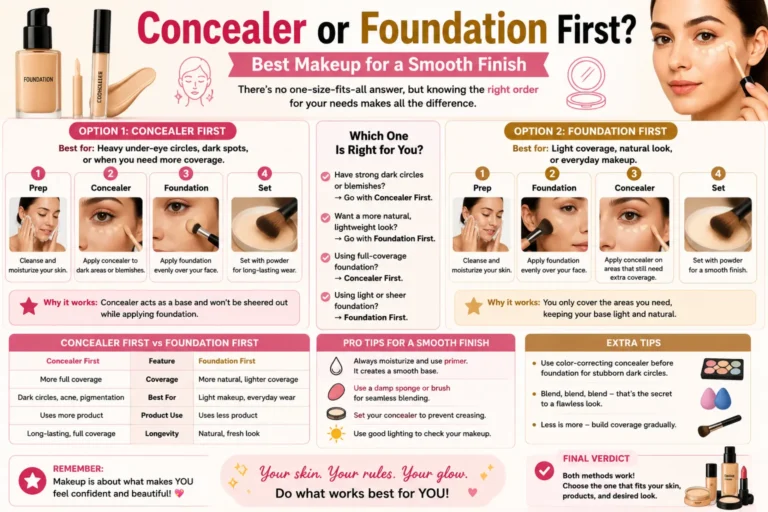
Concealer or foundation first? Most makeup beginners ask this question when building a simple makeup routine. The answer depends on your skin, makeup style, and the coverage you want. However, foundation usually comes first for most everyday makeup looks.
Foundation creates an even base across your face. Concealer then adds extra coverage where you need it most. This order can help you use less concealer and avoid a heavy makeup look.
Still, some situations work better with concealer first. Spot concealing, color correction, and certain makeup techniques may change the order.
In this guide, you will learn exactly when to apply each product. You will also see simple examples, common mistakes, and expert tips. By the end, you will know which product should come first for your makeup routine.
Quick summary
- Apply foundation first for most everyday makeup looks.
- Foundation creates an even base for the rest of your makeup.
- Apply concealer after foundation to cover spots and dark areas.
- Use concealer first when color correcting or using a light base.
- Blend both products gently for a natural finish.
- Choose the order based on your coverage needs and makeup style.
Featured Snippet Answer: For most makeup routines, apply foundation before concealer. Foundation creates an even base, while concealer adds extra coverage to specific areas. Apply concealer first only when your technique or product requires it.
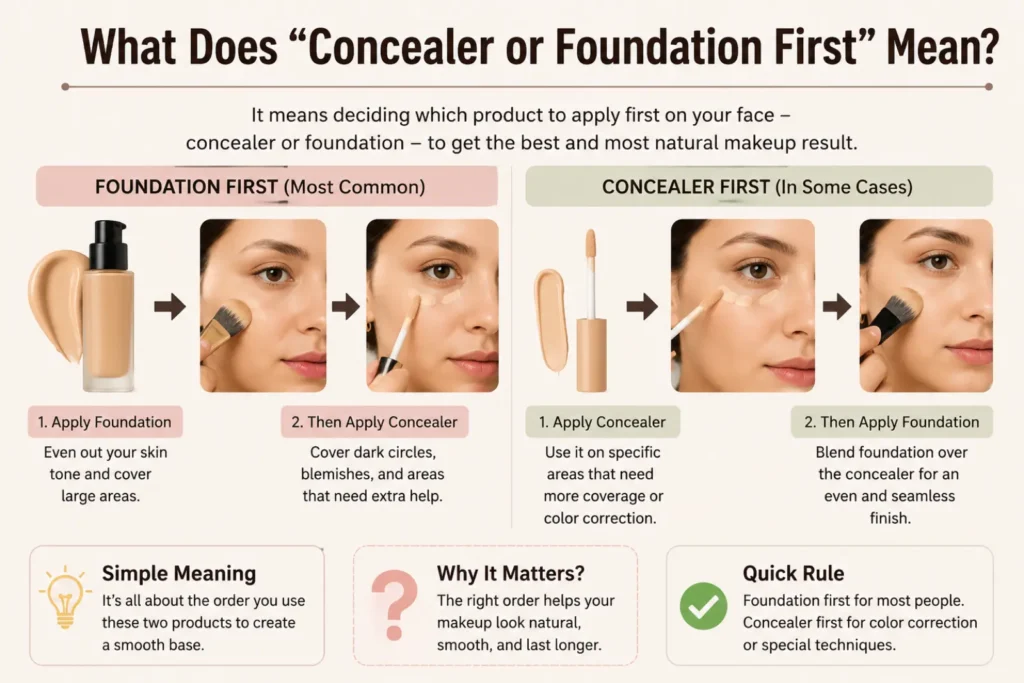
What Does “Concealer or Foundation First” Mean?
The phrase “concealer or foundation first” asks which base product you should apply first.
Foundation usually covers a larger area of your face. It helps even out your skin tone and creates a smooth base.
Concealer provides more targeted coverage. You can use it under your eyes or on small areas.
Think of foundation as your main base. Think of concealer as your detail work.
This simple idea makes the correct makeup order easier to understand.
Why Should Foundation Usually Come First?
Foundation spreads across a large part of your face. It can already cover some redness, uneven tone, and small marks.
After applying foundation, you can see which areas still need coverage.
You can then apply concealer only where necessary.
This method offers several benefits:
- It can reduce the amount of concealer you use.
- It can create a lighter makeup finish.
- It helps prevent excessive product buildup.
- It makes targeted coverage easier.
- It can save time during your routine.
For many people, foundation first creates a more balanced result.
When Should Concealer Go First?
Foundation first works for most routines, but it is not a strict rule.
You may apply concealer first when using a color corrector. Color correction helps balance certain areas before you apply your base.
For example, you might use a peach-toned corrector before foundation. You can then apply foundation over it.
Some makeup artists also use concealer first for specific techniques. This can work when they want very precise coverage.
A light makeup routine may also use only concealer. In that case, you do not need foundation at all.
So, the better question is not always “Which comes first?”
Instead, ask, “What coverage do I need today?”
Foundation First vs. Concealer First
| Feature | Foundation First | Concealer First |
|---|---|---|
| Best for | Everyday makeup | Targeted techniques |
| Coverage | Overall coverage | Specific areas |
| Finish | Even and balanced | More focused |
| Product use | Often uses less concealer | May need careful blending |
| Beginners | Easy to learn | Needs more control |
| Spot coverage | Apply concealer afterward | Can work for small areas |
| Color correction | Usually after correction | Often used before foundation |
| Natural look | Excellent for many people | Works well with light makeup |
For most beginners, foundation first is the easier starting point.
However, personal preference still matters.
Simple Makeup Order for Beginners
A basic makeup routine does not need many steps.
Try this simple order:
- Clean your face gently.
- Apply moisturizer.
- Use sunscreen during the day.
- Apply primer if you want one.
- Apply foundation.
- Apply concealer where needed.
- Set selected areas with powder if needed.
- Apply blush or bronzer.
- Finish with other makeup products.
Your routine can change based on your products.
For example, some people skip primer. Others skip foundation and use concealer alone.
The goal is not to follow every trend. The goal is to create a routine that works for you.
How to Apply Foundation Before Concealer
Start with a small amount of foundation.
Apply it evenly across the areas where you want coverage. Use a clean sponge, brush, or your preferred tool.
Do not rub the product too hard.
Next, look at your face in good lighting.
Notice which areas still need coverage.
Apply a small amount of concealer to those spots. Blend the edges gently.
For under-eye concealer, use a thin layer first. Add more only if you need extra coverage.
This approach helps prevent a thick or cakey appearance.
How to Apply Concealer Before Foundation
Concealer-first makeup can also work.
Start by applying a suitable corrector or concealer to specific areas.
Use a small amount. Blend the edges without spreading the product too far.
Next, apply foundation over the area.
Use gentle movements to avoid removing the concealer underneath.
This method can work well when you need precise color correction.
It may also suit people who prefer a very light base.
Real-Life Examples: Which Order Works Best?
Example 1: Everyday School or Casual Makeup
You want a simple, natural-looking base.
Foundation first makes sense.
Apply a light layer of foundation. Then use concealer only where you need extra coverage.
You can keep the rest of your routine simple.
Example 2: A Small Blemish
You want to cover one small area.
Apply foundation first.
Then use a small amount of concealer directly on the area.
This prevents you from applying heavy coverage across your entire face.
Example 3: Under-Eye Makeup
You want to brighten the under-eye area.
Apply foundation first if you use it across your face.
Then add a small amount of concealer.
Blend carefully around the edges.
Example 4: Color Correction
You want to balance a specific area before applying foundation.
Apply the corrector first.
Then apply foundation over it.
Add regular concealer afterward if the area still needs coverage.
Example 5: No-Foundation Makeup
You want a very light routine.
Skip foundation.
Apply concealer only to the areas that need it.
This creates a simple, targeted makeup look.
Common Mistakes When Applying Concealer and Foundation
Even a good makeup routine can look uneven when you use too much product.
Here are common mistakes to avoid.
Using Too Much Foundation
More product does not always mean better coverage.
Start with a small amount. Add more only where needed.
Applying Too Much Concealer
Heavy concealer can make an area look less natural.
Use thin layers instead.
Skipping Skin Preparation
Dry or poorly prepared skin can affect how makeup sits.
Use suitable skincare before makeup.
Rubbing Instead of Blending
Hard rubbing can move your base around.
Use gentle pressing or blending motions.
Choosing the Wrong Shade
Foundation and concealer should suit the purpose of the product.
Your concealer does not always need to match your foundation exactly.
For brightening, some people prefer a slightly lighter concealer.
Ignoring Your Skin’s Needs
Different skin types can react differently to makeup formulas.
Choose products based on what feels comfortable for your skin.
Tips for a Smooth and Natural Makeup Base
Small changes can make your routine easier.
Start with less product. You can always add more.
Use good lighting. It helps you see where you actually need coverage.
Blend the edges. Sharp product lines can make makeup look uneven.
Give skincare time to settle. This can help your makeup apply more smoothly.
Do not chase perfect coverage. A little natural skin showing through can look balanced.
Clean your makeup tools regularly. Clean tools can help with smooth application and good hygiene.
Check your makeup in natural light. Indoor lighting can change how your base looks.
Does Concealer Go Under or Over Foundation?
For most makeup routines, concealer goes over foundation.
Foundation first gives you an even base. Concealer then adds coverage to areas that still need attention.
This approach works especially well for spot concealing and under-eye makeup.
However, color corrector often goes underneath foundation.
The key difference is the product’s purpose.
A color corrector helps balance an area. A regular concealer usually adds coverage or brightness.
Can You Use Concealer Without Foundation?
Yes.
You do not need foundation to use concealer.
Concealer alone can work well for a simple makeup routine.
Apply it only where you want coverage. Blend the edges carefully.
This method can feel lighter than wearing foundation across your whole face.
It also saves a step in your makeup routine.
If you prefer minimal makeup, targeted concealer can be a useful option.
Concealer and Foundation: How Are They Different?
Foundation and concealer serve different purposes.
Foundation usually provides broad coverage. It helps create a more even appearance across the face.
Concealer usually provides targeted coverage. You can apply it to smaller areas.
Here is a simple way to remember the difference:
Foundation = overall base.
Concealer = targeted coverage.
Neither product is automatically better.
The right choice depends on the look you want.
Synonyms and Related Search Terms
Search engines may connect the main keyword with several related terms.
Useful semantic keywords include:
- foundation or concealer first
- should concealer go before foundation
- do you put concealer on before foundation
- makeup order for beginners
- correct makeup application order
- concealer before or after foundation
- when to apply concealer
- when to apply foundation
- how to apply concealer
- how to apply foundation
- makeup base routine
- natural makeup routine
- under-eye concealer
- color corrector before foundation
- foundation and concealer routine
These phrases answer related questions without repeating the main keyword too often.
Expert Insights
A useful professional approach is to think in layers.
Start with the product that covers the largest area.
Then add targeted products where you need them.
This explains why foundation usually comes before concealer.
Makeup professionals also often focus on product control.
A small amount of product gives you more flexibility. You can build coverage instead of starting with a thick layer.
Another useful principle is to match the technique to the goal.
Want overall coverage? Start with foundation.
Want targeted coverage? Use concealer.
Want color correction? Correct the area before your main base.
This simple system makes makeup application easier to understand.
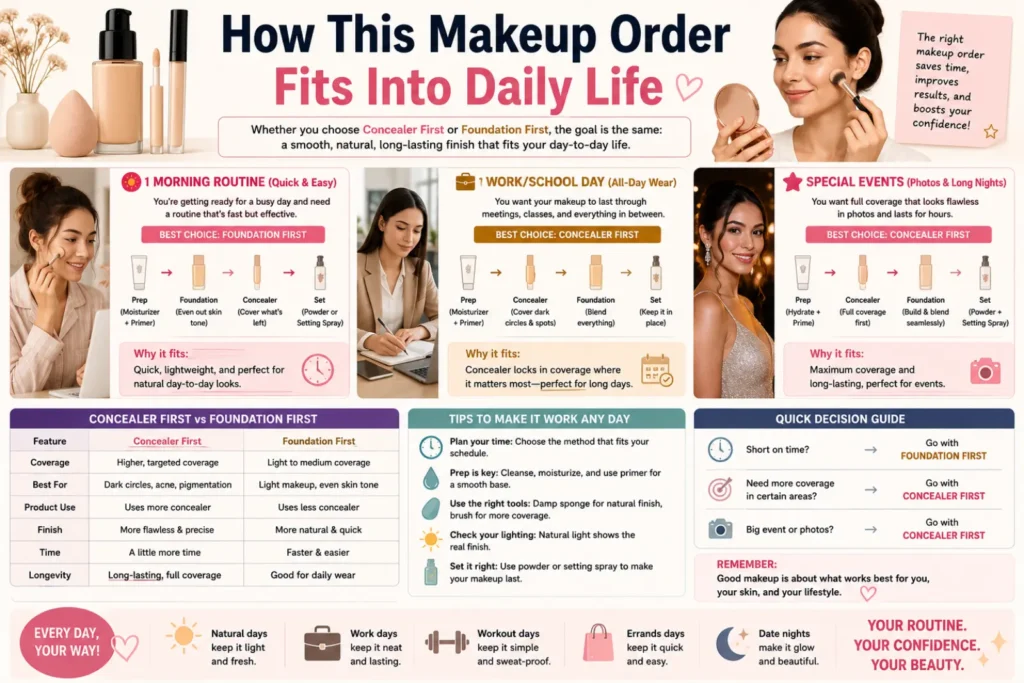
How This Makeup Order Fits Into Daily Life
Your makeup routine does not need to stay the same every day.
You might use foundation and concealer for a special event.
On another day, you might use only concealer.
For a quick routine, you can use moisturizer, sunscreen, and targeted makeup.
For a fuller routine, you can build your base in several thin layers.
Your makeup order should support your lifestyle.
A good routine is one you can use comfortably and consistently.
Frequently Asked Questions
Should concealer go before or after foundation?
For most makeup routines, apply foundation first and concealer second. This lets you see where extra coverage is needed.
Is it better to put concealer on before foundation?
Usually, no. Foundation first works well for most everyday looks. Concealer-first techniques can work for color correction and targeted makeup.
Can I use concealer without foundation?
Yes. Apply concealer only to areas where you want extra coverage. Blend the edges for a more natural result.
Do you put concealer under your eyes before foundation?
You can, but foundation first usually makes more sense for a standard routine. Apply under-eye concealer afterward for targeted coverage.
Should concealer be lighter than foundation?
Not always. The best shade depends on your goal. A matching shade can work for spot coverage, while a slightly lighter shade may brighten certain areas.
Does foundation go over concealer?
It can. This technique often works with color correction. However, applying foundation first is usually easier for everyday makeup.
What comes first, concealer or foundation for beginners?
Beginners should usually start with foundation. Then apply concealer to areas that need more coverage.
Can I skip foundation and just use concealer?
Yes. This is a simple option when you want lighter, targeted coverage.
Conclusion
So, concealer or foundation first? For most everyday makeup routines, foundation should come first.
Foundation creates an even base across your face. Concealer then adds extra coverage to areas that need more attention.
This order can help you avoid using too much product. It can also create a more balanced makeup finish.
However, makeup does not follow one universal rule. Color correction may require a different order. Some people may also prefer concealer-only makeup.
The easiest rule is simple.
foundation first for overall coverage. concealer afterward for targeted coverage. Use concealer or corrector first when your specific technique requires it.
Once you understand the purpose of each product, choosing the right order becomes much easier.