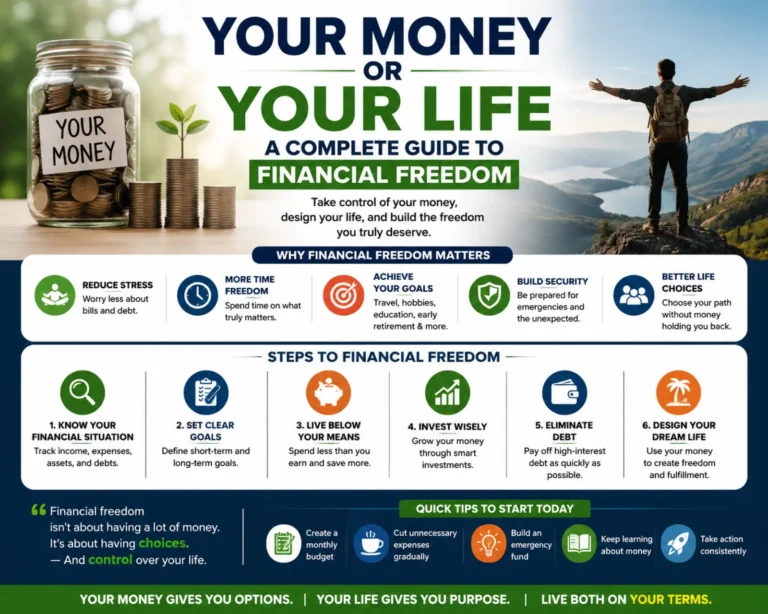
Your Money or Your Life is a powerful approach to money, work, and financial freedom. It helps you see money as more than numbers in a bank account. Every dollar connects to your time, energy, and life.
This idea became popular through the book Your Money or Your Life. The book teaches people to rethink spending, work, saving, and personal values.
The main goal is simple. Spend less on things that do not matter. Save more for the future. Build a life that gives you greater freedom.
You do not need to become rich overnight. Small changes can create lasting results. You can track your income, control your spending, and invest for the future.
This guide explains the Your Money or Your Life method in simple terms. You will learn how it works, why it matters, and how to use it daily.
Quick Summary
- Your Money or Your Life connects money with your time and energy.
- Every purchase costs more than money.
- Your real cost includes the time needed to earn that money.
- The method helps you spend according to your values.
- Tracking income and expenses can reveal your true financial habits.
- Saving and investing can help you reach financial independence.
- The goal is freedom, not simply having more money.
What Is Your Money or Your Life?
Your Money or Your Life is a personal finance philosophy. It helps people understand the true cost of earning and spending money.
The idea asks one important question:
How much of your life does your money really cost?
Suppose you earn $20 per hour. A $100 purchase may seem affordable. However, the purchase may require five hours of work.
Your real cost may become higher after taxes, commuting, work clothes, meals, and other job costs.
Therefore, the purchase could require more than five hours of your life.
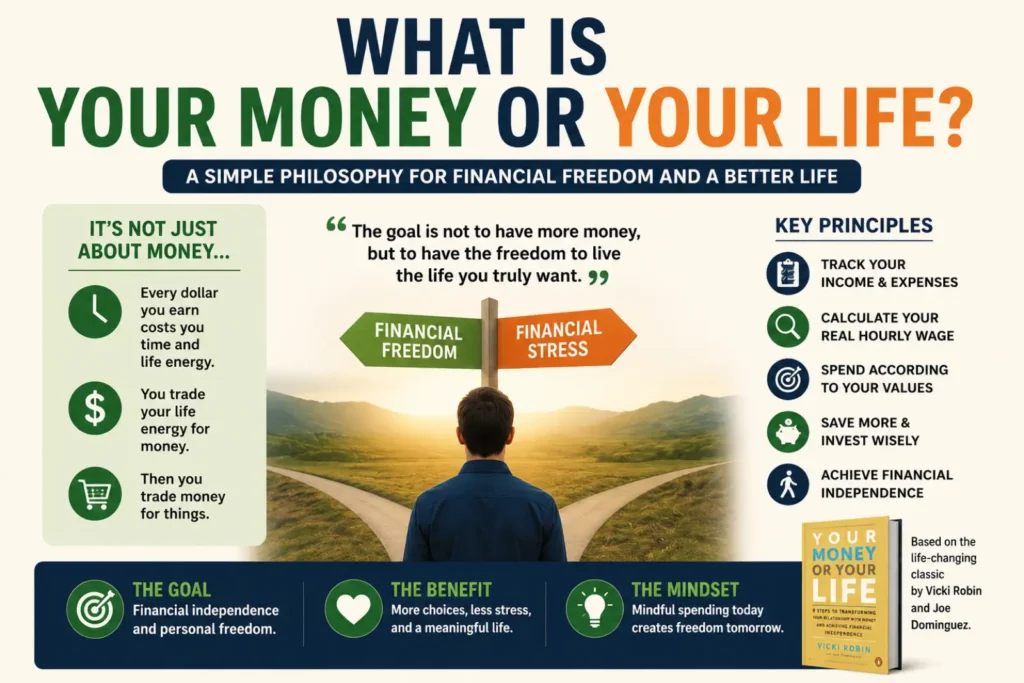
This method changes how you view money. It turns money into a measure of life energy.
The Main Idea Behind Life Energy
Life energy means the limited time and energy you spend during your life.
Your job uses part of that energy. Your commute uses more. Work stress can also take a toll.
You exchange this limited energy for money.
Then, you exchange money for products and services.
The process looks like this:
Life energy → Work → Money → Spending
The Your Money or Your Life method asks you to examine this entire process.
It helps you ask better questions before spending.
- Do I really need this?
- How many hours did this purchase cost?
- Does this purchase support my values?
- Does this expense improve my life?
These questions can improve your financial decisions.
How the Your Money or Your Life Method Works
The method follows several key steps.
1. Review Your Lifetime Money History
Start by reviewing your past income and spending.
Look at old jobs, salaries, major purchases, debts, and savings.
This exercise helps you understand your relationship with money.
You may discover patterns that you never noticed before.
For example, you may notice that stress causes unnecessary spending.
You may also find that certain expenses bring little value.
2. Calculate Your Real Hourly Wage
Your regular salary does not always show your real hourly wage.
You should also consider work-related costs.
These costs may include:
- Transportation
- Work clothing
- Meals away from home
- Childcare
- Work-related equipment
- Stress recovery
- Time spent commuting
Your real hourly wage may be lower than your advertised wage.
This calculation gives you a clearer view of your money.
3. Track Every Expense
Track your spending for at least one month.
Record every purchase.
Small expenses can add up quickly.
You may discover that small daily purchases create large monthly costs.
Tracking does not mean judging yourself.
Instead, it helps you understand your behavior.
You cannot improve what you never measure.
4. Evaluate Your Spending
After tracking your expenses, review each category.
Ask yourself:
Did this expense provide value?
Some expenses support your health, family, or happiness.
Other expenses may come from habit, pressure, or boredom.
The goal is not to remove every enjoyable expense.
The goal is to spend money with greater awareness.
5. Increase Your Savings Rate
Once you understand your spending, look for ways to save more.
You can reduce wasteful spending without removing important experiences.
For example, you might:
- Cancel unused subscriptions.
- Cook more meals at home.
- Compare insurance costs.
- Reduce unnecessary shopping.
- Avoid impulse purchases.
- Negotiate recurring bills.
Even small savings can grow over time.
6. Build Financial Independence
Financial independence means your money can support your needs.
You do not need to depend completely on a job for survival.
Savings and investments can create more choices.
you may choose to work less.
may start a business.
change careers.
take a break.
Financial independence creates options.
Why Your Money or Your Life Matters
Many people earn money without understanding their true financial behavior.
They work more when they want more.
Then, they spend more when they earn more.
This cycle can continue for years.
The Your Money or Your Life approach helps break this cycle.
It encourages people to question automatic financial decisions.
Money should support your life.
Your life should not exist only to earn money.
This idea matters because time is limited.
You can earn more money.
You cannot recover yesterday.
Your Money or Your Life: Real-Life Examples
Example 1: The Daily Coffee Habit
Imagine someone spends $5 each workday.
That equals about $100 each month.
The person may enjoy the coffee.
That spending may provide real value.
However, another person may buy coffee from habit.
They may not even enjoy it.
The key question is not whether coffee is good or bad.
The key question is whether the spending matches personal values.
Example 2: The Expensive Car
A person earns $60,000 annually.
They buy a costly car because they want status.
The car creates large monthly payments.
Insurance, fuel, repairs, and maintenance add more costs.
The person now needs more work hours to pay for the car.
The car may cost more life energy than expected.
Example 3: The Higher-Paying Job
A new job offers a higher salary.
However, the job requires a long commute.
It also creates more stress and higher meal costs.
The salary increases.
The real hourly wage may not increase much.
The Your Money or Your Life method helps compare the full picture.
Your Money or Your Life vs Traditional Personal Finance
| Your Money or Your Life | Traditional Personal Finance |
|---|---|
| Focuses on life energy | Often focuses on money |
| Connects spending with time | Measures spending in dollars |
| Encourages mindful consumption | Often focuses on budgets |
| Values personal freedom | Often focuses on financial targets |
| Questions lifestyle inflation | May focus on increasing income |
| Promotes financial independence | Often focuses on saving and investing |
Both approaches can work together.
A budget shows where your money goes.
The Your Money or Your Life method shows what your money represents.
Common Mistakes People Make
Mistake 1: Treating Every Expense as Bad
The goal is not extreme saving.
Some spending improves your life.
Health, education, family, and meaningful experiences may deserve your money.
Mistake 2: Focusing Only on Income
A high income does not guarantee financial freedom.
Someone can earn a lot and spend everything.
Your savings rate matters too.
Mistake 3: Ignoring Hidden Work Costs
Your job may cost more than your commute.
Work can also require clothing, food, equipment, and recovery time.
Include these costs when calculating your real hourly wage.
Mistake 4: Comparing Your Lifestyle With Others
Social media can encourage unnecessary spending.
Your financial goals should reflect your values.
Do not copy someone else’s lifestyle without understanding its cost.
Mistake 5: Expecting Instant Results
Financial independence takes time.
Small improvements can create powerful long-term results.
Consistency usually matters more than perfection.
Practical Tips for Using Your Money or Your Life
Try these simple strategies.
Track Spending Weekly
Review your spending once each week.
Look for patterns.
Weekly reviews feel easier than yearly reviews.
Use a 24-Hour Rule
Wait one day before making non-essential purchases.
This simple pause can reduce impulse spending.
Create a Values-Based Budget
Divide your money according to your priorities.
Your budget should support the life you want.
Increase Income Carefully
Higher income can accelerate financial progress.
However, avoid increasing spending at the same speed.
Save Automatically
Automatic transfers can make saving easier.
Treat saving as a regular financial habit.
Review Recurring Expenses
Subscriptions can quietly drain your budget.
Review them every few months.
Cancel services you no longer use.
How to Use the Your Money or Your Life Method Daily
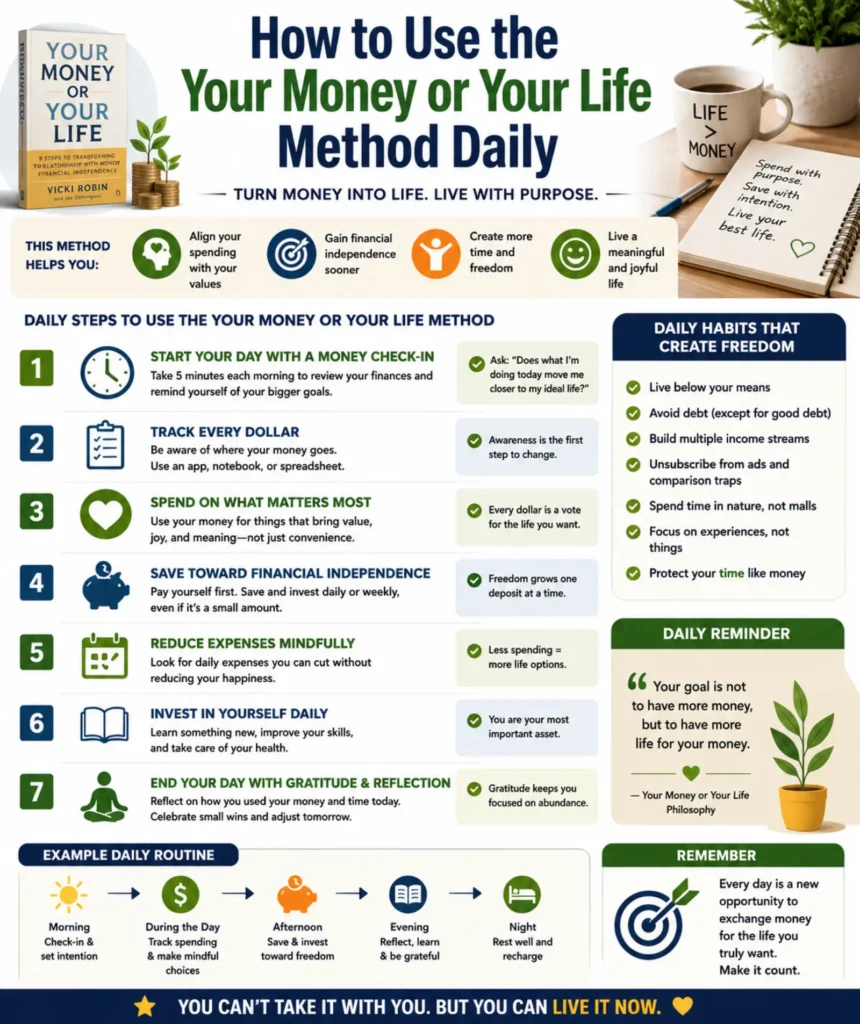
You can apply this philosophy to everyday decisions.
Before buying something, ask:
How much life energy does this cost me?
Then consider the item’s value.
A cheap product may create repeated replacement costs.
A more expensive product may last longer.
The cheapest option does not always provide the best value.
You can also use this method when choosing a job.
Compare more than the salary.
Consider:
- Commute time
- Work stress
- Benefits
- Flexibility
- Personal growth
- Time with family
- Long-term opportunities
A job with a slightly lower salary may provide a better life.
Your Money or Your Life and Financial Independence
Financial independence is a major goal of this approach.
The basic idea is simple.
You save and invest enough money to support your future needs.
Your investments may eventually provide income.
This can reduce your dependence on traditional employment.
Your financial independence journey depends on several factors.
These include:
- Income
- Expenses
- Savings rate
- Investment growth
- Debt
- Lifestyle choices
A higher savings rate can often speed up your progress.
However, your plan should remain realistic.
Synonyms and Related Keywords
Search engines understand related terms around the main keyword.
These terms can support topical relevance.
Useful semantic keywords include:
- Financial independence
- Financial freedom
- Life energy
- Conscious spending
- Mindful money management
- Personal finance
- Wealth building
- Lifestyle inflation
- Savings rate
- Passive income
- Money and happiness
- Financial wellness
- Intentional living
- Early retirement
- Financial independence planning
Use these terms naturally.
Do not repeat them unnaturally.
Expert Insights
The strongest lesson from Your Money or Your Life remains simple.
Money represents choices.
spending habits shape your lifestyle.
Your income determines how much money you receive.
Your expenses determine how much freedom you keep.
This distinction matters.
Many people focus only on earning more.
However, better financial decisions can also create freedom.
Experts often recommend tracking spending, building savings, reducing high-interest debt, and investing consistently.
The Your Money or Your Life framework adds another important question.
Does your financial life support your personal values?
That question can improve both money decisions and life satisfaction.
Frequently Asked Questions
What does Your Money or Your Life mean?
It means that money represents time and energy from your life. The method encourages conscious spending and financial independence.
Is Your Money or Your Life a book?
Yes. Your Money or Your Life is a popular personal finance book associated with financial independence and mindful money management.
What is life energy?
Life energy means the limited time and energy you exchange for money through work.
How do I calculate my real hourly wage?
Divide your true work income by the total time and costs connected with earning that income.
What is the main goal of Your Money or Your Life?
The main goal is to use money intentionally and create greater financial freedom.
Can beginners use this financial method?
Yes. Beginners can start by tracking spending and calculating their real hourly wage.
Does this method mean I should stop spending money?
No. The goal is mindful spending, not avoiding every purchase.
How does this method help with financial independence?
It helps you understand spending, increase savings, and make money decisions that support long-term freedom.
Conclusion
Your Money or Your Life teaches a simple but powerful idea. Money represents part of your limited life energy.
Every purchase requires money. You earn that money with your time and effort. Therefore, spending deserves thoughtful attention.
The goal is not to avoid all spending. The goal is to spend according to your values.
Start by tracking your expenses. Calculate your real hourly wage. Review your spending patterns. Then, make small changes that improve your financial life.
Over time, these choices can increase your savings and freedom.
The most important lesson is simple: use money to build the life you want, instead of giving your entire life to money.