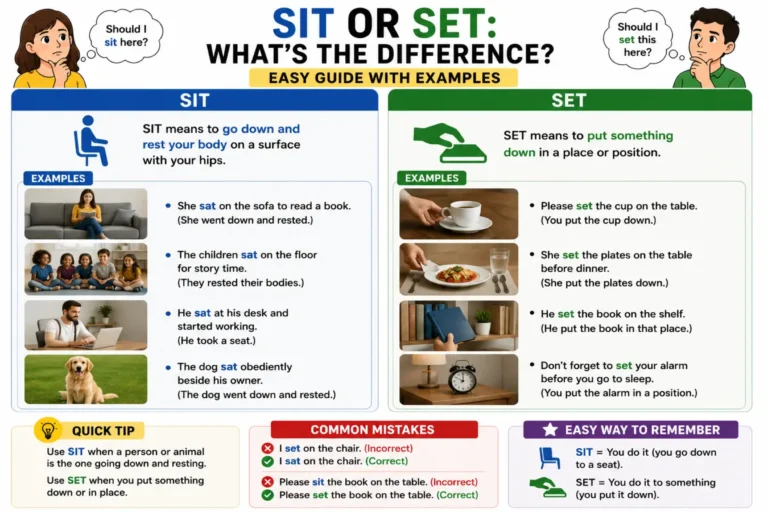
Sit or set is one of the most confusing grammar topics in English. These two words sound familiar, but they have different meanings and uses. Many English learners use them incorrectly because both describe position or movement. However, the grammar rule is simple once you understand it.
The main difference is that sit usually means to rest in a seated position, while set means to place or put something somewhere. Knowing this difference helps you write clearly and speak with confidence. Whether you are writing emails, completing schoolwork, or having a conversation, using the correct word makes a big difference.
This guide explains the meanings of sit and set in simple English. You will also find examples, comparison tables, memory tricks, and grammar tips to help you use both words correctly.
Quick Summary Box
- Sit means to rest in a seated position.
- Set means to place or put something somewhere.
- Sit usually does not need a direct object.
- Set usually needs a direct object.
- Use sit when someone sits down.
- Use set when someone places an object.
- Remember: People sit. People set things down.
What Does Sit Mean?
The word sit means to rest your body on a chair, bench, floor, or another surface. It can also mean to stay in one place or remain in a particular position.
Unlike set, the verb sit usually does not act on another object. The action belongs to the person or animal performing it.
Simple Definition
Sit = To rest in a seated position or remain in one place.
Examples of Sit
- Please sit on the chair.
- The children sat quietly in class.
- My dog likes to sit near the window.
- We sat together during the movie.
- She sits beside her best friend every day.
- The old house sits on a beautiful hill.
- He sat under the tree and read a book.
Each example shows a person, animal, or object remaining in a position.
Sit as an Intransitive Verb
Grammar experts call sit an intransitive verb. That means it does not need a direct object.
Examples:
- Please sit.
- They sat quietly.
- The baby is sitting.
Notice that no object follows the verb.
Common Situations Where We Use Sit
You often use sit when talking about:
- Sitting on a chair
- Sitting at a desk
- Sitting in a car
- Sitting beside someone
- Sitting quietly
- Buildings sitting on land
- Objects remaining in one place
Everyday Examples
- We always sit together at lunch.
- She likes to sit by the window.
- The cat sat on the sofa all afternoon.
- Our school sits near the park.
- The books have sat on the shelf for months.
What Does Set Mean?
The word set means to place, put, or arrange something in a particular position. Unlike sit, this action affects another object.
Whenever you place something somewhere, you usually use set.
Simple Definition
Set = To place or put something in a specific location.
Examples of Set
- Please set the books on the table.
- She set her phone beside the bed.
- He set the cup on the kitchen counter.
- We set the chairs before the meeting.
- They set the decorations for the party.
- The teacher set the papers on her desk.
- Dad set the groceries on the floor.
In every sentence, someone places an object somewhere.
Set as a Transitive Verb
The verb set is usually transitive, meaning it requires a direct object.
Examples:
- Set the alarm.
- Set the table.
- Set your backpack here.
- She set the vase on the shelf.
Each sentence includes something being placed or arranged.
Common Situations Where We Use Set
Use set when talking about:
- Setting the table
- Setting an alarm
- Setting a book on a desk
- Setting furniture in a room
- Setting goals
- Setting rules
- Setting a clock
Everyday Examples
- I always set my alarm before bedtime.
- She carefully set the flowers in a vase.
- Please set your bag near the door.
- We set the picnic basket on the grass.
- The workers set the equipment in place.
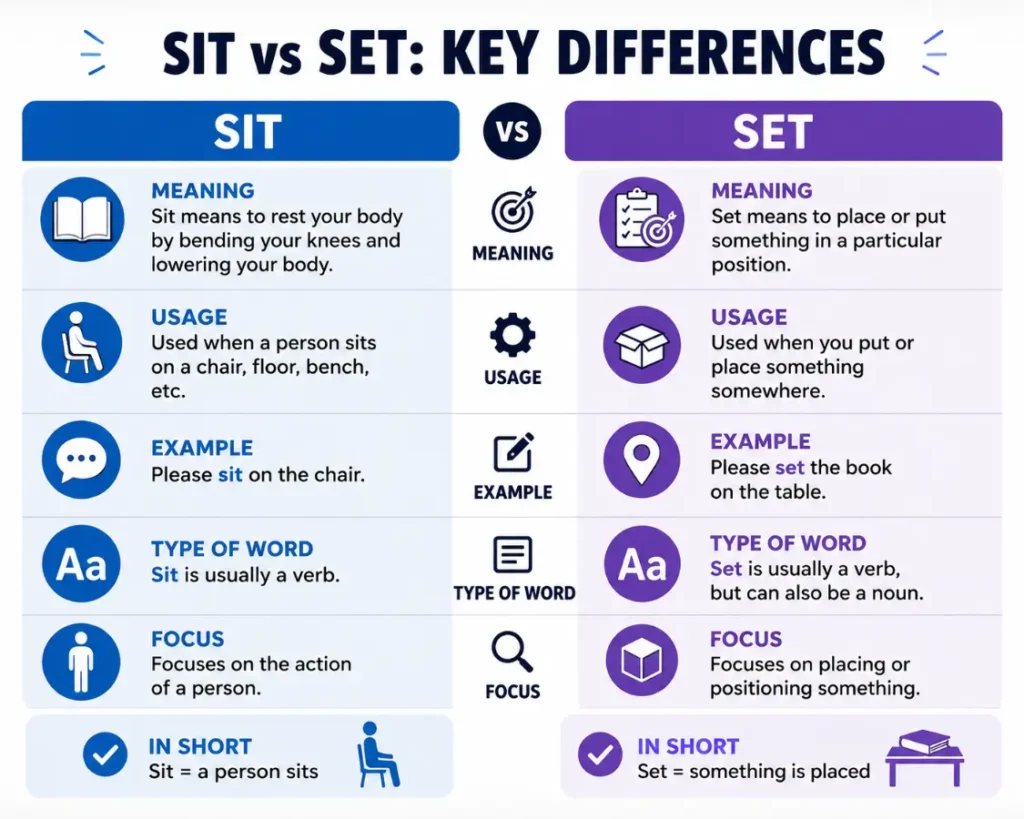
Sit vs Set: Key Differences
Although sit and set are related to position, they describe different actions. Understanding the difference makes your writing more accurate.
| Feature | Sit | Set |
|---|---|---|
| Meaning | Rest in a seated position | Place or put something |
| Verb Type | Intransitive | Transitive |
| Needs an Object? | No | Yes |
| Action | Person or animal rests | Someone places an object |
| Example | She sits on the chair. | She sets the book on the chair. |
Quick Rule
- People sit.
- People set things down.
Side-by-Side Examples
Sit
- The students sit quietly.
- Our cat sits on the couch.
- Grandpa sat outside all afternoon.
Set
- The students set their books on the desks.
- She set the keys on the counter.
- Grandpa set his glasses on the table.
Real-Life Examples of Sit and Set
Learning grammar becomes easier when you see real-life examples. The following situations show how to use sit and set correctly in everyday conversations.
At Home
Sit
- Please sit on the couch.
- The children sat on the floor to play.
- Our cat likes to sit by the fireplace.
Set
- Please set your shoes by the door.
- Mom set the groceries on the kitchen counter.
- Dad set the plates on the dining table.
At School
Sit
- Students sit quietly during the lesson.
- Emma sat beside her best friend.
- The teacher asked everyone to sit down.
Set
- The teacher set the books on each desk.
- Please set your backpack near the wall.
- The librarian set the returned books on the shelf.
At Work
Sit
- We sit together during meetings.
- My manager sits near the entrance.
- Everyone sat quietly while the speaker talked.
Set
- I set my laptop on the desk.
- She set the files beside the printer.
- We set the chairs before the conference started.
During Meals
Sit
- The family sits together every evening.
- Please sit at the table.
- We sat outside for lunch.
Set
- She set the table before dinner.
- He set the glasses beside each plate.
- They set the food on the table.
These examples show a simple rule. People sit, but they set objects somewhere.
Common Mistakes People Make
Many English learners confuse sit and set because both relate to position. However, their meanings are different.
Here are some common mistakes and the correct versions.
Mistake 1
❌ Please set on the chair.
✅ Please sit on the chair.
Reason: A person rests on the chair.
Mistake 2
❌ I sat my phone on the table.
✅ I set my phone on the table.
Reason: You placed your phone somewhere.
Mistake 3
❌ She set beside me.
✅ She sat beside me.
Reason: She rested in a seated position.
Mistake 4
❌ Sit the books on the desk.
✅ Set the books on the desk.
Reason: Books are objects that someone places.
Mistake 5
❌ The dog set on the floor.
✅ The dog sat on the floor.
Reason: Animals sit just like people.
Easy Memory Tricks
You do not need to memorize difficult grammar rules. These simple tricks make the difference easy to remember.
Trick 1: People Sit
If a person or animal is resting, use sit.
Examples:
- The baby sits in the stroller.
- Our dog sits by the door.
- We sat together during lunch.
Trick 2: Set Means Place
If someone places an object somewhere, use set.
Examples:
- Set the book on the shelf.
- Set your keys on the table.
- She set the flowers in a vase.
Trick 3: Ask Yourself One Question
Before choosing the word, ask:
Am I placing an object?
- If yes, use set.
- If no, use sit.
This question solves most grammar mistakes.
When Should You Use Sit?
Use sit when talking about people, animals, or things that remain in a position.
Common situations include:
- Sitting in a chair
- Sitting on a bench
- Sitting beside someone
- Sitting quietly
- Buildings sitting on land
- Cars sitting in a parking lot
- Waiting while seated
Examples
- Please sit here.
- The children sat quietly.
- Our house sits near the lake.
- The cat sits on the windowsill.
- We sat in the front row.
When Should You Use Set?
Use set when placing, arranging, or preparing something.
Common situations include:
- Setting the table
- Setting an alarm
- Setting books on a shelf
- Setting furniture
- Setting goals
- Setting rules
- Setting a timer
Examples
- I set my alarm every night.
- She set the dishes on the table.
- They set the chairs for the meeting.
- Please set your bag by the door.
- He set the laptop on his desk.
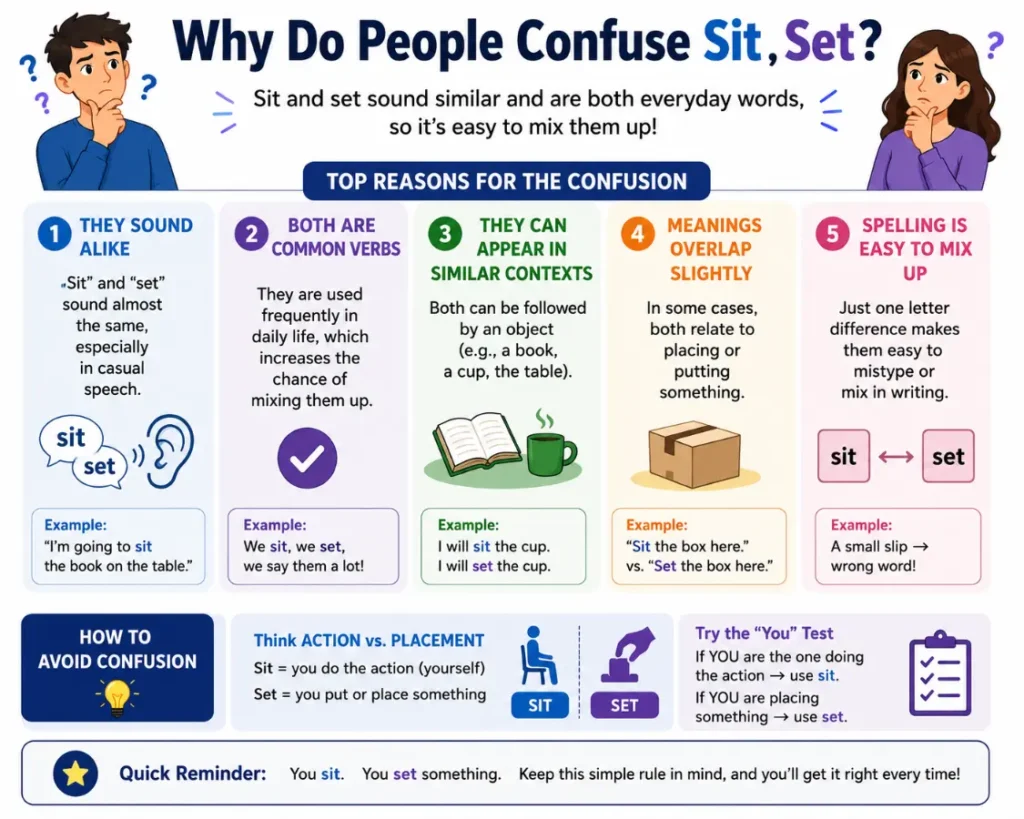
Why Do People Confuse Sit and Set?
There are several reasons why learners mix up these words.
First, both verbs describe position or location.
Second, they often appear in similar situations.
Finally, English verb forms can be confusing because sit changes to sat, while set stays the same in the present and past tense.
Compare these examples:
- Today I sit here.
- Yesterday I sat here.
But:
- Today I set the book down.
- Yesterday I set the book down.
Notice that set does not change in the past tense.
Learning these patterns helps you avoid common grammar mistakes and improves both speaking and writing.
Synonyms and Related Words
Learning similar words helps you expand your vocabulary. It also helps you understand the difference between sit and set more clearly.
Synonyms for Sit
Depending on the sentence, you can use these words instead of sit.
- Rest
- Be seated
- Relax
- Remain
- Stay
- Perch
- Settle
- Lounge
- Wait
- Occupy a seat
Example Sentences
- Please be seated.
- The bird perched on the fence.
- We remained in our seats.
- She likes to relax by the window.
Synonyms for Set
These words have meanings similar to set.
- Place
- Put
- Position
- Arrange
- Lay
- Establish
- Prepare
- Install
- Organize
- Locate
Example Sentences
- Please place the box here.
- She arranged the flowers beautifully.
- They positioned the chairs in a circle.
- We prepared the room for guests.
Related Search Terms (LSI Keywords)
Using related keywords naturally helps improve SEO.
Some common search terms include:
- sit vs set
- difference between sit and set
- sit meaning
- set meaning
- sit or set grammar
- when to use sit and set
- English grammar rules
- common English mistakes
- transitive vs intransitive verbs
- English vocabulary guide
- grammar examples
- English writing tips
Verb Forms of Sit and Set
Understanding verb forms helps you use these words correctly.
| Verb | Present | Past | Past Participle | Present Participle |
|---|---|---|---|---|
| Sit | Sit | Sat | Sat | Sitting |
| Set | Set | Set | Set | Setting |
Examples
Sit
- I sit near the window.
- Yesterday I sat in the front row.
- She has sat there before.
- They are sitting outside.
Set
- I set the alarm every night.
- Yesterday I set the table.
- We have set new goals.
- She is setting the books on the shelf.
Expert Insights
Grammar experts suggest learning verbs through everyday situations instead of memorizing long rules.
Practice using sit and set while speaking and writing. Create your own sentences using both words. This method improves your memory and helps you use the correct word naturally.
Reading books, newspapers, and online articles also helps. Notice how experienced writers use these verbs in context.
Good grammar builds confidence. It also makes your emails, assignments, and professional writing easier to understand.
Practice Quiz
Test your understanding with these simple questions.
1. Please ______ on the chair.
Answer: sit
2. She ______ the flowers on the table.
Answer: set
3. The children ______ quietly during class yesterday.
Answer: sat
4. Please ______ your backpack beside the door.
Answer: set
5. Our cat likes to ______ on the sofa.
Answer: sit
If you answered all five correctly, you understand the difference between sit and set.
(FAQs)
1. What is the difference between sit and set?
Sit means to rest in a seated position. Set means to place or put something somewhere.
2. Is “sit the book on the table” correct?
No. The correct sentence is set the book on the table because you are placing an object.
3. Can sit be used without an object?
Yes. Sit is usually an intransitive verb and does not need a direct object.
4. Does set always need an object?
Most of the time, yes. Someone usually sets something somewhere.
5. Why is the past tense of sit different?
The past tense of sit is sat, while set remains set in both the present and past tense.
6. How can I remember the difference?
Remember this simple rule:
People sit. People set things down.
7. Is “set the table” correct?
Yes. It means to arrange plates, glasses, and utensils before a meal.
Conclusion
Understanding sit or set is easier once you know the basic rule. Sit means to rest in a seated position, while set means to place or arrange something. Although these words often appear in similar situations, they describe different actions.
A simple memory trick can help you remember the difference. People sit, but people set things down. Practice using these verbs in everyday conversations, emails, and writing exercises. The more you use them, the more natural they will become.
Correct grammar improves communication and builds confidence. Whether you are learning English, preparing for an exam, or improving your writing skills, mastering sit and set will help you avoid common mistakes and communicate more clearly.