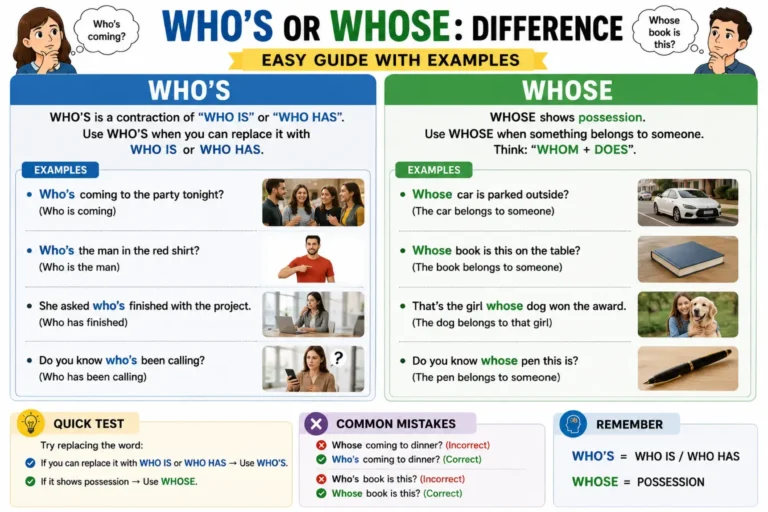
Who’s or whose is one of the most common grammar questions in English. These two words look alike, but they have different meanings. Many students, writers, and professionals confuse them because they sound exactly the same. However, learning the difference is easier than you might think.
A simple grammar rule can help you choose the correct word every time. Whether you are writing an email, completing homework, creating content, or posting on social media, using the right word makes your writing clearer and more professional.
This guide explains who’s and whose in simple English. You will learn what each word means, how to use them correctly, see real-life examples, and discover easy tricks to remember the difference. By the end, you will never confuse who’s and whose again.
Quick Summary Box
- Who’s is the short form of who is or who has.
- Whose shows ownership or possession.
- Who’s always contains an apostrophe.
- Whose never uses an apostrophe.
- Use who’s when you can replace it with who is.
- Use whose when asking or talking about ownership.
What Does “Who’s” Mean?
Who’s is a contraction. It combines the words who is or who has into one shorter word.
The apostrophe replaces the missing letter in the contraction.
Simple Definition
Who’s = Who is or Who has
If you can replace who’s with who is or who has, then who’s is the correct choice.
Examples Using “Who Is”
- Who’s coming to the party?
- Who’s your favorite teacher?
- Who’s ready for lunch?
- Who’s waiting outside?
- Who’s responsible for this project?
Each sentence can also be written with who is.
For example:
- Who is coming to the party?
- Who is ready for lunch?
The meaning stays the same.
Examples Using “Who Has”
Sometimes who’s means who has.
Examples:
- Who’s finished the assignment?
- Who’s already eaten?
- Who’s completed the report?
- Who’s received the invitation?
In these sentences, who’s means who has.
When Should You Use “Who’s”?
Use who’s when:
- Asking about a person’s identity.
- Asking who is doing something.
- Asking who has completed an action.
- Writing informal or everyday English.
Whenever you can replace the word with who is or who has, who’s is correct.
What Does “Whose” Mean?
Whose is a possessive word. It shows ownership or asks who owns something.
Unlike who’s, whose never has an apostrophe.
Simple Definition
Whose = Belonging to whom
It helps identify the owner of an object, idea, or responsibility.
Examples
- Whose book is this?
- Whose phone is ringing?
- Whose shoes are by the door?
- Whose idea was this?
- Whose backpack did you find?
- Whose turn is it?
- Whose car is parked outside?
Each sentence asks who owns something.
More Examples
- I met the teacher whose class won the competition.
- She is the author whose books inspire children.
- The player whose team won celebrated happily.
- We visited the family whose house overlooks the lake.
Here, whose connects a person with something they own or are connected to.
When Should You Use “Whose”?
Use whose when talking about:
- Ownership
- Possession
- Relationships
- Belonging
- Identifying a person by something connected to them
If the sentence asks “Who owns this?”, use whose.
Who’s vs. Whose: Key Differences
Although these words sound the same, they have completely different jobs in a sentence.
| Feature | Who’s | Whose |
|---|---|---|
| Meaning | Who is or who has | Shows ownership |
| Grammar Type | Contraction | Possessive pronoun/determiner |
| Apostrophe | Yes | No |
| Purpose | Talks about identity or actions | Talks about possession |
| Example | Who’s calling? | Whose phone is this? |
Quick Rule
Use who’s if you can replace it with who is or who has.
Use whose if the sentence talks about ownership or belonging.
Real-Life Examples
Learning through everyday situations makes grammar easier.
At School
Who’s
- Who’s absent today?
- Who’s bringing the science project?
- Who’s finished the homework?
Whose
- Whose notebook is on the desk?
- Whose pencil did you borrow?
- Whose project won first prize?
At Work
Who’s
- Who’s leading today’s meeting?
- Who’s completed the monthly report?
- Who’s available this afternoon?
Whose
- Whose office is on the second floor?
- Whose idea improved the project?
- Whose laptop is in the conference room?
At Home
Who’s
- Who’s cooking dinner tonight?
- Who’s watching television?
- Who’s taking out the trash?
Whose
- Whose keys are on the table?
- Whose jacket is hanging by the door?
- Whose dog is barking outside?
On Social Media
Who’s
- Who’s online right now?
- Who’s sharing this video?
- Who’s following the new page?
Whose
- Whose photo received the most likes?
- Whose account shared the news?
- Whose comment got the most replies?
These examples show that who’s asks about a person or action, while whose asks about ownership or possession.
Easy Memory Tricks to Remember the Difference
Many English learners confuse who’s and whose because they sound the same. Luckily, a few simple tricks can help you remember the correct word every time.
Trick 1: Expand “Who’s”
Whenever you see who’s, try replacing it with who is or who has.
If the sentence still makes sense, who’s is correct.
Examples
- Who’s coming to dinner?
- Who is coming to dinner? ✔
- Who’s finished the project?
- Who has finished the project? ✔
If replacing the word sounds natural, use who’s.
Trick 2: Think of Ownership
The word whose shows ownership.
Ask yourself this question:
“Does this sentence talk about something that belongs to someone?”
If the answer is yes, use whose.
Examples
- Whose backpack is this?
- Whose turn is it?
- Whose car is parked outside?
Each sentence asks who owns something.
Trick 3: Look for the Apostrophe
One easy clue is punctuation.
- Who’s has an apostrophe because it is a contraction.
- Whose has no apostrophe because it shows possession.
Remember this simple rule:
Contractions use apostrophes. Possessive words like “whose” do not.
Common Mistakes People Make
Many grammar mistakes happen because people focus only on pronunciation. Here are the mistakes you should avoid.
Mistake 1
❌ Whose coming with us?
✅ Who’s coming with us?
Why?
The sentence means Who is coming with us?
Mistake 2
❌ Who’s backpack is this?
✅ Whose backpack is this?
Why?
The sentence asks who owns the backpack.
Mistake 3
❌ Whose going to drive?
✅ Who’s going to drive?
Why?
The sentence means Who is going to drive?
Mistake 4
❌ I know who’s keys these are.
✅ I know whose keys these are.
Why?
The sentence talks about ownership.
Mistake 5
❌ Who’s dog won the competition?
✅ Whose dog won the competition?
Why?
The dog belongs to someone.
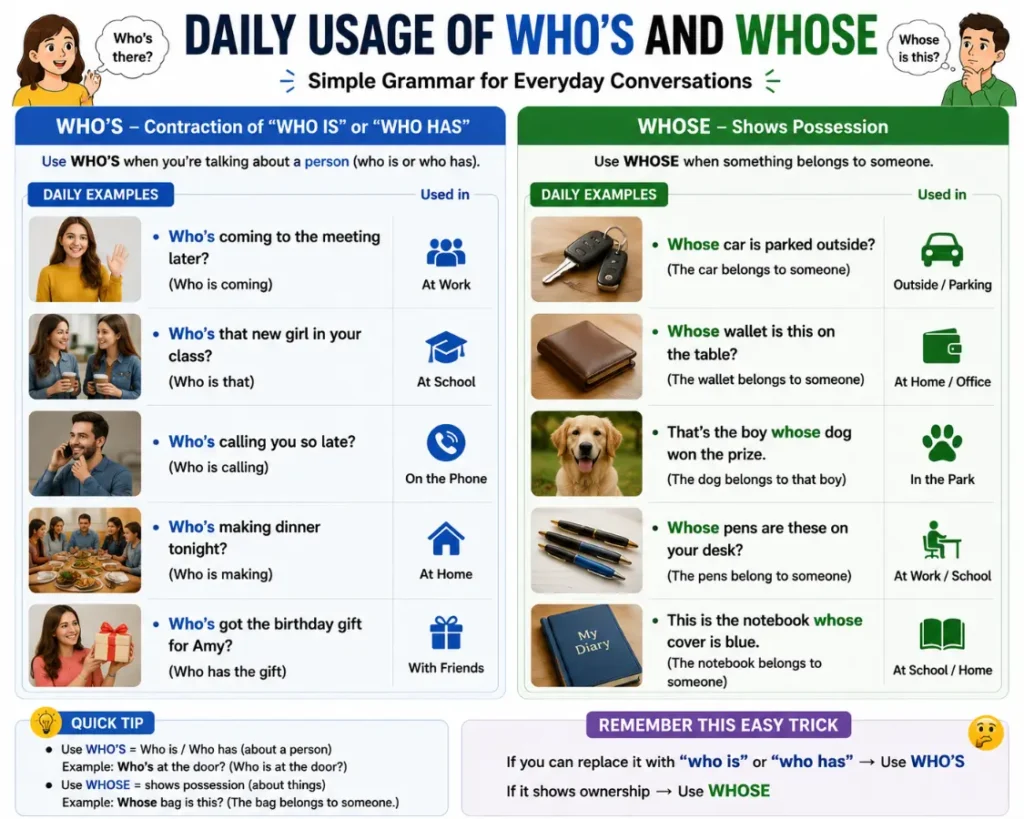
Daily Usage of Who’s and Whose
These words appear in everyday conversations, emails, and messages.
Conversations
- Who’s at the door?
- Whose phone keeps ringing?
- Who’s making breakfast?
- Whose turn is next?
Emails
- Who’s available for tomorrow’s meeting?
- Whose report should I review first?
Schools
- Who’s absent today?
- Whose notebook is missing?
Office
- Who’s leading today’s presentation?
- Whose client requested the update?
Online Chats
- Who’s joining the video call?
- Whose message did you reply to?
Learning these everyday examples makes the grammar rule easier to remember.
Real-Life Scenarios
Here are some situations where choosing the correct word matters.
Scenario 1: Classroom
Teacher:
Who’s finished the assignment?
Student:
Whose notebook is on my desk?
Scenario 2: Family Dinner
Mom:
Who’s helping set the table?
Dad:
Whose plate is still in the kitchen?
Scenario 3: Office Meeting
Manager:
Who’s presenting first?
Employee:
Whose presentation should we review next?
Scenario 4: Sports Team
Coach:
Who’s ready for practice?
Player:
Whose football is on the field?
When Should You Use Who’s?
Choose who’s when:
- You mean who is.
- You mean who has.
- You ask about a person’s identity.
- You ask who is doing something.
- You ask who completed an action.
Examples
- Who’s speaking today?
- Who’s completed the training?
- Who’s answering the phone?
- Who’s your English teacher?
- Who’s ready to leave?
When Should You Use Whose?
Choose whose when talking about ownership or possession.
Examples
- Whose wallet is on the counter?
- Whose bicycle is outside?
- Whose responsibility is this?
- Whose opinion do you trust?
- Whose birthday is today?
Whenever you ask “Who owns this?”, use whose.
Tips to Avoid Grammar Mistakes
These simple habits will improve your writing.
- Replace who’s with who is.
- Ask whether the sentence talks about ownership.
- Check for an apostrophe.
- Read your sentence aloud.
- Practice writing your own examples.
- Proofread before sending emails.
- Learn other common homophones.
These small steps help you avoid common English mistakes.
Why Do People Confuse Who’s and Whose?
The biggest reason is pronunciation.
Who’s and whose are homophones. They sound exactly the same but have different meanings and spellings.
English contains many similar word pairs.
Examples include:
- Their, There, and They’re
- Your and You’re
- To, Too, and Two
- Affect and Effect
- Complement and Compliment
- Its and It’s
Understanding homophones improves grammar, writing, and communication. It also helps you sound more confident in professional and academic settings.
Synonyms and Related Words
Learning related words helps you improve your English vocabulary. It also makes your writing more natural.
Synonyms for “Who’s”
Since who’s means who is or who has, it does not have direct synonyms. However, you can rewrite sentences using the full forms.
Examples
- Who’s ready? → Who is ready?
- Who’s finished the test? → Who has finished the test?
- Who’s calling? → Who is calling?
Using the full form is more formal. The contraction sounds more natural in everyday writing.
Related Words for “Whose”
Whose is a possessive word. These words are related because they also show ownership.
- His
- Her
- Their
- Our
- My
- Your
- Its
- Possession
- Ownership
- Belonging
Examples
- This is his laptop.
- That is their house.
- Whose bag is on the chair?
These words all help show who owns something.
Related Search Terms (LSI Keywords)
Search engines understand related terms. Using them naturally improves topical relevance.
Primary Keyword
- who’s or whose
Secondary Keywords
- who’s vs whose
- difference between who’s and whose
- whose meaning
- who’s meaning
- grammar rules
- English grammar guide
- common grammar mistakes
- possessive pronouns
- contractions in English
- English writing tips
- homophones in English
- when to use who’s
- when to use whose
Expert Insights
Grammar experts recommend understanding the meaning of a sentence before choosing a word.
Instead of memorizing spelling, focus on the purpose of the word.
Ask yourself these questions:
- Does the sentence mean who is or who has?
- Does the sentence ask about ownership?
Answering these questions makes choosing the correct word much easier.
Professional editors also recommend proofreading your work before publishing. Even experienced writers sometimes confuse who’s and whose.
Correct grammar builds trust with readers. It also improves your writing in school, business, and online communication.
Practice Quiz
Test your understanding with these simple questions.
1. ______ coming to the meeting?
Answer: Who’s
2. ______ notebook is on the desk?
Answer: Whose
3. ______ finished the homework?
Answer: Who’s
4. ______ jacket is hanging by the door?
Answer: Whose
5. ______ responsible for this report?
Answer: Who’s
If you answered all five correctly, you understand the difference between who’s and whose.
(FAQs)
1. What is the difference between who’s and whose?
Who’s means who is or who has. Whose shows ownership or possession.
2. Is “who’s” always a contraction?
Yes. It always means who is or who has.
3. Does “whose” need an apostrophe?
No. Whose never takes an apostrophe because it is a possessive word.
4. How do I know which word to use?
Replace who’s with who is. If the sentence still makes sense, use who’s. If the sentence asks about ownership, use whose.
5. Can “whose” refer to things as well as people?
Yes. It can refer to people, animals, groups, and sometimes things.
Example:
The company whose products became popular expanded quickly.
6. Why do people confuse who’s and whose?
They are homophones. They sound the same but have different meanings and spellings.
7. Is “Who’s book is this?” correct?
No.
The correct sentence is:
Whose book is this?
Conclusion
Understanding who’s or whose is easier once you know their purpose. Who’s is simply a contraction of who is or who has, while whose shows ownership or possession. Although they sound the same, they play very different roles in English grammar.
The easiest way to avoid mistakes is to test the sentence. Replace who’s with who is. If the sentence still makes sense, you have the correct word. If the sentence asks who owns something, choose whose instead.
Practice these rules in everyday writing, emails, assignments, and conversations. Over time, using who’s and whose correctly will become second nature. Strong grammar improves clarity, builds confidence, and helps you communicate more effectively in every situation.