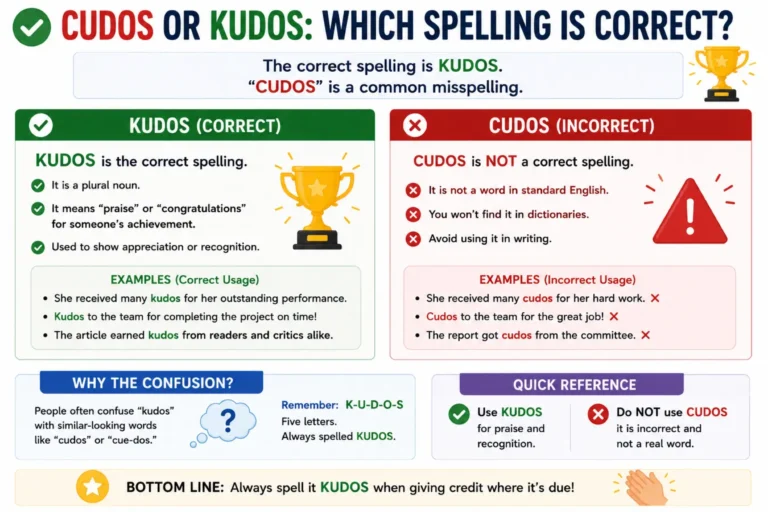
Cudos or kudos is a question many people search online. The two words look similar, but only one is correct in standard English. Many writers, students, and professionals accidentally use cudos instead of kudos. This common spelling mistake appears in emails, social media posts, and even business documents.
Knowing the correct spelling helps you communicate clearly and professionally. It also improves your writing and prevents embarrassing mistakes. In this guide, you will learn the difference between cudos and kudos, why people confuse them, and how to use the correct word in everyday conversations. The explanations are simple, practical, and easy to remember.
Quick Summary
Cudos or Kudos?
- Kudos is the correct spelling.
- Cudos is a common misspelling.
- Kudos means praise, honor, or recognition.
- Use kudos in formal and informal writing.
- Avoid using cudos in professional communication.
- Remember: Only “kudos” is correct.
Is It Cudos or Kudos?
The correct spelling is “kudos.” It means praise, recognition, or admiration for someone’s achievement. “Cudos” is a common misspelling and is not considered correct in standard English. Use “kudos” in emails, conversations, academic writing, and professional communication.
What Does Kudos Mean?
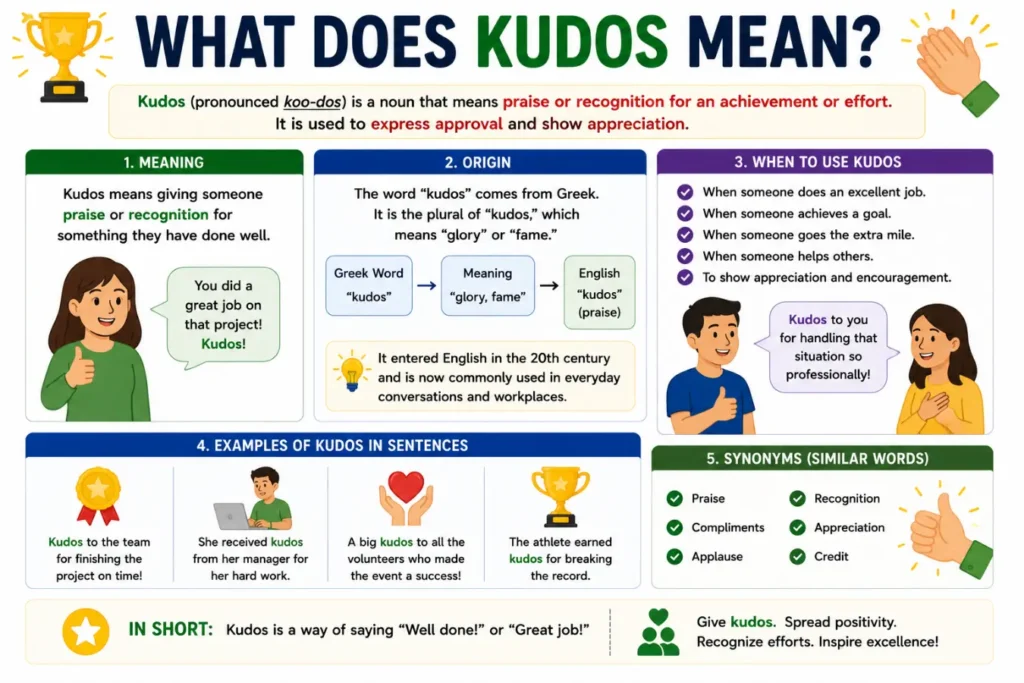
Kudos means praise or recognition for a job well done.
People use the word to congratulate someone on an achievement or success.
You can give kudos to a friend, coworker, student, or team.
Examples
- Kudos to Sarah for finishing the project early.
- The coach gave kudos to the entire team.
- Everyone deserves kudos for their hard work.
The word always refers to appreciation or recognition.
Is Cudos a Real Word?
No.
Cudos is not the accepted spelling in modern English.
Many people type cudos because it sounds similar to kudos.
Spell checkers and dictionaries recognize kudos as the correct word.
Whenever you want to express praise, write kudos, not cudos.
Cudos vs Kudos: What’s the Difference?
The difference is simple.
| Word | Correct? | Meaning |
|---|---|---|
| Kudos | ✅ Yes | Praise, honor, or recognition |
| Cudos | ❌ No | Common misspelling of kudos |
Always choose kudos in professional and academic writing.
Using the correct spelling shows attention to detail.
Why Do People Spell It as “Cudos”?
Many people spell the word incorrectly because of pronunciation.
“Kudos” sounds like it could begin with the letter C.
Other reasons include:
- Typing too quickly.
- Autocorrect mistakes.
- Learning the word by hearing it instead of reading it.
- Copying the incorrect spelling from social media.
The mistake is common, but it is easy to avoid once you know the correct spelling.
Origin of the Word Kudos
The word kudos comes from the Greek language.
Originally, it meant glory, fame, or honor.
English speakers adopted the word in the 1800s.
Today, people use it to recognize achievements in schools, workplaces, sports, and daily life.
Although the meaning has evolved slightly, the idea remains the same.
Kudos is a way to celebrate someone’s success.
How to Use Kudos Correctly
Using kudos is simple.
You can use it in both formal and casual situations.
Workplace Examples
- Kudos to everyone who met the deadline.
- Our manager gave kudos to the sales team.
School Examples
- The teacher gave kudos to the students.
- She earned kudos for her science project.
Everyday Examples
- Kudos on your new job.
- Kudos for helping your neighbor.
- You deserve kudos for your effort.
These examples show that kudos works in many situations where you want to express appreciation.
Is Kudos Singular or Plural?
Many people think kudos is plural because it ends with the letter S.
However, it is generally treated as a singular mass noun in English.
Correct examples include:
- Kudos goes to the entire team.
- She deserves kudos for her dedication.
You may also hear:
- Kudos to everyone.
This expression is widely accepted and commonly used.
There is no need to write one kudo in everyday English.
Most native speakers simply use kudos for both individual and group recognition.
Real-Life Examples of Using Kudos
The word kudos appears in many everyday situations. Here are some common examples.
At Work
Managers often praise employees for excellent performance.
Example:
“Kudos to the marketing team for increasing sales this quarter.”
At School
Teachers recognize students for hard work and good behavior.
Example:
“Kudos to Emma for earning the highest grade in math.”
On Social Media
People congratulate friends on personal achievements.
Example:
“Kudos on finishing your first marathon!”
In Sports
Coaches and fans celebrate outstanding performances.
Example:
“Kudos to the goalkeeper for making several amazing saves.”
These examples show that kudos fits both professional and casual conversations.

Common Mistakes When Using Kudos
Many writers make small mistakes when using this word.
Here are the most common ones.
Mistake 1: Writing “Cudos”
This is the most common error.
✅ Correct: Kudos to you!
❌ Incorrect: Cudos to you!
Mistake 2: Thinking Kudos Is a Verb
Kudos is a noun.
It represents praise or recognition.
Correct:
“I want to give you kudos.”
Incorrect:
“I kudos you.”
Mistake 3: Overusing the Word
Using the same word repeatedly can make your writing sound repetitive.
Mix it with similar words like praise, recognition, or credit.
Tips to Remember the Correct Spelling
Remembering the correct spelling is easy with these simple tricks.
- Think of K for Kind words.
- Remember that dictionaries only list kudos.
- Read the word often in books and articles.
- Let spell check confirm your writing.
- Practice writing “kudos” in emails and messages.
The more you use it, the easier it becomes to remember.
Synonyms and Related Keywords
Using related words improves both writing quality and SEO.
Synonyms of Kudos
- Praise
- Recognition
- Credit
- Appreciation
- Honor
- Acclaim
- Commendation
- Congratulations
- Tribute
- Respect
LSI and Semantic Keywords
- correct spelling of kudos
- cudos meaning
- kudos definition
- kudos examples
- how to spell kudos
- praise and recognition
- English spelling mistakes
- grammar tips
- writing guide
- common English words
These related keywords help search engines understand your content without keyword stuffing.
Expert Insight
Professional writers and editors always recommend using kudos.
The word appears in respected dictionaries, style guides, and business communication.
Using the correct spelling improves your credibility.
It also shows attention to detail.
Whether you write emails, blog posts, academic papers, or social media updates, choosing kudos helps create a professional impression.
Learning common spelling mistakes like this also strengthens your overall English writing skills.
Frequently Asked Questions
Is it cudos or kudos?
The correct spelling is kudos. “Cudos” is a common misspelling.
What does kudos mean?
Kudos means praise, recognition, or admiration for someone’s achievement.
Is cudos a real English word?
No. Standard English dictionaries do not recognize cudos as the correct spelling.
Can I use kudos in formal writing?
Yes. Kudos is suitable for both formal and informal writing.
Why do people write cudos instead of kudos?
Most people hear the word before they see it written. This leads to spelling confusion.
Is kudos singular or plural?
Kudos is generally treated as a singular mass noun, although it often refers to praise given to one or many people.
Can I say “give kudos”?
Yes.
Examples include:
- Give kudos to your team.
- She received kudos for her work.
What is another word for kudos?
You can use words like praise, recognition, credit, honor, or appreciation.
Conclusion
If you have ever wondered whether to write cudos or kudos, the answer is simple. Kudos is the correct spelling, while cudos is a common mistake. Kudos means praise, recognition, or appreciation for someone’s achievement. It works well in professional emails, classroom discussions, business communication, and everyday conversations.
Using the correct spelling improves your writing and helps you communicate with confidence. It also shows attention to detail, which creates a positive impression in both personal and professional settings. Whenever you want to congratulate someone, remember to use kudos. This small change can make your writing more accurate and polished.