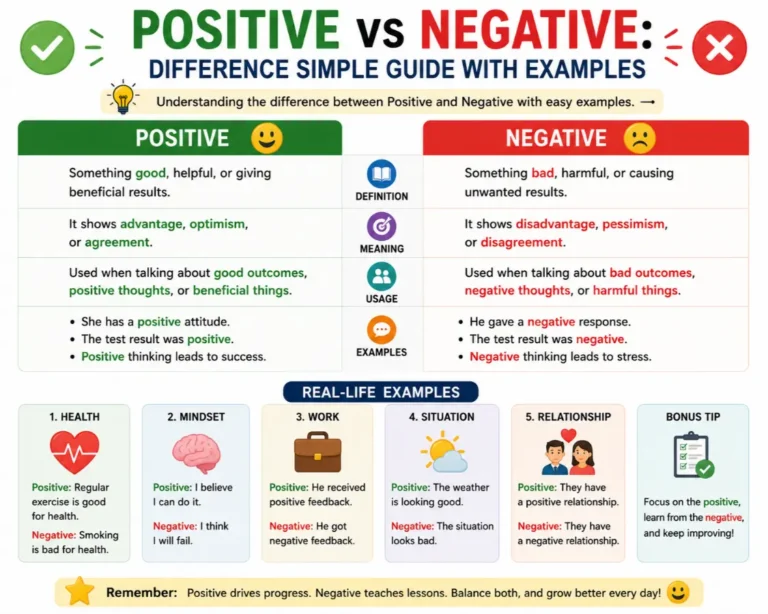
Positive vs negative is a common comparison used in many areas of life. You may hear these words in math, science, emotions, thinking, electricity, and everyday conversations. Although they seem simple, they have different meanings depending on the situation.
Understanding positive and negative helps you make better decisions. It also improves communication and problem-solving skills. For example, positive thinking can motivate you, while negative thinking may help you identify risks.
This guide explains the meaning of positive vs negative in simple English. You will learn the differences, see real-life examples, avoid common mistakes, and discover practical tips for daily life.
Quick Summary Box
- Positive usually means good, helpful, or above zero.
- Negative usually means bad, harmful, or below zero.
- Both terms have different meanings depending on the context.
- Positive and negative are not always “good” or “bad.”
- Understanding both helps you make informed decisions.
- The correct meaning depends on where and how the terms are used.
Positive vs Negative Comparison Table
| Feature | Positive | Negative |
|---|---|---|
| Basic Meaning | Helpful, favorable, above zero | Harmful, unfavorable, below zero |
| Sign | + | – |
| Emotion | Optimistic | Pessimistic |
| Mathematics | Greater than zero | Less than zero |
| Electricity | Positive charge | Negative charge |
| Feedback | Praise and encouragement | Criticism or suggestions |
| Thinking | Focuses on opportunities | Focuses on problems |
| Example | “I can do this.” | “I will probably fail.” |
What Does Positive Mean?
The word positive describes something favorable, beneficial, or encouraging. It often represents growth, success, confidence, or improvement.
A positive person usually looks for solutions instead of problems. They believe challenges can be overcome with effort and learning.
Examples of Positive
- A student studies hard and expects good results.
- A manager praises employees for their work.
- A weather report predicts sunny skies.
- A doctor shares encouraging test results.
- A friend supports you during difficult times.
Positive does not always mean perfect. Instead, it often means focusing on possibilities while staying realistic.
What Does Negative Mean?
The word negative usually refers to something unfavorable, harmful, or below zero. However, negative does not always mean something bad.
In many situations, being negative helps identify risks, mistakes, or potential problems before they become serious.
Examples of Negative
- A temperature of -10°C.
- A business reports financial losses.
- A doctor receives a negative test result for a disease, which is often good news.
- A customer leaves negative feedback.
- A person expects failure without trying.
The meaning changes depending on the situation. Always consider the context.
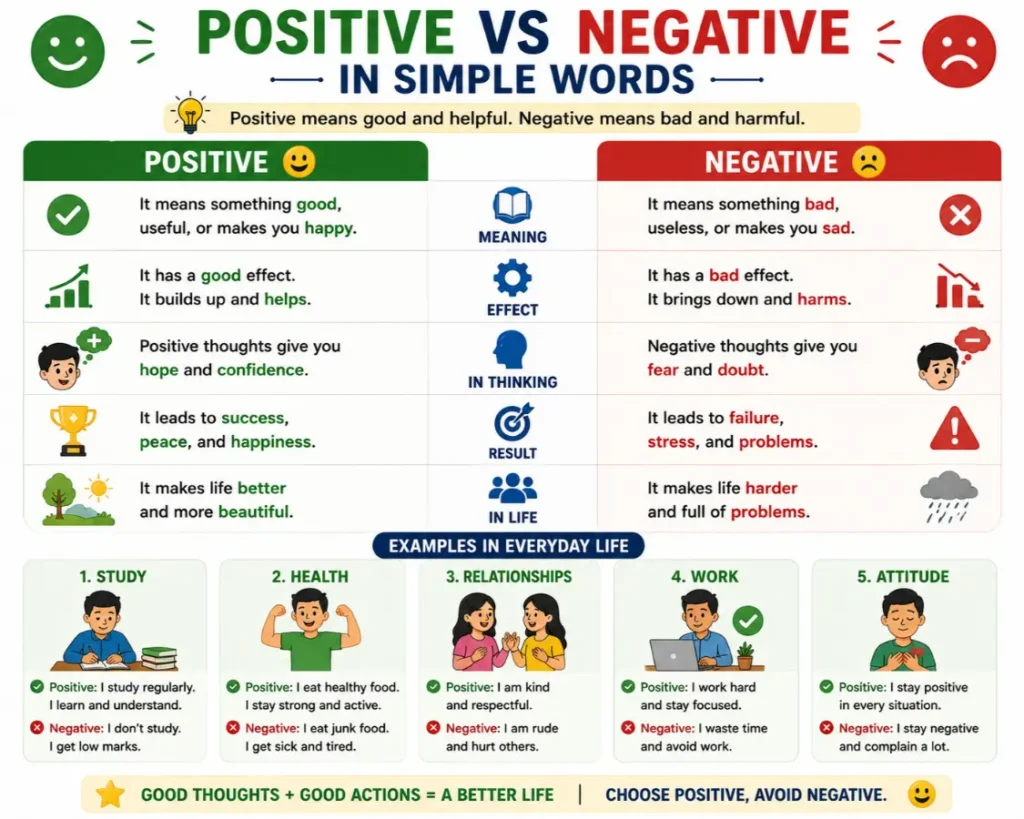
Positive vs Negative in Simple Words
The easiest way to understand positive vs negative is through comparison.
Positive often means adding value, improving situations, or moving forward.
Negative often means reducing value, creating challenges, or moving backward.
Think about these examples:
- Saving money is positive.
- Spending beyond your budget is negative.
- Encouraging someone is positive.
- Discouraging someone is negative.
Still, there are exceptions. For example, a negative medical test result usually means no disease was found.
Real-Life Examples of Positive vs Negative
At School
Positive:
- Completing homework on time.
- Helping classmates.
- Learning from mistakes.
Negative:
- Ignoring assignments.
- Cheating during exams.
- Giving up easily.
At Work
Positive:
- Meeting deadlines.
- Supporting coworkers.
- Solving customer problems.
Negative:
- Missing important meetings.
- Avoiding responsibility.
- Complaining without offering solutions.
In Relationships
Positive:
- Listening carefully.
- Showing respect.
- Saying thank you.
- Offering encouragement.
Negative:
- Constant criticism.
- Ignoring others.
- Blaming without understanding.
- Holding grudges.
In Health
Positive:
- Exercising regularly.
- Eating healthy foods.
- Sleeping well.
- Drinking enough water.
Negative:
- Smoking.
- Poor eating habits.
- Lack of sleep.
- Ignoring medical advice.
Positive vs Negative Thinking
Positive thinking focuses on possibilities and solutions.
Negative thinking focuses on risks and obstacles.
Both have value.
Positive thinking builds confidence and motivation.
Negative thinking can help you identify problems before making important decisions.
The goal is balanced thinking. Stay optimistic while considering possible risks.
Why Understanding Positive vs Negative Matters
Knowing the difference improves many areas of life.
It helps you:
- Make better decisions.
- Solve problems more effectively.
- Improve communication.
- Build healthier relationships.
- Develop emotional intelligence.
- Think more critically.
- Avoid unnecessary mistakes.
People who understand both perspectives often make wiser decisions because they consider opportunities and risks before acting.
Positive vs Negative in Mathematics
In mathematics, positive and negative describe the value of numbers in relation to zero.
- Positive numbers are greater than zero.
- Negative numbers are less than zero.
- Zero is neither positive nor negative.
Examples
- +12 is a positive number.
- -8 is a negative number.
- 0 is neutral.
Understanding positive and negative numbers helps with calculations, measurements, temperatures, and finances.
Everyday Math Examples
- A bank balance of +$500 means you have money.
- A balance of -$500 means you owe money.
- A temperature of 20°C is above zero.
- A temperature of -10°C is below zero.
Positive vs Negative in Science
Science uses positive and negative in many ways.
Electricity
A battery has two terminals:
- Positive (+)
- Negative (-)
Electricity flows because of the difference between these terminals.
Chemistry
Atoms contain charged particles.
- Protons have a positive charge.
- Electrons have a negative charge.
These charges help form atoms and molecules.
Physics
Scientists use positive and negative values to describe direction, movement, and electric fields.
Positive vs Negative Emotions
Emotions affect how people think and behave.
Positive Emotions
Positive emotions include:
- Happiness
- Gratitude
- Hope
- Love
- Excitement
- Confidence
- Peace
These emotions improve relationships and support mental well-being.
Emotions negative
Negative emotions include:
- Anger
- Fear
- Sadness
- Stress
- Jealousy
- Frustration
- Disappointment
Negative emotions are normal. They can warn you about problems or motivate change. However, long-term negative emotions may affect your health if left unmanaged.
Positive vs Negative Feedback
Feedback helps people improve.
Positive Feedback
Positive feedback highlights strengths and achievements.
Examples:
- “Excellent presentation.”
- “You solved the problem quickly.”
- “Your writing has improved.”
Positive feedback increases confidence and motivation.
Negative Feedback
Negative feedback points out areas that need improvement.
Examples:
- “The report needs more research.”
- “Please check your spelling.”
- “You missed an important step.”
Constructive negative feedback should focus on improvement, not personal criticism.
Common Mistakes When Understanding Positive vs Negative
Many people misunderstand these terms because they assume positive always means good and negative always means bad.
Avoid these common mistakes:
1. Ignoring Context
The meaning changes depending on the subject.
For example:
- A negative COVID test is good news.
- Negative temperatures are normal in winter.
2. Confusing Criticism with Negativity
Constructive criticism helps people improve. It is not meant to discourage.
3. Believing Positive Means Perfect
Positive thinking does not ignore problems. It encourages finding realistic solutions.
4. Avoiding All Negative Thoughts
Some negative thinking helps you prepare for risks and make better decisions.
Tips for Using Positive and Negative Effectively
Follow these practical tips in daily life.
Focus on Solutions
Instead of saying,
“This problem is impossible.”
Try saying,
“Let’s find a better solution.”
Learn from Mistakes
Every mistake teaches a lesson.
Use setbacks as opportunities to improve.
Give Balanced Feedback
Praise good work.
Then suggest improvements politely.
Think Before Reacting
Pause before responding to negative situations.
Calm decisions usually produce better results.
Stay Realistic
Positive thinking works best when combined with careful planning.
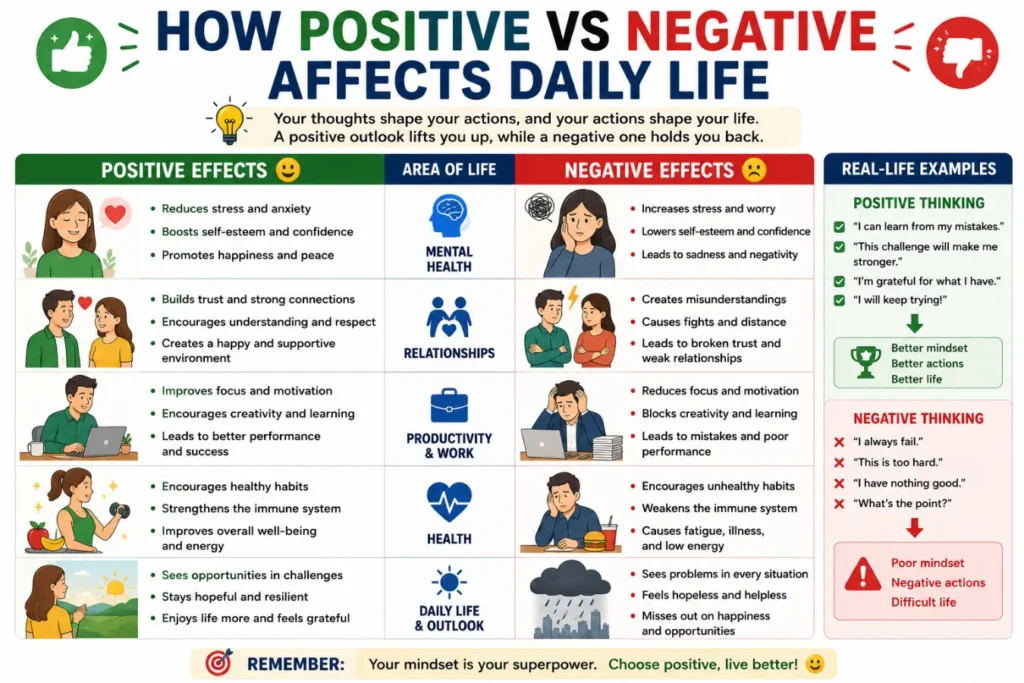
How Positive vs Negative Affects Daily Life
Positive and negative influence almost every decision.
Personal Life
Positive habits improve happiness and health.
Negative habits may reduce productivity.
Education
Positive attitudes encourage learning.
Negative attitudes can reduce motivation.
Business
Positive customer experiences build trust.
Negative reviews highlight areas that need improvement.
Health
Positive lifestyle choices reduce health risks.
Negative choices often increase them.
Money
Positive financial habits include:
- Saving regularly
- Budgeting
- Investing wisely
Negative habits include:
- Overspending
- Ignoring bills
- Taking unnecessary debt
Synonyms and Related Keywords
Using related terms helps readers understand the topic and supports SEO naturally.
Synonyms for Positive
- Favorable
- Optimistic
- Constructive
- Helpful
- Encouraging
- Beneficial
- Confident
- Upbeat
Synonyms for Negative
- Unfavorable
- Pessimistic
- Harmful
- Critical
- Adverse
- Discouraging
- Damaging
- Opposing
LSI Keywords
Use these naturally throughout your content:
- difference between positive and negative
- positive and negative meaning
- positive vs negative examples
- positive thinking vs negative thinking
- positive and negative emotions
- positive and negative numbers
- positive and negative charges
- advantages of positive thinking
- negative mindset
- positive attitude
Expert Insights
Understanding positive vs negative is about more than learning definitions. It helps you think clearly and make informed decisions.
A positive mindset encourages action, confidence, and resilience. At the same time, recognizing negative outcomes helps you prepare for challenges and avoid costly mistakes.
Experts in psychology, education, and business often recommend balanced thinking. This means staying optimistic while evaluating facts and risks objectively.
The goal is not to ignore negativity. Instead, use it as information that helps you grow, improve, and make better choices.
(FAQs)
1. What is the main difference between positive and negative?
Positive usually refers to something favorable or above zero. Negative usually refers to something unfavorable or below zero. The exact meaning depends on the context.
2. Is negative always bad?
No. A negative medical test result is usually good news. Negative feedback can also help people improve.
3. Why is positive thinking important?
Positive thinking improves motivation, confidence, problem-solving, and resilience during difficult situations.
4. Can positive and negative exist together?
Yes. Many situations contain both positive and negative aspects. Considering both leads to better decisions.
5. What are examples of positive and negative numbers?
Positive numbers are greater than zero, such as +8 or +25. Negative numbers are less than zero, such as -3 or -15.
6. How can I develop a positive mindset?
Practice gratitude, focus on solutions, learn from mistakes, surround yourself with supportive people, and set realistic goals.
7. Why is understanding positive vs negative important?
It improves communication, decision-making, learning, relationships, and problem-solving in everyday life.
Conclusion
Understanding positive vs negative helps you make smarter decisions in school, work, relationships, and everyday life. While positive often represents growth, opportunity, and progress, negative helps identify risks, weaknesses, and areas for improvement.
The key is to understand the context. A positive attitude can motivate success, while constructive negative feedback can help you improve. Neither term is automatically good or bad.
By recognizing the strengths of both perspectives, you can think more clearly, solve problems effectively, and respond wisely to challenges. Developing balanced thinking allows you to stay optimistic without ignoring reality, leading to better outcomes in both your personal and professional life.