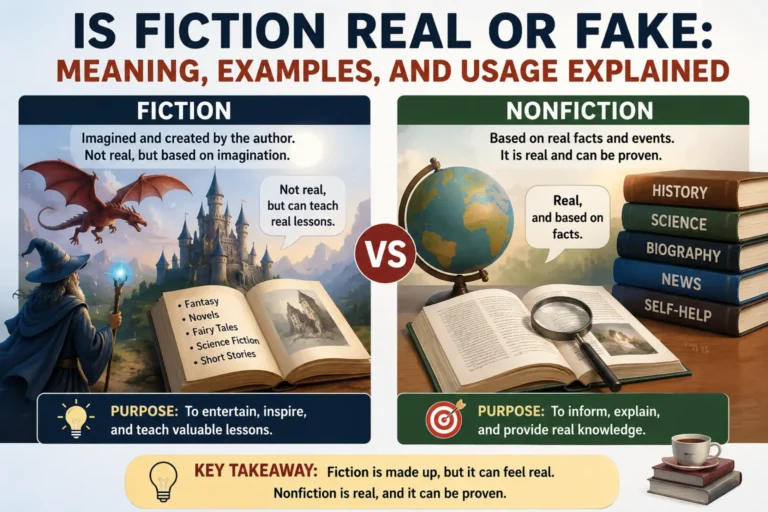
Is fiction real or fake? This is one of the most common questions people ask when they start reading books or watching movies. Many stories feel so real that it becomes hard to tell where imagination ends and reality begins. The answer is simple. Fiction is not real because writers create it using their imagination. However, fiction can include real emotions, places, cultures, and important life lessons.
Stories have entertained people for thousands of years. From fairy tales to modern novels, fiction helps readers explore new worlds and understand different ideas. It also teaches valuable lessons about friendship, courage, love, and hope.
In this guide, you will learn what fiction really means, how it differs from reality, why people enjoy fictional stories, and whether fiction is truly fake. By the end, you will understand why fiction remains one of the most popular forms of storytelling in the world.
Quick Summary
- Fiction is created from imagination.
- Fiction is not a true account of real events.
- Fiction may include real places and historical facts.
- Fiction often teaches valuable life lessons.
- Novels, fairy tales, fantasy books, and many movies are fiction.
- Nonfiction tells true stories based on facts.
- Fiction helps improve creativity and imagination.
- Many fictional stories reflect real human emotions.
What Does Fiction Mean?
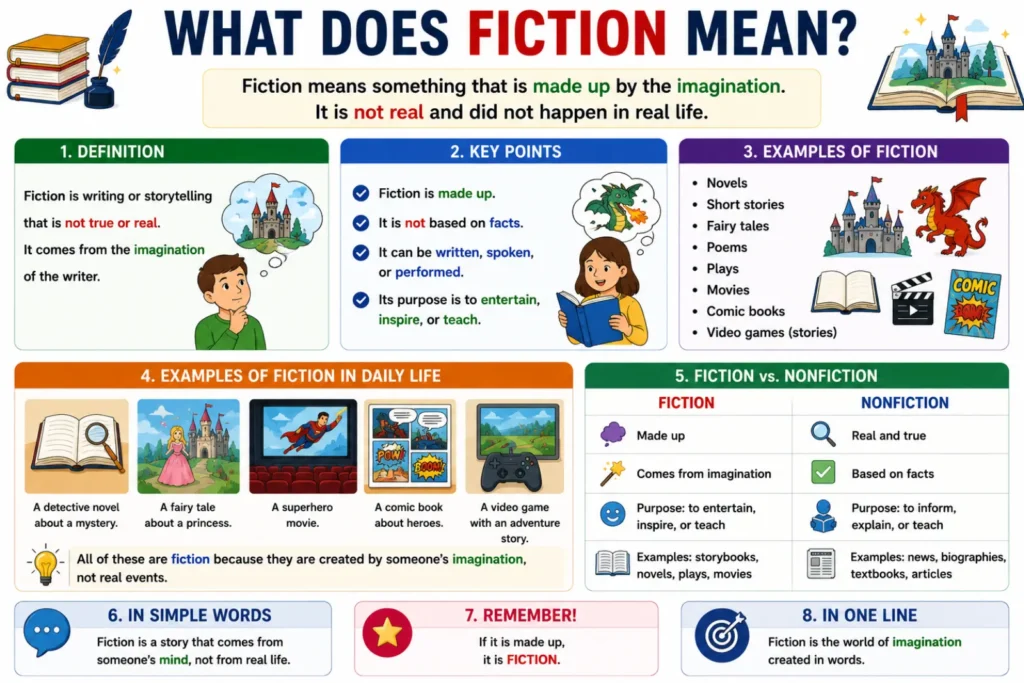
Fiction is a type of writing that tells an imaginary story. The people, events, or places in the story may be invented by the author. Even when some parts are based on real life, the overall story is still made up.
The word fiction comes from the Latin word fictio, which means “to shape” or “to create.” This meaning explains why fiction depends on creativity and imagination.
Authors write fiction to entertain readers. They also write it to share ideas, explore emotions, or teach lessons through storytelling.
Common forms of fiction include:
- Novels
- Short stories
- Fairy tales
- Fantasy books
- Science fiction
- Mystery stories
- Romance novels
- Adventure stories
Each type of fiction creates a different experience for readers.
Is Fiction Real or Fake?
The short answer is fiction is fake as a story, but not always fake in its meaning.
This idea may sound confusing at first.
Imagine reading a novel about a firefighter who risks everything to save people during a disaster. The firefighter may not be a real person. The events may never have happened. Yet the courage, fear, and kindness shown in the story are very real emotions.
That is why many people say fiction tells emotional truths instead of factual truths.
Here is an easy way to understand it:
- The story is imaginary.
- The characters may be invented.
- The emotions are real.
- The lessons are meaningful.
- The experiences often reflect real life.
So, while fiction is technically not true, it still connects deeply with readers because it mirrors real human experiences.
Why Do People Think Fiction Is Real?
Many fictional stories feel believable because skilled writers include realistic details.
These details make readers feel connected to the story.
Authors often include:
- Real cities
- Historical events
- Real jobs
- Family relationships
- Everyday conversations
- Common social issues
For example, a novel may take place in London during World War II. London is real, and the war actually happened. However, the main characters and many events are fictional.
Because real facts mix with imagination, readers sometimes believe the entire story happened.
Movies based on “true stories” also create confusion. Many filmmakers change events to make the story more exciting. Those changes make the movie partly fictional even if it begins with real events.
Fiction vs. Nonfiction
Many people confuse fiction with nonfiction. Learning the difference makes reading much easier.
| Feature | Fiction | Nonfiction |
|---|---|---|
| Based on imagination | Yes | No |
| Tells true events | Usually no | Yes |
| Includes real facts | Sometimes | Yes |
| Main goal | Entertain and inspire | Inform and educate |
| Characters | Usually invented | Real people |
| Examples | Novels, fantasy books | Biographies, textbooks, news articles |
Simple Example
Imagine two books about space.
The first book tells the story of a child who travels to Mars with friendly aliens. That book is fiction.
The second book explains how astronauts actually travel into space. That book is nonfiction.
One tells an imaginary story. The other shares real facts.
Types of Fiction
Fiction comes in many forms. Each genre offers readers a different experience.
Fantasy
Fantasy stories include magic, mythical creatures, and imaginary worlds.
Examples include dragons, wizards, and magical kingdoms.
Popular examples include:
- Harry Potter
- The Lord of the Rings
Fantasy allows readers to escape into worlds where anything is possible.
Science Fiction
Science fiction explores future technology, robots, artificial intelligence, space travel, and advanced science.
Some ideas later become reality.
For example, video calls once appeared only in science fiction. Today, millions of people use them every day.
Mystery
Mystery stories challenge readers to solve puzzles or crimes.
The author slowly reveals clues until the ending.
Mystery books improve critical thinking because readers try to solve the case before the detective.
Romance
Romance focuses on relationships between characters.
These stories often explore love, trust, forgiveness, and personal growth.
Historical Fiction
Some romance stories feel very realistic because they describe common life experiences.
Historical fiction combines real history with imaginary characters.
The setting and historical events are usually accurate.
However, the main storyline is created by the author.
Readers enjoy historical fiction because it makes history more exciting.
Adventure Fiction
Adventure stories take readers on exciting journeys.
Characters may travel across oceans, jungles, deserts, or distant planets.
Adventure fiction often includes danger, bravery, and teamwork.
Can Fiction Contain Real Facts?
Yes.
Many fictional stories include factual information.
Authors often research real subjects before writing their books.
For example, a medical thriller may explain how hospitals work. A courtroom novel may accurately describe legal procedures. A historical novel may include real battles, famous leaders, and important events.
Even fantasy writers research history, science, and culture to make their stories believable.
Here are some real elements found in fiction:
- Historical events
- Famous cities
- Scientific discoveries
- Cultural traditions
- Real professions
- Government systems
- Natural disasters
These details help readers feel connected to the story.
Real-Life Examples of Fiction
Looking at examples makes fiction easier to understand.
Fairy Tales
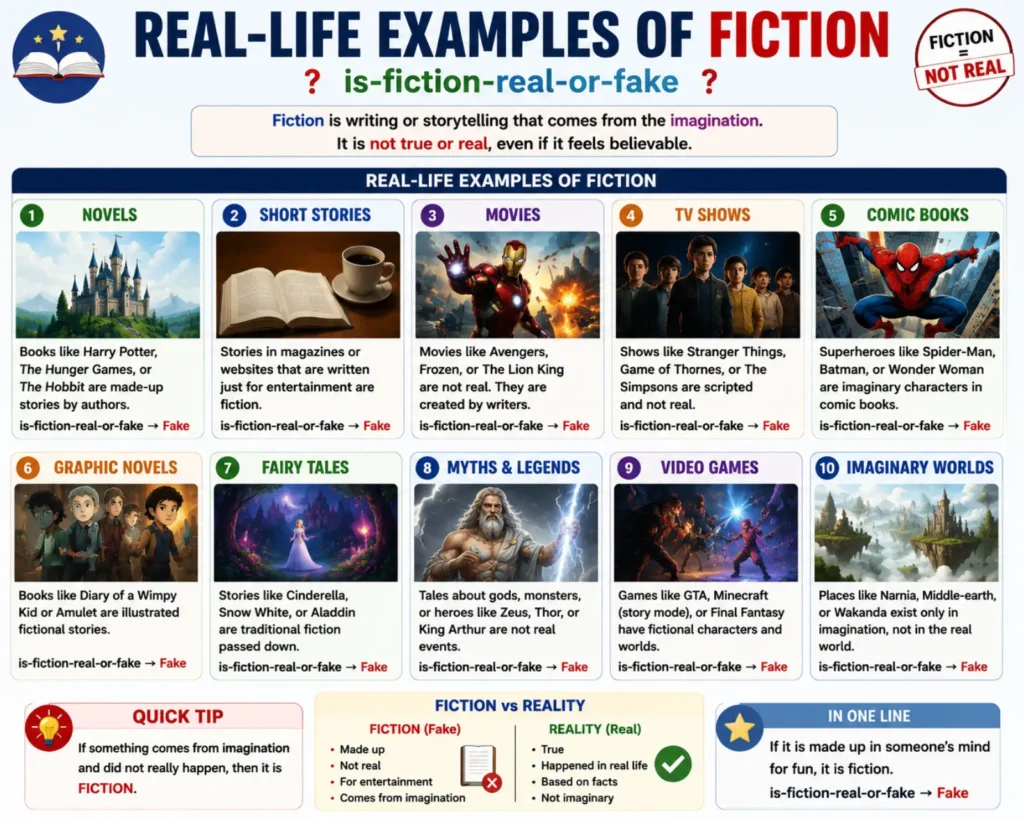
Stories like Cinderella and Snow White are fiction because magical events never happened.
However, they teach lessons about kindness and courage.
Superhero Movies
Characters like Spider-Man and Batman are fictional.
People cannot climb walls like Spider-Man.
Still, these stories encourage bravery, responsibility, and helping others.
Historical Novels
Many novels take place during real wars or historical periods.
The historical background is accurate.
The main characters are often imaginary.
Children’s Stories
Talking animals do not exist in real life.
Even so, children’s stories use animals to teach honesty, friendship, and respect.
Fantasy Worlds
Books about dragons, elves, and magical kingdoms are fictional.
Readers know these worlds are imaginary.
That imagination makes fantasy exciting.
Why Is Fiction Important?
Some people think fiction is only entertainment.
Actually, fiction offers many important benefits.
Reading fiction helps people:
- Develop imagination
- Build empathy
- Understand different cultures
- Improve vocabulary
- Strengthen reading skills
- Reduce stress
- Learn problem-solving
- Think creatively
Research also shows that reading stories helps people understand other people’s emotions.
This ability improves communication in everyday life.
Children especially benefit from reading fiction because stories encourage curiosity and creativity from an early age.
How Is Fiction Used in Daily Life?
Many people think fiction belongs only in books. That is not true. Fiction is part of everyday life. People enjoy fictional stories in many ways, even if they do not realize it.
Here are some common examples:
- Reading novels before bed
- Watching fictional TV shows
- Enjoying superhero movies
- Listening to audiobooks
- Playing story-based video games
- Reading comic books and graphic novels
- Watching animated films with children
Fiction also appears in schools. Teachers use stories to help students improve reading skills and understand important values. Businesses even use storytelling in marketing because stories connect with people better than facts alone.
No matter your age, fiction offers entertainment and learning at the same time.
Why Do People Enjoy Fiction?
People love fiction because it lets them experience something new without leaving home.
A good story allows readers to travel to another country, explore outer space, or solve a mystery. Readers can imagine exciting adventures while sitting in a comfortable chair.
Here are a few reasons people enjoy fiction:
It Sparks Imagination
Fiction encourages readers to think beyond everyday life. Magical worlds, future technology, and exciting adventures inspire creativity.
It Builds Empathy
Readers experience life through the eyes of different characters. This helps them understand different feelings, cultures, and perspectives.
It Reduces Stress
Reading a good story helps many people relax after a busy day. It gives the mind a healthy break from daily worries.
It Teaches Life Lessons
Many stories include lessons about honesty, courage, friendship, patience, and kindness. Readers often remember these lessons because they come through memorable characters.
Common Mistakes About Fiction
Many people misunderstand what fiction really means. These mistakes often lead to confusion.
Mistake 1: Fiction Means Lies
This is the biggest misunderstanding.
A lie tries to deceive someone. Fiction tells an imaginary story for entertainment or education. Readers know the story is fictional before they begin reading.
Mistake 2: Fiction Cannot Teach Anything
Many fictional stories teach valuable lessons.
Books often explore topics such as friendship, bravery, forgiveness, and responsibility.
Sometimes readers learn more from a story than from a textbook.
Mistake 3: Everything in Fiction Is Impossible
Not all fiction contains magic or fantasy.
Many novels describe ordinary people living everyday lives. The events may be fictional, but they feel realistic.
Mistake 4: Historical Fiction Is the Same as History
Historical fiction uses real historical settings but creates fictional characters or events.
History books focus only on verified facts.
Mistake 5: Fiction Is Only for Children
Adults read fiction every day.
Popular genres such as mystery, romance, thriller, and science fiction attract millions of adult readers around the world.
Tips for Understanding Fiction Better
Reading fiction becomes more enjoyable when you know what to look for.
Follow these simple tips.
Focus on the Main Message
Every story has a purpose. Ask yourself what lesson the author wants readers to learn.
Separate Facts from Imagination
Notice which parts seem realistic and which parts come from the author’s imagination.
Pay Attention to Characters
Characters often change during the story. Their growth usually reveals the story’s main lesson.
Read Different Genres
Try fantasy, mystery, romance, science fiction, and historical fiction. Each genre offers a different reading experience.
Think About the Ending
Ask yourself why the author chose that ending. Many endings leave readers with an important message.
Synonyms of Fiction
Using related words helps readers understand the topic better. These words also support SEO by adding natural language variations.
Common Synonyms
- Imaginary story
- Made-up story
- Creative writing
- Narrative
- Novel
- Tale
- Fantasy
- Storytelling
- Fabricated story
- Literary work
Related SEO Keywords (LSI Keywords)
These related search terms naturally support the primary keyword without overusing it.
- fiction meaning
- what is fiction
- fiction definition
- fiction vs nonfiction
- is fiction fake
- fiction examples
- fictional stories
- imaginary stories
- based on imagination
- can fiction be true
- difference between fiction and reality
- nonfiction meaning
- literary fiction
- historical fiction
- science fiction books
Use these keywords naturally throughout your content instead of repeating the same phrase.
Expert Insights: Why Understanding Fiction Matters
Understanding fiction is an important reading skill.
Students who know the difference between fiction and nonfiction perform better in reading comprehension activities. They can identify facts, opinions, and creative writing more easily.
Authors use fiction to explore ideas that may be difficult to explain through facts alone. A fictional story can encourage readers to think deeply about society, relationships, and human behavior.
Many psychologists also believe reading fiction strengthens empathy. When readers follow a character’s journey, they practice understanding another person’s thoughts and feelings.
For writers, understanding fiction improves storytelling skills. For readers, it makes books more enjoyable and meaningful.
The best fiction does more than entertain. It encourages learning, imagination, and personal growth.
Frequently Asked Questions
Is fiction real or fake?
Fiction is imaginary because writers create it from their imagination. However, it often includes real emotions, places, and life lessons.
Can fiction be based on a true story?
Yes. Some fictional books begin with real events but include invented characters or changed details.
Is fiction the same as fantasy?
No. Fantasy is one type of fiction. Fiction includes many genres, such as mystery, romance, adventure, science fiction, and historical fiction.
What is the opposite of fiction?
The opposite of fiction is nonfiction. Nonfiction presents real facts, true events, and accurate information.
Why do schools teach fiction?
Schools teach fiction because it improves reading skills, vocabulary, creativity, critical thinking, and empathy.
Can fictional characters be inspired by real people?
Yes. Many authors create fictional characters based on people they know or famous historical figures. The characters themselves remain fictional.
Is historical fiction true?
Historical fiction uses real historical settings but includes fictional characters or events. It should not replace history books for factual learning.
Why is fiction important?
Fiction helps people imagine new ideas, understand others, reduce stress, and enjoy meaningful stories while learning valuable life lessons.
Conclusion
So, is fiction real or fake? The answer is clear. Fiction is imaginary because it is created through imagination rather than real events. However, that does not make fiction meaningless. Great stories often include real emotions, believable characters, and valuable life lessons that readers remember for years.
Whether you enjoy fantasy, mystery, romance, historical fiction, or science fiction, every genre offers something unique. Fiction entertains, inspires creativity, builds empathy, and helps readers see the world from different perspectives. It also improves reading skills and encourages critical thinking.
The next time someone asks, “Is fiction real or fake?”, you can confidently explain that fiction may not describe actual events, but its ideas, emotions, and lessons often reflect real life. That is why fiction continues to inspire readers of every age around the world.