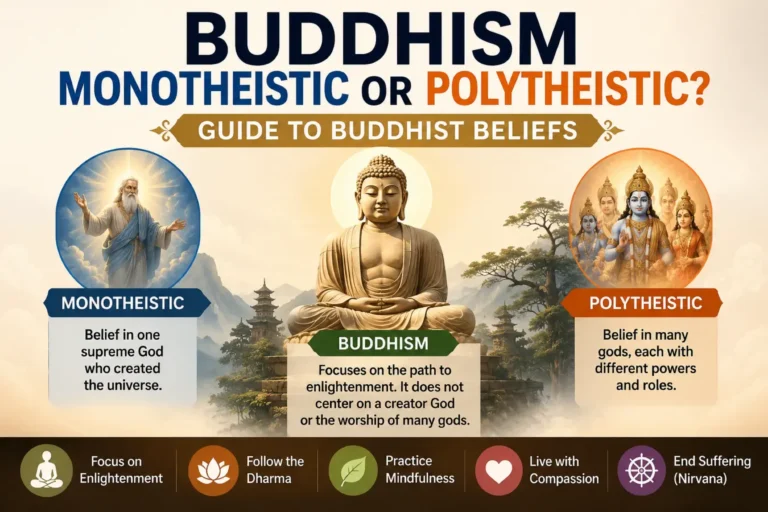
Buddhism monotheistic or polytheistic is a common question for people learning about world religions. The answer is not as simple as “yes” or “no.” Buddhism does not fit neatly into either category. Instead, it focuses on personal growth, wisdom, and ending suffering. Some Buddhist traditions include gods and heavenly beings, while others do not worship a creator god at all.
This guide explains Buddhism in clear and simple language. You will learn what Buddhists believe, how different schools view gods, and why many experts describe Buddhism as a non-theistic religion. By the end, you will understand the key differences and avoid common misunderstandings.
Quick Summary Box
- Buddhism is generally non-theistic, not strictly monotheistic or polytheistic.
- It does not teach belief in one creator God.
- Some Buddhist traditions recognize many gods or heavenly beings.
- These beings are not all-powerful creators.
- The main goal of Buddhism is reaching enlightenment.
- Personal practice matters more than worship.
- Different Buddhist schools have slightly different beliefs.
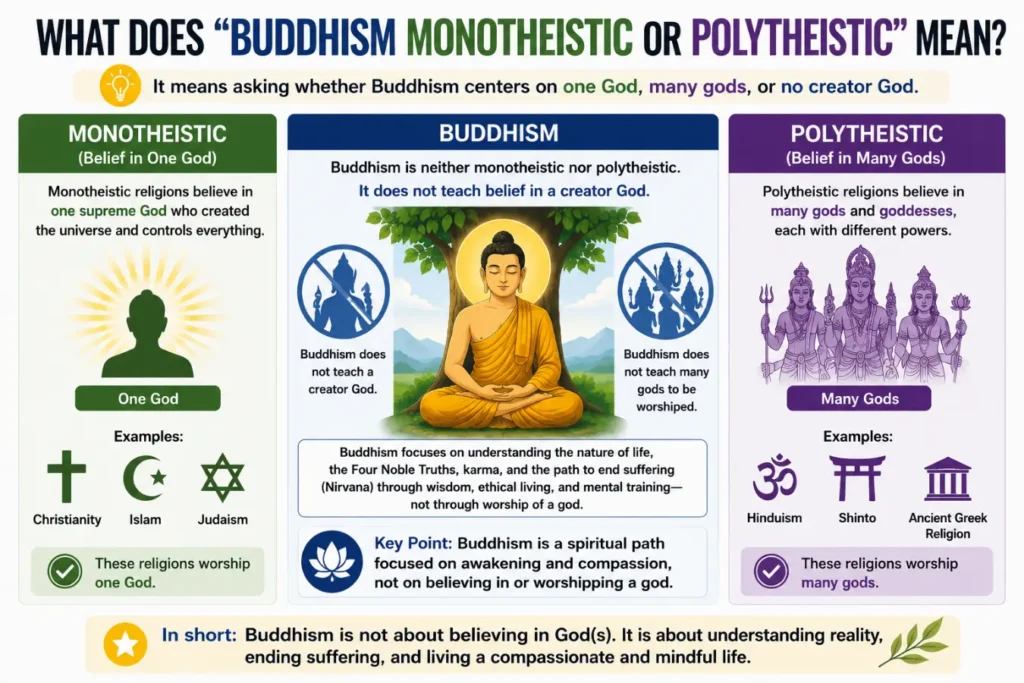
What Does “Buddhism Monotheistic or Polytheistic” Mean?
Many people compare Buddhism with religions like Christianity, Islam, or Hinduism. This comparison raises an important question.
A religion can be:
- Monotheistic – belief in one all-powerful God.
- Polytheistic – belief in many gods.
- Non-theistic – no creator God is central to the religion.
Most scholars describe Buddhism as non-theistic because it does not depend on belief in a creator deity.
What Is Monotheism?
Monotheism means believing in one supreme God who created the universe and controls everything.
Examples include:
- Christianity
- Islam
- Judaism
Key features include:
- One creator God
- Worship of God
- Prayer to God
- God’s authority over creation
What Is Polytheism?
Polytheism means believing in many gods with different powers and roles.
Examples include:
- Ancient Greek religion
- Ancient Roman religion
- Many traditional religions
Each god usually controls a specific area, such as war, love, or nature.
Is Buddhism Monotheistic or Polytheistic?
The short answer is:
Buddhism is neither fully monotheistic nor fully polytheistic.
Instead, Buddhism teaches that:
- There is no creator God.
- Every person can reach enlightenment.
- Karma affects future experiences.
- Wisdom ends suffering.
Some Buddhist traditions include many heavenly beings called devas. However, these beings are not creators. They are also part of the cycle of birth and rebirth.
Why Is Buddhism Considered Non-Theistic?
Many experts use the term non-theistic Buddhism because the religion focuses on practice instead of worship.
Important ideas include:
- Meditation
- Mindfulness
- Compassion
- Karma
- Rebirth
- Enlightenment
These teachings do not require belief in one supreme God.
That is why Buddhism stands apart from many other major religions.
Do Buddhists Believe in Gods?
Yes—but the answer depends on the tradition.
Many Buddhist schools teach about:
- Devas
- Bodhisattvas
- Heavenly beings
- Protective spirits
However:
- These beings did not create the universe.
- They are not eternal rulers.
- They can also be reborn.
Because of this, they are very different from the God found in monotheistic religions.
Comparison Table: Monotheism vs Polytheism vs Buddhism
| Feature | Monotheism | Polytheism | Buddhism |
|---|---|---|---|
| Creator God | Yes | Usually no | No |
| One Supreme God | Yes | No | No |
| Many Gods | No | Yes | Some traditions recognize heavenly beings |
| Focus on Worship | High | High | Personal practice |
| Goal | Serve God | Honor gods | Reach enlightenment |
| Meditation | Sometimes | Sometimes | Central practice |
| Karma | Usually no | Sometimes | Core teaching |
Real-Life Example
Understanding Buddhism becomes easier with examples.
Example 1
A Buddhist meditates every morning.
The goal is inner peace, not pleasing a creator God.
Example 2
A Buddhist temple may contain statues of the Buddha and bodhisattvas.
People show respect through offerings.
They do not believe these figures created the universe.
Example 3
Some Buddhists pray for wisdom and compassion.
The practice supports spiritual growth instead of asking a creator to change events.
Different Buddhist Traditions
Not all Buddhists practice the same way.
Theravada Buddhism
- Focuses on the historical Buddha.
- Gives less attention to gods.
- Emphasizes meditation.
Mahayana Buddhism
- Includes bodhisattvas.
- Encourages compassion.
- Uses devotional practices.
Vajrayana Buddhism
- Includes symbolic deities.
- Uses rituals and visualization.
- Focuses on advanced meditation.
Although practices differ, none teaches one creator God.
Common Mistakes About Buddhism
Many people misunderstand Buddhism.
Here are common mistakes.
Mistake 1
Thinking Buddhists worship Buddha as God.
Truth: Buddha is respected as an enlightened teacher.
Mistake 2
Thinking devas created the universe.
Truth: They did not.
Mistake 3
Assuming every Buddhist believes exactly the same thing.
Truth: Beliefs vary across traditions.
Mistake 4
Thinking Buddhism rejects all spiritual beings.
Truth: Many traditions accept spiritual beings without making them creators.
Tips for Understanding Buddhist Beliefs
Use these simple tips.
- Focus on enlightenment first.
- Learn about karma.
- Understand meditation.
- Remember that Buddhism values wisdom.
- Avoid comparing every religion using the same categories.
- Study different Buddhist traditions.
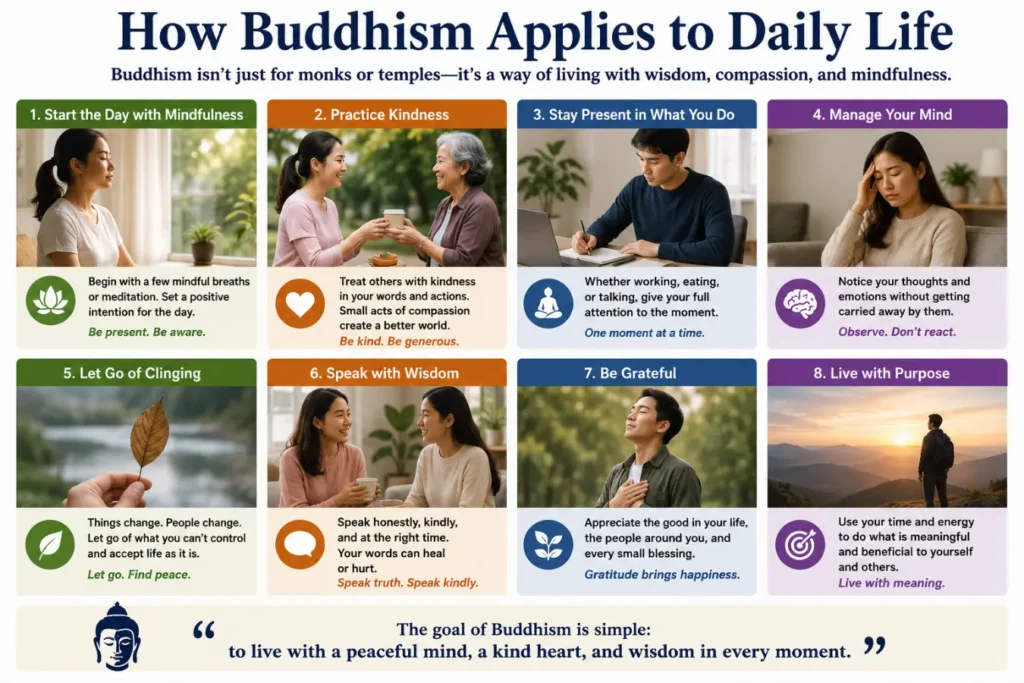
How Buddhism Applies to Daily Life
Many Buddhist teachings help people every day.
Examples include:
- Practicing mindfulness at work.
- Showing kindness to others.
- Managing stress through meditation.
- Accepting change with calmness.
- Making ethical choices.
- Reducing anger and fear.
These lessons do not depend on belief in one God.
Synonyms and Related Keyword
Use these related search terms to better understand the topic.
Related Keywords
- Is Buddhism a religion
- Does Buddhism believe in God
- Buddhism beliefs
- Non-theistic religion
- Buddhist gods
- Creator God in Buddhism
- Buddhism vs Christianity
- Buddhism vs Hinduism
- Buddhist philosophy
- Buddhist teachings
- Buddhist spirituality
- Theravada Buddhism
- Mahayana Buddhism
- Vajrayana Buddhism
Expert Insights
Religious scholars often explain that Buddhism does not fit traditional Western religious categories.
Instead of asking who created the world, Buddhism asks:
- Why do people suffer?
- How can suffering end?
- How can wisdom grow?
This practical focus makes Buddhism unique among the world’s major religions.
Understanding this difference helps avoid confusion when comparing religions.
(FAQs)
Is Buddhism monotheistic?
No. Buddhism does not teach belief in one creator God.
Is Buddhism polytheistic?
Not exactly. Some traditions recognize many heavenly beings, but they are not creator gods.
Does Buddhism believe in God?
Most Buddhist traditions do not require belief in a creator God.
Why is Buddhism called non-theistic?
Because belief in a supreme creator is not central to Buddhist teachings.
Do Buddhists worship Buddha?
Buddhists honor and respect Buddha as an enlightened teacher rather than a creator God.
Are there gods in Buddhism?
Many traditions mention devas and bodhisattvas, but they are not all-powerful creators.
What is the main goal of Buddhism?
The main goal is enlightenment and freedom from suffering.
Can someone believe in God and practice Buddhism?
Some people combine Buddhist practices with belief in God, although traditional Buddhist teachings do not require this belief.
Featured Snippet Answer
Is Buddhism monotheistic or polytheistic?
Buddhism is generally considered non-theistic. It does not teach belief in one creator God or require worship of many gods. Some Buddhist traditions recognize heavenly beings called devas, but these beings are not creators. The central focus of Buddhism is achieving enlightenment through wisdom, ethical living, and meditation.
Conclusion
The question “buddhism monotheistic or polytheistic” has a simple answer with an important detail. Buddhism does not fit neatly into either category. Instead, it follows a non-theistic approach that focuses on personal growth, meditation, compassion, and wisdom rather than belief in a creator God. While some Buddhist traditions include devas and bodhisattvas, these figures are not supreme creators. They are part of the broader Buddhist worldview.
Understanding this distinction helps you compare religions more accurately and appreciate Buddhism on its own terms. Rather than asking who created the world, Buddhism encourages people to understand suffering, develop mindfulness, and seek enlightenment. That unique focus is one reason Buddhism continues to inspire millions of people around the world.