Check or Cheque: Difference and Which Spelling Is Correct?
Check or cheque is a common spelling question that confuses many English learners and writers. Both words refer to the same banking document. However, the correct spelling depends on where you live and write. In …
Written by: Victoria Hughes
Published on:
Check or cheque is a common spelling question that confuses many English learners and writers. Both words refer to the same banking document. However, the correct spelling depends on where you live and write.
In some countries, people write check. In others, they write cheque. The meaning stays the same, but the spelling changes.
Understanding the difference helps you write correctly in business, banking, and daily communication. It also prevents mistakes in professional documents.
This guide explains everything about check vs cheque in simple words. You will learn definitions, examples, comparisons, common mistakes, and expert tips.
Quick Summary Box
Check and cheque have the same meaning.
Both refer to a written order to pay money from a bank account.
Check is the preferred spelling in American English.
Cheque is the preferred spelling in British English.
The choice depends on the country and language style used.
Both spellings are correct in their respective regions.
What Does Check or Cheque Mean?
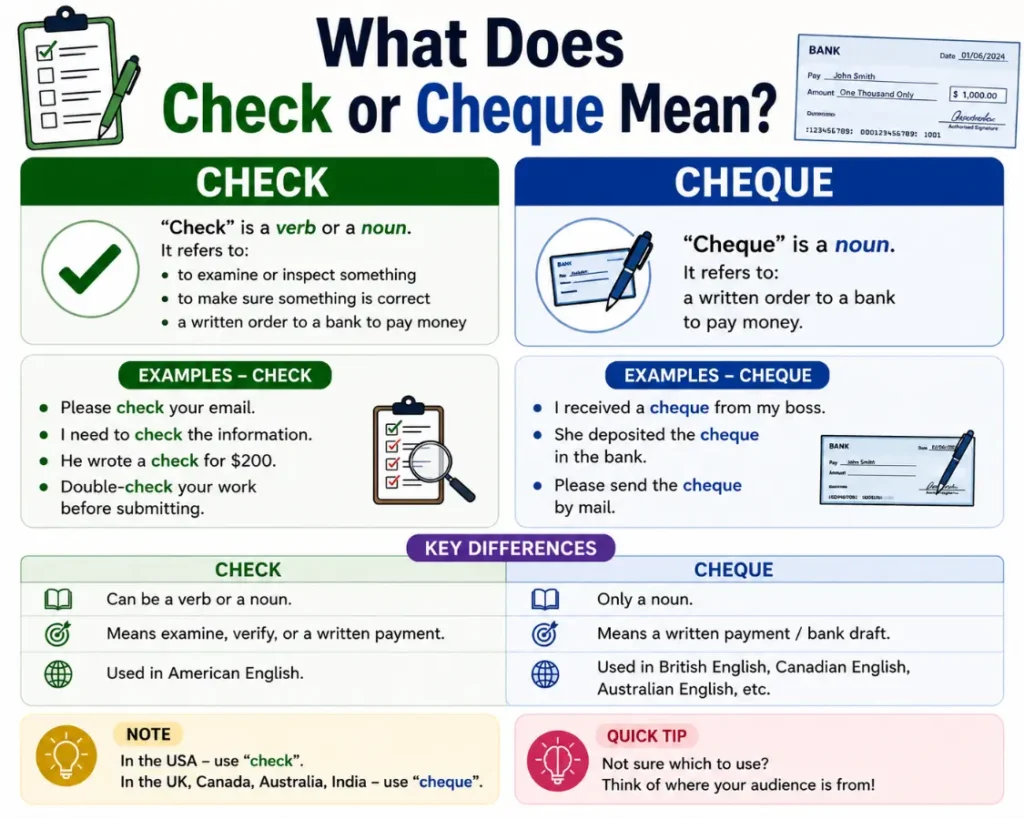
A check or cheque is a written document that tells a bank to pay money.
The account holder writes the amount and the recipient’s name. The bank then transfers the money.
Simple Definition
A check or cheque is:
A written instruction that allows a bank to pay a specific amount of money to a person or organization.
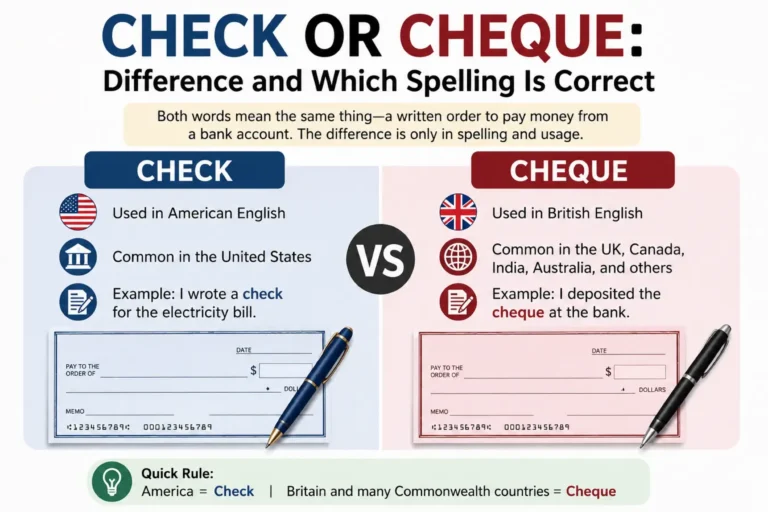
Check vs Cheque: The Main Difference
The only major difference is spelling.
The meaning, function, and purpose remain the same.
Comparison Table
Feature
Check
Cheque
Meaning
Banking payment document
Banking payment document
English Style
American English
British English
Used In
United States
United Kingdom
Also Common In
Philippines, U.S. businesses
Canada, India, Pakistan, Australia
Pronunciation
Same
Same
Meaning Difference
None
None
Featured Snippet Answer
Check is the American English spelling, while cheque is the British English spelling. Both words mean a written order directing a bank to pay money from an account.
Why Do Two Spellings Exist?
English developed differently across countries.
American English simplified many spellings over time. As a result, Americans adopted check.
British English kept the traditional French-influenced spelling cheque.
Today, both forms remain standard.
Where Is “Check” Used?
The spelling check is standard in American English.
You will commonly see it in:
United States banking documents
American business communication
U.S. financial institutions
American accounting systems
Example Sentences
I wrote a check for the electricity bill.
The company mailed me a check yesterday.
Please deposit this check before Friday.
Where Is “Cheque” Used?
The spelling cheque is common in British English and many Commonwealth countries.
Countries using cheque include:
United Kingdom
Pakistan
India
Australia
New Zealand
Canada (often in banking contexts)
Example Sentences
She deposited a cheque at the bank.
The company issued a cheque for payment.
Please sign the cheque before submitting it.
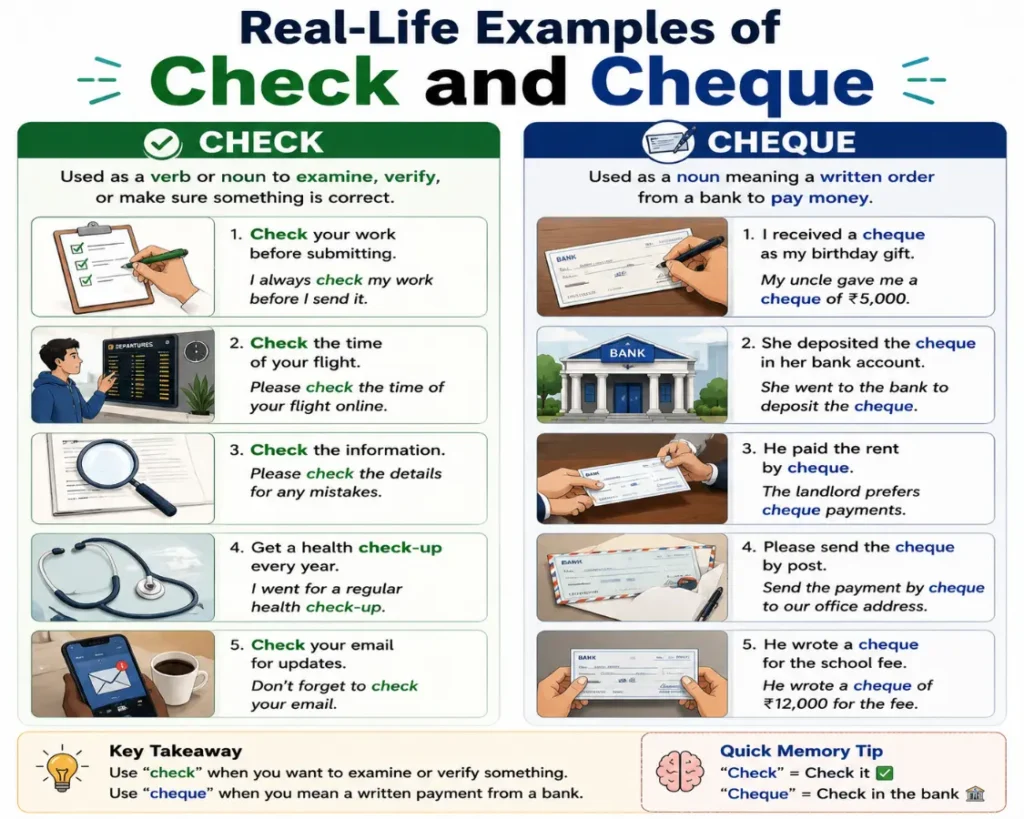
Real-Life Examples of Check and Cheque
Understanding real situations makes the difference easier.
Example 1: United States
A customer pays rent using a check.
Example 2: United Kingdom
A customer pays rent using a cheque.
Example 3: International Business
A company in the U.S. writes check.
A company in the U.K. writes cheque.
The payment process remains identical.
Common Uses of Checks and Cheques
People still use checks and cheques for many purposes.
Personal Payments
Rent payments
Gifts
Loan repayments
Business Transactions
Vendor payments
Employee reimbursements
Contractor payments
Government Payments
Tax refunds
Benefit payments
Compensation payments
Types of Checks and Cheques
Banks offer several types.
Personal Check
Issued from an individual’s account.
Certified Check
The bank verifies available funds.
Cashier’s Check
The bank guarantees payment.
Traveler’s Cheque
Used for travel-related transactions.
Business Check
Issued from a company account.
Common Mistakes People Make
Many writers confuse spelling rules.
Mistake 1: Mixing Styles
Using American English but writing cheque.
Mistake 2: Using Both Spellings Together
Choose one style and stay consistent.
Mistake 3: Assuming Different Meanings
Both words mean exactly the same thing.
Mistake 4: Ignoring Audience Location
Always consider your readers and region.
How to Choose the Correct Spelling
Follow these simple rules.
Use “Check” If:
Writing for American readers
Following U.S. English style guides
Creating content for U.S. businesses
Use “Cheque” If:
Writing for British readers
Following U.K. English standards
Communicating in many Commonwealth countries
Quick Rule
America = Check
Britain and many Commonwealth countries = Cheque
Check or Cheque in Daily Life
You may see these words in:
Bank forms
Payment receipts
Business contracts
Tax documents
Accounting records
Financial software
Even with digital payments growing, checks and cheques remain important in many industries.
Synonyms and Related Terms
Using related terms helps improve understanding and SEO relevance.
Synonyms
Bank draft
Payment order
Financial instrument
Money order
Banking document
LSI Keywords
check spelling
cheque spelling
check vs cheque
bank check
bank cheque
payment check
cheque payment
financial check
British vs American spelling
cheque meaning
Expert Insights: Why the Difference Matters
Language style affects credibility.
Businesses should use the spelling expected by their audience.
A U.S. company using cheque may appear inconsistent. Likewise, a British company using check may seem less professional.
Consistency improves:
Brand trust
Professional appearance
User experience
Search engine relevance
Writers, marketers, and businesses should match spelling with their target market.
SEO Tips for Using Check or Cheque Correctly
Know Your Audience
Use the spelling familiar to readers.
Maintain Consistency
Avoid switching between spellings.
Optimize Regional Content
Target local search intent.
Use Semantic Keywords
Include related banking and payment terms naturally.
Follow Style Guides
Match spelling with your chosen English variant.
(FAQs)
Is check or cheque correct?
Both are correct. The choice depends on regional English usage.
What is the difference between check and cheque?
The difference is spelling only. The meaning is identical.
Why do Americans use check instead of cheque?
American English adopted simplified spellings over time.
Which countries use cheque?
The United Kingdom, Pakistan, India, Australia, and several Commonwealth nations use cheque.
Is cheque outdated?
No. Many countries still use the spelling cheque in banking.
Can I use check in the UK?
People will understand it, but cheque is the preferred spelling.
Is check more common online?
Globally, check often appears more frequently because of American English influence.
Are checks and cheques still used today?
Yes. Many businesses, governments, and individuals still use them.
Conclusion
The debate over check or cheque is simpler than many people think. Both words describe the same banking document used to transfer money from one account to another. The only real difference is regional spelling. American English uses check, while British English and many Commonwealth countries use cheque.
Choosing the correct version depends on your audience and writing style. Consistency matters more than the spelling itself. When you match the language expectations of your readers, your writing appears more professional and trustworthy.
Remember this easy rule: use “check” for American English and “cheque” for British English. Following this guideline will help you communicate clearly in business, banking, and everyday writing.
Victoria Hughes is a writer and content researcher passionate about creating clear, helpful, and easy-to-understand content. She specializes in producing informative articles that simplify complex topics for everyday readers. Through thoughtful writing and careful research, she aims to deliver practical and reliable information.
Victoria Hughes is a writer and content researcher passionate about creating clear, helpful, and easy-to-understand content. She specializes in producing informative articles that simplify complex topics for everyday readers. Through thoughtful writing and careful research, she aims to deliver practical and reliable information.